Geography

Nigeria
Nigeria is a country located in West Africa, bordered by Benin, Niger, Chad, and Cameroon. It is the most populous country in Africa and is known for its diverse geography, including savannas, rainforests, and coastal areas. Nigeria is also home to the Niger River, one of the longest rivers in Africa, and has a significant oil industry.
Written by Perlego with AI-assistance
Related key terms
1 of 5


9 Key excerpts on "Nigeria"
 eBook - ePub
Development in Nigeria
Promise on Hold?
- Edlyne Eze Anugwom(Author)
- 2020(Publication Date)
- Routledge(Publisher)
There is no doubt that Nigeria represents the largest black nation on Earth and perhaps the biggest economy in sub-Saharan Africa. But these significant features have been more the problem rather than an impetus to development, as we shall see from the historical development and socio-political growth of the nation over time. In order to achieve some semblance of order and ease comprehension, this chapter is organized under three main sections. These are: overview of the geography and history of Nigeria; socio-political developments in post-colonial Nigeria; and heterogeneity as the source of recurrent threats of implosion since independence in 1960.Social geography of Nigeria
Nigeria, the largest or most populous country in sub-Saharan Africa is located in West Africa. It is a tropical rainforest region with swathes of desert in the North and is endowed with enormous natural and mineral resources ranging from the well-known oil deposits, iron ore, coal, lead/zinc, lignite, bitumen, limestone, marble, bauxite, salt, barites to gas, clay and gemstone gypsum, etc. In fact, conventional wisdom has it that each region/zone and state in Nigeria can lay claim to at least a minimum of three mineral resources in abundant or commercial quantities. Such states as Plateau, Ondo, Nasarawa, Kaduna, Benue, Edo, Kogi are literally over-flush with mineral resources and some of these states, especially Nasarawa and Plateau, have been the sites of artisanal mining that has recently been associated with insecurity in the Northern areas of Nigeria. According to Obaje (2009), reports from the Geological Survey of Nigeria have it that the country has about 34 known major mineral deposits scattered in different locations across Nigeria. Geographically, Nigeria is on the Gulf of Guinea in the West African subregion with an area of 923,768 square kilometres (made up of 910,768 square kilometres of land mass and 13,000 square kilometres of water). It is bordered by such other nations as Cameroun in the east, Benin in the west and Chad (in the northeast) and Niger (in the northwest) in the extensive fringes of the country.Prominent geographical landmarks in Nigeria include the famous River Niger which flows south through the eastern parts of Nigeria. River Niger, which is Africa’s third longest river (1,174 kilometres) rises from the Futa Jallon Mountains in East Sierra Leone, does a journey of over 4,000 kilometres before entering Nigeria from the northwest. River Niger then receives River Benue, which originates in the Cameroons at Lokoja (consequently called the Confluence town), and then flows for about 547 kilometres into the Atlantic Ocean (see NBS, 2011). The prominence and popularity of River Niger also draw from its main tributaries in many parts of Nigeria. These main tributaries include the Sokoto, Anambra and Kaduna Rivers. The River Benue on the other hand empties into Lake Chad and has Gongola and Katsina-Ala Rivers as major tributaries. These two rivers and their tributaries have been great sources of agricultural success in the country – apart from being home to abundant aquatic life, they have been the source of fertile soil and have provided the possibility of irrigation farming, especially in the North and Middle Belt of Nigeria. However, in recent times they have been the source of adverse climatic events, such as flooding and its attendant destruction. For instance, the massive overflowing of the River Benue in 2012 occasioned great destruction far beyond Lokoja and Kogi state where the menace originated. eBook - PDF
Socio-Cultural and Religious Conflicts and the Future of Nigeria
A Mission for the Local Church
- Lotanna Olisaemeka(Author)
- 2022(Publication Date)
- LIT Verlag(Publisher)
Accessed, December 12, 2014. 9 It is often said that “one out of every four Africans is a Nigerian!” and that Nigeria is the largest black nation on earth. Cf. Ikenga-Metuh, Emefie and Ojoade, Olowo: Nigerian Cul- tural Heritage, Imico Publishing Company, Onitsha 1990, p. 2. 10 See the Constitution of the Federal Republic of Nigeria. Worthy of note is that the name `Nigeria´ was officially used for the first time to refer to the country in 1900 when the pro- tectorate of southern Nigeria was formed under a High Commissioner. Cf. Omenka, Ibea- wuchi Nicholas: The School in the Service of Evangelization. The Catholic Education Im- pact in Eastern Nigeria 1886-1950, E. J. Brill, Leiden, Köln 1989, p. 13. 9 Giant of Africa´, 11 and is located in western Africa, bordering the Gulf of Guinea, between Benin and the Cameroons. The Niger enters the country in the northwest and flows southward through tropical rain forests and swamps to its delta in the Gulf of Guinea. 12 The Area covered is a total mass of 923,768 sq km with 910,768 sq km of land and 13,000 sq km of water. In comparison, the country is slightly more than twice the size of California. Calligraphically, the country borders Benin 773 km, Cameroon 1,690 km, Chad 87 km, Niger 1,497 km. By terrain, the southern lowlands merge into central hills and plateaus; mountains in the southeast and plains in the north. Its natural resources include natural gas, petroleum, tin, iron ore, coal, lime- stone, niobium, lead, zinc, and fertile arable land. 13 There are however pe- riodic droughts and flooding. Currently, the environmental issues include soil degradation, rapid deforestation, urban air and water pollution, deserti- fication, loss of arable land and rapid urbanization. Water, air, and soil, have suffered serious damage of pollution due to oil spills.
- Yushau Sodiq(Author)
- 2017(Publication Date)
- Palgrave Macmillan(Publisher)
1 © The Author(s) 2017 Y. Sodiq, A History of the Application of Islamic Law in Nigeria, DOI 10.1007/978-3-319-50600-5_1 CHAPTER 1 Nigeria: The Giant of Africa INTRODUCTION Nigeria, the largest country in West Africa, is a land of diverse cultures and a nation of many peoples (e.g. the Fulani-Hausa, the Yoruba and the Igbos) with rich religious traditions. The name “Nigeria” was given to the country by Lord Luggard’s wife in 1914. 1 Nigeria is bordered in the north by Niger Republic, in the south by the Gulf of Guinea, in the west by Benin and in the east by Cameron and Chad. Its present population is about 160 million and it has an area of 356,669 square miles. Its climate varies from region to region and generally there are two seasons: dry and wet, with different temperatures. 2 Nigerians speak a range of languages, including English (the official language), Hausa, Igbo and Yoruba. Within each of these major languages are many dialects. Only Hausa, Yoruba and Ibo are written languages. While both Ibo and Yoruba use Latin script, introduced by the British, Hausa was originally written in Arabic script, known as ajami, prior to the arrival of the British. Nigerian currency is called Naira and the government had dropped the use of coins. Major hol- idays in Nigeria are New Year’s Day, Good Friday and Easter, Eid al-Fitr and Eid al-Kabir (Muslim festivals), Independence Day and Christmas Day. Unfortunately there is no “national day” for the indigenous reli- gions, which have become overshadowed by Islam and Christianity, which rival one another in trying to win over the indigenes. 2 Nigeria is a federal republic. It won its independence from the British in 1960 and became a republic in 1963. At present it has 36 states and a federal capital at Abuja. Preceding its amalgamation in 1914 by the British, Nigeria has a long and rich history that goes back more than 3000 years. It boasted major empires in Africa with very rich traditions and cul- tures. eBook - ePub
- (Author)
- 0(Publication Date)
- Rough Guides(Publisher)
Nigeria - Part 1
Nigeria - Part 1 |Introduction and Basics
Of all the countries in Africa, Nigeria is perhaps the hardest to introduce. Many might feel it needs no introduction – corruption, military coups and email scams being all you need to know. Perhaps not surprisingly, this is only a fraction of the truth, for Nigeria is also the land that has produced inspirational visionaries such as Wole Soyinka and Fela Kuti, and contains a wealth of cultural and scenic diversity equal to any in the region.As the most populous country on the continent, bursting with entrepreneurial energy, Nigeria should also have Africa’s largest and most dynamic economy, and yet it languishes behind smaller, less populous nations like Egypt and South Africa. Often decried as a country which has suffered from poor leadership, Nigeria does suffer from dire security and infrastructure issues, forcing most Nigerians into permanent survival mode, which they suffer with enormous good humour. The complexity of Nigeria’s human picture is often reduced to the relations of three ethnic groups, the Yoruba, the Igbo and the Hausa, when in fact its peoples speak more than five hundred distinct languages.Nigeria is in many ways Africa in microcosm, with the rest of the continent’s landscapes and weather patterns rolled into one nation, from the Sahel and savannah landscapes of the Muslim north, to the humid forests and creeks of the largely Christian south.In truth, this is a fascinating country, offering a lifetime of discoveries for curious travellers and expats willing to defer judgement.Nigeria’s notoriety is unduly influenced by its capital, Lagos – a city of incalculable population and urban distress – and even Lagos, for all that its poorer districts may be terrible to live in, can be a dynamic, exhilarating and surprisingly friendly place to visit, with a nightlife unrivalled in West Africa, and indeed most of the world. But if the unforgiving tempo of Lagos is too much, then leave the city – for Oyo, Osogbo, Ife, Benin, or even giant Ibadan eBook - PDF
- E. Anugwom(Author)
- 2017(Publication Date)
- Langaa RPCIG(Publisher)
31 Chapter Two The Niger Delta of Nigeria: Context and Location The Geographical Niger Delta The Niger Delta of Nigeria is regarded as one of the world’s largest wetlands and invariably the largest in Africa. In this sense, it constitutes 20,000 square kilometers and is a flood plain resulting from the accumulation of centuries of silt washed down the Niger and Benue Rivers in Nigeria (see, HRW, 1999). The Niger Delta region is made up of four main ecological zones – coastal barrier islands, mangroves, fresh water swamp forests, and lowland forests. According to Phil-Eze and Okoro (2007), the Niger Delta has the largest and most important mangrove forest in Africa as well as the third largest in the world and harbours a high diversity of flora and fauna – including endemic, endangered and threatened species. Also the fresh water swamp forests of the Niger Delta reach over 11,700 km 2 and has a high and rich biodiversity made up of extensive swamps and forests as already indicated (see, World Bank, 1995; Jones, 1998; Omeje, 2006; Phil-Eze, 2001; NDDC, 2004 etc.). However, the above rich biodiversity is under severe threat from diverse sources such as deforestation, oil and gas exploitation, urban growth and environmentally unsound farming methods resulting from encroaching land degradation from oil activities that continuously limit the land space available for any other purpose. But equally important is that the Niger Delta with an estimated 400km 2 coastline accounts for over half of Nigeria’s coastline. It is an area also inundated by various creeks, small rivers, inland waterways and dense forests and under-growths 32 which makes local knowledge very important for activities in the area. The Niger Delta region has a population of over 36 million (using recent projections) people in the nine constituent states of Abia, Akwa Ibom, Bayelsa, Cross River, Delta, Edo, Imo, Ondo and Rivers (see map). eBook - ePub
Necessary Architecture
Raw Earth Solutions for a Common House in Niger
- Alisia Tognon, Luca Trabattoni(Authors)
- 2021(Publication Date)
- CRC Press(Publisher)
It is particularly important to the Niger State. The river is used as a crossroads for transporting goods or people by pirogues. Nevertheless, it also facilitates agricultural activity and vegetation growth by decreasing the drought, which affects most of the country. Niger is a Sahelian country with an area of 1,267,000 km 2, making it one of the largest countries in West Africa. It is located between 11° 37’ and 23° 33’ latitude North and 0° 06’ and 16° 00’ longitude East, on the South of the Tropic of Cancer. The majority of its territory is desertic, defining it as one of the hottest areas on the planet, marked by a strong climatic instability and by an economical and nutritional high vulnerability. Even the political and economic situation on the border presents a series of instability (UN 2019). Niger shares a border with Chad in the East, Libya and Algeria in the North, Mali and Burkina Faso in the West and Nigeria and Benin in the South. In recent years the country has been well known as a crossroads for migrants 3, who from all over West African countries crossed the deserts to reach the Algerian border and from there to cross the Mediterranean to Europe (UNHCR 2019). In addition to its history of droughts and food insecurity, the analysts marked Niger with three factors, strongly correlated with instability and conflict. Firstly, it is very low-income and landlocked, and, consequently, its governments rely on sizable revenues from mineral exports (Collier 2007). Moreover, rapid population growth produces further stresses eBook - ePub
- Peter Robson, D Lury, D A Lury(Authors)
- 2013(Publication Date)
- Routledge(Publisher)
3
THE ECONOMY OF Nigeria
1. INTRODUCTION
By area and population, Nigeria is one of the bigger countries of Africa. In terms of economic potential, it is also usually lauded as one of the most hopeful. Yet in recent times, Nigeria's image of development effectiveness has been criticized unfavourably by some observers at home and abroad. Its pace of recent performance and immediate future prospects were recently characterized, in the words of a Nigerian economist, as a tale of false hope.1This chapter analyses the structure of the country's economy in the decade preceding its political independence up to the early stages of implementing its first national development plan. Its central theme is that both the character of investment and the behaviour of prices provide a useful understanding of the country's economic activities and problems during this vital period. In another dimension, it will also be argued that the foreign trade and public sectors constituted the fulcrum of change and defined the path of overall development. In overall perspective, it will be demonstrated that although the growth path was a positive one, its most characteristic features were those of distortion and uncertainty.2. RESOURCES
Broadly, Nigeria's resources can be looked at from two standpoints: its physical features and its population. Following the post-independence plebiscite which removed the old Southern Cameroons province to join with the Cameroon Republic, Nigeria has a total land surface of some 357,000 square miles. It lies entirely in the tropics, and displays the characteristic vegetation belts of West Africa moving northward from the swampy southern coast, through the rain forest, derived savannah, open grassland and the southern fringes of the Sahara desert. Following this movement, the land's general elevation itself rises gently northwards from the coast to a general height of 2,000 feet in the north. In the central north-eastern part, the Bauchi plateau rises to over 5,000 feet above sea level. Otherwise, the country's relief consists largely of plains, gently rolling hills and, consequently, deep soils. eBook - PDF
The Route to Power in Nigeria
A Dynamic Engagement Option for Current and Aspiring Leaders
- M. Balogun(Author)
- 2009(Publication Date)
- Palgrave Macmillan(Publisher)
Present-day Nigeria covers an area of 923,768 square kilometers, 2 stretching from the Atlantic Ocean and the forested lowlands of the south, through the arid savannah plains of the middle belt, the rocky hills, and plateaus of the southeast, to the wide expanse of territory bordering the Sahara Desert to the north. The 2007 estimated population of 131.85 million is a far cry from the paltry figure of 16.75 million recorded for the country at the turn of the twentieth century. Senior citizens (i.e., persons aged 65 years and above) constitute a mere 3.1 percent of the population, in contrast to children aged 14 years and below that account for 42.3 percent. Those falling within the 14–65 age-bracket belong to the largest demographic group, representing 54.60 percent of the total. The population is made up of no less than 250 ethnic groups which among them speak close to 400 different languages and dialects. Although the Hausa-Fulani (29 percent), Yoruba (21 percent), Igbo (18 percent) are the most frequently mentioned in the discourse on ethnicity in Nigeria, there are other important—the so-called “minority”—groups. Among these are the Ijaw (10 percent) Kanuri (4.0 percent), Ibibio (3.5 percent), and Tiv (2.5 percent) (http://www.theodora.com/wfbcurrent/Nigeria/ Nigeria_people.html). A few others currently playing significant roles, par- ticularly, at the local and state levels, are the Ogoni, Kwa, Ekoi, Kalabari, Ijaw (in Rivers and Bayelsa States); Bolewa, Ngizim, Karai-Karai (Yobe), Nupe, Gwari (Niger); the Ebirra, Ogori, Igala (Kogi); Birom, Angas (Plateau); Jukun (Taraba); Efik, Anang (Cross River, Akwa Ibom); Edo, Akoko-Edo, Ijaw, Urhobo, Itsekiri (Edo and Delta). The differences between and among the various ethnic groups are sometimes compounded by internal (i.e., within-group) differences.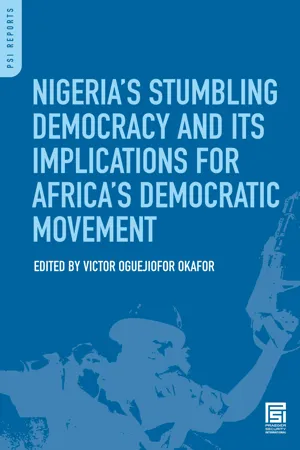
- Victor Oguejiofor Okafor(Author)
- 2008(Publication Date)
- Praeger(Publisher)
7 The Role of Geographical Zoning in Nigeria’s Democracy Abayomi Ferreira Nigeria is a multinational country that was created by continuous British colonial escapades in West Africa in the late nineteenth and early twentieth centuries. Anthropological, ethnological, and historical studies currently list 521 clear and distinct languages in Nigeria. Some ethnic groups speak more than one language. 1 Anthropologists and ethnologists use different criteria to determine the defining characteristics of a nationality. Emakpor Ajise conducted a study in which he attempted to determine the basis for a credible constitutional configu- ration for Nigeria (a country that is beset by persistent internal nationality-based feuding)—an effort by which he is fascinated as a political practitioner of the left- ist ideology. Ajise has shown that the anthropological or ethnological approach applies excessive distinction to peoples who inhabit contiguous territories, who speak the same language but are not necessarily of the same nationality. 2 We use the term nationality in the sense that Ajise uses. Many writers tend to use the term tribe/ethnicity for nationality. One of the examples that Ajise cites is the case of the Olulumo people in the Cross River state whose language is Ejaghan; however, the Olulumo people are not the same nationality as the people who are called Ejaghan and speak Ejaghan. Similarly, in the process of the movements of migrant peoples over time, particularly the nomads of which the Fulani are a prominent example, there are some peoples of the same language who have become permanent inhabitants in strictly definable centers; geographically sur- rounded by peoples of a different language, they still speak their own language even though they are not in geographical contiguity with their main group that now lives in a large area of the country. The Abore Fulani who have settled around the village of Auddaye in Fika Emirate are an example of such people. 3 The
Index pages curate the most relevant extracts from our library of academic textbooks. They’ve been created using an in-house natural language model (NLM), each adding context and meaning to key research topics.

