Geography

India
India is a country located in South Asia, known for its diverse geography. It is bordered by the Himalayas to the north and the Indian Ocean to the south. The country features a wide range of landscapes, including mountains, plains, deserts, and coastal areas, making it one of the most geographically varied nations in the world.
Written by Perlego with AI-assistance
Related key terms
1 of 5
10 Key excerpts on "India"
 eBook - PDF
- Katharine Adeney, Andrew Wyatt(Authors)
- 2017(Publication Date)
- Red Globe Press(Publisher)
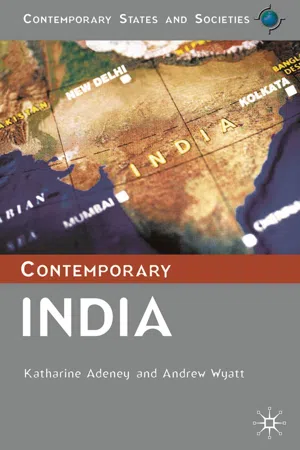
India also has approximately 11,000 km of coastline, and is separated from the state of Sri Lanka by a very narrow strip of shallow sea. India’s geography overlaps with the other states of the subconti- nent: Bangladesh, Bhutan, Nepal, Pakistan and Sri Lanka. For the 38 most part we only discuss India’s geography but we do acknowledge the shared geography of the region. We show how cross-boundary issues contribute to shared environmental problems and resource disputes. The challenges arising from India’s diversity are multiple. They include challenges of international security, environmental change, the maintenance of internal governance and the promotion of human development (Bradnock and Williams, 2002). This chapter will discuss the different manifestations of diversity in India and the ways in which they have each set the challenges for contemporary India. We begin with India’s physical diversity and then move on to discuss India’s social diversity in the second part of the chapter. The Geography of India To give a sense of India’s physical diversity we move southwards in our account. So we begin with the Himalayas, move onto the Indo- Gangetic plain and finish on the Peninsula. There is, of course, much local diversity in the geographical zones we outline but the broad classification provides a useful orientation to India’s fascinating physical environment. The Himalayan mountain range does much to define India’s geography, as the range forms a barrier between the Tibetan plateau and the Indian subcontinent to the south. The drifting subcontinent collided with the Asian continent between 25 million and 70 million years ago, forming the Himalayas. The Himalayas are still growing and are the source of many rivers including the Brahmaputra and the Indus. India’s highest point, the mountain of Kanchenjunga, lies in the Himalayas. At 8598 metres it is the world’s third highest peak. eBook - PDF
- Encyclopaedia Britannica, Inc.(Authors)
- 2009(Publication Date)
- Encyclopaedia Britannica, Inc.(Publisher)
Contemporary India's increasing physical prosperity and cultural dynamism are seen in its well-developed infrastructure and a highly diversified industrial base, in its pool of scientific and engineering personnel (one of the largest in the world), in the pace of its agricultural expansion, and in its rich and vibrant cultural exports of music, literature, and cinema. Though the country's population remains largely rural, India has three of the most populous and cosmopolitan cities in the world ± Mumbai (Bombay), Kolkata (Calcutta), and Delhi. Three other Indian cities ± Bangalore (Bengaluru), Chennai (Madras), and Hyderabad ± are among the world's fastest- growing high-technology centres, and most of the world's major information technology and software companies now have offices in India. India 17 The country Set off from the rest of Asia by the northern mountain rampart of the Himalayas and by adjoining mountain ranges to the west and east, much of India's territory lies within a large peninsula, surrounded by the Arabian Sea to the west and the Bay of Bengal to the east. India has two union territories composed entirely of islands: Lakshadweep, in the Arabian Sea, and the Andaman and Nicobar Islands, which lie between the Bay of Bengal and the Andaman Sea. It is now generally accepted that India's geographic position, continental outline, and basic geologic structure resulted from a process of plate tectonics ± the shifting of enormous, rigid crustal plates over the Earth's underlying layer of molten material. The subcontinent's landmass, which forms one of these plates, has been moving northward, its leading edge forced under (subducted) and raising up the southern part of the Eurasian plate. India's present-day relief features have been superimposed on three basic structural units: the Himalayas in the north, the Deccan (plateau region) in the south, and the Indo-Gangetic Plain (lying over the subsidence zone) between the two. eBook - PDF
The World Today
Concepts and Regions in Geography
- Jan Nijman, Peter O. Muller, Harm J. de Blij(Authors)
- 2016(Publication Date)
- Wiley(Publisher)
Two of its states, India and Pakistan, often find themselves in conflict and both are nuclear powers. In Afghanistan and the remote mountain hideaways of western Pakistan, a terrorist organization’s leaders planned attacks that changed the skyline of New York and presaged the battleground of Iraq. In the ports of India, a growing navy reflects the emer- gence of the Indian Ocean as a new global geopolitical arena in which China, too, is asserting itself. Meanwhile, outsourcing by U.S. companies to India became a hot topic, and India’s spectacular rise in information technology has changed that industry. Our daily lives are increasingly affected by what happens in this fascinating part of the world. THE GEOGRAPHIC PANORAMA The Eurasian landmass incorporates all or part of 6 of the world’s 12 geographic realms, and of these half‐dozen very few are more clearly defined by nature than the one we call South Asia. Figure 8-1 shows us why: the huge triangular Indian subcontinent that divides the northern Indian Ocean between the Arabian Sea and the Bay of Bengal is so sharply demarcated by mountain walls and desert wastes that you could take a pen and mark its boundary, from the Naga Hills in the far east through the Great Himalaya and Karakoram in the north to the Hindu Kush and the Iran‐bordering wastelands of Balochistan and Afghanistan in the west. Note how short the dis- tances are over which the green of habitable lowlands turns to the dark brown of massive, snowcapped mountain ranges. D E F I N I N G T H E R E A L M M A J O R G E O G R A P H I C Q U A L I T I E S SOUTH ASIA 1. Most of South Asia is clearly defined physiographically, and much of the realm’s boundary is marked by mountains, deserts, and the Indian Ocean. 2. South Asia’s great rivers, especially the Ganges, have for tens of thousands of years supported enormous population clusters. 3. South Asia, and especially northern India, was the birthplace of major religions that include Hinduism and Buddhism. eBook - PDF
The World Today
Concepts and Regions in Geography
- Jan Nijman, Michael Shin, Peter O. Muller(Authors)
- 2020(Publication Date)
- Wiley(Publisher)
In the ports of India, a growing navy re- flects the emergence of the Indian Ocean as a new global geo- political arena in which China, too, is asserting itself. Meanwhile, outsourcing by U.S. companies to India became a hot topic, and India’s spectacular rise in information technology has changed that industry. Our daily lives are increasingly affected by what happens in this fascinating part of the world. The Eurasian landmass incorporates all or part of 6 of the world’s 12 geographic realms, and few are more clearly defined by nature than the one we call South Asia. Figure 9-1 shows us why: the huge triangular Indian subcontinent that divides the northern Indian Ocean between the Arabian Sea and the Bay of Bengal is so sharply demarcated by mountain walls and desert wastes that you could take a pen and mark its boundary, from the Naga Hills in the far east through the Great Himalaya and Karakoram in the north to the Hindu Kush and the Iran-border- ing wastelands of Balochistan and Afghanistan in the west (Box 9-1). Note how short the distances are over which the green of habitable lowlands turns to the dark brown of massive, snow- capped mountain ranges. This realm extends from Afghanistan in the west to Bangladesh in the east. India, the realm’s giant, is flanked by six Defining the Realm countries (in clockwise order, Pakistan, Nepal, Bhutan, Bangladesh, Sri Lanka, and the Maldives) as well as Kashmir, a remaining dis- puted territory in the far north. This realm is home to a kaleido- scope of cultures, suggesting that neither formidable mountains nor forbidding deserts could prevent foreign influences. We will encounter many of these influences in this chapter, but most of South Asia also possessed one unifying historical legacy of sorts: the British Empire, which from its late-nineteenth-century heyday through the late 1940s came to hold sway over almost all of it. eBook - ePub
- David M. Darst, David M. Darst(Authors)
- 2013(Publication Date)
- Wiley(Publisher)
, during the British Raj period.Until the end of the nineteenth century, the Indian subcontinent along with Southeast Asia was collectively known as the East Indies by European colonists and traders. The Indian subcontinent was referred to as Hither India (India Citerior) while Southeast Asia was known as Further India (India Ulterior).India’s Political System As of late-2013, India was composed of 28 states and 7 union territories, the latter of which are ruled directly by the national government rather than by a state legislature. Topography of IndiaIndia contains a veritable kaleidoscope of terrains. Its overall area encompasses just over one million square miles, yet the country offers a rich topographical diversity of varied climatic and ecological zones. The country possesses the highest snowbound mountain range in the world, the Himalayas to the north; the wettest spot on the planet, the Garo Hills of Meghalaya on the east coast; humid tropical forests in the southwest; the fertile Brahmaputra valley in the center; the low-lying mangrove swamps of the Sunderbans; and the Thar Desert with its ambient sand dunes toward the west.India’s terrain underscores its mystic and ethereal qualities, as prehistoric crystalline rocks and lava created plateaus and rivers that flow through the uneven western lands, forming picturesque lagoons and backwaters, and traversing cliffs and coastal vistas, all of which set a tantalizing backdrop for the aspirations and development of human society.Sanskrit and the Languages of IndiaSanskrit is the oldest language in the world. The word Sanskrit literally means “perfected language” or “language brought to formal perfection.” The Sanskrit alphabet is called devanagari eBook - ePub
Mapping Innovation in India’s Creative Industries
Policy, Context and Opportunities
- Rohit K Dasgupta, Jennie Jordan, Graham Hitchen, Kishalay Bhattacharjee, Diviani Chaudhuri, Deepa D, Adrija Roychowdhury(Authors)
- 2023(Publication Date)
- Routledge India(Publisher)
7 The geography of Indian creative industries
DOI: 10.4324/9781032633336-7This deep dive provides a perspective on the geography of India, including a focus on two cities. At every turn in our research, we were reminded of the fact that India has features more like many countries rather than one, with very strong regional cultural traditions, multiple languages and strong regional/state governments. No study of the creative industries in India could be complete without a fuller understanding of that geography.Geographical and linguistic diversity
India is in many senses continental. It covers 3.287 million sq. km, 13 times that of the UK, and has a population of 1.4 billion people, 1.3 billion more than the UK. Divided by the Tropic of Cancer, its climate ranges from alpine in the Himalayas, to sub-tropical in the north, and equatorial in the south. As the 2013 Crafting a Livelihood report notes, ‘Production is generally seasonal, with crafts activity being suspended during harvest season, as most artisans are also engaged in agriculture to supplement their livelihoods’.1 The climatic differences create dramatic diversity in everything from the materials and styles of architecture to the stone used for sculpture and the vegetable dyes used for art, to the musical traditions of instruments made from specific woods and hides. Because of this geographic specificity, it is unhelpful to talk about ‘Indian leather-workers’ or ‘Metal working sculptors’ but rather to identify the particular creative tradition according to the geo-located identity of its creators – such as Bastar bell-metal work,2 Warli art3 and Pochampally Ikat weaves.4Across India there are multiple recognised languages with native-speaking populations numbering over one million, and at least 780 languages spoken in total.5 eBook - PDF
Sourcing in India
Strategies and Experiences in the Land of Service Offshoring
- Guido Nassimbeni, Marco Sartor(Authors)
- 2008(Publication Date)
- Palgrave Macmillan(Publisher)
2 India: a Geo-economic Overview 2.1. Introduction During its history India rarely was a unified entity: local dynasties, for- eign invasions, colonial possession have followed one another, creating cultural, linguistic and religious specificities. However, in the past some unifying elements developed, which have helped to form Indian society since the Medieval Ages. Gathering these elements is important not only for the researcher who intends to analyse the sourcing phenomenon, but also for western companies that intend to establish production and sourcing activities in this market and who are confronted with a social and institutional context quite different from the domestic one. In the next sections a short presentation of the history of India is reported, in order to briefly justify its current complexity factors and their historical reasons. Then, the main macro-economical data of the Indian economy are pointed out, together with some information about its varied industrial geography and a description of the main elements that still limit its economic development. 2.2. Historical facts In this section we will analyse some facts related to the history of this country, from the civilization of the Hindus River Valley, through the period spanning the Persian and Macedonian invasions, to Independence from the British Empire (1947) until today. In writing this we have often referred to the works of Sen (2005), Metcalf and Metcalf (2004), Basile and Torri (2002), D’Orazi Flavoni (2000) and many other institutional sources reported in the References section. For further in-depth study we would recommend these works. 22 2.2.1. From India’s origins until Independence in 1947 Indian history spans over several millennia. Here was developed one of the first major civilizations of the world, the Hindus valley civilization (2500 BC), whose most flourishing centres were the cities of Happapa and Mohenjo-Daro, nowadays in Pakistan. eBook - PDF
- Singh, M P(Authors)
- 2021(Publication Date)
- Daya Publishing House(Publisher)
Chapter 3 Geography, Climate and Vegetation: India Geography of India Between the latitudes 8°4’ and 37°6’ North and longitudes 68°7’ and 97°25’ East, India lies on the western fringe it is situated of the Indian Ocean and lies midway between South-East Asia and the South-West Asia. On the north by Himalayas, it is bounded in the East by Myanmar and Bangladesh, in the South by Indian Ocean and in the West by Pakistan. Its three sides are guarded by Oceans i.e., Bay of Bengal in the South-East, Indian Ocean in the South and Arabion Sea in the South-West. Almost through the centre of the country the Tropic of Cancer runs and divides it in two-halves- Tropical zone and Sub-tropical Zone. Indian Peninsula southern part divides the northern part of Indian Ocean into two-the Arabian Sea and the Bay of Bengal. The Indian Union, the total area is 32, 87, 263 sq. km. It measures about 3,214 km from north to south and about 2,933 km from East to West. It has a land frontier of 15,200 km and a coastline about 7,516.6 km, including the coastline of Lakshadweep Islands and Andaman and Nicobar Islands. In the world areawise, it is the seventh largest country. Physical Major Division Physical Major divisions are: 1. Northern Mountains 2. Great Northern Plains or the Indo-Gangetic Plain This ebook is exclusively for this university only. Cannot be resold/distributed. 3. Plateau of Penisular India 4. Western and Eastern Ghats 5. Western and Eastern Coastal Plains 6. Thar Desert (Great Indian Desert) 1. The Northern Mountains With intervening valleys the mountains of the north are young fold mountains comprising three main almost parallel ranges. These Northern Mountains include the Himalayas, the Trans-Himalayan Ranges and the Eastern Hills or Purvanchal. a. Kknown as the Great Himalaya the northern most range of the Himalayas is the Himadri Range or the Inner Himalayas and has an average height of 6000 metres. eBook - ePub
- Anu Kapur(Author)
- 2021(Publication Date)
- Routledge India(Publisher)
The political geography of India, and for that matter of any country, is the outcome of complex processes over time. The present cannot be understood without the understanding of the past. For instance, the schism between India and Pakistan, the churning in the Hindu society with the upward mobility of many castes, the regional variations in sub-cultures and politics etc. cannot be comprehended without taking the varied experiences of numerous localities and areas of society, economy, polity under different princes, kings, emperors, feudal landlords, etc. at different times along with the spread of different indigenous and foreign religions. The spatial differences in society, demography, culture, resources and economy over a physical base, and political structures and processes, and their interrelationships and interactions over time are reflected in the political geography of India. This book on the Political Geography of Contemporary India attempts to provide a comprehensive treatise on the above factors.I know the book would have been a delight to read.Innumerable notes under the general heading, “Book Support Material” can be classified into diverse subtitles of administration, militancy, globalization, geography and politics, political parties, society, history and archaeology, technology, strategy and power. Ideas get sharpened as readings are sifted and categorized. That the craft of geography had been mastered is all evident.The last half of the decade of the 1990s was perhaps the most prolific of his life. It was a creative decade for him. A sense of frustration and sadness does grip when one sees the exhaustive bibliography, several notes and articles, facts and data logged faithfully in his laptop with many a website awaiting a browse. An era of the trio of Professor R. Ramachandran, S.G. Burman, and Chandra Pal Singh in the Department of Geography, Delhi School of Economics comes to an end – a new one unfolds. While projects and infrastructure in the department could be pipelined and reinitiated in administrative routine, the crystal ideas have had to die with Chandra Pal. eBook - PDF
- Erin H. Fouberg, William G. Moseley(Authors)
- 2017(Publication Date)
- Wiley(Publisher)
What Is the Physical and Environmental Geography of South Asia? 159 What Is the Physical and Environmental Geography of South Asia? LEARNING OBJECTIVES 1. Describe the physical geography of South Asia. 2. Explain what the monsoon is and why it occurs in South Asia. 3. Discuss how the river system integrates the region. Physical geographers refer to South Asia as a subcontinent because in the history of plate tectonics, the region was once its own continent. After the supercontinent Pangaea broke apart 200 million years ago, what is now South Asia was part of Gondwana (the great southern continent), and came to rest at the South Pole. Approximately 120 million years ago, the subcontinent split from Gondwana and traveled northward, eventually colliding with Asia about 50 million years ago. This collision created the Himalaya Mountains (Figure 6.1). The collision of the Indian subcontinent into Asia first created the Himalaya Mountains and Karakoram Range, and both mountain ranges continue to grow in elevation at the same time they are eroding, as the plates continue to collide. Mount Everest is growing in elevation at a rate of 2.4 inches (6.1 cm) a year. The two tallest mountains in the FIGURE 6.1 Physical geography of South Asia. The subcontinent of South Asia is still colliding with the Eurasian plate, building the Himalaya Mountains. Major rivers, including the Indus and Ganges, begin from meltwater in the Himalayas. The southern part of the region includes the Deccan Plateau, a high, flat plateau, surrounded by coastal plains. © John Wiley & Sons, Inc. All rights reserved. 160 CHAPTER 6 South Asia world are in this region: Mount Everest in the Himalayas and K2 in the Karakoram Range, which is a western extension of the Himalayas. South Asia has the 14 tallest mountains in the world (Figure 6.2). Monsoon As much as the Himalayas mark a physical geographic bound- ary of South Asia, the monsoon defines a common climate.
Index pages curate the most relevant extracts from our library of academic textbooks. They’ve been created using an in-house natural language model (NLM), each adding context and meaning to key research topics.

