History

Iberian Peninsula
The Iberian Peninsula is located in southwestern Europe and is home to the countries of Spain, Portugal, Andorra, and Gibraltar. It is bordered by the Atlantic Ocean and the Mediterranean Sea. The region has a rich history, with influences from various cultures including the Romans, Moors, and Visigoths.
Written by Perlego with AI-assistance
Related key terms
1 of 5
10 Key excerpts on "Iberian Peninsula"
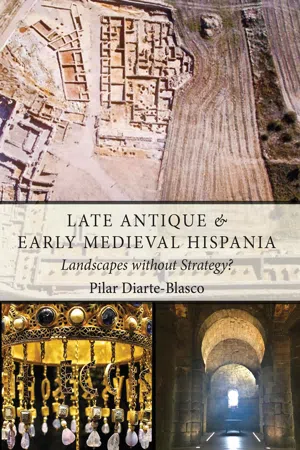 eBook - ePub
Late Antique and Early Medieval Hispania
Landscapes without Strategy?
- Pilar Diarte-Blasco(Author)
- 2018(Publication Date)
- Oxbow Books(Publisher)
Part I
Hispania (AD 400–711). An historical, archaeological and geographical background
 Passage contains an image
Chapter 1
The Iberian Peninsula: a land of multiple landscapes?
Hispania : a geographic and topographic descriptionThe Iberian Peninsula, located in the south-west corner of Europe, comprises two modern counties, Spain and Portugal, and covers an area of approximately 582,000 km2 , making it Europe’s second largest peninsula (behind Scandinavia). It is separated from France by the mountain range of the Pyrenees, which acts as a natural border, while the southern area of the Peninsula is separated from the north-west coast of Africa by the Mediterranean Sea and the narrow Strait of Gibraltar, just c . 15 km wide. It is flanked on the south-east and east by the Mediterranean Sea, and on the north, west and south-west by the Atlantic Ocean. Indeed, the fact that the Peninsula lies between Europe and Africa creates notable influences in terms of surrounding environments and climatology; its position in the Atlantic, African and European plates, together with its tectonic evolution, also creates a particular variation and a diversity of landscapes.Topographic variability is one of the main characteristics of the Iberian Peninsula, with several ranges of mountain chains and basins distributed across all its territory (De Vicente Muñoz and Vegas 2007). The Pyrenees, the Cantabrian Range, the Sistema Central-Cadena Ibérica and the Sierra Morena (from north to south) are the larger main systems of mountain ranges (with a very high mean topography, of c. eBook - PDF
By the Sword and the Cross
The Historical Evolution of the Catholic World Monarchy in Spain and the New World, 1492-1825
- Charles A. Truxillo(Author)
- 2001(Publication Date)
- Praeger(Publisher)
Chapter 1 Spain in World History The ancient Greeks called Spain Iberia, and they conceived of that land as the extreme western end of their Mediterranean-based ecumen. And while the Iberian Peninsula does exist as an integral part of the Mediterranean, it also partakes of an equally significant Atlantic orientation. However, in antiquity (3500 B.C.-A.D. 565) and throughout the better part of the Middle Ages (A.D. 500-1500), Spain is more properly seen within its Mediterranean context—part of the world of Greece, Car- thage, Rome, and North Africa. Later, during the period of the Gunpowder Empires (A.D. 1453-1840), Spain's geographical axis changed towards an Atlantic configu- ration; this occurred in response to its new role as hegemon of the Indies and defender of the Catholic faith against the depredations of Protestant England, rebel- lious Holland and, to the Castilians, perfidious France (Vives 1970). The Iberian Peninsula does, in fact, lie on the extreme western end of the Afro-Eurasian world island. It is primarily a semiarid land dominated by a high central plateau. Furthermore, Iberia is divided from France by the Pyrenees Moun- tains. And it is also internally divided by several mountain ranges. The Levantine or east Mediterranean coastlands of Spain are similar in climate to those of the French Riviera or western Turkey. Around the Bay of Biscay, the Spanish landscape resembles the wet climate of Ireland or Britanny. Meanwhile, along the Atlantic seaboard, Spain and Portugal change from a hilly fertile land in the north to rocky arid lands in the south. Moreover, Andalusia or southern Spain has always seemed more like an extension of North Africa than of western Europe (Braudel 1973). In antiquity and the early Middle Ages, the coastal periphery of Andalusia and the Spanish Levant dominated Iberian history. eBook - ePub
- Javier Muñoz-Basols, Manuel Delgado Morales, Laura Lonsdale, Javier Muñoz-Basols, Laura Lonsdale, Manuel Delgado, Manuel Delgado Morales, Javier Munoz-Basols, Manuel Delgado Morales, Laura Lonsdale(Authors)
- 2017(Publication Date)
- Routledge(Publisher)
As we have seen, historians such as F. Schlegel, Sismondi or Bouterwek considered the Iberian Peninsula as a historical and cultural unity that was severed from the rest of Europe and preserved its common peculiarities through time; however, this unity and continuity disappears, as we have also seen, when we consider Spain and Portugal separately. And this is what happens in nineteenth-century literary histories when they are devoted to each of the national literatures, from their birth to the present moment, as we see herein.It is common in Spanish and Portuguese literary historiographies to identify the Middle Ages with the moment when both national characters are created.4 The Middle Ages are the starting point for most literary histories too: the birth of the nation is equated with the birth of the romance languages, and therefore literatures. This medieval period also provides what became a key element in the conceptualization of Iberian literatures: the Islamic conquest of the Iberian Peninsula and the long years of struggle (or peaceful coexistence, depending on the historian) between Eastern and Western peoples.5 This same idea is repeated in almost every history of the nineteenth century (see Pérez Isasi 2011). According to the Romantic vision, the Christian inhabitants of the Iberian Peninsula simultaneously rejected and were influenced by the long centuries of war and cohabitation with the Moors: they fought against them, but also lived with them; they adopted some of their key customs, and reaffirmed some of their own in opposition. This is why the Iberian Peninsula is often referred to as an “Eastern space,” or as a bridge between Europe and Asia: an imaginary locus filled with often fantastic connotations (César Domínguez 2006). Iberian “orientalism” is easier to find, in fact, in the histories written by foreigners, and progressively disappears as the century progresses, and as Iberian scholars contribute more to literary historiography.6 eBook - ePub
- Gary McDonogh(Author)
- 2008(Publication Date)
- Routledge(Publisher)
www.ujaen.es/centros/caai/articAntiquity.htm ).Iberia evolved for centuries into diverse political-economic and cultural systems. With the decline of the Roman Empire, Visigoths and others invaded and assimilated, but their kingdoms fell to Muslim invaders in the eighth century. Over seven centuries, as we will see, Catholic kingdoms evolved in the North in battle with changing Arab states and their diverse populations to the South. Medieval Portugal became a nation-state within its own expanding maritime empire, while other kingdoms coalesced into a Spanish state through marriages, alliances, rebellions and conquests in the early modern period Portugal itself was forced into an Iberian union from 1580 until 1641. Rather than resolving processes of national/cultural differentiation or concomitant divisions of class, gender, political orientation, and other features, peninsula politics have often monumentalized unity in architecture, language and arts. Nonetheless, nationalist movements have remained strong across Spain, divisions that have changed the state in the last four decades.The Iberian Peninsula today includes three nation-states—Spain, Portugal, and Andorra—and the United Kingdom Dependent Territory (formerly Crown Colony) of Gibraltar (see Chapter 4 ). “State” here, refers to a bounded territory with the ability to exercise legitimate authority, including assembling revenues, controlling borders and making war. This is not the same as a “nation,” which has an emotive and symbolic commitment from its citizens, a sense of belonging mediated through language, symbols and rituals (Anderson 1983; Guibernau 1996, 2004). States may survive with little unity or consent; nations endure without the protection of a state. National ideologies may also hold together contradictory ideas in a symbolic web: Susan DiGiacomo, for example, has underscored how urban Catalan nationalism glorified the caseta and l’hortet eBook - ePub
Cooking through History
A Worldwide Encyclopedia of Food with Menus and Recipes [2 volumes]
- Melanie Byrd, John P. Dunn, Melanie Byrd, John P. Dunn(Authors)
- 2020(Publication Date)
- Greenwood(Publisher)
Iberian Peninsula (1800–Present)Historical Overview
If the modern history of Spain and Portugal were compared to a restaurant, the resulting menu would be eclectic and international. The long twentieth century witnessed tremendous change in this corner of southwestern Europe. Both countries transformed from monarchy to republic, to dictatorship, and then back to republic; both experienced violent revolutions; and both had to deal with the collapse of traditional imperialism. This mixture, much like a tapas bar, took Iberia all over the political map, with many issues, such as regional autonomy or national unity, actively debated today.At the start of the nineteenth century, Portugal and Spain seemed to be great powers. Between them, they dominated all of Latin America, large swaths of southern Africa, and even colonial holdings in the Philippines and other Pacific islands. Exotic spices, vast quantities of silver bullion, coffee, sugar, and other valuable products left Iberian colonies to benefit the homeland. Military bases enhanced Spanish and Portuguese naval power, while indigenous peoples could be conscripted to form colonial armies.These many advantages, however, were more than offset by severe internal divisions. Portugal and Spain struggled to absorb the social, economic, political, and military changes fostered by the Enlightenment and French Revolution. Neither state was able to set a course that took it across dangerous shoals marked privilege, rising expectations, faith, and nationalism.This became clear when Napoleon Bonaparte attempted to dominate both countries in 1807. Although never completely successful, the French grabbed most of Spain and drove the Portuguese court into exile. The rather rapid defeats of Spain and Portugal were partially offset by British allies, whose armies kept the Peninsula War going until the final expulsion of French troops in 1814. Still, French initial success made clear Lisbon and Madrid were weak; within a decade, most of their New World colonies gained independence. eBook - ePub
A Brief History of the Spanish Language
Second Edition
- David A. Pharies(Author)
- 2015(Publication Date)
- University of Chicago Press(Publisher)
3External History of the Iberian Peninsula through the Thirteenth Century
This chapter examines the sociopolitical and cultural events that were crucial in shaping the linguistic configuration of the Iberian Peninsula. We will see that the Romans were not the first group to establish themselves in this region, and that they were also not the last. However, the arrival of the Romans and the subsequent Romanization of the Peninsula are undoubtedly dominant factors in its linguistic history, since the language that the Romans introduced more than two millennia ago is still spoken today in almost every part of the Peninsula. Almost a thousand years after the Roman incursion, the Peninsula witnesses another invasion—that of the Muslims—whose effects in the linguistic configuration of the region are almost equally profound. If indeed the Roman invasion explains the fact that Romance languages are spoken today on the Peninsula, it is the second of the incursions that set in motion the events that eventually made Castilian, rather than one of the other Ibero-Romance varieties, the national language of Spain.Iberian Peninsula before the Arrival of the Romans
The following is a partial list of paleo-Hispanic populations—groups that inhabited the Iberian Peninsula before the arrival of the Romans. Various factors are identified, including their probable origins, when they arrived, where they settled (see map 1 ), and their linguistic contributions to Modern Spanish.• Iberians. This group inhabited a wide area from southeast France (Languedoc, Rosellón) along the Mediterranean coast to Murcia, as well as the valley of the Ebro (originally called the Íber, whence ibero ‘Iberian’). These settlements date from the beginning of recorded history in the region. Since it is has not been possible to translate Iberian inscriptions, the language’s genetic affiliation is not known, though phonological analysis of the inscriptions seems to indicate that it is neither Indo-European nor Basque. For the same reason it has not been possible to identify any definite Iberian relics in the Spanish vocabulary. However, certain words pertaining to domestic and rural life could possibly be of Iberian origin: barro ‘mud’, charco ‘puddle’, boñiga ‘dung’, perro ‘dog’, álamo eBook - PDF
Environment and Nation
Geographical Factors in the Cultural and Political History of Europe
- Griffith Taylor(Author)
- 2019(Publication Date)
- University of Toronto Press(Publisher)
CHAPTER XVIII SPAIN-A NATION FOUNDED ON A DRY PLATEAU A. The Build of Spain and its Historical Implications Europe is sometimes described as the peninsular portion of Eurasia, and it is indeed more peninsular than any other continent. Penin-sulas tend to produce national isolation, though not to the same extent as do islands. We may compare for a moment the four main penin-sular regions of Europe, i.e., Scandinavia, Spain, Italy and the Balkans. Each has its special pattern with historical consequences. In Scandi-navia the peninsula is largely a bleak highland, which permanently isolates the two main coasts, and so has kept Norway distinct from Sweden. The land connection with the continent is with the far north in an inhospitable climate, and so has never been of much consequence. Scandinavia is in essence an island, and much like Britain, for it is removed only a short distance from the mainland. Italy is the most typical peninsula, being so long and narrow. As a result it has no plateau country of importance, almost all the settlement being in the coastal plains. It would serve as the land bridge to Africa, but for the tremendous barrier of the Alps. For the same reason its culture and history have developed on somewhat different lines from those of the rest of Europe. The Balkans are so broad that the peninsula shape is somewhat masked. It is, moreover, unlike Spain in that it is rather open to the north, mainly along the Morava-Vardar Corridor, but it is so mountainous that a number of small national groups de-veloped in the several corners of the Balkans. On the whole it offers perhaps a better geographic parallel to the Spanish Peninsula than do either of the other two. The relation of Spain to France and the build of both are given in the Mantle-map (Fig. 89). The boundary between the two countries is the rugged fold-range of the Pyrenees, which rises to 11,000 feet. eBook - PDF
- (Author)
- 0(Publication Date)
- Rough Guides(Publisher)
>> The Iberian Peninsula THE Iberian Peninsula 118–160 The Iberian Peninsula is big on pride, aflame with colour, and blessed, above all else, with an insatiable appetite for a long night out. With cities as culturally colossal as Barcelona, Lisbon and Madrid to shout about – not to mention islands as diverse as Madeira, the Azores, the Canaries and the Balearics – Spain and Portugal can claim world-class status in everything from art, sport and architecture to hiking, food and beaches. The countries’ legendary festival roster ranges from the messily momentous Tomatina to the electronica-led Benicàssim, while landscapes vary from the wilds of the Tabernas Desert to the pinnacles of the Picos de Europa. THE ROUGH GUIDE TO THE WORLD PORTUGAL We had barely got going on our hike when my ankle rolled to the side and I tumbled over. My guide, José Granja, came across to check that I was OK. “You know, you need to taste the floor sometimes,” he said, peering at me as we got going again. “I fell off my bike once. As I lay there, I saw an ant.” He held a finger close to his face as if to inspect it. “I thought, I might as well make the most of being there, because I’d never throw myself to the ground on purpose.” José’s spiritually flavoured interpretation of my roll in the dust came back to me later. After three days sampling the twin prongs of the Rota Vicentina walking trail, which runs for 340km through Portugal’s southwest, I was pleasantly bone-weary and, yes, feeling pretty in touch with my surroundings. First there’d been the gentle, inland Historical Way, passing goats whose tinny bells chimed in unison to weave rich blankets of sound. Here we encountered no one but an old farmer chasing his cows. “Ai! Ai!” he shouted, followed by a volley of curses as one animal strayed and he stumbled down the hillside in pursuit. eBook - PDF
Nationalizing the Past
Historians as Nation Builders in Modern Europe
- S. Berger, C. Lorenz, S. Berger, C. Lorenz(Authors)
- 2016(Publication Date)
- Palgrave Macmillan(Publisher)
394 Nationalizing the Past racial factors were vital in shaping historical evolution. 24 In the face of third countries, which were supposed to be ‘Iberia’s other’, Spain and Portugal had to present a common position in world politics, as their understanding had strong objective roots, sustained by a shared worldview, a common interpretation of culture and a set of values regarding everyday life. However, both Altamira and Oliveira Martins had to face a further concep- tual problem: how to coin a concept of civilization malleable enough to make it universal, while at the same time serving as an affirmation of the ‘cultural and historical supremacy’ of Spain and/or Portugal (or the Iberian nations as a whole) in the world. The answer was found, once again, in the sphere of ideas and values. There was a ‘peninsular thought, a spirit’ which shaped a ‘moral physiognomy com- mon to all Iberian populations’ and whose main components were ‘religious enthusiasm’ and ‘heroism’, understood in the Herderian sense of the hero being the representative of the best qualities of the national soul. 25 This had been the outcome of the shared origin of the Iberian peoples with Northern African ones, something that had forged an egalitarian spirit, as well as a ‘nat- ural’ tendency towards federalism. The Latin-Roman influence had meant a deviation of the evolution of that physiognomy. And the period of Visigothic dominance had also implied the emergence of some further characteristics of a Hispanic character, such as the links between religious and political power. A new Spain was born again under the period of the Muslim presence, characterized by a spontaneous energy dispersed in multiple kingdoms and languages. Hispanic feudalism did not exist as such, due to the strength of the monarchy and of the municipalities, which permeated the Iberian character and gave it a democratic-oriented tone. eBook - PDF
The Western Mediterranean and the World
400 CE to the Present
- Teofilo F. Ruiz(Author)
- 2017(Publication Date)
- Wiley-Blackwell(Publisher)
In the Iberian Peninsula, those exchanges shaped the historical trajectory of the societies that emerged after 1492. But that was still in the future. In 711, the Muslims crossed the Straits of Gibraltar and swiftly defeated the Visigothic armies. A Visigothic Empire that had enjoyed close to 300 years of continuous existence crumbled in unexpected ways. Two things are important to note. First, the invaders represented a diverse group of Arabs, Berbers, Slavs, and other people united by their faith – and to a certain extent by Arabic, the language of the Qur ’ an – and not by their ethnic identity. Second, the coming of Islam into the peninsula led to numerous conversions from Christianity to Islam (though historians do not fully agree as to the extent of these conversions), above all in the regions along the Mediter-ranean, the newcomers ’ preferred area for settlement (see Chapter 5). Although the Muslims swept deep into the peninsula, they did not hold on to all the territory they had initially conquered. The northern mountains in the Basque homeland, the Pyrenean ridges, and the rugged area of Asturias held no attraction for them. As the Romans had done before, the Muslims left the 63 G EOGRAPHY , H ISTORY , AND C ULTURAL C ONTEXTS mountains and their people to their own fate. A number of Visigoths or Christians fl ed to these mountain lairs. From there they would emerge to challenge the hegemony of Islam in the peninsula in centuries to come. In addition, a series of famines and reverses in the mid-eighth century led the Muslims to withdraw south of the Central Mountains, abandoning a central plain which, without any substantial demographic resources or great agricul-tural potential (in terms of Muslim rural technologies and type of cultivation), held little or no attraction for them.
Index pages curate the most relevant extracts from our library of academic textbooks. They’ve been created using an in-house natural language model (NLM), each adding context and meaning to key research topics.

