Geography

Von Thunen Model
The Von Thunen Model, developed by German economist Johann Heinrich von Thunen in 1826, explains the spatial arrangement of agricultural land around a central market. It suggests that different types of agricultural activities are located at varying distances from the market, with transportation costs and land rent influencing land use patterns. This model provides insights into the organization of agricultural landscapes and the economic principles governing land use.
Written by Perlego with AI-assistance
Related key terms
1 of 5
10 Key excerpts on "Von Thunen Model"
 eBook - PDF
- V. Emayavaramban, K. Kannadasan, S. Vinothkanna(Authors)
- 2021(Publication Date)
Therefore, it is not desirable to accept this model in its original form as observed by many scholars. But this model is still considered to be significant in many ways. 3. Relevance of Von Thunen Model Almost two hundred years ago, Johann Heinrich Von Thunen demonstrated that the geographic pattern of agricultural land use was highly regular and predictable. He first described the pattern of land use within and surrounding his own large estate. Based upon these descriptions he next formulated a hypothesis to explain the geographic pattern. His hypothesis was that the higher the cost of transportation, the lower the amount a tenant farmer would be willing to pay to use the land. He expressed his hypothesis using clear and unambiguous mathematics. He reasoned that by placing reasonable numerical values into his mathematical formulation he could closely predict actual land values and land uses. 35 Von Thunen's Location Theory Among his general conclusions were that land values decline with increasing distance from the market centre; and that land values and land uses change as the various costs of production, transportation, and prices of agricultural commodities change. Today, the cost and technology of transportation has had a dramatic effect upon the agricultural land use patterns that one would expect by applying Von Thunen’s logic. Agricultural land use patterns that are evident surrounding market centres are thought to be historic remnants of a bygone era, or the result of administrative institutions whose existence brings about a usage to the historic patterns of land use. At the scale of the continent and the globe we now can observe von Thunenlike market forces and patterns of land use. The Von Thunen logical framework has been important in the evolution of our thinking of how land values and land uses came about in the modern city. Indeed, Von Thunen’s general theory of land values and land uses has been important in the evolution of thought. eBook - PDF
- R. Knowles, J. Wareing(Authors)
- 2014(Publication Date)
- Made Simple(Publisher)
142 Economic and Social Geography Made Simple proceeded to use his model as a yardstick, or norm, for studying the causes of deviations from the theoretical pattern and the effect of particular variables. For example, the modified diagram (Fig. 12.3b) illustrates the distortions pro-duced by the presence of a navigable river and a second urban centre. The Application of von Thiinen's Model Von Thiinen's model has been dismissed by various writers as being ana-chronistic and of no relevance to the contemporary economic situation. How-ever, von Thünen himself went to some length to point out that his work was essentially a method of approach to the complex subject of agricultural loca-tion, and that while his findings had no claim to universality, the methods by which they were obtained could be applied generally. Changes in transporta-tion since the early nineteenth century have done most to destroy the sym-metry of the land use systems around central markets. Modern transport and refrigeration now enable city markets to receive perishable goods from a variety of distant suppliers. Nevertheless, 'while transport costs continue to form a major part of the total costs of producing and marketing crops, at least some semblance of a concentric zonal system remains'. (J. R. Peet) A neglected aspect of von Thiinen's model is that of its scale. M. Chisholm has suggested that the principles may be applied to the land use on a single farm or estate, to the land surrounding a village, or to the patterns of agricul-ture at national or even continental scale. In other words, the model is applic-able at all scales. Chisholm himself quotes several examples of agricultural villages in southern Europe around which the intensity of land use varies inversely with distance from the settlement. At national level a recent study interpreted the pattern of agricultural land use in Uruguay in terms of the von Thünen model, while O. eBook - ePub
- William P. Anderson(Author)
- 2012(Publication Date)
- Routledge(Publisher)
(Recall that site attributes are those physical characteristics of a particular location that make it advantageous for some economic activity.) Another nineteenth-century economist, Johann Heinrich von Thünen, devised an alternative theory of land rent based on situation attributes. (Recall that situation attributes refer to the accessibility of a place.) As a landowner himself, von Thünen observed that land rents varied significantly even within regions where the physical characteristic of the land varied little. Through careful observation, he discovered that these rent variations could be explained based on the accessibility of different plots of land to market towns. He extended this observation into a formal model not only of spatial variation in rents, but also of spatial patterns of different types of farming. Von Thünen’s model is a foundation stone of economic geography. Not only is it one of the earliest economic models with an explicitly spatial expression, but its basic logic has been extended beyond agricultural land use to help explain urban land-use patterns, as we will see in chapter 18. Von Thünen's model As always, the best way to start discussing a model is by listing its assumptions: All agricultural activity takes place on an undifferentiated plain. That means there is no variation from place to place in soil quality, weather, slope or any other factor that might affect agricultural productivity. At some point in the plain there is a single, isolated market town. All crops produced in the plain must be transported to this market town (hereafter “the market”) for sale. Market prices are assumed to be given (exogenous). Transportation costs for crops produced at any point on the plain are a fixed rate times the distance to the market. The transportation rate may vary across crops. The entire plain is under the ownership of landlords who rent their land to farmers eBook - ePub
The New Urban Economics
And Alternatives
- H.W. Richardson(Author)
- 2013(Publication Date)
- Routledge(Publisher)
von Thünen's agricultural model has been discussed by Hall (1966), Beckmann (1968), Artie and Varaiya (1974 ; 1975), Scott (1975c), and Guigou (1972), and Beckmann (1972) has developed an interesting urban version. von Thünen's own model was abstract, though it was illustrated with numerical examples using data from his own estate (Tellow). His assumptions included: the town is located on a homogeneous plain with land of equal quality; there is no spatial differentiation within the town, hence it can be treated as a single point; landlords maximize profits; they have complete information about production methods, prices, and transport costs; all prices and transport costs are fixed; there are no intermediate goods, and hence no production linkages; and production costs are constant over space. In fact, the model was a little more complicated, in at least two respects. First, his formula for estimating transport costs was based on the assumption that the feed of horses and food for drivers had to be carried along implying a nonlinear transportation function. Second, he assumed that real wages were constant over space, and divided wages up into a 'real'-wage component paid in kind (grain) and a money-wage component. These complications are ignored here. Considering the most simple example of a von Thünen type model, land rent may be defined as revenue minus costs, and costs can be divided between production costs and transportation costs eBook - PDF
The Biodemography of Subsistence Farming
Population, Food and Family
- James W. Wood(Author)
- 2020(Publication Date)
- Cambridge University Press(Publisher)
modern way. Happily for us, it is a model of preindustrial agriculture (although it has also been applied successfully to modern industrialized farms). While not explicitly a model of the relationship between population and farming, it provides important insights into the spatial distribution of farming populations and will crop up repeat- edly in later chapters. Although it sometimes finds modern expression in complicated mathematical or computer models (Blaikie, 1971; Sasaki and Box, 2003), the original version was purely verbal and graphical – which is exactly the version most researchers still use and understand today. It is, in my opinion, a very pretty model. The model was invented by the German mathematician (and farmer) Johann Heinrich von Thünen (1783–1850), who presented it in a book titled The Isolated State, published in 1826. At that stage in his career, von Thünen had partially retired from academia and had purchased a large farm in the northern plains of Germany. In thinking how best to organize his farm, von Thünen started with the following scenario: Imagine a very large town at the center of a fertile plain that is crossed by no navigable river or canal. Throughout the plain the soil is capable of cultivation and is everywhere of the same fertility. Far from the town, the plain turns into an uncultivated wilderness that cuts off all communication between this State and the outside world. There are no other towns on the plain. The central town must therefore supply the rural areas with all manufactured products, and in return will obtain all its provisions from the surround- ing countryside. . . The problem we want to solve is this: what pattern of cultivation will take shape in these conditions? And how will the farming system of the various districts be affected by their distance from the town? We assume throughout that farming is conducted absolutely ration- ally. (von Thünen, 1966 [orig. 1826]: 7–8) We would now call these model assumptions. eBook - ePub
- Roberta Capello(Author)
- 2015(Publication Date)
- Routledge(Publisher)
As the categories of farmers compete for the more accessible land, each unit of surface area will be allocated to the category willing to pay the highest rent for that land. As far as a’, the land will be allocated to category A, who offers the highest rent for the most central locations, from a’ to b’ to category B, and from b’ to c’ to category C : the actual rent realized by the landowner from cultivation of his land is the envelope of the three rent supply curves. It is interesting to ask where, within each area attributed to a category of farmers, a single farmer will locate. The reply is that farmers will be indifferent to whatever location; that is, they will not compete with one another, since each location guarantees the same level of (normal) profit; by moving towards the village, in fact, transportation costs decrease for the exact amount that is necessary to pay a higher rent. One of the main strengths of this model is its ability to demonstrate that it is simple distance from, or accessibility to, the town (expressed by transport costs) that accounts for differences in land rent. It thus departs from the classical Ricardian view that differences in land profitability are due to different degrees of fertility. 7 By so doing, it is able indirectly to explain the location of economic activities in space – a result that is a significant achievement. 8 In this perspective, the Von Thünen model can be defined as a general spatial equilibrium model. Starting from the assumption of a homogeneous space (an un-cultivated plain), and giving for granted a normal profit level, common to all categories of farmer, the model is able to identify at the same time the location of the different categories and the rent level. 2.3 The urban location of firms: the Alonso model In the early 1960s, first William Alonso and then Richard Muth reconsidered von Thünen’s model and adapted it to an urban context, 9 thus paving the way for numerous subsequent studies eBook - ePub
Spatial, Regional and Population Economics
Essays in honor of Edgar M Hoover
- Mark Perlman, Charles J. Leven, Benjamin Chinitz(Authors)
- 2017(Publication Date)
- Routledge(Publisher)
7Thünen, Weber and the Spatial Structure of the Nineteenth Century CityRAYMOND L. FALES and LEON N. MOSES* †Northwestern University, Evanston, Ill., and Livingston College,Rutgers University, New Brunswick, New JerseyEconomists, geographers, and a number of theoretically inclined planners have developed models to explain patterns of urban land use and rent.1 Many of these models are adaptations of J. H. Von Thünen’s theory of agricultural location.2 The more rigorous of them assume a central area in which all production and employment take place, and through which all imports and exports move. The land pattern is depicted as a series of concentric zones of exclusive and progressively less intensive use. The models replicate what is taken to be the usual order of urban land use. The business area is followed by a manufacturing zone and the latter by one devoted to residences. Finally, there is an agricultural zone. Land rents fall continuously with distance from the center of the city.This essay grows out of some dissatisfaction with these models which seem designed to explain land use in a stereotype of the large, densely settled city of the 19th century. They provide little insight into the spatial structure of places like Phoenix, Albuquerque, and Los Angeles which experienced their major growth in the present century. In these cities, population densities are low and rather uniform. Industry, including banking and other services that are often assumed to be core oriented, tends to be broadly dispersed. Even if such cities have an area that can be identified as the core, it is surely not the focus of all economic, recreational, and other activity. Similarly, Thünen-type models do not seem capable of explaining the massive rearrangements of population and employment that are taking place in urban areas such as Chicago, Boston, and Philadelphia. These are examples of cities that took form and experienced their major growth in the nineteenth and the first two decades of the present century. However, powerful forces have been causing a dispersal and intermixing eBook - ePub
The Rural to Urban Transition in Developing Countries
Urbanisation and Peri-Urban Land Markets
- Amrutha Mary Varkey(Author)
- 2023(Publication Date)
- Routledge(Publisher)
The writers who advocate the relevance of Von Thunen principles are such as Chisholm (1968), Horvath (1969), Found (1971), Katzman (1974) and Thiele (1984). Using the traditional assumptions of the Von Thunen Model, Quinn et al. (1997) observed that the land use as a function of distance from Sydney, which is the primate city, has a tendency toward concentric zonation. I seek the empirical evidence of Von Thunen theory in the study of distance and land prices in the Bengaluru periphery (Figure 4.1). Figure 4.1 Distance from National Highway. Compilation by the author. The figure shows how villages are selected in the periphery using the distance from National Highway. The land uses are different at various distances from the city, farther away from the city the greenery is more. But at a distance closer to National Highway less than 1 km–5 km, there is more of built-up land and developments. The land uses differ as the distance from the National Highway increases. Relationship between Distance and Land Transactions in the Periphery There exists active land transactions in the periphery. As Figure 4.2 indicates, as the distance increases, the number of land transactions decreases. At a distance less than 1 km from the national highway, the number of land transactions is more and vice versa. At a distance closer to national highway with less than 1 km, majority of land transactions are taken place, 226 land transactions (out of total 500) are very close to the highway and farther from the city centre the land transactions are less. Figure 4.2 Land transactions and distance. Compilation by the author. As the distance from the national highway increases, the agricultural land transactions are more as we see in Figure 4.3. Similarly, the land price decreases as the distance from the city increases. As the distance increases, the number of agricultural transactions increased to 17 and land price reduced to Rs. 665 eBook - ePub
- John M. Hartwick(Author)
- 2015(Publication Date)
- Routledge(Publisher)
Basic land-use theory (Von Thunen theory) is about allocating competing activities to sites. In the absence of externalities, site boundaries for the competing activities shift until an allocation is compatible with a rent function that has no jumps at the spatial boundary. In addition one can envisage competing activities as competing at every site for the space in question: the highest bidder wins and this outcome is part of the definition of an efficient use of the sites. These ideas come out of the classical Von Thunen Model of allocating crops to areas for an efficient use of land.Urban economics borrowed from the Von Thunen Model and developed a model of a city with all jobs at the center and the residences of workers in an area surrounding the center. At the spatial edge, agricultural activity and residential activity compete for sites in a Thunen-like fashion. The generation of an equilibrium land-rent function becomes a central focus. The rent or annual charge on land becomes a sort of puzzle piece that when inserted in a household’s utility maximization problem leaves the household in a utility maximizing equilibrium. When we bring the correct land-rent function to each resident of our city, each household maximizes its utility “correctly” and similar households are on the same indifference curve. Or one might think of the equilibrium of many similar households becoming “closed” by the presence of the appropriate land-rent function. Thus a characterization of land-use economics is finding the appropriate rent function. Central to the locational equilibrium of a household is the “cost” of an equilibrium shift in location: a small shift in the location of the household farther from the center involves a cheaper home (land rent declines with distance from the center) but a marginally more costly commute. And the bottom line is: von Thunen analysis plus basic textbook consumer theory allows us to create fairly plausible-looking cities, on paper. We have left open the question of why so many jobs in cities are clustered in a central area (a central business district). This question has no simple unique answer. We will return to this matter of the clustering of jobs many times in this book.The “open-city” assumption involves very similar worker-households ending up with the same utility in different cities. And two cities of different sizes under the open-city assumption will in general have similar workers with different wages—an odd outcome, at first glance, but one supported by much empirical evidence. The larger city will generally have similar workers earning higher wages but these better paid workers will be facing, on average, higher housing prices in the larger city. This trade-off of higher wages versus higher residential costs allows similar workers to end up on the same indifference curve in two different cities, one large and one small.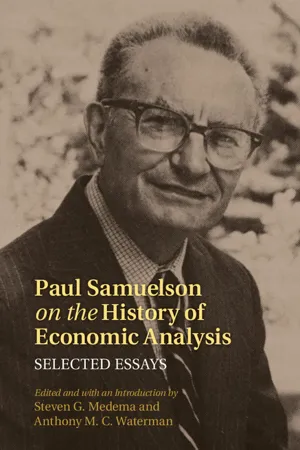 eBook - PDF
Paul Samuelson on the History of Economic Analysis
Selected Essays
- Steven G. Medema, Anthony M. C. Waterman(Authors)
- 2014(Publication Date)
- Cambridge University Press(Publisher)
Thünen’s model has in it elements of all of the following systems: 1. The Ricardo-Torrens theory of comparative advantage. fixed coefficients for good 2. In actual life, delivered cloth could become so expensive for workers far enough out that, realistically, no cheapness of the farm goods could induce them to live out there. That would define a finite external margin (which is ruled out by my extreme assumption that vegetables require land only). Far out landowners have rent per acre that yields ever lower utility. Therefore, we might suppose that each ekes out a living by owning ever more acres. Since the model requires zero work of the landowners, this is no problem. But the mind does rather boggle at the prospect of an indivisible human being straddling over ever more expansive acres and doing all consuming on them. 214 V. Johann Heinrich von Thünen 2. The Malthus-West-Ricardo theory of rent. 3. The Heckscher-Ohlin and Stolper-Samuelson theory of factors-and- goods pricing. 4. The Marx-Dimitriev-Leontief-Sraffa system of input-output. 9 Moreover, Thünen has correctly perceived how his versions of those models operate under competition. Not only has he understood their positivistic features but, in addition, he has anticipated the Allyn Young, Frank Knight, and Dennis Robertson demonstration that charging compet- itive land rents is what leads to normative social efficiency (albeit possibly great inequalities and inequities). Thus, Thünen would understand at once a demonstration by a modern economist that it would be wrong to allocate workers homesteads on which they alone are to work – wrong, even if the size of their acres was made lower near to town in order to achieve ethical equity. As each homesteader sought to acquire more land, or to hire more workers, preventing them from doing so would lead to deadweight loss.
Index pages curate the most relevant extracts from our library of academic textbooks. They’ve been created using an in-house natural language model (NLM), each adding context and meaning to key research topics.

