History

Conscientious Objector
A conscientious objector is an individual who refuses to participate in military service or war on the grounds of moral or religious beliefs. Throughout history, conscientious objectors have faced challenges and discrimination for their refusal to bear arms, often advocating for alternative forms of service or conscientious objection provisions in military conscription laws.
Written by Perlego with AI-assistance
Related key terms
1 of 5
10 Key excerpts on "Conscientious Objector"
 eBook - ePub
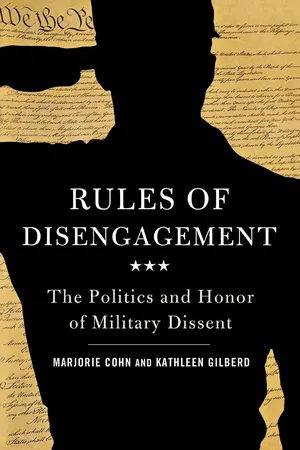
- Marjorie Cohn, Kathleen Gilberd(Authors)
- 2009(Publication Date)
- NYU Press(Publisher)
TWOModern Conscientious Objectors
SOLDIERS INVARIABLY CONSIDER the morality of the wars in which they participate and the means by which those wars are carried out. American GIs face very personal questions about the right or wrong of the wars in Iraq and Afghanistan, their roles in those wars, and the methods of warfare—the rules of engagement. For many, of course, the answers depend on the specifics. World War II was different in many fundamental ways from the war in Vietnam. But military law and regulations allow soldiers to disengage and seek noncombatant status or discharge only if they have religious, moral, or ethical objection to all war, or, in the language of the regulations, “war in any form.”This chapter offers a brief definition of conscientious objection, then discusses several Conscientious Objectors, including some whose beliefs do not fit the military’s limited terms. Their own statements and stories reveal the legal process and the practical experience involved in applying for CO status. Perhaps more than with any other type of discharge or dissent, the legal terms for modern COs were established by cases during the Vietnam War. And we discuss the substantive rights they won before moving on to the current regulations and the process of applying for discharge or noncombatant status as a CO.Conscientious objection has a long and honorable history in the American military, with cases going back to the colonies and the Revolutionary War. Through litigation and public pressure, COs have expanded the definition of conscientious objection and the rights of CO applicants over the years, forcing the military to recognize a wide range of religious and moral beliefs as a basis for objection and to treat objectors with some measure of respect and dignity. Soldiers and sailors like those discussed in this chapter have demanded that the military obey the courts and its own regulations. These objectors’ efforts have helped to protect and expand GIs’ rights in other discharges and dissent as well. No longer available |Learn more
The International Human Right to Freedom of Conscience
Some Suggestions for Its Development and Application
- Leonard Hammer(Author)
- 2020(Publication Date)
- Routledge(Publisher)
A selective Conscientious Objector is one who objects to a particular military action on the basis that the requested military action violates a conscientious belief. 7 States generally do not acknowledge such a right despite the groundwork for recognising the right to an overall military Conscientious Objector. It is necessary then to analyse the contentions of a selective Conscientious Objector and demonstrate how the assertion of a selective objector is comparable to a general military objector, such as to refute any distinction between them. In essence, once one derives the right to military conscientious objection from the freedom of conscience, it is difficult to understand how such a right would not include selective objection. Note that along with selective conscientious objection, there also are other forms of objection that might not be fully incorporated into the right to military conscientious objection. For example, the right to military conscientious objection for those already serving in the military or objection to alternative military service are additional applications of the right to military conscientious objection. 8 Some of these forms of military conscientious objection might be relevant to the development of customary international law, as well as important to an understanding of the manner in which a conscientious belief can manifest eBook - PDF
The Conscience Wars
Rethinking the Balance between Religion, Identity, and Equality
- Susanna Mancini, Michel Rosenfeld(Authors)
- 2018(Publication Date)
- Cambridge University Press(Publisher)
part i conscientious objection in a constitutional democracy Theoretical Perspectives 1 Conscience and Its Claims A Philosophical History of Conscientious Objection Julie Saada and Mark Antaki [B]reak the law. Let your life be a counter friction to stop the machine. What I have to do is to see, at any rate, that I do not lend myself to the wrong which I condemn. 1 Conscientious objection is generally understood as a refusal to take up arms in the name of an ethical or political principled pacifism, of a religious convic- tion forbidding participation in warfare, or of a political criticism of a government’s decision to wage a specific war perceived as unjust. 2 Legally recognized since the end of the nineteenth century, 3 conscientious objection has involved, however, not only objection to war and conscription, but also, and from varying political perspectives, to vaccination, abortion, same-sex marriage, mandatory schooling, and taxation. However one conceives what moves a Conscientious Objector – from political to religious or moral conviction – conscientious objection implies that the individual conscience has a particular status that allows it to be an authority and an autonomous source of obligation. It implies too that the demands of conscience are opposable to positive law and require either that an exception be made for the objector or that a positive law be modified or repealed. For this reason, it is difficult to distinguish the refusal to commit an action from a positive action demanding change in law or policy. Indeed, in those places where, and times when, conscientious objection is not legally recognized and regulated, it is often difficult to distinguish conscientious objection from civil disobedience. 1 Henry David Thoreau, “Civil Disobedience,” in Walden and Other Writings of Henry David Thoreau (New York: The Modern Library, 1937), 633–59, at 644.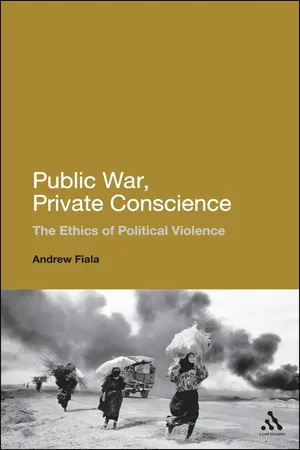 eBook - PDF
Public War, Private Conscience
The Ethics of Political Violence
- Andrew Fiala(Author)
- 2010(Publication Date)
- Continuum(Publisher)
These cases broadened the conception of conscientious refusal— from an explicitly religious exception grounded in the theology of PUBLIC WAR, PRIVATE CONSCIENCE 149 traditional Christian peace churches to a more broadly construed moral objection to war. Instead of appealing to the official dog-mas of an organized religion as the basis for conscientious objec-tion, these individuals argued that conscientious refusal can also be grounded in basic ethical beliefs. Seeger had explained his own views as follows: “I have concluded that war, from the practical standpoint, is futile and self-defeating, and that, from the more important moral standpoint, it is unethical” (quoted in Welsh v. U.S. , 1970). The Court held in the Welsh case that Conscientious Objector status could be granted to people whose “consciences, spurred by deeply held moral, ethical or religious beliefs would give them no rest or peace if they allowed themselves to become a part of an instrument of war” ( Welsh v. U.S ., 1970). Thus, during the Vietnam era, conscientious refusal was expanded from a purely religious exemption of the sort envisioned by the Founders toward a moral refusal that could be grounded in just war ideas. And this extended far enough to include conscientious objection for a black Muslim like Muhammad Ali. With this sort of moral exemption in place it becomes possible to defend “selective conscientious objection.” Selective refusal is dif-ferent from outright pacifism. Absolute pacifists will argue that war in general is wrong. But selective conscientious objection holds only that a particular war is wrong.
- Ö. Ç?nar(Author)
- 2013(Publication Date)
- Palgrave Macmillan(Publisher)
Concluding RemarksWestern Europe took a long time to accept the need for freedom of conscience. As evidenced by the aforementioned changes in attitudes during the Renaissance, Reformation, and Enlightenment periods, the separation of Church and State eventually led to the word “conscience” being conveyed without its former religious connotation. The idea of conscience has taken on a secular significance so that it is now no longer evaluated solely within a religious framework but also from a secular viewpoint.As a result of past struggles waged against State and Church, freedom of conscience is now recognized in international and domestic law as an individual freedom.71In the next chapter, the historical and philosophical origins of the concept of conscientious objection will be examined so that its link with the evolution of the concept of conscience and freedom of conscience, as expounded above, will be better understood. Passage contains an image
CHAPTER 2
Conscientious Objection to Military Service
Conscientious objection has travelled a long way since the first known Conscientious Objector was executed in the third century because of his religious pacifism; today, international and national mechanisms have begun to accept conscientious objection for religious, ethical, moral, philosophical, humanitarian, or similar motives; that is to say, on nonreligious as well as solely religious grounds.1Conscientious Objection to Military Service Based on Religious BeliefsIn 295 AD , when Roman soldiers arrived in Numidia (today’s Algeria) with the object of recruiting males for the Roman army, Maximilianus, the first recorded Conscientious Objector, said he would not become a soldier. His grounds for refusal were that he was a Christian and that in the teachings of Christ, violence was condemned; Maximilianus was consequently executed.2 Nevertheless, he entered the history books as the first known Conscientious Objector. Many Christians were later put to death for refusing to join the military.3
Passage contains an image
CHAPTER 2
Conscientious Objection to Military Service
Conscientious objection has travelled a long way since the first known Conscientious Objector was executed in the third century because of his religious pacifism; today, international and national mechanisms have begun to accept conscientious objection for religious, ethical, moral, philosophical, humanitarian, or similar motives; that is to say, on nonreligious as well as solely religious grounds.1Conscientious Objection to Military Service Based on Religious BeliefsIn 295 AD , when Roman soldiers arrived in Numidia (today’s Algeria) with the object of recruiting males for the Roman army, Maximilianus, the first recorded Conscientious Objector, said he would not become a soldier. His grounds for refusal were that he was a Christian and that in the teachings of Christ, violence was condemned; Maximilianus was consequently executed.2 Nevertheless, he entered the history books as the first known Conscientious Objector. Many Christians were later put to death for refusing to join the military.3 eBook - PDF
Contingent Pacifism
Revisiting Just War Theory
- Larry May(Author)
- 2015(Publication Date)
- Cambridge University Press(Publisher)
During the Vietnam era, several US Supreme Court cases considered the question of selective conscientious objection to participating in war. The deci- sions before the 1960s were grounded, as was the 1946 Circuit Court opinion, in the idea that Conscientious Objectors must base their opposition to serving in war on a belief in a higher authority. 7 But in 1963, another US Circuit Court allowed a Conscientious Objector to claim an exemption from military service because of the dictates of what was termed “Godness” where humans stand to this being in a horizontal rather than vertical relation, making the religious authority not one that is strictly “higher.” 8 In 1970, in Welsh v. United States, the US Supreme Court moved even fur- ther from demanding a belief in a traditionally understood idea of God when it held: If an individual deeply and sincerely holds beliefs that are purely ethical or moral in source and content but that nevertheless impose upon him a duty of conscience to refrain from participating in any war, those beliefs certainly occupy in the life of that individual “a place parallel to that filled by . . . God” in traditional religious persons. 9 The Welsh court also explained the general idea behind allowing conscientious objection as follows: “Section 6(j) [of the Selective Service Act] . . . exempts from military service all those whose consciences, spurred by deeply held moral, ethical, or religious beliefs, would give them no rest or peace if they were to become part of an instrument of war.” 10 This standard seems to me to be largely the correct one to use in such cases, but I do think the idea of “no rest or peace” needs to be explicated in terms of conscience rather than merely pru- dential considerations. And, importantly, it is not at all clear why both selective and general Conscientious Objectors could not meet this standard in terms of intensity of belief.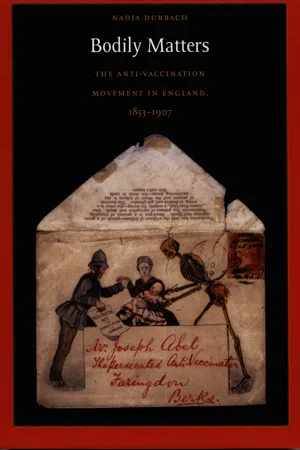 eBook - PDF
Bodily Matters
The Anti-Vaccination Movement in England, 1853–1907
- Nadja Durbach, Daniel J. Walkowitz(Authors)
- 2004(Publication Date)
- Duke University Press Books(Publisher)
≥ Conscien-tious objection was so popular among the working classes at Higham Ferrars, Northamptonshire, that in December 1898 several factories had to close down as all their ‘‘hands’’ had left work to apply for certifi-cates before the 12 December deadline. ∂ The first widely acknowledged Conscientious Objectors, therefore, were not the pacifist or socialist ‘‘conchies’’ identified with World War I but, rather, working- and lower middle-class anti-vaccinationists. The vaccination conscience clauses were controversial. As most of the applicants who applied for these exemption certificates came from the working classes, and many were women, these acts generated a national debate over the classed and gendered nature of the conscience and the meanings of conscientious objection. The years between 1898 and 1907 thus mark a significant moment in the making of the modern subject and citizen. As the debate over conscientious objection to vac-cination reveals, who exactly was entitled to make a claim to possess a conscience, with its concomitant rights, was itself a contested issue. The Conscientious Objector to Vaccination The Conscientious Objector to vaccination eventually became a legal category because politicians acceded to an already pervasive popular discourse that claimed conscientious beliefs as the property of all cit-izens, whether male or female, rich or poor, educated or uneducated. From their very earliest resistance to compulsory vaccination, agitators insisted that their objections were ‘‘conscientious.’’ In 1854, both the hydropath John Gibbs and the medical botanist John Skelton pointed to compulsory vaccination’s attack on the ‘‘conscientious convictions’’ of parents. As early as 1858, George Ridley of Bury St. Edmunds, a vaccina-tion defaulter, used the term conscientious objection to plead his case in court. By 1870, anti-vaccinationists were regularly mobilizing this de-fense—significantly, long before a conscience clause was in place. eBook - PDF
American Catholic Pacifism
The Influence of Dorothy Day and the Catholic Worker Movement
- Anne Klejment(Author)
- 1996(Publication Date)
- Praeger(Publisher)
4 Conscription and the Catholic Conscience in World War II Patrick G. Coy It was not always easy to be Catholic and American. Throughout the nineteenth century and part of the twentieth, U.S. Catholics faced nativist charges that their religion was inimical to a democratic way of political life. Their allegiance to Rome in doctrinal matters also called into question their allegiance to Washing- ton in matters of war and peace. Catholics often went on the counterattack, seeking to prove their critics wrong with defensive explanations long on rhetoric but short on substance. 1 Catholics also went to war, accepting America's wars as just with little critical reflection. Of the nation's four thousand Conscientious Objectors to World War I, only four were Catholic. 2 Most Catholics apparently suspected that for many Americans the litmus test for patriotism lay in whether one answered an uncritical "yes" when the nation called its citizens to arms. 3 It was a well-founded suspicion, for the equation of military service during war with patriotism is prominent in the history of not only this nation-state, but most nation-states. 4 The multifaceted response of the Catholic Worker movement to World War II revealed that Catholicism can nurture and affirm the independent thought and moral judgment that is the lifeblood of the democratic experiment. As war fever heated up and the nation carried on a debate over conscription, some Catholics, most notably those associated with the Catholic Worker movement, invoked a bedrock principle in Catholic moral theology in their opposition to conscription: the primacy of the individual conscience. This principle made it possible for Catholic Workers and Catholic Conscientious Objectors to step outside the current that swept the rest of the church and the nation into war. eBook - ePub
Conscientious Objection
Resisting Militarized Society
- Özgür Heval Çinar, Coskun Üsterci, Özgür Heval Çinar, Coskun Üsterci(Authors)
- 2013(Publication Date)
- Zed Books(Publisher)
Most Conscientious Objectors had moved from their homes, and the authorities did not pursue them, a situation that would change with the arrest of Nikos Karanikas in 1995. Karanikas was transferred to a military prison and given a four-year sentence for draft evasion during a time of general mobilization. In December 1995, following a strong show of support, the military court of appeal reduced his sentence to one year in prison suspended for three years. Nevertheless, while he was leaving the courtroom he was issued with new call-up papers. Karanikas did not report for duty so he was charged with desertion. Also charged with desertion was Nikos Maziotis. He had been arrested in the meantime for another offence, and was sentenced in 1998 to a ten-month term of imprisonment, which the court of appeal reduced to eight months.After the Association of Greek Conscientious Objectors together with the İ zmir Savaş Karş ıtları Derneğ i (Izmir War Resisters’ Association) was honoured with the Friedrich Siegmund-Schultze Peace Prize by the German EAK (Evangelische Arbeitsgemeinschaft zur Betreuung der Kriegsdienstverweigerer) in February 1997, the Greek parliament passed a law (Law no. 2510 of 27 June 1997) introducing a form of civilian social service as an alternative to military service. The legislative process took significantly longer in comparison with the rest of Europe, however. The term Conscientious Objector was mentioned for the first time in a legal text, though without marking the formal recognition of conscientious objection as a human right. This is clearly shown by the preamble, where it is stated that ‘dealing with the relative issue of the Conscientious Objectors, respecting always the obligatory and catholic character of the military service, is necessary for the compliance of the country with obligations undertaken under international conventions’. The main law governing the refusal of conscription for reasons of conscience today is Law no. 3421/2005.The attitude of the army hardened a great deal immediately after the law was introduced. The first Jehovah’s Witnesses who refused to undertake an alternative service were given six-year sentences, which was double the duration of the alternative service at that time. Lazaros Petromelidis and Yannis Chrysovergis appealed against the excessively long sentence and the conditions involved in undertaking the alternative service. Petromelidis was arrested near his residence and in April 1999 he was given a four-year sentence. Following a large solidarity campaign, the military court of appeal ordered his release. eBook - PDF
- S. Gibson, S. Mollan, S. Gibson, S. Mollan(Authors)
- 2016(Publication Date)
- Palgrave Macmillan(Publisher)
Murfin of his experiences as a Conscientious Objector during the 1914–18 war, ibid. pp. 3–4. 17. The Friend, 30 March 1917, p. 242, The Library for the Religious Society of Friends, London. 18. ‘Persecution in England (under the Military Service Act) 1916’ (A notebook compiled by H.J. Hosmer Boorman), cutting from Tribunal 22/6/16, IWM Misc. 2614, Dept. of Documents, Imperial War Museum. 19. ‘Persecution in England 1916’, ibid. p. 29. 20. ‘Persecution in England 1916’, ibid. p. 5. 21. Duckers, J. S., ‘Handed Over:’ The Prison Experiences of Mr J. Scott Duckers, Solicitor, of Chancery Lane, under the Military Service Act, London: C. W. Daniel, 1917, p. 29. Library for the Religious Society of Friends, London. 22. Duckers, J. S., ‘Handed Over’, ibid. pp. 29–30. 23. Duckers, J. S., ‘Handed Over’, ibid. p. 41. 24. Duckers, J. S., ‘Handed Over’, ibid. p. 43. 25. Duckers, J. S., ‘Handed Over’, ibid. p. 44. 26. Duckers, J. S., ‘Handed Over’, ibid. p. 73. 27. Duckers, J. S., ‘Handed Over’, ibid. pp. 78–9. 28. ‘Persecution in England (under the Military Service Act) 1916’ (A notebook compiled by H. J. Hosmer Boorman), Labour Leader, 15/6/16, IWM Misc 2614, p. 15, Dept. of Documents, Imperial War Museum. References Althusser, L. (1993) Essays on Ideology (London: Verso). Bibbings, L. (2003) ‘Images of manliness: The portrayal of soldiers and conscien- tious objectors in the Great War’, Social and Legal Studies, 12, 335–358. Bourke, J. (1999) Dismembering the Male: Men’s Bodies, Britain and the Great War (London: Reaktion). Braithwaite, C. (1995) Conscientious Objection to Various Compulsions Under British Law (York: William Sessions Ltd.). 102 Peace Movements and Resistance Brock, P. (ed.) (2004) These Strange Criminals: An Anthology of Prison Memoirs by Conscientious Objectors from the Great War to the Cold War (Toronto: University of Toronto Press). Foucault, M. (1990) The History of Sexuality, Vol. 1 (London: Penguin).
Index pages curate the most relevant extracts from our library of academic textbooks. They’ve been created using an in-house natural language model (NLM), each adding context and meaning to key research topics.

