History

Cosmetic Surgery
Cosmetic surgery refers to medical procedures aimed at enhancing a person's appearance through surgical and medical techniques. Its history can be traced back to ancient civilizations, where rudimentary forms of cosmetic surgery were performed. Over time, advancements in technology and medical knowledge have led to the development of a wide range of cosmetic surgical procedures to address various aesthetic concerns.
Written by Perlego with AI-assistance
Related key terms
1 of 5

12 Key excerpts on "Cosmetic Surgery"
 eBook - ePub
Reflecting on Cosmetic Surgery
Body image, Shame and Narcissism
- Jane Northrop, Jane Megan Northrop(Authors)
- 2013(Publication Date)
- Routledge(Publisher)
1 Evolving appearance norms and Cosmetic Surgery
Cosmetic Surgery is one of the fastest growing and most lucrative of medical specialities (Haiken 1997, Sullivan 2001). This chapter considers the historical and social settings and trends that have evolved to provide such an extraordinarily fecund cultural climate in which the practice of Cosmetic Surgery most certainly thrives. The demand for Cosmetic Surgery, however, has arisen from within a particular set of social matrices emerging over many centuries. This chapter draws on the work of sociologists and social historians to identify these processes, and to argue that bodily appearance has persistently been used in systematic ways to organize and classify particular social groups. The earliest Cosmetic Surgery was instrumental in refashioning the features of physical appearance collectively deemed to be stigmatizing, but its more recent emergence as a major grooming industry has seen such surgery take on an increasingly significant role in determining the parameters of appearance, and the appearance of women in particular. Despite the evident growth in the Cosmetic Surgery industry, determining its actual size relies on estimation. Cosmetic Surgery is sanctioned by institutional medicine, but functions largely outside its structures; consequently, it is difficult to establish the magnitude of the industry with any accuracy. This chapter begins by providing a brief overview of the recent growth in the Cosmetic Surgery industry, before considering the social and historical underpinnings of its formative development. It draws on the Cosmetic Surgery Report (CSR) undertaken by the Health Care Complaints Commission (HCCC) of New South Wales in 1999, and statistics provided by the American Society of Plastic Surgeons (ASPS 2008, 2010, 2011).The CSR (Walton 1999) examined the Cosmetic Surgery industry in the most heavily populated Australian state of New South Wales (NSW). It found the way services were delivered to be far from ideal, leaving consumers vulnerable. The CSR defined Cosmetic Surgery as a surgical procedure undertaken to ‘reshape normal structures of the body, or to adorn the body, with the aim of improving the consumer’s appearance and self-esteem’ (1999:v). It observed that consumers themselves initiate treatments with a view to improving their appearance and promoting self-esteem. It also acknowledged that their judgments about their appearances were subjective. As found in many global settings, the CSR noted considerable variation in the training of those who practise Cosmetic Surgery. eBook - PDF
Cosmetic Surgery Narratives
A Cross-Cultural Analysis of Women's Accounts
- Debra Gimlin(Author)
- 2012(Publication Date)
- Palgrave Macmillan(Publisher)
2 Cosmetic Surgery in Two Healthcare Contexts This chapter examines the history of plastic surgery in Britain and the US, with a particular focus on the factors that have contributed to the significantly higher prevalence of aesthetic operations in the US (ISAPS, 2010). Davis (1995) has argued that the organization of healthcare in any country both determines who has access to cos- metic surgery and shapes the discourses employed in expressing the practice’s controversial elements. Based on Davis’ claims, a compar- ative analysis of Cosmetic Surgery in Britain and the US requires attention to their very different healthcare systems. At the same time, the field of plastic surgery cannot be explained solely as a product of its medical context. As Haiken (1997: 18) notes, cos- metic surgery is a ‘cultural practice’ as well as a medical one; its analysis should therefore consider the ‘cultural, as well as medical’ setting. Haiken’s (1997) claim is accurate up to a point – the meanings of Cosmetic Surgery are informed by a range of issues that are not explic- itly medical, including social divisions of age, gender, ‘race’ and class, consumption practices, media imagery and constructions of ‘beauty’. A similar point can be made, however, about the ‘medical context’; rather than being reducible to, say, technological developments or ‘pure science’, the medical is also cultural. Any nation’s healthcare system is the product of a particular set of historical circumstances, social structures and shared values; the specific manifestations of these in Britain and the US – in each country’s ‘racial’/ethnic mix and relations, popular culture, welfare system and military history – have also shaped practices of and attitudes towards Cosmetic Surgery 26 Cosmetic Surgery in Two Healthcare Contexts 27 in both settings. The following discussion focuses primarily on the period between 1915 and 2005. eBook - ePub
- Bryan Turner, Bryan S Turner, Bryan Turner, Bryan S Turner(Authors)
- 2012(Publication Date)
- Routledge(Publisher)
Technologies and Body Modification
 Passage contains an image
24 Getting Work Done
Cosmetic Surgery as Constraint, as Commodity, as Commonplace Heather Laine Talley DOI: 10.4324/9780203842096-25Aesthetic surgery is simultaneously an ancient and a distinctly modern practice. The desire to change what our bodies look like is not new, and the techniques of modern Cosmetic Surgery are startlingly similar to surgical procedures completed in ancient India and Greece. Yet, Cosmetic Surgery as it is currently practiced by doctors, consumed by patients, and pictured in the cultural imagination is entirely contemporary. Cosmetic Surgery has become a prominent facet of popular and consumer culture. In certain ways, Cosmetic Surgery is another commodity like travel or cable television or wine that is consumed under the guise of increasing one’s quality of life. As a product bought and sold in the medical marketplace, Cosmetic Surgery is increasingly dissociated from its technological kin, reconstructive surgery, but Cosmetic Surgery shares a deeply intertwined history with surgery explicitly focused on repairing, as opposed to improving, appearance.The first recorded account of aesthetic reconstruction written in approximately 600 BCE India describes the process through which flaps of skin were cut from the cheek and forehead and attached to the nose or ear in order to reconstruct noses and earlobes of those who had been ‘disfigured’ through accident or reprimand (Chambers and Ray, 2009 ). Greek physicians attempted procedures at the beginning of the millennium, but gradually such medicine was denounced by the Catholic Church on the grounds that aesthetic intervention interfered with Divine Will. Yet, the desire to surgically alter bodily appearance did not disappear entirely. In the sixteenth century, an Italian surgeon Gaspare Tagliacozzi published the first book exclusively focused on plastic surgery, and a 1794 edition of The Gentleman’s Magazine described the ‘curious’ work of nose reconstruction, a procedure particularly useful in the age of syphilis, to the Western world. While initial efforts were almost entirely focused on repair, the late nineteenth century witnessed the emergence of surgery which employed reconstructive techniques for cosmetic purposes. At the turn of the twentieth century, people experimented with wax injections in order to contour the body, though given the tendency of free floating wax to migrate the risks most notably cancer clearly outweighed the benefits (Gilman 1999 ). To be sure though, World War I marks a turning point in the history of aesthetic surgery. Men returning from the war were disfigured in large numbers, and surgeons began to develop procedures that they hoped would help men integrate into their post war lives (Haiken 1999 eBook - ePub
Discourses of Perfection
Representing Cosmetic Procedures and Beauty Products in UK Lifestyle Magazines
- Anne-Mette Hermans(Author)
- 2021(Publication Date)
- Routledge(Publisher)
2 Cosmetic Procedures As I will examine the representation and discursive construction of cosmetic procedures, this chapter provides an essential overview of the Cosmetic Surgery market. Before examining the Cosmetic Surgery industry, however, it is necessary to explore the concept of ‘Cosmetic Surgery’ and provide a definition that will be used in this thesis (see Section 2.1). Moreover, a brief history of cosmetic procedures as well as an outline of the current state of the Cosmetic Surgery industry will be presented (see Section 2.2). Following this, previous literature on the topic of representations of cosmetic procedures, particularly in the media, will be discussed (see Section 2.3). As most of the literature discussed in these first three sections relates to cosmetic procedures for women, Section 2.4 concentrates on previous research that has investigated the Cosmetic Surgery market for men in particular. 2.1 Cosmetic Surgery – Towards a Definition Since there is widespread confusion surrounding the use (and perhaps usefulness) of the terms ‘plastic’, ‘cosmetic’, ‘aesthetic’, and ‘reconstructive’ surgery, several definitions are considered here in an attempt to provide a working distinction. As will be explained below, the ambiguities that exist between the usage of the different terms within the field are most likely related to the procedures’ shared basis and the (relatively arbitrary) distinction between ‘necessary’ and ‘elective’ surgery. The term ‘plastic’ has its origins in the Greek word πλαστῐκ-ός [plastikos], “fit for moulding” 1, and has traditionally been used not only in its adjectival form but also as a noun denoting “the arts of moulding”, “a modeller, a moulder, a sculptor”, or even “a fashioner, a creator” (“Plastic”). This link to the arts, to the creative, is still used in some contemporary marketing communications by cosmetic providers (cf. Haiken 1997: 4)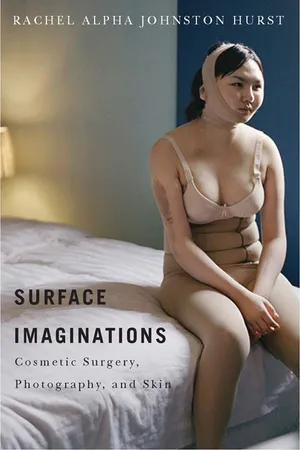 eBook - ePub
Surface Imaginations
Cosmetic Surgery, Photography, and Skin
- Rachel Alpha Johnston Hurst(Author)
- 2015(Publication Date)
- McGill-Queen's University Press(Publisher)
FROM THE QUEST FOR RECOGNITION TO SURFACE IMAGINATION SURGERY 2The interviewees in this study underwent their surgeries in contemporary North America. What are the historical and cultural conditions within which the profession developed and flourished in Europe and North America, and what are the resulting social and cultural understandings of Cosmetic Surgery? In particular, how has this context forged the important link between the embodied psychical surface of the skin and the topography of the photograph?This chapter begins with an overview of modern Cosmetic Surgery as a medical specialty and cultural phenomenon, focusing specifically on the profession’s quest for legitimacy and the gendered and racialized nuances within this commercialized field. In the section “The Quest for Recognition,” I argue that the profession strategically emphasized the psychological outcomes of Cosmetic Surgery over the beauty outcomes in order to legitimate surgical interventions. Indeed, Cosmetic Surgery and psychoanalysis emerged in the same moment in history, and they have been entwined ever since. Dynamic power relations between surgeons and patients are a mixture of capitalist exchange and the entrenchment of body ideals in a sexist and white supremacist society. Furthermore, the relationship between doctors and patients is ambiguous because, in this medical encounter, unlike the majority in the West, the patient selfdiagnoses. The relationship traverses into further murky waters as surgeons consciously and unconsciously develop their own signature styles, which are often justified by recourse to classical aesthetics and the history of Western art.1 eBook - ePub
Reshaping the Female Body
The Dilemma of Cosmetic Surgery
- Kathy Davis(Author)
- 2013(Publication Date)
- Routledge(Publisher)
Chapter One sets the stage with a brief historical sketch of the recent expansion of the surgical fix. Cosmetic Surgery has not only become the fastest growing medical specialty, it is one of the most risky. This has necessitated its increasing legitimation on the part of the medical profession and the welfare state. The forms this legitimation takes depend on the way the health care system is organized. The Dutch case will be drawn upon here as the exception which proves the rule; namely, that even socialized medicine with its discourse of need cannot solve the problem of whether and under what circumstances the surgical alteration of the body for aesthetic reasons can be justified.Chapter Two deals with explanations for women’s involvement in beauty and their practices of body improvement. Social psychology, psychoanalysis, and sociology have looked to women’s propensity toward conformity, low self-esteem, and narcissism, or to their position as brainwashed consumers in late capitalist society for such explanations. What is missing from these accounts is an analysis of gender and the cultural constraints of the feminine beauty system. I locate this analysis in several traditions of contemporary feminist theory on femininity and the body, which treat women’s preoccupation with beauty as a cultural phenomenon, linking the constraints of beauty practices to the reproduction of femininity and to power asymmetries between the sexes and among women. I draw upon this work to develop a theoretical perspective for explaining women’s involvement in Cosmetic Surgery without relegating them to the position of cultural dope—a perspective which highlights womens agency and their active and knowledgeable struggles within the cultural and structural constraints of femininity and the beauty system.The next four chapters form the heart of the book. Starting from the three empirical studies described above, the trajectory which a woman follows in order to have her body altered by surgical means is explored. The three themes—identity, agency, and morality—will serve as heuristic devices for understanding women’s biographical reconstructions of their suffering over appearance, of their decision to undergo Cosmetic Surgery, of the surgery, and of its aftermath. eBook - ePub
- Joseph S. Alter(Author)
- 2013(Publication Date)
- University of Pennsylvania Press(Publisher)
shuangyanpi shoushu ), a relatively simple procedure in which a fold is added to the eyelid, transforming it from a stereotypical “single eyelid” Asian eye into a “double eyelid” eye, which is considered stereotypically European. I will return to this below.This brief summary of the establishment of Cosmetic Surgery in China and the career of its founder, Song Ruyao, illustrates the importance of the transnational flow of medical techniques through study abroad, conferences, visiting experts, medical journals and textbooks, and personal friendships. These techniques developed and moved around the globe in response to movements of people and culture that preceded them: to use Arjun Appadurai’s labels, Cosmetic Surgery moved along the terrain of the ethnoscape and technoscape (and was also conditioned by the finanscape and mediascape) of global culture (Appadurai 1990: 295–310).In short, Cosmetic Surgery did not arrive in China completely “emptied” of its Western meanings. On the contrary, those particular meanings took on new significance in the global and domestic political context of the 1960s and 1970s. Cosmetic Surgery was associated with the bourgeois pursuit of beauty then, and it still is. The difference is that within China the pursuit of beauty was formerly attacked and denounced, but after the end of Maoism it was glorified as a natural expression of human nature, of the personal freedom and individuality that had been suppressed under Mao. As of now, it does not yet appear that in China Cosmetic Surgery has become the symbol of artificial, decadent, and superficial beauty that one might think it is in the U.S., if one were to take the Hollywood comedians seriously. (However, its popularity in the U.S. puts the lie to that stereotype.)This history illustrates the notion of the “empty frame.” Cosmetic Surgery was a kind of bodily practice constituted within definite social and political contexts, and these contexts shaped the meanings that were attached to the practices. When these practices were associated with nations perceived as enemies, they were denounced and viewed with exaggerated notions of threat, rather than being neutralized, naturalized, and accepted. Ultimately, the changing domestic and international political context led to their neutralization, naturalization, and acceptance in China from the 1980s onward. It is important to remember that this process occurred at the cost of great personal suffering by practitioners like Song Ruyao. eBook - ePub
Cosmetic Surgery
A Feminist Primer
- Cressida J. Heyes, Meredith Jones, Cressida J. Heyes(Authors)
- 2016(Publication Date)
- Routledge(Publisher)
Feminists have by and large accepted this distinction, and have limited their political critique to cosmetic procedures while implicitly accepting that reconstructive surgery—including that aimed solely at improving appearance (such as birthmark or scar revision)—is fully justified. However, a number of essays in this volume question these distinctions and examine the blurry boundaries between them. In the modern history of Cosmetic Surgery, the first written account of a face-lift is dated 1901; breast augmentation dates back to risky injections of—briefly—paraffin, followed by a longer postwar period of experimentation with liquid silicone (Haiken 1997: 235–55); liposuction was invented in 1974 and has become increasingly popular since the 1980s. Since at least the 1950s, women have overwhelmingly been the target consumers for Cosmetic Surgery, while men have practiced it: in 2007, 91 percent of all cosmetic surgical procedures in North America were performed on women, while eight out of nine cosmetic surgeons are men. Furthermore, these women have been mostly white: in 2007, 76 percent of cosmetic surgical procedures in North America were performed on “Caucasian” patients. 3 Historically speaking, this feminization of Cosmetic Surgery will probably be short-lived: in the longue durée Cosmetic Surgery may be, as Sander Gilman (1999a: esp. 31–6) has argued, more implicated with ethnicity and national belonging than with gender, while statistical trends indicate that a steadily increasing proportion of recipients are men as well as non-white eBook - PDF
Under the Knife
Cosmetic Surgery, Boundary Work, and the Pursuit of the Natural Fake
- Samantha Kwan, Jennifer Graves(Authors)
- 2020(Publication Date)
- Temple University Press(Publisher)
Stigma, as the soci-ologist Erving Goffman has long described it, is an attribute that is discrediting. 45 The stigma of Cosmetic Surgery has historical roots. At the turn of the twentieth century, those who were conducting inva-sive medical procedures that would today be labeled Cosmetic Surgery had quite a spotty reputation. Reputable surgeons accused these prac-titioners of placing healthy patients at risk and performing medical interventions that contradicted “the traditional American injunction against vanity,” as well as the Hippocratic oath to do no harm. The historian Elizabeth Haiken documents that “‘beauty surgery’ was the province of quacks and charlatans.” 46 In the industry’s initial stages of development, Cosmetic Surgery earned the unfortunate reputation of being “dirty work.” Practitioners and clients alike were perceived as socially deviant. 47 Over time, efforts to increase the profession’s legitimacy have been somewhat successful, with professional organizations playing a pivotal role in this transformation. 48 For example, the formation of the American Association of Plastic Surgeons in 1921 helped define The Cosmetic Surgery Paradox / 9 boundaries of acceptable practice, set standards, and regulate practi-tioners. 49 These organizations eventually collected data on their cli-entele and began marketing extensively to their new consumer base. 50 New social norms that emphasized beauty and individuality, along with the medicalization of appearance, further added to the indus-try’s legitimacy. 51 Today, the industry has mostly moved out of the “domain of the sleazy, the suspicious, the secretively deviant, or the pathologically narcissistic.” 52 Even with this cleaner reputation, the Cosmetic Surgery profes-sion still experiences reputational struggles. For example, research in the United States and abroad finds that the public, along with other medical professionals, grossly underestimates the scope of this spe-cialty. eBook - PDF
- Jeffrey E. Janis(Author)
- 2018(Publication Date)
- Thieme(Publisher)
Self-perception and self-esteem of patients seeking Cosmetic Surgery. Aesthetic Plast Surg 29:184, 2005. 7. Nahai F. Evaluating the cosmetic patient on antidepressants. Aesthet Surg J 34:326, 2014. 8. Nahai F. What is aesthetic surgery, anyway? Aesthet Surg J 30:874, 2010. 9. Nahai F, ed. The Art of Aesthetic Surgery: Principles and Techniques, ed 2. New York: Thieme Publishers, 2010. 13 Nature’s paradigm for survival relies to a great extent on the concept of beauty. Ultimately, evolution requires successful survival of a species, animal or plant, through nature’s own rules of beauty: harmony, balance, and symmetry. An overarching study of beauty lends itself to the philosophical comprehension of aesthetics —a field dedicated to the art and understanding of beauty and good taste. Thus the study of beauty through scientific methods is an effort toward explaining aesthetics. AESTHETICS AND ITS ASSOCIATION ■ Often refers to the study and philosophy of beauty and taste ■ Origin from Greek word, aisthetikos, implying “sensitive, relating to perception of the sense,” which in turn derives from aisthánomai, implying “I sense and feel.” ■ The field of aesthetics—thus our understanding of beauty—changes in each stage of human civilization and evolution. • What is acceptable as the “ideal” beauty has evolved. • Classical female beauty is much different from the “cover girl” concepts of beauty of the modern world, which influence aesthetic medicine. ■ Aesthetic medicine comprises several disciplines whose goal is to improve the cosmetic appearance of patients. • The rise of aesthetic medicine and surgery in modern times has an increasing relationship to the science of aesthetic medicine and the safety of invasive and noninvasive procedures. • Social acceptance of aesthetic procedures continues to evolve among the sexes and various cultures. • Clinical and psychological studies have shown an overall sense of well-being of patients who seek aesthetic procedures. eBook - PDF
Textbook of Plastic, Reconstructive, and Aesthetic Surgery, Vol 6
Aesthetic Surgery
- Karoon Agrawal, Kuldeep Singh, Lokesh Kumar, Karoon Agrawal, Kuldeep Singh, Lokesh Kumar(Authors)
- 2022(Publication Date)
- Thieme(Publisher)
47. Aesthetic/Cosmetic Surgery tourism is a fast growing market and in a global society the reasons for seeking cos- metic surgery abroad may vary significantly. As Sir Bruce Keogh’s review of the industry recently reported, rising demand for cosmetic enhancement has been driven by a number of socio-economic and technological factors, lead- ing to the normalization of serious and potentially harmful cosmetic interventions. In response to the Keogh Review, there have been some developments but not enough to fully protect the Cosmetic Surgery consumer. • The General Medical Council also issued new guidance which sets out the standards they expect from doctors 38 General who provide cosmetic interventions, including stipu- lations to market their services responsibly, seek a patient’s consent themselves rather than delegate this to somebody else and consider patients’ vulnerabili- ties and psychological needs when making decisions with them about treatment options. While this pre- sumably will not do anything to prevent poorly quali- fied doctors from offering their services as a cosmetic surgeon, it will, at least, allow prospective consumers of Cosmetic Surgery services to ascertain whether the surgeon in question is appropriately qualified. • This could look like the model in France where, follow- ing the enactment of the Kouchner law 2002, regula- tion is much stricter, consent procedures are far more detailed, and additional safeguards regulating adver- tising and requiring a ‘cooling-off’ period, to allow the consumer to reflect on the decision, have been brought in. • The Royal College of Surgeons, UK (2016) incorpo- rated a new regulation to guard patients undergoing aesthetic surgery from “aggressive marketing.” It also included the initiative to make a roster of duly certi- fied surgeons, who are suitably qualified to take on definite procedures. eBook - PDF
Body Work
Beauty and Self-Image in American Culture
- Debra Gimlin(Author)
- 2002(Publication Date)
- University of California Press(Publisher)
9 According to some critics, these developments, and the increasing flexibility in body alter-ing that they permit, are linked to cultural discourses likening the 77 / Cosmetic Surgery body to what Susan Bordo has called “cultural plastic.” The body is now understood as having a potential for limitless change, “un-determined by history, social location or even individual biogra-phy.” 10 Not only has the body come to stand as a primary symbol of identity, but it is a symbol with an unlimited capacity for al-teration and modification. The body is not a dysfunctional object requiring medical intervention but a commodity, not unlike “a car, a refrigerator, a house, which can be continuously upgraded and modified in accordance with new interests and greater re-sources.” 11 The body is a symbol of self hood, but its relation to its inhabitant is shaped primarily by the individual’s capacity for ma-terial consumption. Of the various forms of body work, plastic surgery is surely the hardest to justify. The physical dangers are real. The sym-bolic damage done to all women by the apparent surrender of some to unattainable ideals of beauty is significant. Yet the criti-cisms also leave out a good deal. Most important, the criticisms operate either at the grand level of cultural discourse or the highly grounded level of physiological effect. As a result, they overlook the experience of the women who have plastic surgery. In this chapter, after first discussing the role of the doctor as a gatekeeper to plastic surgery, I focus on that experience. First—and most important to those who undergo it—plastic surgery often works. This fact stands in contrast to a rhetoric that concentrates on the unattainable character of contemporary beauty ideals, portraying plastic surgery as a Sisyphean task. Crit-ics of plastic surgery imply that those who undergo it will com-plete one operation only to discover some new flaw.
Index pages curate the most relevant extracts from our library of academic textbooks. They’ve been created using an in-house natural language model (NLM), each adding context and meaning to key research topics.

