History

Desiderius Erasmus
Desiderius Erasmus was a Dutch Renaissance humanist, theologian, and scholar known for his critical edition of the New Testament and his satirical work "The Praise of Folly." He advocated for the reform of the Catholic Church and promoted the study of classical literature and the use of reason. Erasmus's ideas had a significant impact on the Reformation and the development of humanism.
Written by Perlego with AI-assistance
Related key terms
1 of 5
9 Key excerpts on "Desiderius Erasmus"
 eBook - PDF
The Idea of International Society
Erasmus, Vitoria, Gentili and Grotius
- Ursula Vollerthun, James L. Richardson(Authors)
- 2017(Publication Date)
- Cambridge University Press(Publisher)
29 29 2 Desiderius Erasmus of Rotterdam Erasmus stands out among the writers of the later Renaissance both for his renown at the time and for the unabated interest that he continues to attract. Numerous editions and translations of his work appeared at the time and continue to appear, accompanied by a stream of commentar- ies. Virtually all aspects of his thought have been examined in minute detail, but his ideas on international relations constitute a notable excep- tion, notwithstanding the comment of a prominent Erasmus scholar, Margaret Mann Phillips, that he was the man of his century who could best survey the whole European scene. In the first flood of the spirit of nationalism, one person was watching the entre- choc of nations with a lucid and penetrating eye, and deriving from the prospect the first true idea of international relations on a general scale: and that man was Erasmus. 1 Erasmus is usually seen as the central figure among the ‘north- ern humanists’ of the early sixteenth century, notably Thomas More and John Colet in England, Guillaume Budé in France and Johannes Reuchlin in Germany. Humanism – the promotion of classical literature and learning – originating in fourteenth-century Italy and coming to fru- ition in the Florentine Renaissance, had transformed the European intel- lectual world, challenging the dominance of the scholastic philosophy of the late middle ages. At the turn of the sixteenth century, scholasticism was still the orthodoxy in northern universities, but was on the defensive. Humanism was not a rival doctrine but an entirely different intellectual approach. 2 Its foundation was the recovery and propagation of the classical Greek and Roman texts, taking full advantage of the new technology – printing. 1 M. M. Phillips, Erasmus and the Northern Renaissance (New York: Collier Books, 1965), p. 129. 2 On humanism, see, for example, Q. Skinner, The Foundations of Modern Political Thought, vol. eBook - PDF
Renaissance Humanism, Volume 2
Foundations, Forms, and Legacy
- Albert Rabil, Jr.(Authors)
- 2016(Publication Date)
23 ài^Desiderius Erasmus Albert Rabil, Jr. I N JUNE I 5 1 4 Desiderius Erasmus (1467-1536) LEFT ENGLAND and made his way to Basel. All along his route through the Low Coun-tries and Germany he was greeted by humanists as the brightest star of the learned world, prince of the humanists. In terms of actual out-put, most of Erasmus's work lay ahead of him in that year. He had writ-ten a theological handbook ( Enchiridion ), a satire (The Praise of Folly), and two educational treatises, one addressed to teachers (On the Method of Study) and one to students (Copia: Foundations of an Abundant Style). He had edited two books (Adages and Lorenzo Valla's Annotations on the New Testament). And he had published several translations from Greek authors (Libanius, Euripides, and Lucían). But these works were enough to suggest to his contemporaries the peculiar character of Eras-mus's genius. Stated simply, it was that Erasmus succeeded beyond all others in combining the classical ideal of humanitas and the Christian ideal of pietas. The classical was the ideal of eloquence combined with deep learning; the Christian was the ideal of devotion born of under-standing. Erasmus instilled eloquence and learning into Christianity and piety into paganism. Not only did his contemporaries see Erasmus so in 1514, but by a wonderful (wonderful because so rare) coincidence, Erasmus saw himself in the same way and at that very moment came to believe that it was his peculiar mission to bring about in all Christendom this fusion which his contemporaries saw in him. Erasmus was forty-seven. It seemed that all he had worked so hard for was to be achieved at the very pinnacle of his own life and career. What was it that brought Erasmus and his contemporaries to this point? How did he arrive at this consciousness of himself and his mis-sion? How did it come to be recognized? And what was the outcome of this dramatic realization? That story requires a close look at Erasmus's life and age. eBook - ePub
The Other Renaissance
From Copernicus to Shakespeare: How the Renaissance in Northern Europe Transformed the World
- Paul Strathern(Author)
- 2023(Publication Date)
- Pegasus Books(Publisher)
CHAPTER 10 ERASMUS D ESIDERIUS E RASMUS WAS PROBABLY the leading intellectual figure of the northern Renaissance, as most who encountered him, or corresponded with him, agreed. He is best known for his humanist philosophy, his secular writings, his translations of the Bible, and his general intellectual influence, which was felt all over Europe. Indeed, the name Erasmus is to many all but synonymous with Renaissance humanism, which placed emphasis on humanity rather than medieval spirituality. A gauge of the pervasiveness of Erasmus’s influence can be seen from the remarkable fact that in the 1530s (the decade of his death) some 10–20 per cent of the books in circulation throughout Europe were written by him, or plagiarized from his works. As we have seen, Nicholas of Cusa is generally regarded as the ‘father of humanism’. It was he who said: The greatest danger against which most men have warned us is that which comes from communicating intellectual secrets to minds become subservient to the authority of an inveterate habit, for such is the power of a long-lasting observance, that most men prefer death to giving up their way of life. And in this aspect, Erasmus was certainly his true successor. Where Nicholas of Cusa was mystical in his faith – which bordered on pantheism – yet rational in his scientific thinking, Erasmus’s core beliefs are more difficult to identify, or even analyse. He was scientific, in that he thought scientifically, or rationally, but he did not think about science. He was a scholar, deeply versed in classical learning, who brought his knowledge to bear on how humanity should conduct itself; yet he refrained from open opposition to the Church. As such, he chose the middle road (via media) which earned him the animosity of both sides in this divisive age. Yet as he said, ‘Human affairs are so obscure and various that nothing can be clearly known eBook - PDF
Rhetoric and Theology
The Hermeneutic of Erasmus
- Manfred Hoffman(Author)
- 2019(Publication Date)
- University of Toronto Press(Publisher)
ONE Erasmus, Rhetorical Theolo g ian � 1 IMAGES OF ERASMUS The history of Erasmus interpretation has produced a puzzling variety of readings. 1 Despite repeated attempts at reducing his life and work to common denominators, the humanist has had a way of eluding his interpreters. For all the labe ls pinned on him, he remained an enigmatic fi gu re. His personality cannot be clearly traced nor his place and role in history definitively fixed. If there is a basic theme running through most modern interpre tations, it touches not on something certain but, iron ically, stre s ses the ambiguity of his think'fftg and the ambivalence of his attitude. Looking at Erasmus as both an unsystematic thinker and a 'man for all seasons' 2 could result in either positive or negative assessments. Those who came from a nineteenth-century liberal point of view tended to appreciate in him the broad-minded intel lectua l, impartial and adaptable, open to reason but critical of hypocrisy, fanaticism, and dogmatism. He was seen as a sceptic hiding behind the facade of the humanist. Modern liberal ism had found its forerunner: a rationalist who espoused an undogmatic religion so general as to hold the ult i mate truth in suspension, and a moralist who advocated so broad an un churched fellowship of the spirit that he was willing to concede al l sorts of personal convictions, if only they led to ethical im provement. Accordingly, he was heralded as a father of religious toleration and an early proponent of religious pluralism. No wonder, then, that his alleged relativizing of the truth and moral izing of religion squared readily with modern notions of histori- 16 Rhetoric and Theol ogy cal contingency, social pluralism, religious individualism, and freedom of choice. Liberal interpreters recognized in Erasmus their own ideas, ideals, and values.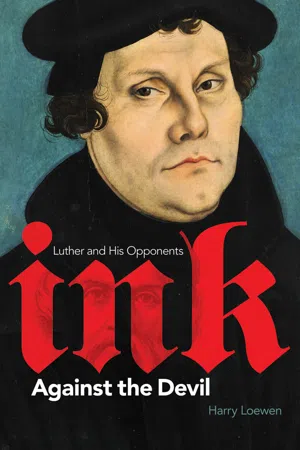 eBook - PDF
Ink Against the Devil
Luther and His Opponents
- Harry Loewen(Author)
- 2015(Publication Date)
- Wilfrid Laurier University Press(Publisher)
He expresses the hope that all regions in Germany will eventually heed his call to do some-thing for German boys and girls in this regard (Werke 3, 34). While both the humanists and the reformers welcomed the revival of learning and scholarship, especially in languages, the two groups were far apart when it came to the religious and spiritual longings of people in church and society. The humanists were all in favour of correcting the abuses in church and society and in promoting humanistic values, but they were not as much concerned about the existential questions of the heart, the Sitz im Leben (focus in life), as it were. This is where a reformer like Luther, who had deeply expe-rienced the longings of the human heart and had wrestled with sin, guilt, and Anfechtung , was able to help many religiously inclined men and women. In the sixteenth century there were many people who still thought more in reli-gious terms than secular terms. As a reformer and humanist, Luther combined both aspects within his person. But Luther’s deep faith and religious thinking was more or less foreign to many of the more rationally and secularly inclined Renaissance humanists like Erasmus. The conflict that developed between the Two Riders of the Human Will 93 humanist Erasmus and the theologian Luther must be seen against this back-ground of two contrasting personalities. LUTHER AND ERASMUS M Desiderius Erasmus of Rotterdam (1466–1536) was a Dutch Renais-sance humanist, Catholic priest, and theologian, and one of the most influen-tial thinkers and writers of his time. Like Luther, Erasmus was critical of the corruption of the Roman papacy, especially of its sale of indulgences which he lampooned in his Praise of Folly (1511). Luther was thus initially drawn to this prince of humanists, respecting his learning and reputation and benefiting from his scholarship. The two men never met in person, but they did exchange cordial letters from time to time.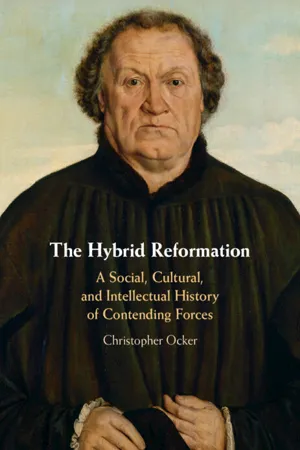 eBook - PDF
The Hybrid Reformation
A Social, Cultural, and Intellectual History of Contending Forces
- Christopher Ocker(Author)
- 2022(Publication Date)
- Cambridge University Press(Publisher)
18 Erasmus’ impact on learning in the sixteenth century seems less revolutionary and more complex than it did seventy years ago. Yet there is something worth pondering in a conceptualization of cultural change built on the recognition of difference, a criticism of uniformities that erase human freedom. Beyond Erasmus, Heer’s third force points us to a cultural “space” Erasmus could unwillingly share with people he might have disdained, a place between juxtaposed, polarizing partisans, in a religiously ambiguous gap between fighting opponents, where equivocators survived and mediators tried to thrive. A generation after Heer, in another imposing study that deserves far more attention than it has received, Thierry Wanegffelen, a student of the late Jean Delumeau, examined the “vast and complex reality” that existed between Catholic and Protestant confessions in France. Wanegffelen characterized the inhabitants of this terrain as “nonconfessional Catholics” who evaded the counterposing forces of orthodoxy pulsing out of Rome and Geneva. 19 Assuming special importance in his study was the confessionally Catholic but cautiously prevaricating Queen Marguerite de Navarre and her chancellor, Michel de L’Hôpital, who later became chancellor of all of France in the reign of Francis II. 20 Wanegffelen’s tragic death at forty-four years of age meant that he never could complete his own formulation of historical writing as a humane enterprise, which was on his mind near the end of his life. 21 But this book in particular showed how variegated “the flat land of Cartellverband (https://oecv.at/Biolex/Detail/11002184, accessed 16 April 2022), as well as Kuhn and Burri in note 11. 17 For the origins and meaning of historicism, still useful is Calvin G. Rand, “Two Meanings of Historicism in the Writings of Dilthey, Troeltsch, and Meinecke,” Journal of the History of Ideas 25 (1964): 503–518. eBook - PDF
- David M Whitford(Author)
- 2014(Publication Date)
- T&T Clark(Publisher)
Erasmus wrote widely, composing works of satire, grammar, moral advice, theological polemic, classical and patristic editions, and biblical interpre-tation. Though it is impossible to consider all he wrote about the meaning of the Scriptures and how to interpret them in a single brief chapter, some themes show up time and again. 38 First, though Erasmus believed that the humanists were bringing light of the classical realms into the darkness of the medieval world, he was not a revolutionary. He believed that the point of Revelation and Scripture 43 Christianity was the philosophy of Christ, the living out of the simple ethical Christianity most fully seen in the Sermon on the Mount. He believed that simple Christianity was preferable to the ceremonies of the late medieval Church, but he was not prepared to leave the Church. Instead, he believed in the moral reformation of the individual as the path to any reformation of the institutional church. Second, Erasmus set out a program of reading Scripture for the less learned. The individual in the reading of Scripture should pay attention to several points. Among these were knowing the context, knowing “. . . what is said, by whom, to whom, with what words, at what time, at what occasion, and what precedes and what follows.” 39 Erasmus was attempting an early reading guide for the unlearned, an assistance to their own explorations in the Scriptures. Another point was Erasmus’ sometimes confusing desire for readers of Scripture to be reading deeply in Paul, and also to be reading those patristic authors who were most allegorical. 40 The confusion comes from the difference between the Pauline material, which tends to give very little room for allegorical license, and the materials toward which the allegorical com-mentators gravitated, which were not usually Pauline. However, this appar-ent contradiction resolves itself when we consider the kind of Christianity Erasmus supported. eBook - ePub
Renaissance and Revolution
The Remaking of European Thought
- Joseph Anthony Mazzeo(Author)
- 2019(Publication Date)
- Routledge(Publisher)
The humanists begin the process of separating the idea of wisdom from the idea of divine revelation. Erasmus, although a sincere believer, identifies wisdom with ethical knowledge, and finds harmonies and identities between the ethical precepts of the New Testament and the teachings of Cicero and Seneca. In effect, he makes salvation hinge on the achievement of a limpid ethical purity and, although Erasmus would not have denied the necessity and value of revelation, he does not think of salvation as resting on the possession, through grace, of a firm faith in what is otherwise inapprehensible, on belief in a divine message which is a scandal and a stumbling block, if not utter foolishness, to reason. Although there was in Erasmus much of the Pauline type of the “Greek,” of the seeker after wisdom to whom the Cross is a stumbling block, he was sensitive to the paradoxes of Christianity and gave them an interpretation consonant with his humanistic ideals. For him, there is indeed a wise folly which is specifically Christian, but it has little to do with theologically sophisticated attempts to explain the Incarnation or the Trinity. The folly of Christianity is not so much intellectual as moral, for the folly of Christianity lies in the heroic morality of its founder. Such conduct and such sacrifice will always appear as folly to selfish and evil men, just as it appeared such to the evil men of Athens when they encountered it in the person of Socrates. Indeed, Socrates is truly worthy of being called St. Socrates, in spite of his ignorance of Christianity, while the large majority of self-styled Christians are not worthy of the name.In effect, Erasmus subsumes the Christian concept of wisdom into the concept of humanitas, for quiet charitableness and broad tolerance is the possession of truly rational men, men endowed with natural reason which is at the same time “right” reason, who have been ethically formed according to that “primary” wisdom or prisca sapientia which inheres in reason itself and which is perfected and strengthened through the complementary and compatible precepts of the Gospels.During the course of the Renaissance, the idea of wisdom became secularized in various degrees and in various ways. As we have seen, Erasmus still thought of wisdom in religious terms, although he detached it from its traditional religious definition in terms of the data of revelation and precisely defined theories of grace. Rather, he attempted to redefine wisdom and make it the result of ethical insight and of a natural upright reason without entirely detaching it from its religious moorings. In so doing he conflated the best of ancient moral wisdom with what he took to be the essence of Christianity. The boldness of this move should not be underestimated, for the main tradition of Christian theology and philosophy during the Middle Ages was far more inclined to try to adapt classical metaphysics and science to the uses of Christianity than ancient morality. Even when Scholastics like St. Thomas read the Nicomachean Ethics eBook - PDF
Humanists and Holy Writ
New Testament Scholarship in the Renaissance
- Jerry H. Bentley(Author)
- 2018(Publication Date)
- Princeton University Press(Publisher)
Furthermore, Erasmus' own critics provided him with a motive to put distance between himself and his predecessors. In a famous letter of 1514, Maarten van Dorp reported to Erasmus the reservations held by many with respect to Erasmus' scholarly projects. He suggested to Eras-mus, among other things, that in Valla's and Lefèvre's works, humanist scholarship had exhausted itself; it was not likely to lead to further discoveries of any interest or importance. 1 1 6 In his reply (1515), Erasmus acknowledged his respect for both Valla and Lefèvre, but made it clear also that he disagreed 1 1 4 H . J. de Jonge, Erasmus und die Glossa ordinaria zum Neuen Testa-ment, Nederlands archief voor kerkgeschiedenis, n.s. 56 (1975):51-77. This su-perb analysis ought to serve as a model for future studies of Erasmus' thought on medieval commentators. 1 1 5 Holborn, pp. 173-74. Cf. EE, no. 334 (2:78). 116 EE, no. 304 (2:14-15). 176 D E S I D E R I U S E R A S M U S with both at some points. 1 1 7 Thus Erasmus looked critically on the works of his humanist predecessors well before his New Testament appeared in print. Nevertheless, with its ominous warning that he represented the views of the theological fac-ulty at the University of Louvain, Dorp's letter probably for-tified Erasmus in the resolve to present himself as an inde-pendent scholar. Thus already in the first edition of the New Testament, Erasmus reviewed critically the work of Valla and Lefèvre. He charged Valla with caviling at trivial points of grammar and exegesis in notes to Matt. 1:16, Mark 1:4, Mark 7:34, Luke 2:23, Luke 2:38, 1 Cor. 9:5, and Col. 2:18, among others. Finally, as noted above, he found Valla's efforts at the higher criticism somewhat deficient. Perhaps even more disappointing was the Pauline scholar-ship of Erasmus' friend, Lefèvre d'Étapies.
Index pages curate the most relevant extracts from our library of academic textbooks. They’ve been created using an in-house natural language model (NLM), each adding context and meaning to key research topics.

