History

Executive Order 9981
Executive Order 9981, signed by President Harry S. Truman in 1948, abolished racial discrimination in the United States Armed Forces. This landmark order marked a significant step towards desegregation and equality within the military, and it laid the groundwork for the broader civil rights movement in the United States.
Written by Perlego with AI-assistance
Related key terms
1 of 5
8 Key excerpts on "Executive Order 9981"
- Geoffrey Jensen(Author)
- 2016(Publication Date)
- Routledge(Publisher)
Brown decision, the providing of integrated health care for African American soldiers and their families, and the desegregation of the Veteran’s Administration and the National Guard and reserves. All of which owe, in some part, to Truman’s order, an enterprise brought on by a host of rationales that proved to be his most enduring triumph, a social victory that transformed and ultimately transcended the American Armed Forces.Notes
1 Aspects of this work first appeared in my dissertation. See Geoffrey W. Jensen, “It Cut Both Ways: The Cold War and Civil Rights Reform Within the Military, 1945-1968 (Ph.D. dissertation, University of Arkansas, 2009). Several historians have recently questioned aspects of Truman’s civil rights agenda, specifically his executive order desegregating the military, often interpreting them in a more critical light that shortchanges the man and the results. For example, Carol Anderson’s Eyes off the Prize (New York: Cambridge University Press, 2003), 3, while tipping its cap to the effort of the president condemned his actions as “the politics of symbolic equality” and therefore, Truman failed to “come even close to what needed to be done.” Christine Knauer’s Let Us Fight as Free Men: Black Soldiers and Civil Rights (Philadelphia: University of Pennsylvania Press, 2014), 53, deemed the president’s position on the matter to be “ambivalent”, while “his actions lagged behind his words.” Worse yet, though it fostered the potential for reform, “it did not result in decisive and far-reaching actions on behalf of black equal rights.”; See also, Geoffrey Jensen. Review of Knauer, Christine Let Us Fight as Free Men: Black Soldiers and Civil Rights. H-War, H-Net Reviews. November 2014. URL: www.h-net.org/reviews/showrev.php?id=42375 eBook - ePub
With the Stroke of a Pen
Executive Orders and Presidential Power
- Kenneth R. Mayer(Author)
- 2021(Publication Date)
- Princeton University Press(Publisher)
55In issuing E.O. 9981, Truman stepped into a process that had been emerging since the end of World War II. It was less a revolutionary policy change than it was a critical step in harnessing the developing momentum and establishing concrete steps to carry out the task of nondiscrimination: “By placing presidential authority squarely behind an official commitment to end such discrimination [in the military], and by publicly stating that he sought to eliminate racial segregation from the military, Truman broke with prior national policy and altered the course of the debate. His intervention emboldened advocates of racial equality, put supporters of segregation on the defensive, and opened a path leading toward the completion of formal racial integration.”56Compared with Truman, Eisenhower was less inclined to rely on executive power to promote a civil rights agenda. Nevertheless, the executive orders in the 1940s had firmly established that the presidency was the focal point of racial progress, and the Eisenhower White House recognized that a retreat was politically impossible. In his 1953 State of the Union Address, Eisenhower pledged his dedication to “equality of opportunity for all,” and promised to use “whatever authority exists in the office of the president” to end segregation in Washington, D.C., in federal government employment, and in the military. It is clear, though, that Eisenhower took a restrictive view of how far that authority would extend. During the 1952 campaign, he told Herbert Brownell that if elected he would work to end discrimination in those areas under federal jurisdiction. Although Eisenhower took a progressive stance on the issue, Brownell found that “the qualifier federal jurisdiction was quite limiting in his 1952 position.”57 eBook - ePub
Let Us Fight as Free Men
Black Soldiers and Civil Rights
- Christine Knauer(Author)
- 2014(Publication Date)
- University of Pennsylvania Press(Publisher)
Chapter 5Truman’s Order
The pressure on the president to make decisive changes mounted, as the chances of winning over the increasingly important black vote in the upcoming presidential election became more difficult. At the end of June 1948, an anonymous White House memorandum recommended that Truman “support the introduction of moderate [civil rights] legislation beating the Republicans to the punch” and garner “credit.”1 The president felt it necessary to act, but followed a slightly different route. On July 26, he issued Executive Order 9981, which called for the “equality of treatment and opportunity for all persons in the Armed Services without regard to race, color, religion, or national origin.”2 Since executive orders do not require the approval of the House or Senate, Truman circumvented painstaking discussions and the likely rejection of any such civil rights legislation in Congress.3 Contrary to numerous accounts and after-the-fact interpretations, the presidential order did not officially demand the immediate and complete desegregation or integration of the military. Instead, it established the President’s Committee on Equality of Treatment and Opportunity in the Armed Services, later known as the Fahy Committee, to ensure the order’s implementation and to force the armed services to change.4 eBook - PDF
African Americans and the Presidents
Politics and Policies from Washington to Trump
- F. Erik Brooks, Glenn L. Starks(Authors)
- 2019(Publication Date)
- Greenwood(Publisher)
7. The repeal by the states of laws discriminating against aliens who are ineli- gible for citizenship because of race, color, or national origin. Harry S. Truman 127 8. The enactment by Congress of legislation granting citizenship to the people of Guam and American Samoa. 9. The enactment by Congress of legislation, followed by appropriate adminis- trative action, to end immediately all discrimination and segregation based on race, color, creed, or national origin, in the organization and activities of all branches of the Armed Services. 10. The enactment by Congress of legislation providing that no member of the armed forces shall be subject to discrimination of any kind by any public authority or place of public accommodation, recreation, transportation, or other service or business. The committee was disbanded in December 1947, and Truman advanced its rec- ommendations by two additional executive orders. Executive Order 9980, signed on July 26, 1948, desegregated the federal workforce by ordering, “All personnel actions taken by Federal appointing officers shall be based solely on merit and fit- ness; and such officers are authorized and directed to take appropriate steps to ensure that in all such actions there shall be no discrimination because of race, color, religion, or national origin.” The order also established in the Civil Service Commission a Fair Employment Board (hereinafter referred to as the Board) of not less than seven persons, the members of which shall be officers or employees of the Commission. The Board shall— (a) Have authority to review decisions made by the head of any depart- ment which are appealed pursuant to the provisions of this order, or referred to the Board by the head of the department for advice, and to make recommendations to such head. In any instance in which the recommendation of the Board is not promptly and fully carried out the case shall be reported by the Board to the President, for such action as he finds necessary.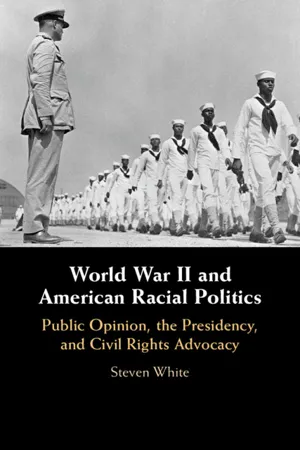 eBook - PDF
World War II and American Racial Politics
Public Opinion, the Presidency, and Civil Rights Advocacy
- Steven White(Author)
- 2019(Publication Date)
- Cambridge University Press(Publisher)
47 Ibid. 48 Juhnke, “Creating a New Charter of Freedom,” 197. 49 Ibid., 210. 50 See Chapter 2. 142 The Truman Administration, Military Service unilateral executive action for any change to occur. Truman’s Febru- ary 1948 civil rights message to Congress indicated as much. “During the recent war and in the years since its close we have made much progress toward equality of opportunity in our armed services without regard to race, color, religion or national origin,” Truman told Congress. “I have instructed the Secretary of Defense to take steps to have the remaining instances of discrimination in the armed services eliminated as rapidly as possible. The personnel policies and practices of all the services in this regard will be made consistent.” 51 Like with antidiscrim- ination provisions for defense contractors, segregation in the military presented a unique sector where action could take place via executive order. Although presidents have significant authority over the military, the military establishment was not a particularly receptive audience. The War Department resisted military integration successfully during the Roo- sevelt presidency, and this resistance lingered into the Truman years as well. Before turning to a discussion of the committee hearings that emerged from Truman’s 1948 executive order, I first provide some back- ground on efforts between 1945 and 1948 to press the military for a more equitable utilization of black troops. An August 1945 memorandum describing the military’s perception of black troops and an April 1948 meeting of the National Defense Conference on Negro Affairs provide some insights into the military’s position. On August 8, 1945, Truman Gibson, the black lawyer who had been named chief civilian advisor in the War Department by Roosevelt, wrote a memorandum that summarized the arguments being made against mil- itary integration at that time. eBook - ePub
Take Up Your Pen
Unilateral Presidential Directives in American Politics
- Graham G. Dodds(Author)
- 2013(Publication Date)
- University of Pennsylvania Press(Publisher)
Richard Nixon continued the use of unilateral presidential directives for affirmative action policies. For example, Nixon's Department of Labor issued “Revised Order #4,” which revised LBJ's Executive Order No. 11,246 by extending the “Philadelphia Plan,” which required some federal contractors in some cities to establish goals and timetables for minority hiring. And Nixon's Executive Order No. 11,478 of August 1969 prohibited racial discrimination in the federal government's civilian workforce.In 1980, Jimmy Carter issued two executive orders to advance policies concerning race. In August, he created the official designation “historically black colleges and universities” (HBCUs) and sought to ensure that such schools enjoyed various benefits from federal programs.102 And two days before the presidential election of 1980, Carter issued an executive order to facilitate consistent and effective implementation of various laws prohibiting discrimination by having the attorney general coordinate such efforts.103Subsequent presidents sought to use unilateral directives to curtail affirmative action. For example, Ronald Reagan considered rescinding LBJ's Executive Order No. 11,246, but in the end Reagan's Department of Labor merely issued regulations to modify it. George H. W. Bush also sought to use a unilateral directive for that purpose. Shortly after the controversial and racially charged Senate confirmation hearings in 1991 concerning Justice Clarence Thomas's nomination to the Supreme Court, Congress and the White House agreed on a compromise civil rights bill. The day before Bush signed the legislation into law, however, he issued an order to all federal agencies to end programs involving quotas, preferences, or setasides. The order was reportedly just a draft and was intended to be included in Bush's signing statement for the civil rights bill, but when critics charged that Bush was effectively using an executive order to repudiate the same legislation that he was signing, the president withdrew the order and modified his signing statement.104 And in 1995, one month after the Supreme Court decided to subject all racial classifications to “strict scrutiny” in Adarand Constructors, Inc., v. Pena, 515 U.S. 200, Bill Clinton issued a presidential memorandum calling for the elimination of affirmative action programs that created a quota, established a preference for unqualified people, or had outlived their purposes.105
- Marcus D. Pohlmann, Linda Vallar Whisenhunt(Authors)
- 2002(Publication Date)
- Greenwood(Publisher)
The committee finally required more than 1,600 "corrective ac- tions" after receiving complaints of discrimination. 11 Executive Order 10925 may have become best known, however, for making the first formal reference to racial "affirmative action" 186 CIVIL RIGHTS ERA in relation to federal employment. 12 It required federal contractors to take "positive measures" in their fight against racial discrimina- tion in the workplace, and to promote information about employ- ment opportunities among minority groups, especially blacks, who previously had been excluded from such jobs. The President's Equal Employment Opportunity Committee be- gan with a presidentially ordered survey of the federal government's hiring practices. It found that African Americans were badly un- derrepresented, especially in the higher ranks of governmental em- ployment. 13 The committee then acted on its affirmative action mandate in the summer of 1961, directing federal agencies to re- duce their "underutilization" of blacks and other minorities, and to report back on their progress in the areas of hiring and promotion. Within a year, African Americans constituted 13 percent of the fed- eral government's civilian workforce, exceeding their percentage of the national population, which then was less than 12 percent. 14 THE LAW Asserting that discrimination in regard to race, creed, color, and national origin was unconstitutional and articulating an ideal of equal opportunity with regard to federal employment and govern- ment contracts, President Kennedy issued Executive Order 10925 15 establishing his Committee on Equal Employment Opportunity. After formally establishing the committee, the first part of the order set forth the composition of the committee, which included the vice president of the United States as the chairman of the com- mittee and the secretary of labor as the vice chairman. This part of the order also addressed administrative matters. eBook - PDF
The Unitary Executive
Presidential Power from Washington to Bush
- Steven G. Calabresi, Christopher S. Yoo(Authors)
- 2008(Publication Date)
- Yale University Press(Publisher)
This order expanded the Kennedy administration’s program in two significant ways. First, it ap-plied the antidiscrimination prohibitions to all of a contractor’s activities during the performance of the contract, not just those activities connected with the contract. Second, it expanded the program to include sex discrim-ination as well. Like Kennedy, Johnson did not rely upon his defense or procurement powers as the basis for his actions, nor did he rely upon the newly enacted Civil Rights Act of 1964 . Instead, Johnson followed Kenne-dy’s example and simply invoked “the authority vested in [him] as Presi-dent of the United States by the Constitution and statutes of the United States.” 16 Courts and commentators have struggled to determine whether Johnson issued the order pursuant to statutory authority or under his im-plied powers as president. 17 Enactment of the Civil Rights Act of 1964 raised a whole new round of questions about the propriety of these execu-tive orders. Opponents of the executive order argued that in passing Title VII, which is the portion of the act dealing with employment discrimina-tion, Congress had explicitly prohibited the use of quotas, preempting the president’s authority, and that the House’s failure to pass an amendment explicitly authorizing the executive antidiscrimination program suggested that it was unauthorized. The order’s supporters pointed out that the Sen-ate’s failure to pass an amendment that would have explicitly provided that Title VII constituted the exclusive remedy for discrimination bolstered 342 The Modern Era, 1945–2007 the imposition of additional antidiscrimination protection. 18 Regardless of how this controversy is resolved, Johnson’s actions clearly indicate that he believed he had the authority to direct the manner in which the subordinate executive officers executed the laws.
Index pages curate the most relevant extracts from our library of academic textbooks. They’ve been created using an in-house natural language model (NLM), each adding context and meaning to key research topics.

