History

G.I. Bill
The G.I. Bill, officially known as the Servicemen's Readjustment Act of 1944, was a landmark piece of legislation in the United States. It provided a range of benefits to World War II veterans, including financial assistance for education, housing, and business loans. The G.I. Bill played a significant role in helping millions of veterans transition to civilian life and contributed to the post-war economic boom.
Written by Perlego with AI-assistance
Related key terms
1 of 5
10 Key excerpts on "G.I. Bill"
 eBook - ePub
Paid Patriotism?
The Debate over Veterans' Benefits
- James T. Bennett(Author)
- 2017(Publication Date)
- Routledge(Publisher)
4The 1944 GI Bill: Hype ExemplifiedThe Servicemen’s Readjustment Act of 1944, or GI Bill, may be the least controversial and most lauded major public policy measure ever enacted in the United States. Journalists shower it with nostalgia-crusted encomia; politicians stumble over each other to claim that their pet project is its natural heir; and even scholars "veer toward hagiog-raphy," as one of their number admitted, when treating the subject.1"I cannot overstate the value and meaning of the GI Bill," wrote Michael J. Bennett, one such panegyrist. "Its sweep was so vast, its impact so particular, that only one conclusion seems self-evident: The bill made a reality of Jefferson’s concept of creating independent yeomen."2 We may wonder whether a nation of independent yeomen can be created, paradoxically, by an extensive program of the federal government. Bennett, who insists that the GI Bill "made modern America," is one of many who wax rhapsodic over the GI Bill.3 Political scientist Milton Greenberg, provost of American University, called it "revolutionary" and "one of the major tipping points in American history."4 Typical of journalistic inflation was Patrick Owens’s claim in Newsday that "Except for the Homestead Act of the last century, it is doubtful whether any single legislative enterprise has done so much as the GI Bill to open up opportunity for talented people."5 One need not be a habitual debunker or curmudgeon to ask just how extensive an overlap there is between myth and fact.The GI Bill’s major provisions included educational and vocational training; unemployment compensation; mustering-out pay (which was separated from the omnibus bill); loans to veterans wishing to buy a home, farm, or business; and hospitalization and disability for the wounded. Responsibility for administering this cluster of programs was centered in the Veterans Administration, which, unlike the other New Deal-era agencies, was beholden to veterans. eBook - ePub
The Laws That Shaped America
Fifteen Acts of Congress and Their Lasting Impact
- Dennis W. Johnson(Author)
- 2009(Publication Date)
- Routledge(Publisher)
7 THE PROMISE TO AMERICA’S VETERANS
The GI Bill of 1944
Clark Kerr, president emeritus University of California (1994)Long live the GI Bill of Rights!Peter F. Drucker (1993)The GI Bill of Rights—and the enthusiastic response to it on the part of America’s veterans—signaled the shift to the knowledge society. Future historians may consider it the most important event of the twentieth century.The GI Bill of 1944 has been hailed by educators, social scientists, and historians as one of the most important pieces of legislation in the twentieth century. Enacted three weeks after the D-Day invasion of Normandy, and over thirteen months before the end of hostilities in the Pacific Theater, the GI Bill was a multi-dimensional piece of legislation that provided returning veterans with unemployment compensation, low-cost loans to purchase homes or businesses, and educational benefits. The legislation was enacted out of a sense of obligation to the millions of men and women who served in the armed forces; but the chief concern of the Roosevelt Administration, Congress, and the veterans’ organizations that lobbied hard for this legislation was to prevent a return of economic hard times and political instability. The education of returning veterans was only of secondary concern. In fact, few policymakers in Washington predicted that veterans would jump at the chance for free college tuition or on-the-job training programs. But jump they did, flooding colleges and universities in the five or six years after World War II, and, to an even greater extent, flooding non-college programs, like on-the-job training, correspondence schools, and even programs for the completion of high school. It was the education provision of the GI Bill that proved to have the most far-reaching impact on American society.The GI Bill’s promise of educational assistance was an unusual feature in the history of veterans’ benefits. Some educational relief was given to World War I disabled veterans, but typically the federal government gave only mustering-out pay, cash bonuses, or surplus public land. Following each American war, Congress has provided some level of benefits for its veterans, their widows, and survivors. Congress responded out of a sense of gratitude, but it was also prodded by organized veterans’ organizations: the Society of the Cincinnati following the Revolutionary war, the United Brethren of the War of 1812, the National Association of Mexican War Veterans, and especially the Grand Army of the Republic following the Civil War. At times, the grants had been quite generous, particularly for Civil War and Spanish-American war veterans; and, by the beginning of the twentieth century, veterans’ benefits constituted approximately 40 percent of the entire federal budget. eBook - ePub
The High Cost of Good Intentions
A History of U.S. Federal Entitlement Programs
- John F. Cogan(Author)
- 2017(Publication Date)
- Stanford University Press(Publisher)
9 A New Kind of Entitlement The GI BillWe may be a war-weary people by the time we have shattered the Axis. . . . There will be an urge to let down after the fast pace we maintained to win this war, to dump men willy-nilly back into civilian life, to let them find a job as best they can and where they can. . . . But the Army will not take that easy way.Robert P. Patterson, assistant secretary of war, 19431THE SERVICEMEN’S READJUSTMENT ACT OF 1944 was the only major new entitlement created during World War II. Popularly known as the GI Bill, the law granted educational assistance, cash readjustment assistance, and government-backed home, farm, and business loan guarantees to all veterans regardless of their disability status. The educational program provided aid for tuition, books, supplies, and living expenses while the veteran was in school. The GI Bill is important for three reasons.First, the law permanently established as national policy the view that society owed a debt to all wartime veterans, not just to those who had suffered from disabling wartime injury or illness. Moreover, the law’s underlying premise was that all wartime veterans should, to the extent possible, be assisted in returning to the status in civilian life that they had achieved when they had departed for war. The policy and the premise were sharp departures from prior wartime veterans’ programs that had initially restricted benefits to veterans who suffered wartime injuries.Second, the GI Bill’s noncash, or in-kind (as they are now called), benefits were a new type of entitlement benefit. Entitlements to in-kind benefits bestow a right to reimbursement on people and institutions that provide the benefits prescribed by the law. Under the GI Bill, educational institutions, college professors, training instructors, and school administrators were entitled, directly or indirectly, to compensation for the educational services they provided to veterans. Bankers and financial institutions that provided guaranteed home loans were entitled to receive repayments from the government on defaulted loans. These service providers had a vested financial interest in the program. Along with veterans’ organizations, their lobbies were powerful advocates for maintaining and expanding benefits. eBook - ePub
Called to Serve
A Handbook on Student Veterans and Higher Education
- Florence A. Hamrick, Corey B. Rumann(Authors)
- 2012(Publication Date)
- Jossey-Bass(Publisher)
The original post–World War II GI Bill “covered full tuition, fees and book costs, in addition to a living stipend at most public and private colleges for a period of up to 48 months depending on the veteran's length of service. It also only required a 90-day enlistment with an honorable discharge” (McBain, 2008, p. 4). Although history has ultimately been kind to the authors of the original GI Bill, it is important to note that the GI Bill was not passed unanimously or without conflict. The bill contained several provisions to support veterans, including education benefits, home loan guarantees, and unemployment payments, and certain parts of the legislation were quite controversial (U.S. Department of Veterans Affairs, 2009). In the end, veterans using the original GI Bill received the most comprehensive and complete support of any GI Bill recipients to date. The generous benefits “allowed veterans to receive a college or other vocational education and cross class lines in the process” (McBain, 2008, p. 3) while also laying a foundation for the U.S. economic boom of the 1950s. Because of the industrial nature of the U.S. economy in the mid-twentieth century, it was possible for veterans to pursue vocational training and establish strong middle-class statuses for their families.The GI Bill also opened educational doors for women veterans:Overall, the educational level of women in the U.S. declined during these years, making the women veterans who chose to go to college under the G.I. Bill a very privileged group. The G.I. Bill had a positive impact on the lives of thousands of women veterans; and they, just like men, used their educational benefits to pursue professional careers that would otherwise have been unavailable to many of them given their family finances. Regardless of whether or not these women eventually opted to get married and have families, their G.I. Bill educations expanded their horizons, and often those of their families as well. (Bellafaire, 2006, para. 5)The World War II–era GI Bill served veterans and the U.S. economy as intended and changed higher education irrevocably. However, the educational benefit in particular was politically controversial. Eligibility requirements and related educational benefit levels for veterans of succeeding wars evolved in the contexts of contemporary political climates. eBook - ePub
Congress and U.S. Veterans
From the GI Bill to the VA Crisis
- Lindsey Cormack(Author)
- 2018(Publication Date)
- Praeger(Publisher)
6The Serviceman’s Readjustment Act of 1944
The first GI bill, known as the Serviceman’s Readjustment Act, passed on June 12, 1944, by a 1-vote margin in the Senate and was signed into law 10 days later by President Franklin Delano Roosevelt. As the close vote indicates, public and political opinions were not as closely aligned behind government programs subsidizing educational opportunities for veterans as they are nowadays.The VA was not directly tasked with providing higher educational assistance until the 1944 statute. After World War II the amount of government money available to support service members pursuing a college degree led to great enrollment rates among service members. Compared to similarly situated men who did not serve, members who could avail themselves of higher education with government assistance were significantly more likely to do so.7 For the nationwide graduating class of 1949, 70 percent were veterans.8 In total this bill sent 2,232,000 veterans to secondary education or apprenticeship programs at the cost of $5.5 billion.9 While the influx of enrollees overwhelmed some schools and led to increased class sizes, academic administrators at the time generally reported that veterans were a privilege to instruct and good for the university enterprise.10 eBook - PDF
Big Daddy
Jesse Unruh and the Art of Power Politics
- Bill Boyarsky(Author)
- 2007(Publication Date)
- University of California Press(Publisher)
Life was waiting; the days of dying were over.” 12 Part of the impetus behind the GI Bill was the fear of postwar unem-ployment. Economists did not foresee the productivity and expansiveness of post–World War II America, and they felt that sending millions of vets to school would ease the competition for scarce jobs. There were also other, less tangible, factors. Still fresh in the national consciousness were memo-ries of the treatment accorded the veterans who had marched on Washing-ton during the Depression in 1932 seeking immediate payment of a $500 bonus for World War I service, not due until 1945. When the veterans, known as “The Bonus Army,” refused to disband, police charged. Two men were killed. Federal troops, commanded by General Douglas MacArthur, drove the protesters from their Anacostia camp. The mass media continued to find the vets a compelling subject. By 1943, badly disabled veterans were being discharged into civilian life, neglected by a ponderous Veterans Administration bureaucracy. The American Legion, leading the fight for improved benefits, called them the Forgotten Battal-ion, and in testimony before Congress, the vets told of their disabilities and their failure to get help from indifferent or overwhelmed officials. The sto-ries reverberated in the tabloid mind of Walter Howey, a Hearst editor who was the model for Walter Burns, the ruthlessly scheming newsroom boss in Ben Hecht and Charles MacArthur’s play The Front Page. Howey sensed a great newspaper story, one that would touch the hearts of Hearst readers around the country. So did his boss, William Randolph Hearst. Moreover, t h e g i b i l l o f r i g h t s 35 36 t h e g i b i l l o f r i g h t s the issue gave Hearst another way of attacking his enemy, President Franklin D. Roosevelt, who opposed giving the disabled World War I vet-erans their long-sought-after $500 bonus. eBook - PDF
- Peter Karsten(Author)
- 2005(Publication Date)
- SAGE Publications, Inc(Publisher)
Swords Into Ploughshares: Our G.I. Bill. Salt Lake City, Utah: Olympus Publishing, 1973. GI BILLS 318 Olson, Keith. The G.I. Bill, the Veterans and the Colleges. Lexington: University Press of Kentucky, 1974. Also available at: (January 16, 2004). Further Reading Halberstam, David. The Fifties. New York: Villard Books, 1993. Ross, David. Preparing For Ulysses: Politics and Veterans During World War II. New York: Columbia University Press, 1969. Severo, Richard, and Lewis Milford. The Wages of War: When America’s Soldiers Came Home, from Valley Forge to Vietnam. New York: Simon & Schuster, 1989. Willenz, June. Women Veterans: America’s Forgotten Heroes. New York: Continuum, 1983. Related Entries All Volunteer Force; American Legion; Bonus March; Veterans Administration —Mark Boulton Goldwater–Nichols Act Coauthored by Arizona Republican senator Barry Goldwater, the chairman of the Senate Armed Services Committee, and Alabama Democratic representative William Nichols, the chairman of the House Armed Services Committee, the Goldwater–Nichols Act of 1986 instituted profound changes to the operations and management of the U.S. Department of Defense. Signed into law by Pres. Ronald Reagan on October 1, 1986, it was intended to remedy certain operational and administrative failings encountered throughout the Vietnam War, in the 1982 Marine Corps barracks bombing in Beirut, Lebanon, and in the invasion of Grenada in 1983. The bill sought to improve the quality of military advice provided to civilian decision makers, place greater responsibility upon combatant commanders, and institute greater cooperation and coordination among the individual military services. The origins of Goldwater–Nichols can be traced back three decades prior to the bill’s final passage. eBook - PDF
A World at Arms
A Global History of World War II
- Gerhard L. Weinberg(Author)
- 2005(Publication Date)
- Cambridge University Press(Publisher)
These plans were discus- sed in considerable detail during hostilities and included very import- ant departures in the benefits to be accorded veterans of the armed services. Instead of, or in addition to, the types of benefits which had been a part of prior American wartime mobilizationbonus payments, pensions, medical servicesthe World War II program included some novel features. A "GI Bill of Rights" emphasized educational benefits, which would enable literally millions of veterans to pursue higher education after the war, and home loan entitlements, which greatly eased the path to house-ownership for millions more. These massive investments by the federal government in those who had served the country in wartime had a major impact on post-war America, and they would provide some new openings for advances by both Blacks and women." There was also planning for demobilization and reconversion in the domestic economy, but it is probably correct to assert that in President Roosevelt’s thinking the most important part of post-war planning was the continuing effort to obtain public support for Amer- ican participation in a world organization and for a continued active role by the United States in international affairs. Influenced by the disasters which had overtaken the Wilson administration in the 1918 and 1920 elections and which had turned the country in directions that Roosevelt, like increasing numbers of Americans, believed had contributed to the outbreak of another world war, the President was determined to do things differently. Symbolized by the holding of both the preparatory conference and the founding conference of the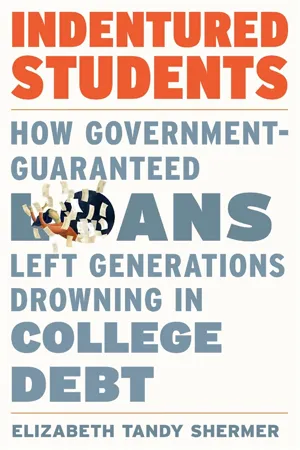 eBook - PDF
Indentured Students
How Government-Guaranteed Loans Left Generations Drowning in College Debt
- Elizabeth Tandy Shermer(Author)
- 2021(Publication Date)
- Belknap Press(Publisher)
3 A Bill of Rights for Only Some GIs “The conditions under which GI Joe is forced to acquire his education paral- lels that of the concentration camp,” Thomas Wicks fumed in a 1946 telegram to President Harry Truman. The newspaper editor demanded that something be done so that veterans could receive the aid intended to help them stay in colleges, like the University of Missouri campus near Wicks. “Why must [vet- erans] live in mud,” he wondered, or “in a room with three other men that was built for two, living in unhealthful conditions, trying to study in a poorly illuminated room.” He was not the only one concerned about “the future leaders of America being treated on par with dogs.” The White House received reports from all over the country that former enlistees had not received the educational benefits guaranteed to them under the 1944 Servicemen’s Read- justment Act. Some complained that they or their spouses had been taking classes for months under the so-called GI Bill of Rights without seeing the stipends promised to support them and their families. College remained pro- hibitively expensive for many. An Oklahoman wrote that 20 percent of the veterans at a nearby agricultural college had been barely surviving while they waited months for government checks. Such widespread delays forced former service personnel to dip into their savings, ask parents for help, cash in war bonds, take part-time jobs, procure loans, or just drop out. 1 When Americans reminisce about the famed GI Bill, few bring up over- crowded classrooms, shoddy dorms, and late payments. They also rarely men- tion that GIs almost did not get their Bill of Rights. The larger war over A Bill o Rigcts or Only Some GIs 77 government spending, federal authority, and economic security had not ended when Congress abruptly defunded New Deal agencies, including the National Youth Administration (NYA) and Civilian Conservation Corps (CCC). eBook - PDF
- Angie Papple Johnston(Author)
- 2022(Publication Date)
- For Dummies(Publisher)
The benefit amount you’re entitled to depends on how long you served. Check out Table 13-1 for the specifics. However, if you served at least 30 continuous days on active duty and were discharged due to a service-connected disability or if you received a Purple Heart, you get 100 percent of your GI Bill benefits. This version of the GI Bill also lets schools give veterans priority enrollment, which means you may have the chance to enroll in courses earlier than other students. You’re allowed to pass this benefit onto a dependent, who can then pass it on to another eligible dependent if they don’t want it after you die. The Forever GI Bill also gives you the opportunity to earn an additional educational assistance allowance while you’re performing qualifying work study activities, such as pro- viding hospital and home healthcare. Your MHA is based on where you attend most of your classes, rather than the school’s location (like the Post-9/11 GI Bill), and you can use it for technical education or a postsecondary vocational education. Here are other perks this version offers: CHAPTER 13 Bringing Receipts: Using Your GI Bill 203 » Restoration of your benefits if your school closes or if a course of study was disapproved (in some cases) » Additional benefits for enrolling in a STEM (science, technology, engineering, and mathematics) program » Limited charges for certain licensure and certification tests, such as GMAT, GRE, and CLEP, or state licensing, which is in contrast to the Post-9/11 GI Bill, which charged you for an entire month of entitlement to pay for these tests Harry Walter Colmery is the “father” of the original GI Bill, having authored the Servicemen’s Readjustment Act of 1944 (popularly called the G.I. Bill of Rights). Though he passed away in 1979, Congress named the act that improved the Post- 9/11 GI Bill after him.
Index pages curate the most relevant extracts from our library of academic textbooks. They’ve been created using an in-house natural language model (NLM), each adding context and meaning to key research topics.

