History

War Industries Board
The War Industries Board was a United States government agency established during World War I to coordinate the production of war materials and ensure efficient use of resources. Led by Bernard Baruch, it played a key role in mobilizing the American economy for war production, setting production priorities, and allocating scarce resources to support the war effort.
Written by Perlego with AI-assistance
Related key terms
1 of 5
6 Key excerpts on "War Industries Board"
 eBook - ePub
Planning War, Pursuing Peace
The Political Economy of American Warfare, 1920-1939
- Paul A. C. Koistinen(Author)
- 2015(Publication Date)
- University Press of Kansas(Publisher)
PART ONEPLANNING WAR
The political economy of warfare during the interwar years was shaped largely by the War Industries Board (WIB) of World War I. In its final form, the board was a gigantic planning partnership of government and business that inextricably combined public and private interests.Worked out in various stages between 1915 and 1918, the WIB was patterned roughly after the American economy. Serving for a dollar a year or without compensation, businessmen and professionals directed the board through its commodity section–war service committee system. Commodity sections oversaw major industries or economic sectors, such as steel, chemicals, and finished products, and were staffed by businessmen on temporary government service. War service committees existed for most industries and were made up of industry representatives, trade association officials, and various experts. Unlike commodity sections, these committees were not technically a part of the WIB; they were set up only to advise commodity sections on production, priorities, and other economic mobilization functions. In actuality, however, commodity sections and war service committees usually operated as one.Although crude, the War Industries Board proved to be an effective means for harnessing the economy for war. The greatest obstacle facing the board was the War Department, the major claimant on the economy. It intensely resisted adjusting army supply operations to those of civilian agencies. The results were dire. By winter 1917–1918, the economic mobilization machinery began grinding to a halt. Under the threat of losing control over supply, the War Department was forced to adapt its economic functions to those of the WIB. Although considerable progress was made along these lines by the time of the armistice, a great deal remained to be done before America’s mobilization future was secure.Interwar planning by the army continued its adjustments to the dictates of modern warfare. Legislation passed in 1920 authorized the War Department to plan for procurement and economic mobilization. Procurement planning was intended to rationalize army supply operations so that the service could respond better during an emergency; economic mobilization planning was intended to familiarize the War Department with developments that had occurred during World War I and to help keep the nation prepared for future hostilities. The Navy Department ultimately joined in the planning, although the War Department was always in the lead. eBook - ePub
Calculating Property Relations
Chicago's Wartime Industrial Mobilization, 1940–1950
- Robert Lewis, Deborah Cowen, Nik Heynen, Melissa Wright(Authors)
- 2016(Publication Date)
- University of Georgia Press(Publisher)
The War Industries Board was “no more than an extension and elaboration of the regulatory mechanism the state had built up to monitor the large corporations since the late nineteenth century.” Little systematic knowledge was created. While partially successful, the state was loath to intervene in the private realm. Accordingly, by the end of the war, the federal government had little knowledge of the nation’s industrial capacity beyond a basic inventory of factories and their location. 50 The problems of industrial planning during the Great War forced the military and the federal government to reassess their options for the future. The National Defense Act of 1920 authorized the War Department to plan the economic mobilization of both the armed services and the entire wartime economy. The Industrial Mobilization Plan of 1930 became the blueprint for future wartime plans. The Special Senate Committee to Investigate the Munitions Industry in the mid-1930s outlined ways of organizing industrial mobilization. The creation of the Army and Navy Munitions Board and the Army Industrial College recognized the need for collaborative planning of war production requirements. This expansion of industrial planning during the interwar years had an impact on defense planning during World War II. The most important decisions involved producing knowledgeable military staff, linking wartime military plans to the economy, and making a survey of the nation’s industrial plants. By the time the state turned to war, the military had assembled information, among other things, about the nation’s production lines, firm locations, employment levels, and fixed capital
- Ami J. Abou-bakr(Author)
- 2013(Publication Date)
- Georgetown University Press(Publisher)
See also Cuff, War Industries Board, 67. 73. Cuff writes that “only after America became deeply immersed in the maelstrom of war itself would the president moderate his caution toward governmental innovation. Only then would influence swing more positively to the men anxious to break down the walls of traditional government on behalf of a new kind of war system.” Cuff, War Industries Board, 67. See also Koistinen, “Industrial-Military Complex,” 386. 74. Koistinen, “Industrial-Military Complex,” 395–96. 75. Ibid., 395; Cuff, War Industries Board, 138. 76. Koistinen, “Industrial-Military Complex,” 395. 77. Cuff writes that Wilson, “stung by the attacks of his critics … denounced charges of organizational collapse in Washington and publically opposed proposals for a war cabinet and munitions industry.” Cuff, War Industries Board, 141. 78. Hitchcock, “War Industries Board,” 547. 79. Ohl, “Navy, the WIB, and the Industrial Mobilization,” 20. 80. Cuff, War Industries Board, 141. 81. Ibid., 104. 82. Many in Congress felt that these preparedness experts were embedding themselves in Washington in an attempt to drive purchase prices up (at public expense) to benefit industry, and many business volunteers struggled to work in an environment where congressional inquiries “looked for and expected the worst.” This congressional distrust made the WIB a politically hazardous topic and significantly reduced Wilson’s willingness to engage or actively support the organization. This caused the president and legislature to avoid “facing issues of economic mobilization whenever possible” because of the political sensitivity of public–private cooperation
- Benjamin Coombs(Author)
- 2013(Publication Date)
- Bloomsbury Academic(Publisher)
2 Government and Industry during Wartime British industry went through a variety of changes as a result of the different political and economic priorities and pressures brought about by the Second World War. During the First World War and against the typical position of laissez-faire liberalism, the state had assumed more control over the different facets of the British economy than ever before. 1 The extent of state influence over the British economy during the Second World War increased even further with greater controls over prices and quantities, controls over the supply of labour and scarce resources, new taxes, restrictions on capital and with the curtailment of exports. While business generally supported the temporary centralization of economic power, there were concerns that this might become permanent or result in the nationalization of private companies. 2 The change from rearmament under peacetime conditions to a state of continuous total war for six years meant that industry underwent a series of physical and organizational transformations. These changes were repeated in the war industries of other nations, depending upon the relationship between the government and industry, the priorities for each of their service departments, and whether the factory locations supported the concentration or dispersal of production. To illustrate these types of changes, this chapter will identify the greater involvement of industrialists to senior positions within the British government upon the outbreak of war. The priority system for all three services emphasized the dominant position of aircraft production and anti-aircraft defence until November 1941, when the tank programme was given an equal status. The strengthening involvement of senior industrialists into key positions of authority will be examined by the case example of the five different Tank Boards, alongside the other changes that occurred in war planning and centralized organization.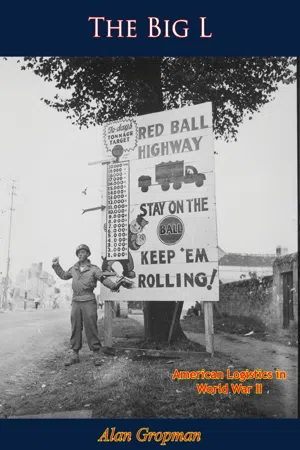 eBook - ePub
The Big L
American Logistics in World War II
- Alan Gropman(Author)
- 2021(Publication Date)
- Barakaldo Books(Publisher)
Second, future wartime procurement and production processes were reviewed for needed support from the government. Programs were enacted to provide an industrial base for national defense. Risks to businesses with the capacity and technology for producing warfighting equipment were reviewed. Entry obstructions for doing business with the government—and terminating it—were reviewed.Finally, organizations and structures, such as the War Industries Board, that were created to manage the crisis, were dissolved. Some legislation enacted for wartime procurement was folded into new statutes, such as the Budget and Accounting Act of 1921, while others, such as the National Defense Act of 1916 remained but had little effect on things.Some of the tasks before industrialists like Bernard Baruch and before the military elements were how to maintain an interest in the industrial base, how to foster the development of new technologies, how to bring military thinking and requirements to the private sector and work with business and industry, how to manage systems with long lead times for development, how to capitalize on the experience of the industrialists who knew how to make major items through mass production systems, and how to maintain the interest of the business community during times when the military would have little funding either to buy things or to invest in production.One of the strategies was to enact legislation. In 1924 the Congress passed the Air Corps Act to stimulate the nascent aircraft industry. This act, while focused on the improvement of the military air service, also stimulated the civilian aircraft industry, a likely precursor of the dual-use concept! In effect, the Act allowed the aircraft industry to continue its research and development work, while beginning limited production of aircraft for military purposes. This was a creative and unique addition to acquisition practice in the sense that “...it recognized that different processes were needed for research and development and for procurement, and that both required a strong industrial base for emergencies.”{185} eBook - ePub
Labor Market Politics and the Great War
The Department of Labor, the States, and the First U.S. Employment Service
- William J. Breen(Author)
- 2011(Publication Date)
- The Kent State University Press(Publisher)
CHAPTER FIVEThe Role of theWar LaborPolicies BoardBy the spring of 1918 the Department of Labor’s drive to establish a centralized control over the wartime labor market, which had seemed almost within its grasp during the winter, had reached an impasse. Although the USES, with the aid of a $825,000 grant from President Wilson’s emergency war fund, had expanded rapidly, the Seattle experiment and other indications of ineptitude had robbed it of any chance of securing the support of either the employment professionals in the states or the major government departments and agencies. Lacking support in Congress, the Department of Labor could only hang on and hope that the wartime drift of events would work in its favor. Evidence of a mounting labor shortage in the spring intensified the pressure on all the parties involved. In the early summer, the newly created War Labor Policies Board finally managed to break the deadlock and secure an agreement that the USES would be given a virtual monopoly over the supply of labor for war industries. The price for that agreement, however, was a fundamental reorganization of the USES and a reorientation of its policy.During the first twelve months of American involvement in the war, a fierce debate raged between those who believed that wartime demands were creating a labor shortage that was rapidly assuming crisis proportions and those, particularly representatives of organized labor, who feared that reactionary employers were using the issue to try to undermine labor standards.1 The debate highlighted the complete absence of reliable, up-to-date statistical information on trends in the labor market.2This lack of accurate information on the operation of the labor market meant that government policy in this area, as in many others, was driven by “informed guesswork.” However, the wartime crisis forced the state to develop more appropriate statistical data on which to base policy. In this instance, policy preceded rather than followed the creation of appropriate statistical information. The Department of Labor had made little effort to develop adequate statistical flows until the crisis became acute in the spring of 1918; it had heretofore relied on manifestly inadequate data in promoting its role in regulating the national labor market. Policy throughout 1917 and early 1918 had been driven by ideology and guesswork rather than accurate information. The development of a genuine crisis in the labor market forced a reassessment of this policy and highlighted the need for current empirical information on the demand and supply of labor. It was pressure from the various states, rather than from industry or organized labor, that forced the policy reassessment and clarified the need for accurate statistics on the operation of the labor market.3
Index pages curate the most relevant extracts from our library of academic textbooks. They’ve been created using an in-house natural language model (NLM), each adding context and meaning to key research topics.

