History

Manhattan Project
The Manhattan Project was a top-secret research and development project during World War II that produced the first nuclear weapons. It was led by the United States with the support of the United Kingdom and Canada. The project culminated in the bombings of Hiroshima and Nagasaki in 1945, marking the beginning of the nuclear age.
Written by Perlego with AI-assistance
Related key terms
1 of 5

11 Key excerpts on "Manhattan Project"
- William Sims Bainbridge, William S. Bainbridge(Authors)
- 2011(Publication Date)
- SAGE Publications, Inc(Publisher)
754 T he U.S. project to develop atomic weapons during World War II was one of the most complex yet suc-cessful scientific and technological projects ever attempted, but its leadership dynamics and consequences have been hotly debated ever since. The histories of it tend to focus on past actions and events, interwoven with tech-nical discussions, but the goal here is to distill insights and general principles that might be of use to leaders in the future. Therefore, this chapter will focus on decisions that could inform decision making in a wide range of other sci-ence and technology domains: the commitment to build and use the bomb and the intricate network of science-based technical decisions about how to develop and build the bomb. Insights from considering these topics may be applied in much simpler future contexts, including many that are not in any way morally controversial, but it will be necessary here also to consider the distinctive meaning for humanity of the Manhattan Project. In the weeks after the Pearl Harbor attack that brought the United States into the war, President Franklin D. Roosevelt gave formal approval for what became the Manhattan Project. This was a crash program of scientific research as well as engineering and production that pro-duced not one but two kinds of atom bomb, one based on the naturally occurring chemical element uranium, and the other based on the synthetic element plutonium. The first test was carried out successfully in secret July 16, 1945, with a plutonium bomb, and the first use in war was the untested uranium bomb dropped on Hiroshima, Japan, August 6, 1945. The Nagasaki attack on August 9 used a plutonium bomb, and two highly publicized post-war tests were carried out in July 1946 at Bikini atoll in the Pacific with plutonium devices. The average power of each of these was the equivalent of about 20,000 tons of TNT conventional explosive. eBook - PDF
Technology and International Transformation
The Railroad, the Atom Bomb, and the Politics of Technological Change
- Geoffrey L. Herrera(Author)
- 2012(Publication Date)
- SUNY Press(Publisher)
The project itself evolved in two parts: first, the pre-1942 scien- tific efforts overseen by the National Defense Research Council (NDRC) founded in 1940 and its successor, the Organization for Scientific Re- search and Development (OSRD) founded the next year, and, second, the Manhattan Project proper. The NDRC/OSRD were both founded and directed by Vannevar Bush. The idea was to mobilize American science but avoid the mistakes of World War I by keeping scientists in their own university labs and free of unnecessary bureaucratic entangle- ments. The mechanism for this agenda was the contract for research activities in a specified area, not a particular product. This allowed the government to control basic research adroitly: a hand light enough to not kill science’s creative spark, but heavy enough to avoid directionless 179 THE ATOMIC BOMB AND THE SCIENTIFIC STATE puttering by the scientists. The Manhattan Project consisted of army- directed research laboratories at the University of Chicago, Columbia University, and the University of California, Berkeley (among other places); plutonium and uranium manufacture at Oak Ridge, Tennessee, and Hanford Washington; and bomb research, assembly, and manufac- ture at Los Alamos, New Mexico. 165 The bomb project began with three physicist refugees: Albert Einstein, Eugene Wigner, and Leo Szilard. In mid-1939, Szilard and Wigner—responding to the Hahn-Strassmann experiment and the Meitner-Frisch interpretation of the fissioning of barium—pressed Einstein to help them draft and sign a letter to President Roosevelt warning him of the strong possibility of a fission bomb. Roosevelt was sufficiently impressed to order the creation of the Uranium Commit- tee, under the directorship of the head of the National Bureau of Standards Lyman Briggs. No longer available |Learn more
America's Greatest Projects
From the Panama Canal to the Alaskan Pipeline
- Dom Perrotta(Author)
- 2020(Publication Date)
- Christian Faith Publishing, Inc.(Publisher)
The Manhattan ProjectA lot has been made about the fact that the two atomic bombs dropped over the Japanese cities of Hiroshima and Nagasaki, while they likely brought a quick end to World War II, also killed nearly 130,000 Japanese civilians as well as an estimated 20,000 Japanese soldiers. Unless your Uncle Tony was a part of the US infantry that battled the Japanese in the Pacific Theater and suffered the trauma and deprivation at the hands of the heinous Japanese military, you might wonder if there could have been a better (more humane) way to end the war. Indeed that is a fair question to ask about the carnage that was wreaked on the mostly nonmilitary Japanese population. However, this project deals with the achievements and successes of the many engineers and scientists who put their lives on temporary hold in order to assure that the worst criminal in world history, Adolph Hitler, and his Japanese counterparts would never have the opportunity to reign supreme. The Japanese, because of the arrogance and stubbornness of their military leaders, became the unwitting victims of American determination and ingenuityinstead of Hitler and the Nazis.Project Outline A. Early EventsThis project traces technological events leading up to the dropping of the first two atomic bombs on Japan, including the ideas and the attempts by other nations to develop similar weapons that could ultimately make them the world’s strongest military powers. We describe the activities of many US engineers and scientists, as well as hundreds of individuals, many who were volunteers in the war effort, to achieve this engineering feat.- Beginning of Hitler’s reign
- Nuclear energy has its beginning
- Maintaining neutrality
- Preparing for inevitable war (with Germany)
- Manhattan Project begins
- Groves meets with scientists across the US
- Methods to achieve nuclear weapons
- Nuclear sites selected
 eBook - PDF
- Joseph A. Angelo Jr.(Author)
- 2004(Publication Date)
- Greenwood(Publisher)
In chapter 5, the overall impact of these applications is discussed, and in chapter 6, some of the thorny issues surrounding the use of nuclear technology are addressed. Many applications can trace their technical heritage to wartime activ- ities and events at Los Alamos or one of the other bomb-spawned national laboratories that emerged from the Manhattan Project. The nuclear weapon–oriented laboratory system inherited from the Manhattan Project by the USAEC was expanded to promote nuclear research and technol- ogy in support of growing national defense needs during the cold war. En- couraged by the USAEC, these laboratories also began to aggressively pursue many peaceful applications of nuclear technology. But such efforts would not be without social, political, or environmental consequence. From the historic perspective provided by the passage of half a century, it is truly remarkable that the atomic bomb was built on a schedule that permitted its use in World War II. For one thing, the major theoretical breakthroughs in nuclear physics supporting the concept of an atomic bomb were only a few years old. Throughout the billion-dollar project, other fascinating new discoveries occurred faster than scientists or engi- neers could comfortably absorb them. Under the goal-oriented leadership of General Groves, physicists and chemists were given no time to wander down intellectual side roads or to confirm fundamental concepts through the lengthy, conservative scientific process of hypothesis formation, labo- ratory experimentation, technical publication, and peer review. eBook - PDF
Humanitarian Disarmament
An Historical Enquiry
- Treasa Dunworth(Author)
- 2020(Publication Date)
- Cambridge University Press(Publisher)
3 The Manhattan Project to ‘Operation Rolling Thunder’ 1 Humanitarian Disarmament Sidelined I Introduction With the demise of the League of Nations and the outbreak of the Second World War the landscapes for both disarmament and humanitarianism underwent a paradigm shift. In a dynamic repeated from the First World War, the conflict triggered a massive renewal of development and acquisi- tion of weapons and weapons technology, with the most profound shift being the development of the atomic bomb in the Manhattan Project and the subsequent attacks on Hiroshima and Nagasaki in what turned out to be the final days of the war. 2 The nuclear age had dawned with the United States emerging from the war as the world’s only nuclear-weapon possessor state. The war experience also transformed humanitarianism. 3 The destruc- tion wrought by the war necessitated humanitarian assistance on a scale never before seen. The estimated death toll (battlefield and civilians) is fifty-five million people, although some estimates go as high as sixty-two to seventy-eight million. 4 Most of Europe’s infrastructure had been destroyed, and large parts of Asia and North Africa had been badly 1 Operation Rolling Thunder was part of the strategic bombing campaign carried out by US military aircraft throughout North Vietnam from March 1965 to October 1968. 2 As Albert Einstein expressed it: ‘The unleashed power of the atom has changed everything save our modes of thinking and we thus drift toward unparalleled catastrophe.’ Telegram (24 May 1946) sent to prominent Americans, reproduced in Robert Andrews (ed.), Famous Lines: A Columbia Dictionary of Familiar Quotations (New York: Columbia University Press, 1997), p. 340. 3 Michael Barnett, Empire of Humanity: A History of Humanitarianism (London: Cornell University Press, 2011), p. 97. 4 The fifty-five million figure is used by Steven Pinker, The Better Angels of Our Nature: A History of Violence and Humanity (London: Penguin, 2011), p. eBook - PDF
Atom Projects: Events And People
Events and People
- Boris Lazarevich Ioffe(Author)
- 2017(Publication Date)
- World Scientific(Publisher)
In the same year, 1942, Fermi, in a conversation with Teller, ex-pressed a new idea — to use an atomic bomb to start a thermonuclear reaction of deuterium with tritium — or deuterium-deuterium — that occurs at higher temperatures; such a bomb could be made ex-tremely large. Teller was enthusiastic about this idea and started working on it (see below). On December 7, 1941, Japanese bombers attacked the American Naval base in Pearl Harbor on the Hawaiian islands. Japan had en-tered the war. At the same time the USA declared war on Germany. Once a program of action was formulated and it was clear that it could be achieved, it was necessary to create the organizational struc-ture. The atom project was named “Manhattan Project”. General Groves, of the Corps of Engineers, was appointed its Head by the Secretary of War. A new laboratory had to be built, sufficient in size and sufficiently isolated for the secret work to be conducted. Robert Oppenheimer was appointed its director — a brilliant physicist and a man of a sharp, fast mind. General Groves considered him a genius (although he did not have such an opinion of, for example, the Nobel laureate Ernest Lawrence, who had built the first cyclotron). A site had to be found for the new laboratory. Los Alamos was chosen, 35 miles north-west of Santa Fe, in a rather desolate area. Labo-ratory buildings had to be constructed, as well as housing for the staff, electricity and gas supply, communication and roads. Since it Events 23 was envisaged that far more personnel than at previous experiments would be working at the new Lab (about 10,000), their training for their new job had to be organised. All this was done in less than one to two years. The physical problem that had to be solved was to ensure a complete reaction. For this, one had to prevent the two pieces of uranium or plutonium from detonating prematurely and at the same time from separating before the common explosion. eBook - PDF
- Erik V Koppe(Author)
- 2008(Publication Date)
- Hart Publishing(Publisher)
5.2 The United Kingdom The United Kingdom had been one of the United States’ closest allies dur-ing the war. Much nuclear research had already been carried out before the war, but British nuclear scientists had not received much help from their government or industry, due to the fact that there had been greater want for directly applicable war machinery. Growing US involvement in the war had led to an increasing exchange of information on atomic energy research, particularly in view of British expertise. The first informal discussions between representatives of both sides date back as far as early 1940, but as soon as Manhattan got on its way, the information flow had become one-way traffic and it had been stopped after a while. Exchange of information was resumed, however, after the 1943 Quebec Agreement between the United States, the United Kingdom and Canada 121 which established an official basis for coopera-tion. Based on the Agreement, a selected number of British scientists such as Chadwick, Frisch and Fuchs had come to the United States to work for the Manhattan Project or the ‘Tube Alloys Project’ as the British called it, subsequently followed by Niels Bohr and his son Aage who had escaped to England. 122 The German-born physicist Fuchs, who had made signif-40 Nuclear Weapons in Historical Perspective 121 Quebec Agreement between the United States and the United Kingdom, signed and entered into force on 19 Aug 1943. At: . 122 Early 1943 Chadwick had contacted Bohr in Copenhagen through the British intelli-gence and the Danish underground and had asked him to come to England. When things grew worse in Denmark and Bohr was warned that he would be arrested within a couple of days, the Bohrs fled to Sweden by fishing boat. From there, Bohr was transported to Great Britain in Oct 1943 in the bomb bay of a Mosquito bomber by which the British diplomatic pouch was flown back and forth from Stockholm. eBook - ePub
Nuclear Zero?
Lessons from the Last Time We Were There
- George H. Quester(Author)
- 2017(Publication Date)
- Routledge(Publisher)
The world would still require nuclear reactors to solve the energy needs of a growing and much too poor population. These same reactors would still have to be monitored so no fissionable material got diverted for nuclear weapons. Unemployed and Uncontrolled Physicists The success of the Manhattan Project depended on a coordinated allocation of all American efforts devoted to the pursuit of a nuclear weapon, with the relevant engineers and nuclear physicists having to agree to leave their universities and laboratories and move to places like Oak Ridge and Los Alamos. Anyone fearing that the Nazis were engaged in a similar pursuit of the atomic bomb looked to see if German physicists were similarly concentrated or remained at their home laboratories and universities. When it became clear that these Germans were not at a single location, British and American intelligence agencies began to draw the conclusion that there was no serious German bomb project. The Allied emphasis on coordination, which produced a bomb when many around the world had assumed that no bombs could be built in a reasonable length of time, proved to be an important contributing factor to success. Yet this American assumption of the need for coordination and top-down management may have left the risk that separate German nuclear weapons activities were underway, because of bureaucratic or personal jealousies in wartime Germany, such that one German project might fail, but another might succeed. It is common to mock the nuclear research funded by the German Post Office (even Hitler poked fun at this when he heard about it), but in the Germany of World War II (much as in any future nonnuclear world), it was possible that separate bomb efforts could be underway without being coordinated with each other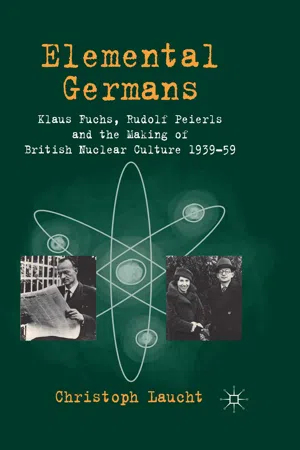 eBook - PDF
Elemental Germans
Klaus Fuchs, Rudolf Peierls and the Making of British Nuclear Culture 1939-59
- Christoph Laucht(Author)
- 2012(Publication Date)
- Palgrave Macmillan(Publisher)
Also closely connected with the emergence of Big Science was the massive financial government support for science projects. Here, Fuchs and especially Peierls had a strong impact on the function and scope of government spending in relation to science, in particular as scientists would increasingly act as lobbyists for massive government support. Since European émigré scientists had long been used to state- funded research in the sciences in their homelands, German-speaking 78 Elemental Germans scientists had welcomed government funding early on while their American-born colleagues in particular discussed its effect on science. 148 Peter Bacon Hales has thus concisely summed up the essence of the Manhattan Project, calling it ‘one manifestation of a complex and evolving ideology blending corporate capitalism, government social management, and military codes of coercion and obedience’. 149 As one chief result of the massive government spending on science, a great number of scientists found employment outside universities in the United States and the United Kingdom after the war. The Second World War had a tremendous impact on university physics departments in Britain and the United States and the formation of ‘the military-industrial complex’. 150 The Los Alamos laboratory, for example, was turned into a permanent nuclear weapons research establishment. 151 While the Los Alamos Scientific Laboratory, as it became officially known in 1945, and the other two chief MED sites at Oak Ridge and Hanford became permanent facilities and the Argonne National Laboratories near Chicago, Illinois, or the Sandia National Laboratories in Albuquerque, New Mexico, evolved directly out of the Manhattan Project, other atomic-arms-and-energy-related installations like the Lawrence Livermore National Laboratory in Livermore, California, were newly founded a couple of years later. eBook - ePub
Behind the Fog
How the U.S. Cold War Radiological Weapons Program Exposed Innocent Americans
- Lisa Martino-Taylor(Author)
- 2017(Publication Date)
- Routledge(Publisher)
that they were moving (Jette 1977: 20). As director of the atomic bomb project, Oppenheimer had an exceedingly difficult challenge on which to focus his brilliant yet troubled mind, and although his security clearance was delayed due to his communist affiliations, project work did not pause.University of California–Berkeley’s Nobel-prize winner Glenn Seaborg, co-discoverer of plutonium, was helping to assemble the Manhattan Project team. Seaborg recruited a group of promising scientists from the stable of young break-through scholars that surrounded him; the average age of Manhattan Project chemists was 25 (Jette 1977: 20). University of California’s Joseph Kennedy, a tall 27-year-old chemist from Texas, would play an important role in the bomb effort when he arrived in Los Alamos in March 1943. Kennedy’s bespectacled colleague Arthur Wahl, a radio-chemist and plutonium expert, followed his friends to Los Alamos on April 1, 1943.Secrecy defined life in Los Alamos. Names and words were forbidden, including “plutonium,” and even its atomic number, “element 94,” was referred to as “49”—its atomic number backwards. The words “uranium,” and “atomic bomb” were also banned; the bomb was the “gadget,” and uranium was “tuballoy” (Sparks 2000: 20). Even the town’s name was forbidden to be used, and residents were instructed to use “the Hill” to signify Los Alamos. “Laboratory members were not allowed personal contact with relatives or friends … even when off the mesa, there could be no conversations with friends or strangers,” according to a former Hill resident (Steeper 2003: 91). This group was closed and rigorously insular, maintaining a lock-tight culture of secrecy and forced isolation. Sociologist Fred Emil Katz would describe Los Alamos as a Closed Moral Universe, a closed reference group that filled the vision of its “rank-and-file” members who each actively and willingly contributed to the cause and converted the vision into reality (Katz 2004: 8, 73). eBook - PDF
Peace Movements Worldwide
[3 volumes]
- Michael N. Nagler, Marc Pilisuk, Michael N. Nagler, Marc Pilisuk(Authors)
- 2010(Publication Date)
- Praeger(Publisher)
Still less was made known to the American public. At the end of the war the scientists’ petition and their reasoning were reclassified secret to keep it from public knowledge, and its existence was unknown for more than a decade. Several Manhattan Project scientists later expressed regret that they had earlier deferred to the demands of the secrecy managers—for fear of losing their clearances and positions, and perhaps fac- ing prosecution—and had collaborated in maintaining public ignorance on this most vital of issues. One of them—Eugene Rabinowitch, who after the war founded and edited the Bulletin of the Atomic Scientists (with its Doomsday Clock)—had, in fact, after the German surrender in May, actively considered breaking ranks and alerting the American public to the existence of the bomb, the plans for using it against Japan, and the scientists’ views both of the moral issues and the long-term dangers of doing so. He first reported this in a letter to the New York Times published on June 28, 1971. It was the day I submitted to arrest at the federal courthouse in Boston; for the preceding 13 days my wife and I had been underground elud- ing the FBI while distributing the Pentagon Papers to 17 newspapers after injunctions had halted publication in the Times and the Washington Post. The Rabinowitch letter began by saying it was ‘‘the revelation by the Times of the Pentagon history of U.S. intervention in Vietnam, despite its classification as ‘secret,’’’ that led him now to reveal: Before the atom bomb-drops on Hiroshima and Nagasaki, I had spent sleepless nights thinking that I should reveal to the American people, perhaps through a reputable news organ, the fateful act—the first intro- duction of atomic weapons—which the U.S. Government planned to Hiroshima Day 41 carry out without consultation with its people. Twenty-five years later, I feel I would have been right if I had done so.
Index pages curate the most relevant extracts from our library of academic textbooks. They’ve been created using an in-house natural language model (NLM), each adding context and meaning to key research topics.

