History

Operation Rolling Thunder
Operation Rolling Thunder was a sustained bombing campaign conducted by the United States during the Vietnam War from 1965 to 1968. The operation aimed to demoralize the North Vietnamese and reduce their capacity to wage war. Despite its extensive duration and intensity, Rolling Thunder did not achieve its strategic objectives and is often criticized for its limited impact on the overall outcome of the war.
Written by Perlego with AI-assistance
Related key terms
1 of 5
10 Key excerpts on "Operation Rolling Thunder"
 eBook - ePub
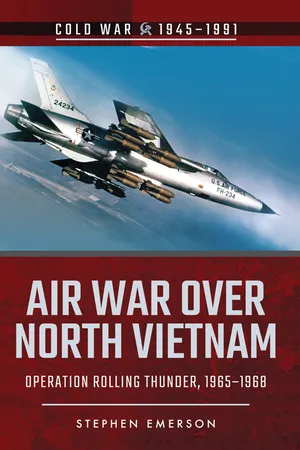
Air War Over North Vietnam
Operation Rolling Thunder, 1965–1968
- Stephen Emerson(Author)
- 2018(Publication Date)
- Pen & Sword Military(Publisher)
3. THE AIR CAMPAIGN UNFOLDSIn what was to become the largest and longest sustained air campaign in U.S. history up to that time, Operation Rolling Thunder started off poorly. The first mission scheduled for February 20, 1965 was scratched as a result of the South Vietnamese military’s preoccupation with coup concerns and the ongoing political instability. The next three planned missions, likewise, fell victim to political intrigue and bad weather conditions. It would be a full 17 days following President Johnson’s go ahead that the air campaign would actually begin. Even then the initial air strikes failed to send the meaningful message of strength and resolve that Washington had intended, or upon whom the ultimate success of the campaign depended.What had originally been envisioned as an eight-week campaign of coercive diplomacy would eventually stretch into an astonishing 180 weeks—more than three and half years—with American pilots dropping more bombs on North Vietnam than were dropped on all of Europe during World War II. In the end, however, conflicting and often competing military and political strategies would doom it to failure as it fell well short of achieving its primary objective of bringing a negotiated end to the war in South Vietnam. More important, the war and America’s role in Vietnam would expand to unprecedented levels during the course of the air campaign, dragging the United States ever deeper into a ground war it sought so desperately to avoid. It would take another four years—and another bombing campaign—after the end of Rolling Thunder before Washington and Hanoi were able to finally reached a negotiated a peace settlement.The Opening Salvo
The first Rolling Thunder mission, a joint American–South Vietnamese effort, finally got underway on the afternoon of March 2, 1965—six days before the first of 3,500 U.S. Marines would wade ashore at Da Nang—signaling the start of the planned eight-week air campaign. Rolling Thunder 5 (Rolling Thunder 1–4 having been cancelled) called for attacks on the ammunition storage depot at Xom Bang and the naval base at Quang Khe, all in the southern panhandle of North Vietnam. In keeping with President Johnson’s desire for joint action, the U.S. Air Force was to strike Xom Bang, while the VNAF with the Air Force flying cover was to hit Quang Khe. eBook - PDF
How Wars Are Won and Lost
Vulnerability and Military Power
- John A. Gentry(Author)
- 2011(Publication Date)
- Praeger(Publisher)
The barbaric attacks against a conventional North Vietnamese defense failed, leading to a DRV victory in an opposite-approach interaction. The history of Rolling Thunder is appreciably different. U.S. airmen ini- tially aimed in March 1965 to destroy standard military, industrial, and logistical targets while “slow squeeze” advocates wanted to threaten the same North Vietnamese assets. Both groups wanted to degrade Lao Dong leaders’ will to fight by damaging (or threatening damage) to the DRV’s ability to fight—not to harm civilians. Put differently, airmen and policy- makers meant to conduct “denial,” not “punishment,” bombing. 160 U.S. ROE in 1965 prohibited air strikes near the Chinese border and within 30 and 10 nautical miles, respectively, of the centers of Hanoi and Haiphong—the DRV’s two largest cities. 161 The restrictions ensured the safety of many civilians at the price of rendering many defense-related 86 How Wars Are Won and Lost industries and military facilities invulnerable. When, after some strikes on other ostensibly strategic military and economic targets Hanoi showed no inclination to quit, in mid-1965 Rolling Thunder’s emphasis shifted to tactical-level interdiction targets—logistical facilities, transportation infra- structure like bridges, and cargo trucks—mainly in rural areas far from population centers. Primary targets were the thinly populated Mu Gia Pass region of southwestern North Vietnam, which was the head of the Ho Chi Minh Trail, and sparsely populated southern Laos. 162 The attacks on electric power plants in 1967, which mainly aimed to shut down industrial production, were the only part of Rolling Thunder re- motely consistent with Arreguín-Toft’s thesis and Pape’s assertion that Roll- ing Thunder aimed to affect civilian morale. 163 But the DRV’s generating capacity was small and most North Vietnamese used little or no electricity. eBook - ePub
Vietnam
An American Ordeal
- George Donelson Moss(Author)
- 2016(Publication Date)
- Routledge(Publisher)
97 There were other costs: captured U.S. pilots and air crewmen provided Hanoi’s leaders with a bargaining chip that they later used in negotiating with American officials. ROLLING THUNDER also gave the Communists a propaganda advantage that they exploited to influence world and American public opinion. Robert McNamara, disillusioned by the failure of the air war, wrote in a memo to President Johnson:The picture of the world’s greatest superpower killing or seriously injuring 1,000 noncombatants a week, while trying to pound a tiny, backward nation into submission, (is not a pretty one).98Although opinion polls showed that a large majority of Americans consistently supported the air war against North Vietnam for its duration, the growing number of domestic opponents of the war seized on ROLLING THUNDER. Doves denounced it as expensive, futile, and wrong. They denounced the extensive damage done to homes, small businesses, and schools, and the loss of civilian lives. Administration spokesmen claimed that precision bombing destroyed only military targets. They dismissed Hanoi’s claims that thousands of civilians were being killed by the bombing as so much Communist propaganda.North Vietnamese officials invited U.S. journalists to come and see for themselves. In December 1966, Harrison Salisbury, a prominent New York Times journalist, traveled to North Vietnam. His dispatches from Hanoi highlighted collateral damage, the civilian casualties and widespread destruction to civilian structures. Salisbury’s reports were widely read and fueled the growing antiwar movement.ARC LIGHT: THE SOUTH VIETNAM AIR CAMPAIGNS , 1965-68While ROLLING THUNDER unfolded against North Vietnam, the United States simultaneously waged a large-scale air war against the VietCong and NVA forces fighting in southern Vietnam. Air operations in South Vietnam were an integral part of the U.S. war strategy. The southern air war reflected the same logic that underlay the aerial campaign against North Vietnam: that America would use air power extensively to force Hanoi to stop its aggression in South Vietnam. The air war in South Vietnam was also much larger, lasted far longer, and was much more diversified than the bombing campaigns against North Vietnam. It also connected with air wars waged in Laos and Cambodia. eBook - ePub
Bombing to Win
Air Power and Coercion in War
- Robert A. Pape(Author)
- 2014(Publication Date)
- Cornell University Press(Publisher)
Although the bombing retracted geographically, the number of sorties flown for interdiction purposes actually increased as resources were released from missions farther north. After November 1968 aerial bombardment of North Vietnam effectively came to an end, with air interdiction continuing only in the immediate area above the demilitarized zone. 32 In order to assess how well each strategy performed, we must know how faithfully actual operations adhered to the intended strategies. The conventional view is that the Rolling Thunder campaign failed to execute coherently any of the three proposed strategies. Not surprisingly, military officers charge that civilian intervention doomed operations that would have worked, and civilian analysts blame the bluntness of the military instrument for making signals ambiguous and for disrupting the delicate orchestration of force and diplomacy. In effect, both sides contend that errors in execution eroded the coercive effectiveness of Rolling Thunder. 33 This conventional view is wrong. Although implementation problems existed, they did not cause coercion to fail. As a whole, the campaign largely satisfied the fundamental requirements of each strategy. Rolling Thunder implemented the essential components of the lenient Schelling strategy. As the civilians intended, the structure of the bombing presented an obvious pattern of escalation toward industrial targets; it escalated progressively in conspicuous measures of intensity. The weekly average of sorties grew from 883 in 1965, to 1,050 in January-June 1966, to 2,637 in July-December 1966; it declined slightly to 1,985 in January-March 1967 but soared to 3,150 in April-June 1967 eBook - PDF
Rolling Thunder 1965–68
Johnson's air war over Vietnam
- Richard P. Hallion, Adam Tooby(Authors)
- 2018(Publication Date)
- Osprey Publishing(Publisher)
39 1965 Though scheduled for February 20, 1965, Rolling Thunder I missed its planned start date: and so did Rolling Thunders II, III, and IV. A convoluted demi-coup among South Vietnam’s ever- contentious generals played out over several days, disrupting both the air campaign plan and unseating Nguyen Khanh little more than a year after he had seized power from “Big” Minh. In his place stepped the flamboyant Air Force chief, Nguyen Cao Ky, a lead-from-the-front A-1 pilot whose preferred dress was a natty all-black flight suit. Unlike the unfortunate Diem and Nhu, Khanh departed both alive and even with some face-saving decorum, being serenaded on his way by his erstwhile rivals, as Ambassador Maxwell Taylor looked on “glassily polite.” Rolling Thunder finally got underway on March 2, starting with Rolling Thunder V, without taking the North Vietnamese by surprise: two days earlier, on February 28, the American and South Vietnamese governments had issued a joint communiqué announcing the onset of “a continuous limited air campaign against the North to bring about a negotiated settlement on favorable terms.” Rolling Thunder V sent some 160 Air Force and VNAF aircraft over the North against targets drawn from the Joint Chiefs’ 94-target list compiled over six months previously. Supported by six KC-135 tankers, 25 F-100Ds, 20 F-105Ds, and 19 VNAF A-1Hs flew against the Quang Khe naval base (JCS Target 74), and 41 F-105Ds, 20 B-57Bs, and 12 F-100Ds struck an ammunition depot at Xóm Bang (JCS Target 64), with modest success. But PAVN gunners shot down three F-105Ds, two F-100Ds, and one VNAF A-1H. The surprisingly high losses alarmed McNamara, who launched a top-level JCS review chaired by Deputy Secretary of Defense Cyrus Vance. His review, completed in mid-March, found that SEA loss rates so far were less than the Army Air Force experienced during World War II, though double Korea’s. In October, the massive B-52s were deployed against targets inside South Vietnam – a friendly country – when the USAF began bombing Vietcong bases near the Cambodian border. The Vietcong responded by attacking American airbases and destroying US planes. But this did not discourage American fliers who, soon after, bombed a friendly Vietnamese village, killing 48 civilians and injuring 55 others.Although protests against the war had already started in America, Johnson also faced pressure from those who wanted to escalate the war. On 22 November 1965, the chairman of the House Armed Services Committee, L. Mendel Rivers, called for bombing raids against Hanoi and North Vietnam’s principal port Haiphong, saying it was,‘folly to let the port of Haiphong and military targets of Hanoi remain untouched while war supplies being used against our troops are pouring into port’.Upping the stakes yet again, the 7th Fleet sent two nuclear-powered ships – a guided-missile frigate and an aircraft carrier – to take up positions off Saigon. US A-1 Skyraiders, A-7 Corsairs, and F-4 Phantoms were then sent to bomb, strafe and fire rockets at the Ho Chi Minh trail in an attempt to cut down on the amount of supplies getting through. But they did not go unopposed, the NVA responding with withering fire from anti-aircraft batteries.On 9 December 1965, an article in The New York Times reported that the bombing had not succeeded in slowing the infiltration of NVA troops and supplies into South Vietnam. The USAF responded by turning their attention to industrial targets in the North, destroying a power plant in Uongbi.A 37-day bombing halt over Christmas failed to bring Hanoi to the negotiating table and Rolling Thunder was resumed at the end of January. Its purpose, said Maxwell Taylor, the retiring ambassador to South Vietnam, was to, ‘change the will of the enemy leadership’ and show others that ‘wars of liberation’ were ‘costly, dangerous, and doomed to failure’. Rolling Thunder was stepped up again in March with USAF and USN flying two hundred sorties over North Vietnam in a single day. In April, F-4 Phantoms took out the road and rail bridges connecting North Vietnam to the city of Nanning in China. But these sorties took their toll on the fliers and the USAF imposed a limit of a hundred missions on flight crew. Nevertheless, in a concerted campaign against the Ho Chi Minh trail, B-52s dropped a million tons of bombs on the Mugia Pass, where the trail passes from North Vietnam into Laos. On 17 April the bombing campaign was escalated once again with USAF and USN planes began to close in on Hanoi and Haiphong. The North Vietnamese responded by sending up their MiGs, flown by Soviet-trained pilots, in their first concerted effort to engage American planes in air combat. But in a raid on 29 June US bombers managed to destroy 50 per cent of North Vietnam’s stock of fuel. This was the beginning of a campaign to knock out all the fuel installations in the Hanoi-Haiphong area, forcing the North Vietnamese to evacuate all but essential workers from the area. China denounced the bombing as ‘barbarous and wanton acts that have further freed us from any bounds of restriction in helping North Vietnam’. They also claimed that US planes had hit Chinese fishing boats in international waters, killing three sailors.
 eBook - PDF
When Governments Collide
Coercion and Diplomacy in the Vietnam Conflict, 1964-1968
- Wallace J. Thies(Author)
- 2023(Publication Date)
- University of California Press(Publisher)
83. The result of this tendency was very likely to muddle even further any efforts to transmit "signals" to Hanoi. On April 30, 1965, for example, ROLLING THUNDER 13 began with an attack by thirty-nine U.S. Navy planes on the Thien- linhdung army depot, only 85 miles south of Hanoi. The effect of this attack, however, was almost certainly diminished by the events of the next two days: no strikes were launched on May 1, and the strikes on May 2 consisted of an attack on a railroad siding 100 miles south of Hanoi by four Navy jets (these points are based on the New York Tim«' coverage of the air war). 23. Brigadier General Paul Gorman, Ellsberg Trial Transcript, p. 11,512. Gorman's argument was that access to the Pentagon study would have helped the North Vietnamese understand why the bombing was being conducted as it was, certainly an ironic position since the whole strategy of "graduated pressures" constituted an elaborate effort to make the North Vietnamese understand what they were in for if they did not comply with American demands. 24. In this respect, it should be kept in mind that confining the air strikes to the southern DRV very likely reinforced the belief in Hanoi, reported by Seaborn (see Chapter 3, above), that the bombing was a limited measure intended to strengthen the U.S. bargaining position prior to an international conference which the U.S. was seeking in order to gain a face-saving exit from the war. 308 W H E N G O V E R N M E N T S C L A S H the flow of men and supplies to DRV/VC forces in the South, thus hopefully reducing the casualties they could inflict on American forces. And yet, the coincidence between the Administration's deepening concern over the situation in the South and the anti-infiltration cam- paign that began with ROLLING THUNDER 9 should not be taken as proof that the Administration had finally been able to overcome the problems that had plagued the 15-month-long effort to intimidate Hanoi (see Section I, above). eBook - PDF
- Kevin Ruane(Author)
- 2024(Publication Date)
- Manchester University Press(Publisher)
5 The American war, 1965-1968 Alongside Operation Rolling Thunder, the Johnson administration launched a vigorous public relations exercise designed to educate the American people about the situation in Vietnam, justify the bombing, and advertise the terms upon which Hanoi could have peace (5.2). Although North Vietnam also professed interest in a negotiated settle- ment, the aims of the two sides were so far apart that talk of compro- mise was - and would remain - little more than public posturing, the Johnson administration playing to domestic opinion and the DRV government to the wider international community (5.3). As for the war itself, Hanoi had responded to the onset of Rolling Thunder by increasing its support for the Vietcong, with manpower and material assistance funnelled into South Vietnam via the Ho Chi Minh Trail (5.1). For their part, US strategists began arguing that more time was needed for the bombing to take effect. Time, though, was not on South Vietnam's side, a fact confirmed in July 1965 when the US Field Commander, General William C. Westmoreland, urgently requested major American reinforcements to forestall the imminent collapse of the Saigon government and army in the face of concerted Vietcong pressure. After intense inter-agency debate in Washington, President Johnson agreed to furnish Westmoreland with whatever manpower resources he needed. However, as with the decision to launch an air war against the DRV, evidence now suggests that Johnson, far from willingly embracing an aggressive policy, continued to harbour deep misgivings about escalation (5.5). Yet, in the final analysis, Johnson's Cold War orthodoxy proved decisive, with both his decision to meet Westmoreland's immediate request and his commitment to look posi- tively on similar requests in the future predicated on the need to pre- vent the loss of the trigger-domino of Southeast Asia and so insulate his government from the inevitably negative domestic political conse- 103 eBook - ePub
Vietnam
An Epic Tragedy, 1945-1975
- Max Hastings(Author)
- 2018(Publication Date)
- Harper(Publisher)
14 Rolling Thunder 1. Stone Age, Missile AgeAir Force chief Curtis LeMay never lived down a sentence in his 1965 memoirs: “My solution . . . would be to tell [the North Vietnamese] frankly that they’ve got to draw in their horns and stop their aggression, or we’re going to bomb them back into the Stone Age.” Deep in the South Vietnamese jungle, one of LeMay’s readers, Doug Ramsey, hankered to meet the general so he could point out that “it is hard to bomb something back into the stone age which has never left that in the first place.” Lyndon Johnson committed US aircraft against the North because he was desperate to break out of the cycle wherein Washington seemed forever to dance to the enemy’s tune. McGeorge Bundy wrote to him on June 30, 1965: “It is within our power to give much more drastic warning to Hanoi. . . . If Gen. Eisenhower is right in his belief that it was the prospect of nuclear attack which brought an armistice in Korea, we should at least consider what realistic threat is available to us.” Fred Weyand, one of America’s smartest officers, and later MACV’s chief, supported Lyndon Johnson’s “Rolling Thunder II” offensive of North Vietnam: “If we were going to bend their will to ours, [this] was the only thing we had going for us.”For the past century, air power has exercised a potent and often illusory charm for governments seeking to leverage might. It appears less messy, ugly, and politically costly to dispatch planes to deliver ordnance from virgin skies than to send soldiers to wade through a figurative and sometimes actual mangrove swamp. Most aircrew take for granted the spurious moral absolution conferred upon those who escape eye contact with the people whom they kill.Skeptics who have studied a little history know the limitations of bombing. It invariably hurts bystanders. It can be effective, indeed decisive, against moving troops and vehicles and against unhardened installations. It often fails, however, against dug-in troops and complex industrial and communications targets. Between 1950 and 1953, the USAF expended enormous effort on severing the supply routes between China and North Korea, but Operation Strangle was never more than a limited success. In 1965 the bomber barons said, “Air power has moved on; technology enables us to land a bomb on a dime,” and Lyndon Johnson invited the US Navy and USAF to inflict measured punishment upon the North Vietnamese. Operation Rolling Thunder was intended to unleash American might in a restricted and thus humane fashion, forswearing any intent to enforce regime change.![Book cover image for: Gradual Failure: The Air War Over North Vietnam 1965-1966 [Illustrated Edition]](https://img.perlego.com/book-covers/3018372/9781786253989_300_450.webp)
- Jacob Van Staaveren(Author)
- 2015(Publication Date)
- Normanby Press(Publisher)
air strikes; they limited strikes to targets approved by Washington; they directed pilots to dump unused ordnance in the China Sea; and they prohibited the use of napalm. In addition, reconnaissance aircraft were barred from flying over a target area immediately before an attack and, if sent on a bomb assessment mission, they had to fly unescorted and at medium altitude. There were other operational restrictions: pilots were instructed to exercise “extreme caution” in attacking North Vietnamese vessels to avoid hitting non-military personnel and to inflict the “maximum feasible damage level” on authorized targets, but not to conduct restrikes without Washington’s consent. {196} {197} Initially, four targets designated by the JCS were earmarked for the attack, but by aircraft take-off time on March 2, the number was reduced to two: JCS target 64 at Xom Bang, an ammunition depot about ten miles above the DMZ, covering roughly thirty-five acres and containing forty-nine barracks, administration, and support structures and JCS target 74A, the north’s southernmost naval base at Quang Khe, sixty-five miles above the 17th parallel and possessing berthing, repair, dry-dock, and logistic facilities. {198} Secretary of Defense Robert S. McNamara conducting a press briefing at the Pentagon, February 7, 1965. Thus, the attack on Xom Bang was the first Rolling Thunder strike and, except for the six Farm Gate A-1Es used during the VNAF-Farm Gate strikes on February 8, it was also the first conducted solely by Air Force tactical aircraft. The assault force consisted of twenty-five F-105s and twenty B-57s with a “mix” of supporting aircraft: sixteen F-105s and eight F-100s for flak suppression; F-100s for MiG and rescue combat air patrol (CAP); two RF-101s for reconnaissance, and six SAC KC-135s for refueling. Most of the F-105s and some of the F-100s came from Korat and Takhli in Thailand
Index pages curate the most relevant extracts from our library of academic textbooks. They’ve been created using an in-house natural language model (NLM), each adding context and meaning to key research topics.

