History

Pueblo Revolt
The Pueblo Revolt was a successful uprising in 1680 by Pueblo Indians against Spanish colonizers in present-day New Mexico. Led by Popé, the revolt aimed to overthrow Spanish rule and reclaim indigenous autonomy. The Pueblo Revolt resulted in the expulsion of the Spanish from the region for over a decade, marking a significant moment of resistance and self-determination for the Pueblo people.
Written by Perlego with AI-assistance
Related key terms
1 of 5
7 Key excerpts on "Pueblo Revolt"
 eBook - ePub
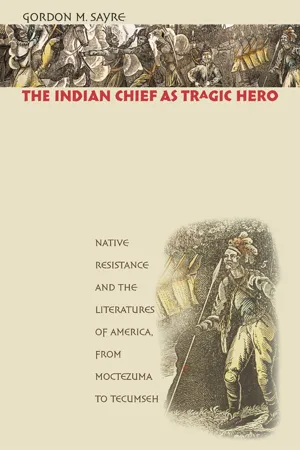
The Indian Chief as Tragic Hero
Native Resistance and the Literatures of America, from Moctezuma to Tecumseh
- Gordon M. Sayre(Author)
- 2006(Publication Date)
- The University of North Carolina Press(Publisher)
Chapter 7: The Pueblo Revolt The Pueblo Revolt of 1680 demands our attention as the most successful native uprising against colonial invaders in the history of North America. In August of that year, the peoples of the mud-brick towns known by the Spanish word for village, from Taos in the north to Jemez, Acoma, Zuni, and Hopi in the high desert west of the Rio Grande, rose up against the Spanish colonizers who had established themselves after Juan de Oñate’s entrada in 1598. More than four hundred Spaniards were killed, including twenty-one of the province’s thirty-three missionaries, out of a total population of some three thousand. Spanish survivors fled to the provincial capital of Santa Fe, where an estimated twenty-five hundred Indian warriors held them in siege for more than a week, cutting off the town’s water supply, launching burning missiles over the palisades, and taunting their former oppressors with mockeries of the Latin Mass. On 21 August Governor Antonio Otermín finally battled his way out of Santa Fe and led a retreat downstream to El Paso. The Spanish were kept out of the pueblos for twelve years thereafter, until soldiers and settlers led by Diego de Vargas reoccupied Santa Fe and solidified alliances with a few pueblos that had not joined the revolt. In its time, this revolt and reconquest on the northern frontier summoned up a good measure of military effort and heroic passion in New Spain. The lurid martyrdom of the Franciscan missionaries killed by the Indians in the uprising followed the sort of Manichaean drama that was used to raise political support and pious contributions for the cause of conversion
- Trudy Griffin-Pierce(Author)
- 2010(Publication Date)
- Columbia University Press(Publisher)
The Pueblos saw their success as the overthrow of foreign domination and the revival of their own traditional cultures. Historically, the Pueblo Revolt is the most spectacular victory that Native Americans have ever achieved through a com-bined show of force within what is now the United States. Every pueblo north of Isleta participated by killing Spaniards and providing fighting men to aid in the siege of Santa Fe and the expulsion of the Spanish. Spanish oppression had led Keresans and Tanoans to organize at an intervillage level that had never existed before and would never exist again with such a complete unity of purpose. Village autonomy, quarrels within each village, and the increase in Apache and Navajo raiding quickly dissolved the spirit of cooperation that had made the revolt so successful. Village leaders were not used to working with leaders of other villages in alliances; each pueblo had its own traditions and its own way of accomplishing things. Within each village, disagreements developed among various religious societies, and personality conflicts or controversial actions of individuals led to the expulsion of some societies from villages. Without the de-terrent of Spanish guns and horses, the Pueblos were at the mercy of mounted Apaches and Navajos, who had taken many of the horses left behind by the Spaniards. Raids became increasingly frequent, and food became even scarcer with drought and famine. When Governor Otermin made the first attempt to reconquer the area in 1681–1682, Pueblo unity was still strong enough to rebuff his efforts, although Encounters with Europeans and Meicans: Trade and Warfare (129–183) 41 he did manage to sack and burn most of the pueblos south of Cochiti. Not until 1692 did a new governor, Diego de Vargas, begin a reconquest. By then, Pueblo factionalism and a willingness on the part of some Pueblo villages to consider the Spanish as possible allies against raiding groups made his plan more feasible. eBook - PDF
Revolts, Protests, Demonstrations, and Rebellions in American History
An Encyclopedia [3 volumes]
- Steven L. Danver(Author)
- 2010(Publication Date)
- ABC-CLIO(Publisher)
The Pueblo Revolt of 1680: Conquest and Resistance in Seventeenth- Century New Mexico. Norman: University of Oklahoma Press, 1995. Weber, David J. The Spanish Frontier in North America. New Haven, CT: Yale University Press, 1992. Weber, David J., ed. What Caused the Pueblo Revolt of 1680: Readings. Selected and Introduced by David J. Weber. Historians at Work Series. Boston: Bedford/St. Martins, 1999. Pueblo Religions Pueblo Indian spiritualism is very different than the Western notion of “religion”; rather, it is all inclusive that requires observance 24 hours a day and seven days a week. There is no single “Pueblo Religion” that encompasses all of the 19 New Mexico Pueblos, or the Hopi Pueblo in Arizona, yet several key similarities can be gleaned. Primarily, Pueblo Indians have a universal belief that all things created by the creator, or as Joe Sando (Jemez Pueblo) writes, “the Great One,” have a spi- rit. This Great One is omnipresent, yet this omnipresence does not carry the same connotation as the Christian god. In fact, Sando writes that in no pueblo tongue is there a word for “religion.” A general belief among pueblos, indeed among many native tribes, involves the belief in the spiritualism that emanates throughout the earth, sky, water, all plants and animals, and all things. They do not believe they have dominion over the Great One’s creations, but rather that they are merely a part of a balance that exists as a result of the respect and deference that they show the earth and all creation. This included periods in which Indian people needed to utilize the resources of the land. Pueblo Revolt (1680) 45 Therefore, when a Pueblo Indian needed to hunt, he would first ask permission from the animal to offer up its life for the sustenance of the human. That animal would be treated with the utmost respect according to long-standing spiritual tradi- tions before, during, and in its preparations after the kill.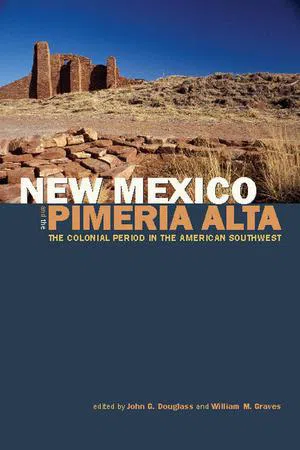
- John Douglass, William M. Graves(Authors)
- 2017(Publication Date)
- University Press of Colorado(Publisher)
chapter 9 in this volume). Fortunately, the events that occurred during this period left an indelible mark in the archaeological record. The things Pueblo people designed, made, lived in, broke, and threw away provide a window into the dozen years between 1680 and the reconquista of the 1690s in New Mexico, telling us what happened to the pan-Pueblo alliance that facilitated the Revolt of 1680. In what follows, we examine changing relations within and among six of the new, postrevolt Pueblo villages established in the wake of the 1680 uprising. We are particularly interested in the “social lives” of these communities. Who founded and lived at these villages? Who were their allies? Who were their enemies? And how did the residents of each village choose to negotiate the Spaniards’ return in the 1690s? We develop this archaeological history by combining information from Spanish colonial documents with the archaeological record—particularly data from ceramics and lithics—to discover concordances and reveal contradictions. In the process, we demonstrate the ways that material culture challenges and augments traditional historical accounts, ultimately providing a more detailed and nuanced understanding of the Pueblo Revolt period.The Mesa Villages
Postrevolt Pueblo Indians’ settlement patterns consisted of an extended network of mission villages founded prior to 1680, mesatop redoubts and refugee communities (both newly constructed and reoccupations of older settlements), and appropriated former Spanish colonial settlements. In the northern Rio Grande, people constantly flowed back and forth between these different loci. Some eastern Pueblo individuals took refuge among the western villages of Acoma, Hopi, and Zuni. Still others joined with the Apache and Navajo. These dislocations mark an important moment in Pueblo Indian history, as they gave rise to new social formations that continue to structure Pueblo Indian communities as we know them today (Liebmann and Preucel 2007 No longer available |Learn more
Reining in the Rio Grande
People, Land, and Water
- Fred M. Phillips, G. Emlen Hall, Mary E. Black, Black E. Mary(Authors)
- 2015(Publication Date)
- UNM Press(Publisher)
The Pueblo tribes would suffer terribly in the centuries following the arrival of the Spaniards. By the time of the Pueblo Revolt in 1680, when the Pueblo groups collectively but temporarily expelled the Spaniards from the Rio Grande and other western pueblos, the number of pueblos was down to just thirty-one, with a total population of around fifteen thousand. Most of these pueblos were abandoned between 1600 and 1640, due to the ravages of epidemics unwittingly brought to the New World, forced labor, raids by non-Puebloan tribes facilitated by the Spaniards’ introduction of the horse, loss of land and resources, and drought and famine. When Spanish rule was restored in 1692, only twenty pueblos remained or were resettled. 2 Of these, some eighteen pueblos remain today, a testament to the tribes’ resilience and their determined commitment to a sustainable, agricultural way of life. This lifestyle remains firmly rooted in a deep and enduring philosophical and spiritual appreciation of the connections of land, life, and water. In the thousands of years between the first appearance of humans in the Southwest and their eventual settlement in substantial numbers along the Rio Grande and its tributaries, the human/water connection was closely interwoven with climate fluctuations and the fits and starts of technological advances achieved through trial and error. Hunting as a primary means of survival gave way to hunting and increasingly sophisticated gathering of food and plant materials, followed by the revolutionary idea of farming. Tending to crops required reliable access to sustainable sources of water, tethering people to geographic areas suited for farming, and required attention to the careful timing and placement of crops
- Michael V. Wilcox(Author)
- 2009(Publication Date)
- University of California Press(Publisher)
During the Revolt of 1680 , several “refugee sites” were created uni-fying distinct and disparate linguistic and religious communities in an effort to expel the Spanish and reassert traditional religious and social practices (figure 8 ). Historic period regional demographic shifts have traditionally been interpreted using a combination of acculturation based on catastrophic, disease-population crash models. For the most part, the processes that lead to ethnic conflicts (including acts of vio-lence, social and economic subordination, and religious suppression) have not been accounted for in many historical or archaeological con-tact period studies. While regional abandonments can be interpreted as resulting from catastrophic epidemics that devastate entire communi-ties, population shifts during the Revolt of 1680 were motivated by a desire to maintain social distances and restore a traditional social and religious order. As such, these abandonments imply a very different set of motives and social consequences for Puebloan people. In examining the responses of Puebloan people to the violent encounters of the sixteenth-century entradas (literally, “entrances,” or expeditions), we find that abandonment and mobility were an impor-tant means of preserving and protecting Pueblo traditions and commu-nities. In many cases, abandonment signaled not the end of communal life but an active and conscious effort to preserve local authority, com-munally based status systems, and familial, clan, and religious identities. For archaeologists, the study and documentation of Revolt period communities offers a unique opportunity to examine the relationship between social conflicts, regional abandonments, and the settlement of new communities. While disease and acculturation were obvious factors in the interaction of Pueblos and Spanish colonists, I suggest that a more profitable analysis of contact period social interaction should involve an analysis of conflict and resistance. No longer available |Learn more
Puebloan Societies
Homology and Heterogeneity in Time and Space
- Peter M. Whiteley(Author)
- 2018(Publication Date)
207 CHAPTER TEN From Mission to Mesa Reconstructing Pueblo Social Networks during the Pueblo Revolt Period ROBERT W. PREUCEL AND JOSEPH R. AGUILAR On the morning of September 14, 1692, Governor Diego de Vargas stood in the plaza of Santa Fe and proclaimed the repossession of the kingdom of New Mexico. After the alférez raised the royal standard three times, he ordered the Tewa and Tano Indian inhabitants to repeat three times, “Long live the king, our lord (may God keep him), Carlos II, king of all the Spains, all this New World, and the kingdom and province of New Mexico” (Kessell and Hendricks 1992, 402).1 Twelve years earlier, a confederation of Pueblo nations and their Indian allies had risen up in a united front and forced Governor Antonio de Otermín to flee from Santa Fe and retreat in ignominy to El Paso del Norte. The loss of New Mexico was a severe blow to the expansionist goals of the Spanish empire. For this reason, Vargas’s repossession was a spectacular triumph; he had accomplished what neither of his predecessors, Governors Pedro Reneros Posada and Domingo Jironza Petríz de Cruzate, could do. Spain had reestab-lished her northern colony. The status of the new colony, however, was quite precarious. Vargas’s authority was restricted to Santa Fe and its immediate vicinity. Of special concern were the rebels living in their mesatop redoubts in the Keres and Jemez districts. Over the next two years, Vargas visited these villages to try to persuade the people to come down from their mesas and take up lives in their mission homes. Each time he was rebuffed in his efforts, as Pueblo leaders stalled for time. Finally, he was forced to attack them, one after another.
Index pages curate the most relevant extracts from our library of academic textbooks. They’ve been created using an in-house natural language model (NLM), each adding context and meaning to key research topics.

