History

Volksgemeinschaft
Volksgemeinschaft, meaning "people's community," was a concept promoted by the Nazi regime in Germany to create a unified national community based on racial purity and loyalty to the state. It aimed to eliminate social divisions and create a homogeneous society through exclusion and persecution of those deemed undesirable, such as Jews, Roma, and other minority groups.
Written by Perlego with AI-assistance
Related key terms
1 of 5

11 Key excerpts on "Volksgemeinschaft"
 eBook - ePub
Nazism as Fascism
Violence, Ideology, and the Ground of Consent in Germany 1930-1945
- Geoff Eley(Author)
- 2013(Publication Date)
- Routledge(Publisher)
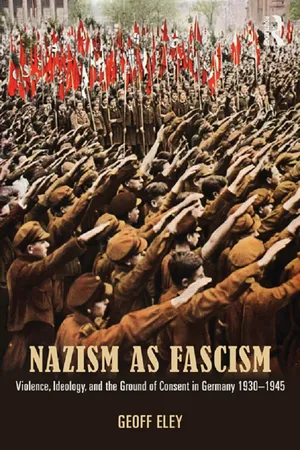
itself as doing ideological analysis as such.The idea of the Volksgemeinschaft is now being pursued in a similar way, offering valuable insight into how popular consent to Nazi rule could be secured. In setting the scene for such a discussion, for example, Detlef Schmiechen-Ackermann uses the example of the popular enthusiasm surrounding the festivities on Hitler’s 48th birthday on 20 April 1937 in order to focus the interpretive dilemmas involved, especially in light of the deceptively transparent photographic record.2 Did the “ jubilant crowd with arms raised high in the Hitler salute” signify genuine joy, he asks, or was this a carefully staged propaganda shot? How far did the adulation for Hitler translate into knowing support for the policies of his regime? Which policies were supported, and which not? Who was absent from the crowd, and why? During the heyday of social history these questions had long received a straightforward answer: the idea of the “people’s community” had been just a trick, a “fictitious concept” and a false promise, a projection of unity by the triumphal Nazis who wanted to close the books on Weimar’s divisiveness and legitimize themselves into the future.3 However relentlessly trumpeted by the regime’s propaganda, social historians argued, the vaunted “state of harmony in German society ... had in reality never existed.”4 Against the claims of the Volksgemeinschaft, the pioneers of Third Reich historiography in the 1970s typically invoked the absence of significant change in the social structure, contrasting the Nazi rhetoric with the stark continuities of inequality beneath – most imposingly of all in Tim Mason’s Arbeiterklasse und Volksgemeinschaft, but also in Ian Kershaw’s early works and in the positions consistently advanced by Hans Mommsen.5 The appeal of the Volksgemeinschaft may have been “a potent mobilizing agent,” one such commentator now concedes. But “between the exaggerated pseudo egalitarian propaganda that claimed to have transcended class, denominational, and political division and the essential continuities in the class structure of Nazi Germany” there remained a huge gap.6 “What are the reasons,” Heinrich August Winkler asked rhetorically, “why we should actually take the Nazi slogans for anything real?”7 eBook - ePub
Digital Demagogue
Authoritarian Capitalism in the Age of Trump and Twitter
- Christian Fuchs(Author)
- 2018(Publication Date)
- Pluto Press(Publisher)
Volksgemeinschaft (national ethnic community) was an ideology that tried to mobilise a cross-class mass movement in the name of the nation by trying to unite hatred against those who were constructed and presented as being enemies of the German nation (Jews, communists, socialists, liberals, people of colour, etc.). There was also Nazi election propaganda specifically directed at workers (36–8).According to data, in the German federal election 1933, in which 39 per cent of the eligible voters cast their ballot for the Nazis, 33 per cent of all blue-collar workers voted for them, 28 per cent of the white-collar workers and public servants, 47 per cent of the self-employed, 53 per cent of those without occupation and 37 per cent of the houseworkers (Falter and Hänisch 1986, table 13; Falter 1987, 229). According to data, the NSDAP became the largest working-class party in July 1932, when only 23 per cent of all blue-collar workers voted for the Social Democrats (SPD), who had held 31 per cent of the blue-collar workers’ votes in 1928, and 27 per cent voted for the Nazis (Falter and Hänisch 1986, table 14; Falter 1996, 34, 44). In the November 1932 and March 1933 elections, the Nazis also held the largest share of blue-collar workers’ votes. In the 1933 election, they obtained 33 per cent of blue-collar workers’ votes, the SPD 21 per cent and the Communists (KPD) 17 per cent (Falter and Hänisch 1986, table 14; Falter 1996, 34, 44).Nazi-Fascism’s Volksgemeinschaft IdeologyEmpirical research seems to indicate that the NSDAP’s members and voters were not simply ‘petty bourgeois’, but that it was rather a party that used the ideology and politics of the Volksgemeinschaft for trying to achieve support throughout the population and distract attention from class conflicts. Hitler continuously stressed the Volksgemeinschaft ideology and made pleas for how it should unite Germans with nationalist sentiments across class boundaries. For example, he argued in a speech given on 18 May 1930, in Regensburg: ‘First of all we are Germans, and then workers, entrepreneurs and public servants’3 (Hitler 1992, Volume 3, 197). In another speech, Hitler said on 24 September 1931, in Hamburg: ‘We are members of a people, and a common fate unites us. It must stop that one divides oneself into bourgeois, public servants, proletarians, etc. We first have to be Germans. [Thundering applause]. If fate blesses us, we want to create German unity, for which we will sacrifice us. Then we will arrive at a kingdom of power, greatness and glory’4 (Hitler 1992, Volume 4, 115). The quote shows that Hitler presented the superiority of the German Volksgemeinschaft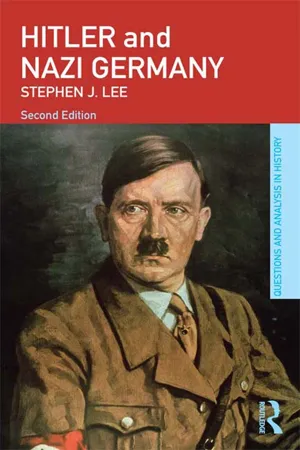 eBook - ePub
- Stephen J. Lee(Author)
- 2013(Publication Date)
- Routledge(Publisher)
Lebensraum. The driving force for this was the concept of the master race.Racial theory also aimed at creating a new form of social cohesion – by replacing class divisions with racial unity and racial supremacy. The Volksgemeinschaft would reconcile what Peukert calls a ‘society of fractured traditions, social classes and environments’.7 In place of embittered Germans from competing economic groups, there would emerge healthy, vigorous, and productive Aryans, united in their loyalty to a regime which had only Aryan interests in mind. The new stereotype proved attractive to most of the population and therefore ensured their allegiance to a regime which appeared to value them so highly. This, of course, was part of the overall formula. For, in return for their new unity of purpose and elevated status, the people were to be ‘primed for self-sacrifice’.8 Hence the racial policies were closely connected not only with the propaganda and indoctrination trends within Germany’s schools (see Chapter 4 ) but also with the new work ethic implicit in organisations like the Reich Labour Service (RAD), SdA and KdF.To be fully effective the Volksgemeinschaft needed to have its ‘impurities’ removed. The victims were all those who, for genetic reasons, did not fit into the stereotype of Aryanism. These were considered ‘alien to the community’ (gemeinschaftsfremd) and had therefore become race enemies in the broader sense. There were three broad types. First, there were threats from ‘biologically impaired’ individuals. Some of these might have been Aryan by origin but, for a specific reason, now threatened to ‘pollute’ the community through diseases or defects which were transmissible to future generations. Second, individuals or groups following certain lifestyles threatened to undermine the social integrity or economic performance of the Volksgemeinschaft; these included vagrants, alcoholics and homosexuals. Third, groups classified by membership of an ‘inferior’ race had to be prevented from ‘contaminating’ the Volksgemeinschaft by being deprived of certain forms of contact with it. Among these targets were Sinti and Roma, Negroes and Slavs. The last of these became far more important with the expansion of the Reich into eastern Europe in 1939 and again in 1941. The most important racial ‘threat’ of all came from the Jews. It was possible to fall victim to Nazi racial policy through belonging to any of these three categories – or even to more than one. Indeed, Hitler emphasised that there was a ‘Jewish conspiracy’ to coordinate all three. The Third Reich systematically targeted all groups with a combination of legislation promulgated either by the government or issued by the Reichstag, and executive action by the SS-Gestapo complex. The latter became increasingly important with the ever-growing involvement of Himmler himself. Already one of the key executive agencies before 1939, during the war the SS became the main functionary in all cases. (See Chapter 10 , Analysis 2 eBook - ePub
Culture and Education
Looking Back to Culture Through Education
- Filiz Meseci Giorgetti, Ali Arslan, Craig Campbell(Authors)
- 2020(Publication Date)
- Routledge(Publisher)
“Volksgemeinschaft”. Mythos, wirkungsmächtige soziale Verheißung oder soziale Realität im “Dritten Reich”? Zwischenbilanz einer kontroversen Debatte, ed. Detlef Schmiechen-Ackermann (Paderborn: Schöningh, 2012), 13–53; and Dietmar v. Reeken and Malte Thießen, “‘Volksgemeinschaft’ als soziale Praxis? Perspektiven und Potenziale neuer Forschungen vor Ort,” in “Volksgemeinschaft” als soziale Praxis. Neue Forschungen zur NS-Gesellschaft vor Ort, ed. Dietmar. v. Reeken and Malte Thießen (Paderborn: Schöningh, 2013), 11–33.18 See Wildt, “‘Volksgemeinschaft’,” sections 4 and 5.19 See Michael Wildt, “Volksgemeinschaft und Führererwartung in der Weimarer Republik,” in Attraktion der NS-Bewegung, ed. Gudrun Brockhaus (Essen: Klartext Verlag, 2014), 175–93, esp. 192.20 Ibid.21 See Michael Wildt, Volksgemeinschaft als Selbstermächtigung. Gewalt gegen Juden in der deutschen Provinz 1919 bis 1939 (Hamburg: Hamburger Ed., 2007), 18; Richard Bessel, “Eine ‘Volksgemeinschaft’ der Gewalt,” in Schmiechen-Ackermann “Volksgemeinschaft”, 258–9.In the educational context, the social practices of “producing” the Volksgemeinschaft are included in the respective generational structure within which the children were prepared for their future participation in the Volksgemeinschaft. Crucial in this context was to develop in the children’s minds the clear recognition of the legality of this order of belonging, and to develop social practices for its reproduction. This process was organised by way of social moratoria for the “German” child, during which it was at first exempted from (violent) participation in the Volksgemeinschaft while at the same time the educational-methodical shape of the formation was designed. For this, the National Socialists made use of an aestheticisation of violence, by presenting the process of submission to the Führer’s will, as well as the recognition of and submission to the interests of the Volksgemeinschaft, as being beautiful and worth striving for.22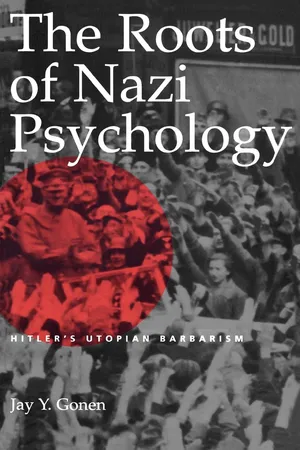 eBook - ePub
The Roots of Nazi Psychology
Hitler's Utopian Barbarism
- Jay Y. Gonen(Author)
- 2013(Publication Date)
- The University Press of Kentucky(Publisher)
In this brief sample of Orwellian “newspeak,” the sarcastic Hitler is “the epitome of a true democrat” while democratic Austria and, even more so, Czechoslovakia are each a “dictatorship,” which deserved to be destroyed by him. But he was dead serious when he pitted himself against Churchill to judge who was a more authentic delegate of his people. Churchill represented but a fraction of the people, while Hitler imagined that he represented the entire folk.In these statements it can be readily seen that the racial ideal of what a true democracy would be is based on some mystical notion of representing the will of the entire people. And in Hitler's ideology, this expression cannot take place unless society is ordered and led by the force of personality to begin with. Then, and only then, is a human community “redeemed from the curse of Mechanism and becomes a living thing” (Hitler 1943, 446). The folkish state was thus more than an organization. It was a living organism, which promoted the people's community or Volksgemeinschaft. And it successfully accomplished this in accordance with the people's separate personalities and collective will, with an emphasis on the latter.Thus, Nazi ideology aspired to a blissful union of individual contentment through collective merging as if there were no contradiction between the two. The contradiction was conveniently brushed aside through the supposition that no personal satisfaction was possible for individuals anyway except through the collective. But in spite of this cozy presumption, there had been an inherent contradiction there all along, as the requirements of the national collective completely preempted the rights of the individual. Nevertheless, Nazi ideologues were eager to promote their discrepant ideals as if they reinforced one another rather than negated each other. Under the umbrella of the Volksgemeinschaft eBook - PDF
- Tim Kirk(Author)
- 2006(Publication Date)
- Red Globe Press(Publisher)
Chapter 4: The Myth of the ‘National Community’: German Society under Nazism The Nazis did not merely want to win political power; they wanted to transform German society forever. Hitler’s appointment to the chan- cellorship in January 1933 was not simply a change of government; it was a change of regime, and signified a fundamental change in the political system. Winning power was not an end in itself, Hitler told the Nuremberg party rally in September 1933, the political revolution – which he had declared complete in July – must be followed by an ideo- logical revolution. Yet the Nazis did not have a detailed ideological programme of social reform for achieving this; what they did have was a comprehensive critique of modern society and its perceived shortcom- ings. They wanted to create a ‘Volksgemeinschaft’, a national community of all the people, regardless of wealth or rank, that would transcend the divisions and conflicts of modern society. It was an idea with myth- ical qualities, promising the restoration of a shared sense of national purpose, and at the same time concealing the ‘conglomerate of dispar- ities and contradictions’ that made up the Nazi programme in 1933. 1 Many – most – of the Nazis’ preoccupations were shared with their conservative and nationalist allies, and embraced the usual targets of right-wing populism: emancipated women and working mothers; lack of discipline in the young and the decline in social deference; and all kinds of culture that offended middlebrow taste, whether pulp fiction and popular film (especially if it was American) or the experimental avant-garde. Nazi propaganda fuelled concerns about criminality and disorder, putting the blame on outsiders in the community (Gemenis- chaftsfremde). This meant not only racial outsiders – generally Jews, but 83 eBook - PDF
Germans and Jews
The Right, the Left, and the Search for a "Third Force" in Pre-Nazi Germany
- George L. Mosse(Author)
- 2023(Publication Date)
- University of Wisconsin Press(Publisher)
Moreover, among the German Jews themselves the Zionists, with their attacks on Jews who lounged in city cafés, shared identical attitudes with the assimilationists, though they despised each other. The adoption of völkisch ideas undoubtedly facilitated the reassertion of Germanism deemed necessary and desirable by the leaders of the Reichs- bund. In keeping with the ideology, the Schild ran a series focusing on heroic figures of the Jewish tribe within Germany, all military leaders or inventors, and pointed with pride several times to the Jews who had fought in the Free Corps. 50 These attitudes reached the limits of good taste when the Reichsbund in October 1933 sent the new Nazi government a The Influence of the Völkisch Idea on German Jewry 74 declaration affirming its stand along with the German fatherland, for Ger- many’s Lebensraum and honor were at stake. The German Reichsbund was not unique in its reaction to rightist and antisemitic pressure. For example, in the 1930s a league of French Jewish war veterans reacted in much the same manner to the rising tide of anti-Jewish feeling in that coun- try. Just as the Patriotic Union of French Jews stressed their deep roots in France and advocated “French” courage and morality (in contrast to the Bolsheviks and East European Jewish immigrants), so the assertions of the Reichsbund must be viewed as a militant Germanism in the face of Nazi contentions. Throughout history and in every nation, veterans’ organizations tend to become rightist pressure groups. 51 Jewish veterans’ organizations shared this tendency, now heightened by the attempts to exclude them from the national scene. Hans-Joachim Schoeps was right when he wrote, in 1934, that the Reichsbund had established itself as the organization of German-conscious Jews. The front-line experience of the First World War which that organi- zation sought to reflect in its attitudes had a definite affinity to the events that were taking place in contemporary Germany. eBook - PDF
Heimat, Region, and Empire
Spatial Identities under National Socialism
- Claus-Christian W. Szejnmann, Maiken Umbach(Authors)
- 2016(Publication Date)
- Palgrave Macmillan(Publisher)
The operations of these social micro- cosms of a new Germany depended on how far ideological framings were compatible with individual experiences on the ground – and thus plausi- ble. As long as subliminal prejudices continued to exist, the short period of the war years left little time to translate the Volksgemeinschaft into practice. Some historians argue that such a common ground was only established at a different stage, notably with the collective adoption of a master nar- rative that cast Germans first and foremost as a community of victims, detached from any stated aims of National Socialism. 64 If this is true, then the mentoring of resettlers could only have served a different, more short- term purpose, notably to appease their growing political unrest and anxiety about an uncertain and in many ways unattractive future. In any case, the real outcomes of the measure adopted to integrate ethnic Germans can only be comprehensively assessed if one widens the scope of the inves- tigation well beyond 1945, up until the 1960s. Until then, the question of whether or not communities of ethnic German resettlers could, and Daniel Mühlenfeld 209 should, be fully integrated into mainstream German society remained open, and virulent. Notes 1. John Hiden, ‘The Weimar Republic and the Problem of the Auslandsdeutsche’, Journal of Contemporary History, 12 (2) (1977), 273–289, here 278, 285. 2. Doris L. Bergen, ‘Instrumentalization of Volksdeutschen in German Propaganda in 1939. Replacing/Erasing Poles, Jews, and Other Victims’, German Studies Review, 31 (3) (2008), 447–470, here 447f. 3. Doris L. Bergen, ‘The Nazi Concept of “Volksdeutsche” and the Exacerbation of Anti-Semitism in Eastern Europe, 1939–1945’, Journal of Contemporary History, 29 (4) (1994), 569–582, here 570. 4. Himmler was appointed on 7 October 1939. Cf. Decree of the Führer and Reich Chancellor on the Strengthening of Germandom, 7 October 1939 (Federal Archives Berlin [BAB], R43 II/604, 27f.). eBook - PDF
A German Generation
An Experiential History of the Twentieth Century
- Thomas A. Kohut(Author)
- 2012(Publication Date)
- Yale University Press(Publisher)
7 By contrast, the Nazis were in tune with the needs of youth, presenting young people with the opportunity to be independent, to assume responsibility, and to take action. The National Socialists, it seemed, would make the lived experience of the youth movement a national social reality. The intense collectivism of the 5 ANALYSIS Extending the Collective in the Community of the Volk ANALYSIS 125 youth movement group would be carried forward and extended in the na-tional “community of the people.” Defining politics as self-interested and divisive, the interviewees saw the creation of a homogeneous and harmoni-ous Volksgemeinschaft as bringing “politics” as they understood it to an end, and National Socialism seemed an apolitical movement of national regenera-tion and social unity that followed in the footsteps of the youth movement. 8 In contrast to the youth movement, however, National Socialism offered not hikes, games, and songs but rearmament and the open violation of the Ver-sailles Treaty. 9 It offered not excursions to ethnic Germans living abroad but their incorporation in the Reich. The National Socialists produced visible achievement. Most obviously they eradicated the disturbing spectacle of the unemployed loitering on German streets, an accomplishment due not only to the economic upswing, which had already begun before 1933, and to rearmament but also to the fact that unemployed people were put in work camps. 10 The National Socialists also eliminated the very visible disorder of the Weimar Republic, to which SA street violence had contributed so consid-erably. 11 The Nazis reduced the sense that one lived in an arbitrary and anar-chic environment, instituting a regime where danger was apparently placed under human agency, controlled and directed by state, party, and security apparatus. Unpredictable disorder was replaced by Gestapo terror, but that, if one obeyed and conformed, was readily negotiated.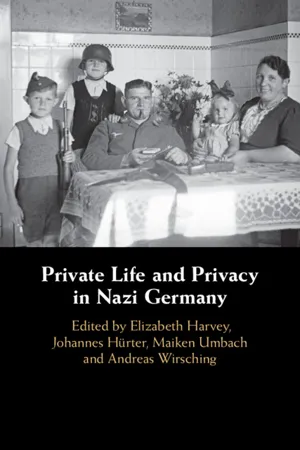 eBook - PDF
- Elizabeth Harvey, Johannes Hürter, Maiken Umbach, Andreas Wirsching(Authors)
- 2019(Publication Date)
- Cambridge University Press(Publisher)
The safe private space which might surround the Volksgenossen for the sake of recreation and the family no longer had any physical tangible boundaries: it was defined, instead, by non-spatial con- cepts such as a sphere of trust or a ‘marital bond’. This abstraction seems at first to be paradoxical, because it was precisely at this point that the Nazi legal reform had directed its fierce criticism of the old ‘liberalist’ bourgeois law, accusing it of being too abstract and out of touch with everyday life because it clung to rigid laws instead of allowing fair judgements. 83 The Nazi legal theorists and practitioners thought it ‘fairer’ not to apply general norms, but to set the limits of individual freedom in each particular case, and always with reference to the Volksgemeinschaft. This meant that although völkisch privacy could enjoy legal protection, it was always restrained by the fragile limits of concepts such as ‘honour’, ‘trust’ and ‘marital sentiments’. Ackermann et al. (eds.), Der Ort der ‘Volksgemeinschaft’ in der deutschen Gesellschaftsgeschichte (Paderborn, 2017), 274–86. 83 See also Hans-Jürgen Dickhuth-Harrach, ‘Gerechtigkeit statt Formalismus’: Die Rechtskraft in der nationalsozialistischen Privatrechtspraxis (Cologne, 1986); Christian Hilger, Rechtsstaatsbegriffe im Dritten Reich: Eine Strukturanalyse (Tübingen, 2003). The Vulnerable Dwelling 205 9 Walther von Hollander as an Advice Columnist on Marriage and the Family in the Third Reich Lu Seegers I suppose these lines have turned out almost too private, but that is nearly always what happens. You put your unreserved trust in a complete stranger. There are no embellishments or exaggerations. 1 These words were written in the summer of 1940 by thirty-four-year-old Karla Anders from Hamburg and were addressed to Walther von Hollander, probably to this day the best-known German advice colum- nist. eBook - PDF
Heidegger, Morality and Politics
Questioning the Shepherd of Being
- Sonia Sikka(Author)
- 2017(Publication Date)
- Cambridge University Press(Publisher)
The resulting ideal is not usually one of complete separation between peoples, but of a harmony that would preserve difference. In Herder’s thought, the preservation and cultivation of distinct national iden- tities takes place within a universal ideal of furthering “humanity” (Humanität), although what this term means remains rather vague. For Schleiermacher, each Volk is a particular aspect of the divine image, with its own definite vocation (Beruf). Therefore, while each Volk should keep to its own without taking in foreign elements, every Volk should also be respected as having a place within the divine order. 12 Fichte, who also held a strong notion of the unique place and vocation (Bestimmung) of every individual being, including every Volk, 12 See the pieces collected in the Nazi volume, Patriotische Predigten; Schleiermacher 1935, 22, 58, 69. Cultures, Peoples, Nations 133 133 advocates a Christian republic of nations based on mutual recognition (Fichte 1847, 205). This internationalism complements rather than contradicts the nationalism of the Addresses to the German Nation. Following Kant’s formula for perpetual peace, Fichte’s model is that of a league of nations (Völkerbund) that preserves difference, not an international state (Völkerstaat) that would dissolve them (Fichte 1970, 160). The Germans, he feels, are particularly good at respecting the individuality of other peoples (Addresses, Fichte 1846, 471) and so, one assumes, especially well-suited to produce a formula for such a system, which would also be a formula for eternal peace (Fichte 1970, 162). This may seem an ironic judgment in view of later events, but it would not have seemed so to someone who saw the German character expressed by such think- ers as Kant and Herder.
Index pages curate the most relevant extracts from our library of academic textbooks. They’ve been created using an in-house natural language model (NLM), each adding context and meaning to key research topics.

