Literature

Epistolary Fiction
Epistolary fiction is a literary genre that presents the narrative through a series of letters, diary entries, or other written correspondence. This form allows for multiple perspectives, intimate insights into characters' thoughts and emotions, and a sense of immediacy. Notable examples include "Dracula" by Bram Stoker and "Frankenstein" by Mary Shelley.
Written by Perlego with AI-assistance
Related key terms
1 of 5
11 Key excerpts on "Epistolary Fiction"
 eBook - ePub
The Novel in Letters
Epistolary Fiction in the Early English Novel 1678-1740
- Natascha Würzbach(Author)
- 2023(Publication Date)
- Routledge(Publisher)
Any attempt to draw a hard and fast line between what is a literary work and what belongs to the world of reality, to set up, in other words, a definition of the novel, would seem to be doomed to failure. Yet a distinction can be drawn, and one which is less a matter of whether a narrative is historically true or not than of whether its structure reflects the specifically literary intention of the author. Formal qualities such as self-sufficiency of the plot, the stylistic disguise assumed by the author, the way he forms and organises his thought, the way he makes use of the apostrophe to appeal to a wider audience or takes over stock motives from other stories, determine whether a work is fictitious enough to be considered a work of fiction. It is, then, the literary device, the artistic form in which the ideas are served up, that alerts us to the fact that what we have before us is a work of fiction. I hope to have made clear that the epistolary novel, although possessing its own particular merits and limitations, has, mutatis mutandis, much in common with other kinds of narration. The technique of narration on two levels, questions of immediacy and point-of-view, and the relationship between narrator and reader are matters of concern in first-person and third-person novels as well. The epistolary novel, with roots in the realm of “practical” writing as well as in traditional fiction, proved especially suitable for psychological analysis, so that this aspect of story-telling developed considerably during the course of the eighteenth century. Towards the end of the eighteenth century the epistolary novel was replaced by other literary forms and never again regained its former importance; nevertheless, Fanny Burney and Jane Austen wrote epistolary novels and short stories before they found other means of expressing what they wished to say eBook - ePub
The Epistolary Renaissance
A Critical Approach to Contemporary Letter Narratives in Anglophone Fiction
- Maria Löschnigg, Rebekka Schuh, Maria Löschnigg, Rebekka Schuh(Authors)
- 2018(Publication Date)
- De Gruyter(Publisher)
Following modern definitions of epistolary writing, which include hybrid forms where the epistolary voice is no longer limited to the letter but “unfolds through multiple forms of communication that have descended from the letter” (Bowers 2009: n. pag.) and which is combined with other (non-epistolary) narrative voices, this volume draws attention to the elasticity and adaptability of Epistolary Fiction, which, among other factors, has contributed to the form’s survival and renaissance. This is also confirmed by Linda Kauffman (1992: xiv), who argues that the “very looseness of its [the epistolary mode’s] conventions has made it resilient, adaptable, and relevant in diverse historical epochs”. The fact that a number of contemporary works of Epistolary Fiction, and especially epistolary short stories, “use a mixed mode, in which letters carry not all of the narrative” (Beebee 1998: 385) renders it necessary to distinguish between the term ‘Epistolary Fiction’ on the one hand (i. e. narrative literature which includes epistolary modes that propel the plot and are essential for the structural denotation of meaning), and the various epistolary modes (including letters, postcards, and digital forms of communication) integrated into the narrative on the other. In fact, the integrated elements which are (usually) visually marked as separate texts assume a dual status as they constitute an autonomous meaning-making unit while simultaneously adopting a different semantic status as soon as they are deciphered as parts of the whole narrative. What Altman (1982: 169) says about letters in this context is similarly applicable to the different digital modes staged in a large number of contemporary epistolary novels: “Within the epistolary work the letter has both a dependent and an independent status. Like tesserae, each individual letter enters into the composition of the whole without losing its identity as a separate entity with recognizable borders” eBook - PDF
Contexts of Pre-Novel Narrative
The European Tradition
- Roy Eriksen(Author)
- 2020(Publication Date)
- De Gruyter Mouton(Publisher)
It was a period of experimentation, though often unconscious, of investigation into the possibilities and means of expression and re-search into language itself. And while the incipient English epistolary novel was freeing itself from continental models, at the same time it progressively acquired characteristics of its own. The beginnings of the epistolary novel in England 299 5. The nature of English epistolary narrative With far greater readiness than drama, the epistolary novel provides an answer to the need for authenticity expressed by the readers who were opposed to the artificiality and arbitrariness of romantic in-vention. The genre presents itself as direct evidence, as a document of facts and feelings. While third person narrative reveals its fictitious nature more easily, the epistolary novel is far more convincing. It may, as a matter of fact, be difficult to distinguish epistolary narrative from genuine correspondence. The difference between the two lies solely in the fact that the novel must present itself as a complete and self-contained world with all the information necessary to understand the story and its characters. Thus its mimetic nature reveals itself only through its inherent self-sufficient structure. What the epistolary novel offers, however, is only an illusion of reality achieved by processes which are equally artificial. One of these processes is the make-believe presentation of an authentic collection of letters in the form of a novel. The mode of transmission of genuine letters is almost always accurately explained in the preface. Whenever the author talks about herself or himself, it is always as the editor of pre-existing material, certainly not written by her or him. Nevertheless, it is in this distancing from material and the non-acceptance of responsibility as novelist and narrator that the author exalts his function and authority as the organiser of the material and expresses his power as demiurge. eBook - PDF
Novel Beginnings
Experiments in Eighteenth-Century English Fiction
- Patricia Meyer Spacks(Author)
- 2008(Publication Date)
- Yale University Press(Publisher)
Even readers fully aware of the letters’ fictionality may feel overtones of the forbidden in the process of reading them. The fascination of reading over someone’s shoulder helps to make the fiction imaginatively compelling. At the same time, it may heighten a reader’s slightly uncomfortable self-consciousness. Epistolary novels can generate special awareness of the processes of reading and writing. Novels are by definition products of writing, but we don’t always think about this fact. Reading a novel couched as correspon-dence, we can hardly do otherwise. The imagined writers of the letters are specifically imagined as writing, often also as reading. The letters are produced, as it were, before our eyes. As a result we may become more aware of ourselves as readers, as well as vividly conscious of the novel’s characters as writers — and perhaps of the novelist behind the characters. Like the other classifications I have suggested (the novel of adven-ture, the novel of development), the epistolary novel does not define an exclusive category, nor does the novel of consciousness. Pamela, a striking case in point, is both an epistolary novel of consciousness and a story of development, as well as of romance. The epistolary novel as a subspecies of the novel of consciousness di¤ers from other categories, though, in implying an identity between form and theme that originates in form. In the novel of adventure and the novel of development, theme loosely implies form: one happening succeeding another to delineate adventure; a structure of causality to convey processes of development. Because the form of personal letters implies intimacy and demands attention to voice (the particular note of a correspondent putting words on paper) and con-sciousness (the actuality behind the voice), it implies emphasis on con-sciousness: form thus entailing theme. By the time Pamela was published, to wide acclaim, in 1740, many novels of consciousness 9 fictions in letters had preceded it.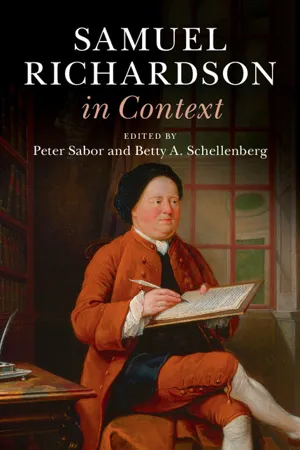 eBook - PDF
- Peter Sabor, Betty A. Schellenberg(Authors)
- 2017(Publication Date)
- Cambridge University Press(Publisher)
Disagreement particularly surrounds the extent to which the increasingly popular genre of the epistolary novel, which flourished following the publication of Les lettres portugaises in 1669, drew on the practices and techniques of actual correspondence. On the one hand are those who see Epistolary Fiction as developing out of real-life letters, with some literary- stylistic additions such as polyphonic point of view. The chief propo- nents of this argument are the authors of the two classic histories of the epistolary novel, Godfrey Frank Singer and Robert Adams Day; critics of French Epistolary Fiction and its emergence from letter-writing manu- als, such as Bernard Bray and Laurent Versini; and, with some qualifica- tions, writers on women’s letters of the period, such as Shari Benstock and Linda Kauffman. 1 On the other hand are those who reject this teleological approach in favour of one that emphasises the functional versatility of the letter in the period, and the difficulty, if not impossibility, of drawing a distinction between its real and fictional incarnations. Adherents to this view include James How, whose discussion of how the establishment of the Post Office in the 1650s opened up new ‘epistolary spaces’, applies to letters of all kinds, 2 and Thomas O. Beebee, whose conception of the let- ter ‘as a Protean form which crystallized social relationships in a variety of ways’ leads him to claim that ‘Epistolary Fiction is a function rather than a thing; it arises when an outside “real” reader takes up the position of the fictional addressee’. As Beebee acknowledges, ‘this line of argument tends to blur the boundary between real correspondence and Epistolary Fiction’. 3 This debate is brought into sharp relief by the case of Samuel Richardson. eBook - ePub
Stories in Letters - Letters in Stories
Epistolary Liminalities in the Anglophone Canadian Short Story
- Rebekka Schuh(Author)
- 2021(Publication Date)
- De Gruyter(Publisher)
Part II: Analytical Case Studies5 The Epistolary Mode as First- and Second-Person Narration in the Single-Letter Story
The epistolary mode, the narrative mode of letters, is commonly classified as a sub-form of first-person narration. Romberg (1962 : 7), for instance, includes the epistolary novel in his Studies in the Narrative Technique of the First-Person Novel (1962). Stanzel ’s (1986: 202, 225) typological circle places the epistolary novel with the first-person narrative situation, noting that, in contrast to the first-person proper, the epistolary mode foregrounds the experiencing, rather than the narrating self. Fludernik ’s more recent narratological study Towards a Natural Narratology (1996) also classifies epistolary narratives as first-person narratives, adding in parentheses that such a classification can only be made “(with obvious caveats and qualifications)” (Fludernik 1996: 168). While it is true that letters are written and thus narrated by a first-person ‘I’10 which is, in Genette’s terms, homodiegetic with regard to the character’s world, in order for a text to be recognizable as an epistolary narrative, this ‘I’ needs to address a ‘you’. Altman (1982), in particular, stresses the importance of the epistolary addressee, arguing that it is this addressee’s “presence alone [which] distinguishes the letter from other first-person forms” (Altman 1982: 87). While diary narratives also frequently address a ‘you’, the ‘you’ of epistolary narratives more strongly shapes the writing itself and, contrary to the diary narrative, the ‘you’ is addressed to become the ‘I’ of a new letter (Altman 1982: 117). Thus, there is a “desire for exchange” (Altman, 1982: 89). In Romberg’s (1962 eBook - PDF
Intricate Relations
Sexual and Economic Desire in American Fiction, 1789-1814
- Karen A. Weyler(Author)
- 2004(Publication Date)
- University Of Iowa Press(Publisher)
30 b A Manner Unq ue stionably More Agreeable and literary history of the novel itself, but critics of American fiction have not, by and large, known what to make of the persistence of epistolarity during the early national era. 1 Although the epistolary status of various in-dividual works has been the subject of recent essays and book chapters, none of these addresses these underlying questions: Why did epistolary fic-tion persist, even thrive, in the United States, comprising more than 30 percent of the novels written by Americans between 1789 and 1814 , as well as a large percentage of the British novels most favored by American read-ers? 2 Why did writers and readers find Epistolary Fiction so engaging? Fi-nally, how did writers and readers use Epistolary Fictions? Here I propose to explore how and why the epistolary form was so ideally suited to the cul-tural politics and social practices of the early Republic and hence so widely appreciated by American writers and readers, for epistolarity was not only an aesthetic narrative choice, but also an ideological one: While virtually all early American novels emphasize the importance of self-examination and discipline, Epistolary Fiction most clearly and consistently articulates this concern, for it creates a world in which the individual’s conduct is con-stantly mirrored, much as Adam Smith postulates in The Theory of Moral Sentiments . By melding the philosophical content of advice texts with the voyeuristic thrills of letter fiction, late eighteenth-century American epis-tolary fiction aptly expresses prevailing Lockean pedagogical theories about reading, writing, and the importance of habit formation—skills of crucial importance, especially for the bourgeois woman and the polity whose symbolic weight she was increasingly coming to bear. As is commonly acknowledged, the eighteenth century was the great age of the letter in English-speaking America, as well as Britain and the Con-tinent.
- Anna de Pretis(Author)
- 2014(Publication Date)
- Gorgias Press(Publisher)
In fact, it seems difficult to talk of an epistolary mode without employing theatrical metaphors. The comparison with theatre underlines another feature of epistolary writing, that is to say the frequency with which correspondents and scholars refer to epistolary utterance as “speaking” and such. A letter is truly regarded as part of an exchange that is preferably 2 Rousset (1964), 67. 3 The issue of “real time” suggests the opportunity of a deep examination of the letter form’s temporality, which I undertake in chapter 6. 4 Versini, (1979), 56. E PISTOLARITY AND S ELF -R EPRESENTATION 65 characterized by its immediacy and directness. In this sense, to elide the fact that the addresser is not actually talking directly to the addressee, but rather writing to an absent person, is part of the epistolary illusion, and what in the end allows the communication to take place. Yet another epistolary paradox is constituted by the fact that letter writers in turn stress that contact with their correspondents (the “bridge” function, as Altman called it), 5 and also choose to emphasize, at times, the distance that separates them (the “barrier”, in Altman’s definition). But the emphasis on separation is never achieved at the expense of the “immediacy” and “truthfulness” of the exchange, because that could mean questioning the sense itself of writing a letter, risking to make it appear as a useless and self-illusory operation. This is why a letter is often regarded as the half of a dialogue. In every letter the interaction of two characters operates, although only one is speaking: the weight of the addressee, as we have seen, is great and peculiar to the letter form. If we choose to define the letter in terms of utterance just to emphasize the linking function that it assumes between addresser and addressee, then we cannot see it as a monologue, but as one in the two parts of a dialogue.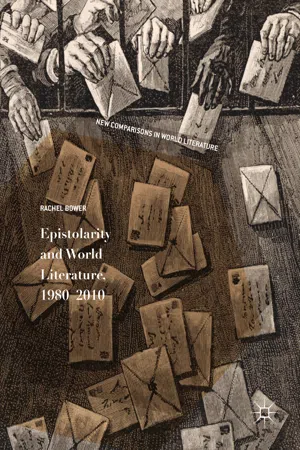 eBook - PDF
- Rachel Bower(Author)
- 2017(Publication Date)
- Palgrave Macmillan(Publisher)
Epistolary scholars are increasingly grappling with the choice between ‘either tracing a chronological development without form, or adumbrat- ing timeless formal relationships’ (Beebee 1999, 9). Janet Gurkin Altman is right when she argues that historical studies ‘inform us of the exist- ence of certain works, but they do not suggest models for reading them’ (1982, 6). 4 Altman’s own work describes with precision how the ‘formal prop- erties’ of letters are used ‘to create meaning’ (4). And yet, although Altman’s widely cited study of epistolarity is useful in analysing the epistolary resurgence, in practice, her reading is quite distinct from my own approach. Unlike Altman, I do not seek to produce a typology of the epistolary form. For our purposes, Altman’s claim that ‘for the let- ter novelist the choice of the epistle as narrative instrument can foster certain patterns of thematic emphasis, narrative action, character types, and narrative self-consciousness’ (9), offers only a partial account of the way in which epistolary conventions and techniques become meaningful in the specific fields in which they are used. It should be clear from the outset that it is not my intention to offer an encyclopaedic catalogue of epistolary works or a free-standing model of a genre. Neither is my task limited to identifying new epistolary conventions or describing the ideals that underpin the revival. My focus on context, however, does not signal a turn away from technique: on the contrary, the disciplines of stylistics and narratology, often overlooked in the study of postcolonial and world literature, are indispensable if we are to ask why authors returned to epis- tolary conventions at this historical moment. Critics of postcolonial literature have long sought to read literature in relation to its historical and socio-political contexts, and in recent years a number of critics have looked to world-systems theory to pursue this challenge anew. eBook - PDF
An Accented Cinema
Exilic and Diasporic Filmmaking
- Hamid Naficy(Author)
- 2018(Publication Date)
- Princeton University Press(Publisher)
The fourth letter highlights the mother's sadness at her family's fragmentation due to the Lebanese civil war, double exile, and dias-pora. The fifth letter adds the last layer to this palimpsest. It recounts the car bombing of the post office that brings to a close the mother-daughter communication. Likewise, the first letter of News from Home (quoted later) centers on the nuclear family relations, particularly the mother-daughter inti-macy and their respective birthdays. Later letters bring new pieces of informa-tion, new concerns, or an added nuance to an old item. The viewing of the epistolary films resembles an archaeological expedition in reverse: instead of digging deeper for information, it is added layer by layer. 13 As a result, theoretically, epistolary spectatorship is more congruent with cog-nitive psychology than with Lacanian psychoanalysis. Each letter compels viewers to revise their earlier hypotheses about the writer(s), addressee(s), and reciter(s) of the letters, the world they inhabit, and the desires and prohibitions under which they are attempting to connect. This spectatorial activity is con-gruent with the epistolary's repetitive structure that results from the inability to close the gap of exile. The gap is reiterated with each letter, turning episto-larity into, if not communication, at least a ritual of communication. Another important structural and thematic component of epistolary com-munitarianism is the trial motif, by which diegetic characters and filmmakers seek to redress a historical wrong by appealing to spectators' sense of morality and justice. Trial films are not epistolary in the strict sense of the term, involv-ing letters. However, they are often made under the regimes of erasure and desire that are similar to the letter-films, and their diegetic characters address the audience directly, using the film itself as an epistle. In this manner, the trial motif transforms a film from film-letter to letter-film. eBook - PDF
The Epistolary Novel
Its Origin, Development, Decline, and Residuary Influence
- Godfrey Frank Singer(Author)
- 2016(Publication Date)
This is a weak and ineffectually sentimental piece of work of rather hybrid nature once attributed to Sarah Wentworth Morton, 1 Cambridge History of American Literature, New York, 1917, I, p. 284. 195 196 THE EPISTOLARY NOVEL but now doubted to be hers at all. It was published in Boston in 1789. By this time the greatest vogue of the epistolary novel in England was past, but our fiction was sired (some people would prefer grandsired) by a novel in letters, which, although its intrinsic worth may not be very high is, none the less, an epistolary novel. A year later, in 1790, the epistolary strain was carried on with the appearance of Memoirs of the Bloomsgrove Family. In a Series of Letters to a Respectable citizen of Philadelphia. The continuation of this title on the title-page of the book itself is interesting because it is in that all-inclusive and didactic tone so common to similar English works some twenty or thirty years previous to this. It is: Con-taining Sentiments on a Mode of Domestic Education, suited to the present State of Society, Government and Manners, in the United States of America: and on the Dignity and Impor-tance of the Female Character. With a Variety of Interesting Anecdotes. The author is Enos Hitchcock, D.D.; the publish-ers are Thomas and Andrews of Boston; the Dedication is to Mrs. Washington. It is scarcely necessary to point out that this highly instructive work is hardly a novel in the current sense of that term. In 1792 came Jeremy Belknap's The Foresters, An Amer-ican Tale: Being a Sequel to the History of John Bull the Clothier. In a Series of Letters to a Friend. This is a curi-ously rambling affair that ought to be read with indicative notes because of its endless topical allusions and political cruxes. It is definitely post-Revolutionary in tone, looking back to the period of accomplishment in the colonies. From that point of view, its present-day interest purely as literature must necessarily prove a very feeble one.
Index pages curate the most relevant extracts from our library of academic textbooks. They’ve been created using an in-house natural language model (NLM), each adding context and meaning to key research topics.

