Literature

Skating to Antarctica
"Skating to Antarctica" is a memoir by Jenny Diski that chronicles her journey to Antarctica as a way to escape her troubled past. The book explores themes of isolation, self-discovery, and the beauty of nature. Diski's writing style is introspective and poetic, making for a captivating read.
Written by Perlego with AI-assistance
Related key terms
1 of 5

2 Key excerpts on "Skating to Antarctica"
 eBook - ePub
- Mark Nuttall, Torben R Christensen, Martin Siegert, Mark Nuttall, Torben R Christensen, Martin Siegert(Authors)
- 2018(Publication Date)
- Routledge(Publisher)
Mojisola Adebayo’s Moj of the Antarctic (2007), for example, combines images taken of the actor/playwright in character in Antarctica with live performance. The play is premised on two journeys: Adebayo’s own on a tourist ship, and a nineteenth-century journey of a black lesbian slave who escapes, cross-dressed as a white man, from the American South to Britain, and thence (on a whaling vessel) to Antarctica. This scenario enables Adebayo to explore the politics of gender, sexual orientation and race in relation to the continent’s literary and exploration history. Through the device of an African storyteller, the action is placed within a mythic frame, which underlines Africa and Antarctica’s ancient history as one continent, and also predicts the melting of the ice and flooding of the land in the future due to global warming. In this and other recent plays, such as Lynda Chanwai-Earle’s Heat (2004), the ice is no longer imagined as simply a backdrop – an impressive spectacle or a minimalist white surface to be marched across – but becomes an agent in its own right – fragile, unstable, unpredictable, threatened and threatening, intrinsically connected with the rest of the globe. Film While drama, poetry and prose are all forms that predate human encounters with Antarctica, film developed alongside it: “The classical era of polar exploration and the start of motion pictures took place at almost the same time” (McKernan 2000: 92). Many of the famous Heroic-Era expeditions, including those led by Carsten Borchgrevink, Jean-Baptiste Charcot, Nobu Shirase, Douglas Mawson, Scott, Shackleton and Amundsen included a kinematograph. Capturing the exotic icescape and its wildlife, as well as the expedition personnel and living conditions, was central to generating popular interest in the expedition, which was in turn important for raising funds to cover the inevitable debts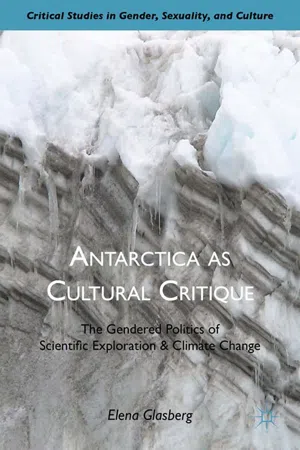 eBook - PDF
Antarctica as Cultural Critique
The Gendered Politics of Scientific Exploration and Climate Change
- E. Glasberg(Author)
- 2012(Publication Date)
- Palgrave Macmillan(Publisher)
Concerned with science, but not scientific in method, Antarctica as Cultural Critique is a book of ice that instead opens horizontally, “like a book open on its spine,” which is how a glaciologist describes the striations of ice and earth in Figure 0.1. An ice book resists reading as detection of data and truth. It engages an open and living ecology—by which I mean a history of studying earth and its environments and their interconnections, as well as less conventionally understood forces, including the effect of the way these forces are studied. Such a book of ice is more of an assemblage of nested ecologies within the hard limits of the material earth. INTRODUCTION xiv In adding my volume to the impossible, shifting ice, I am think- ing backward, from what Gilles Deleuze describes as a “perverse or depraved” and endless search “after signifiers”: Or there’s another way: you see the book as a little non-signifying machine . . . This second way of reading’s intensive . . . There’s nothing to explain, nothing to understand, nothing to interpret . . . this second way of reading . . . relates a book directly to what’s Outside . . . Writing is one flow among others, with no special place in relation to others, that comes into relations of current, countercurrent, and eddy and other flows—flows of shit, sperm, words, action, eroticism, money, and so on. ( Negotiations 7–9) Deleuze is not the first to think of a book as within a flow of other books, of acts, and of life including nonhuman material life. All books flow into all books and acts, as water becomes ice and melts again and refreezes. Such circulations and strange openings—those Holes at the Poles—are what I hope to tap into, connect to, and proliferate. In writing about Antarctica, a place that has been overrun by heroic bodies and narratives, I want to retrieve ice from this history of loss at the “end” of modern time–space.
Index pages curate the most relevant extracts from our library of academic textbooks. They’ve been created using an in-house natural language model (NLM), each adding context and meaning to key research topics.

