Literature

Wuxia Literature
Wuxia literature is a genre of Chinese fiction that typically features martial arts, chivalrous heroes, and adventures set in ancient China. The term "wuxia" translates to "martial hero" and the stories often revolve around themes of honor, loyalty, and righteousness. Wuxia literature has had a significant influence on Chinese popular culture and has gained international recognition through films, television, and literature.
Written by Perlego with AI-assistance
Related key terms
1 of 5
8 Key excerpts on "Wuxia Literature"
 eBook - ePub
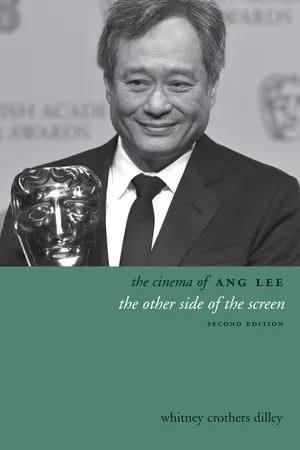
The Cinema of Ang Lee
The Other Side of the Screen
- Whitney Crothers Dilley(Author)
- 2014(Publication Date)
- WallFlower Press(Publisher)
wuxia world, a reader must take these impossible feats as a matter of course.For the Western viewer experiencing wuxia for the first time, the fact that these clan members can run up walls and take off into flight (as the masked robber of the Green Destiny sword does in an early scene), ignoring normal laws of gravity, or can stand on bamboo stalks and sway around dangerously, lightly jumping from one bamboo stalk to another (as Mu Bai and Jen do), without any branches breaking, is initially startling. For Chinese viewers familiar with the wuxia genre, these tropes are well known; Chinese readers have pored over these novels and imagined the scenes of flying warriors in their heads for years—however, the advent of Lee’s film Crouching Tiger, Hidden Dragon marked the first time a director actually risked attempting to portray these fanciful visual images onscreen. The aforementioned “bamboo grove” fight sequence is one example of a common trope for the genre—King Hu’s masterpiece wuxia film, A Touch of Zen (Xianü, 1969), also had a bamboo grove fight scene, but his warriors had to stay at ground level because of the limitations of special effects at that time. In Lee’s world, wuxia warriors magically float at the tips of the trees, and for the uninitiated Western viewer, images like this were entirely new and unexpected, leading to a sense of childlike wonder and exhilaration. Western audience members may have spent a few seconds wondering about these strange occurrences, but ultimately decided that they just did not mind, even if it did not make “sense.” The flight choreographer for these otherworldly scenes was Yuen Wo Ping, who had already come to the attention of mainstream cinemagoers for his work in The Matrix (1999), another visually startling film. (One can only imagine how much more powerful these images would have been had one not already seen the astonishing special effects of the twirling slow-motion flight choreography of The Matrix
- Stephen Teo(Author)
- 2021(Publication Date)
- Routledge(Publisher)
This book is aimed at forging an inroad into the literature on these very topics, and for this effort, it crosses disciplinary boundaries between film studies and philosophical studies. In my previous book on the martial arts film, Chinese Martial Arts Film: The Wuxia Tradition, I focused essentially on the history of the genre and on its development in the Hong Kong cinema, chiefly, and in the mainland Chinese film industry from the start of the new millennium onwards (the genre really only took off in China from 2002 onwards, since it was banned in the mainland from the 1930s until the late 1970s). My new book will complement my previous book by giving a new focus on the philosophy of Chinese martial arts film through a sustained focus on a selected core of films that I deem to be representative for the analytical effort at hand. The genre imparts a general if perhaps superficial knowledge of martial arts and the precepts underlining action and the thinking behind the actions of the protagonists. Apart from its faculties of entertaining audiences around the world, the genre, I believe, is a functioning channel for people, whether Easterners or Westerners, to obtain some cognizance of Chinese thought and history. The focus will indeed be on Chinese philosophy which has a long history, and the reason for this focus is both subjective and objective—subjective inasmuch as Chinese philosophy is of personal interest to me, and objective because no wuxia film could be bereft of Chinese philosophical concepts: they are naturally present in the films albeit lying hidden, being deeply embedded in the structures. My interest in Chinese philosophy takes the form of a search for intellectual roots which coincide with my own fondness for wuxia film and the literature
- Riccardo Moratto, Defeng Li, Riccardo Moratto, Defeng Li(Authors)
- 2022(Publication Date)
- Routledge(Publisher)
11 Are Translated Chinese Wuxia Fiction and Western Heroic Literature Similar? A Stylometric Analysis Based on Stylistic Panoramas1Kan Wu and Dechao LiDOI: 10.4324/9781003298328-1211.1 Introduction
Wuxia, or Chinese martial arts fiction, is a traditional genre of Eastern heroic literature that originated from unique historical and cultural contexts during China’s Warring States Period (475–221 BC) (Huang 2018 , 152). Previous research on Wuxia (Flannery 2012 ; Vander Elst 2017 ; Keulemans 2020 ) has attempted to compare this type of Chinese heroic literature with Western chivalric stories and heroic fantasies – two subgenres of heroic literature deriving from a medieval background (Honegger 2010 , 61). Those studies have demonstrated that Wuxia could be very different from the two Western subgenres in terms of cultural values, religious belief, and above all, worldviews, even though they share the heroic theme. Wu and Li, however, discovered that when readers read a Wuxia translation, they sometimes experience a déjà vu–like reminder of chivalric stories or heroic fantasies (Wu and Li 2018 , 102–3). This raises the question as to whether there are any possible stylistic connections between heroic literature in the East and that in the West. An examination of such stylistic connections may give us clues about the current reception of translated Wuxia and is hence our first research objective. To conduct the investigation, we turn to Stylometry – the statistical analysis of literary styles (Holmes 1998 , 111) – for methodological support.Existing stylometric research on (translated) texts of varied genres has employed a number of stylistic indices at such linguistic levels as characters (Daelemans 2013 ; Eder et al. 2016 ), words/lexes (Jones and Nulty 2019 ; Melka and Místecký 2020 ), n-grams/clusters (Mastropierro 2018 ; Valencia et al. 2019 ), sentences and paragraphs (Rong et al. 2006 ), tones and rimes (Hou and Huang 2020 ), and their combinations (Brocardo et al. 2014 ; Liu and Xiao 2020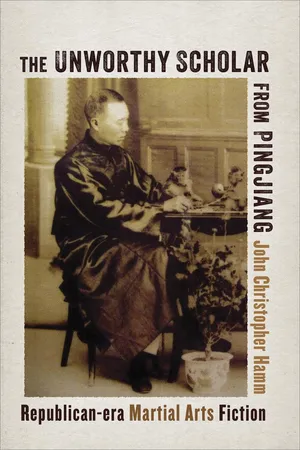 eBook - ePub
The Unworthy Scholar from Pingjiang
Republican-Era Martial Arts Fiction
- John Christopher Hamm(Author)
- 2019(Publication Date)
- Columbia University Press(Publisher)
These elements, their ramifications, and their interactions—including both their synergy and the tensions among them—are essential to the poetics of xiaoshuo as a genre in the Republican era. Embedded in this poetics are an uncertainty about the value of xiaoshuo and presumptions about its limitations that echo critiques by contemporary progressive critics yet derive from premodern discourse on the genre. Xiang Kairan’s contemporary and colleague Bao Tianxiao relates that the Republican vogue for martial arts fiction began, and the modern genre of martial arts fiction was created, through the marriage of Xiang Kairan’s unique literary talents with the entrepreneurial vision of the publisher Shen Zhifang 沈知方 —a marriage for which Bao played matchmaker. Modern scholarship has by and large accepted Bao’s account. Chapter 3 undertakes to unpack this version of the genre’s origins, examining in more detail the question of in just what sense Xiang and Shen’s collaboration may be said to mark the creation of wuxia xiaoshuo as a thematic genre. It begins by reviewing the history of notions of fictional subtypes in China and the late-Qing interest in the question of genre, then proceeds to examine the status before the 1920s of two particular thematic genres: detective fiction and fiction of martial arts and chivalry. Key to my investigation is the fact that Modern Times, one of the founding works of modern martial arts fiction, was featured in Shen Zhifang’s magazine Detective World (Zhentan shijie 偵探世界). I argue that while this placement may seem at first glance no more than an editorial convenience, it was in fact a concrete factor in the process by which wuxia xiaoshuo achieved its modern identity and exemplifies the logic by which the process took place eBook - PDF
Stories for Saturday
Twentieth-Century Chinese Popular Fiction
- Timothy C. Wong(Author)
- 2003(Publication Date)
- University of Hawaii Press(Publisher)
III. Gallantry if “ saturday ” stories as a whole were considered “old-style” in their heyday, those dealing with martial gallantry— wuxia — show us most clearly why. For, to a greater extent than all the others, wuxia stories follow the old formula of making the wildest fantasies seem credible by surrounding them with recognizable fact. The stories, in-cluding the three collected here, greatly exaggerate the capabilities of the martial arts, now displayed through cinematic magic in “kung fu” films: Combatants in a sword fight can leap at will to the top of a mast; a person can fly with the wind and transport people and goods as he does so; a young woman can scamper over rooftops and, unde-tected, enter and exit the heavily guarded house of a fierce warlord. But even in the 1920s, when the three selections here were published, most Chinese readers did not question these feats any more than their grandparents did the similar feats in the narrative Sanxia wuyi (Three heroes and five gallants), 1 published in 1879 and usually pointed to as the immediate predecessor for the vernacular wuxia fiction that followed. Two major reasons for this come quickly to mind. Most obviously, because fiction in China originated with the interaction of fantasy and fact, wuxia stories can be regarded as one fairly natural result. The martial arts do extend human physical capabilities to fantastic lengths. If practitioners are not really superhuman, they are at least extraor-. . . . . . . . . . . . . . . . . . . . . . . . dinary. While there is no evidence any of them levitate, much less fly, real martial artists have been known, for example, to smash bricks with their bare hands. It is stretching the imagination only slightly to depict the best of them as people who can fly, or at least leap to the top of a building or a mast with a single bound. Remember here that the Chinese reader is seeking recreation and not really factual or philosophical truth. eBook - PDF
Stateless Subjects
Chinese Martial Arts Literature and Postcolonial History
- Petrus Liu(Author)
- 2012(Publication Date)
- Cornell East Asia Series(Publisher)
In so doing, he naturalizes the formalism and visibility of women as a newly available and emotionally charged category of political discourse. 92 CHAPTER 2 In order to make the generic conventions of martial arts fiction and those of romance novels compatible, Wang introduces a formula that would logically solve the problem: the Secret Scripture as a training manual. Unlike earlier single-hero martial arts stories, Wang’s novels typically feature two protagonists, a man and a woman, and the romantic entanglement between the two takes precedence over the usual emphasis on features made famous by martial arts films: “trials of the Shaolin monks,” the transformation of the inner self, or graphic descriptions of combat. However, the requirements of romance, now incorporated by the martial arts novel, contradict a central tenet in Confucian moral philosophy and the narrative convention of this genre itself: that superior martial skills have to be learned in conjunction with the transmission of a specific kind of ethics. Conventionally, the wuxia of the martial arts novel can never be acquired independently from solitary reading. Rather, the aspiring disciples have to be part of an institution (a martial clan [bang pai] or a martial school [Shaolin or Wudang]) and undergo a series of (moral) trials and spiritual practice. Therefore, martial arts stories invariably emphasize that a person’s martial powers correspond to that person’s age and experience, and the powerful martial artists are naturally the older characters. By constructing this power differential, martial arts fiction defends and naturalizes a kinship structure that is essential to its conservative sexual ideology. But while older men and women are the “natural superiors” according to this kinship structure, beginning with Wang, the cross-fertilization between martial arts fiction and romance dictates that the novel needs to focus on a younger couple. eBook - PDF
- David Der-wei Wang(Author)
- 2017(Publication Date)
- Belknap Press(Publisher)
While similar in some ways to the liberal arts, wenxue ke reflected the traditional paradigm of Chinese “literature,” one that comprised several different fields of humanistic learn-ing. The prototype of “literature” in modern terms was the program of Literary Works. The core curriculum of Literary Works featured courses such as Methodology of Literary Study, Etymology, Phonology, Literary Trends across Dynasties, and Classical Treatises on Writing. Combin-ing traditional Chinese philological study and the Western Romantic appeal to aesthetic taste, the program paved the way for the eventual institutionalization of literature as an exercise and appraisal of rhetorical forms and fictional narratives. Nevertheless, though it has adopted the Western system of generic classification with categories such as fiction, prose, poetry, and drama, and though it experiments with modern discourses ranging from real-ism to postmodernism, modern Chinese literature continues an implicit dialogue with the traditional concepts of wen and wenxue. That is to say, writers and readers of Chinese literature tend to associate literary 5 Introduction exercises not only with the endeavor of using the word to represent the world, but also with the continued process of illuminating a cosmic pattern, a process that purportedly emanates from the mind and finds manifold manifestations—in corporal, artistic, sociopolitical, and natural terms—in the world. Thus, instead of merely playing with the dialectic of truth versus fiction, modern Chinese literature implants itself at every level of human experience, forming an ever-amplifying orbit of manifestations that are imaginatively evoked and historically embedded. eBook - PDF
Paper Swordsmen
Jin Yong and the Modern Chinese Martial Arts Novel
- Christopher Hamm(Author)
- 2004(Publication Date)
- University of Hawaii Press(Publisher)
There is nothing within the texts, that is, to challenge the identity, or at least the homology and functional overlap, of the literary classics of the high cul-tural tradition, the manuals of the martial arts to which the novels’ pro-tagonists dedicate their efforts and attention, and the texts that Jin Yong’s readers find in their hands. The linkage between the spheres is in fact asserted through such devices as Wanderer ’s employment, for its Chinese title, of the name of a key text within the tale it narrates, and celebrated extradiegetically in fans’ description of the practice of reading Jin Yong’s novels as liangong, “working out,” that is, practicing the martial arts. The Deer and the Cauldron ’s portrayal of a multi- (or at least bi-) level and less than fully harmonious cultural system complicates this picture. The novel’s argument for the authority of the high cultural tradition— embodied in its narrative of the Qing empire’s attainment of internal unity and external strength, as well as in its portrait of the Kangxi emperor as sage-king—is the most overt of any of Jin Yong’s novels. This triumph is achieved, however, at the cost of a widening disjunction between the high tradition and the martial arts. Despite the novel’s acknowledgment of the Manchu’s military virtues, the martial arts remain associated primarily with the Han chauvinists of the Heaven and Earth Society, and the Soci-ety’s final-scene appearance as embittered intransigents seems to exclude not only them but all of Jin Yong’s earlier paladins as well from the rec-onciliation here offered under the aegis of the sages’ teachings. An even greater challenge to the status of the martial arts is presented, of course, by the novel’s protagonist. Wei’s obdurate and self-satisfied refusal to walk the path laid down by previous protagonists further displaces the martial arts from the center of the novel’s vision.
Index pages curate the most relevant extracts from our library of academic textbooks. They’ve been created using an in-house natural language model (NLM), each adding context and meaning to key research topics.

