Politics & International Relations

House of Commons
The House of Commons is the lower chamber of the UK Parliament, responsible for making and passing laws. Its members, known as Members of Parliament (MPs), are elected by the public in general elections. The House of Commons plays a crucial role in scrutinizing the government, debating important issues, and representing the interests of the public.
Written by Perlego with AI-assistance
Related key terms
1 of 5
8 Key excerpts on "House of Commons"
 No longer available |Learn more
- (Author)
- 2014(Publication Date)
- Learning Press(Publisher)
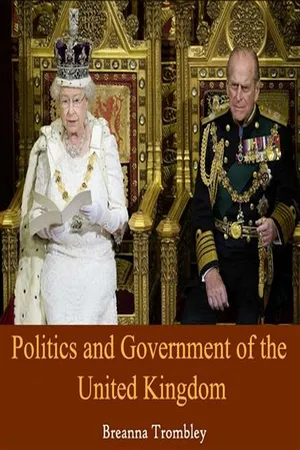
________________________ WORLD TECHNOLOGIES ________________________ Chapter- 4 House of Commons of the United Kingdom Parliament meets at the Palace of Westminster The House of Commons is the lower house of the Parliament of the United Kingdom, which also comprises the Sovereign and the House of Lords (the upper house). Both Commons and Lords meet in the Palace of Westminster. The Commons is a demo-cratically elected body, consisting of 650 members (since 2010 General Election), who are known as Members of Parliament (MPs). Members are elected through the first-past-the-post system by electoral districts known as constituencies. They hold their seats until Parliament is dissolved (a maximum of five years after the preceding election). ________________________ WORLD TECHNOLOGIES ________________________ A House of Commons of England evolved at some point in England during the 14th century and, in practice, has been in continuous existence since, becoming the House of Commons of Great Britain after the political union with Scotland, and also, during the nineteenth century, of the United Kingdom of Great Britain and Ireland after the political union with Ireland. The House of Commons was originally far less powerful than the House of Lords, but today its legislative powers exceed those of the Lords. Under the Parliament Act 1911, the Lords' power to reject most legislative bills was reduced to a delaying power. Moreover, the Government is primarily responsible to the House of Commons; the prime minister stays in office only as long as he or she retains its support. Almost all government ministers are drawn from the House of Commons and, with one brief exception, all prime ministers since 1902. The full, formal style and title of the House of Commons is The Honourable the Commons of the United Kingdom of Great Britain and Northern Ireland in Parliament assembled. eBook - ePub
- Mark Ryan, Steve Foster(Authors)
- 2023(Publication Date)
- Routledge(Publisher)
section 9.4 ). In the context of the representative function, in 2004 the Select Committee on Modernisation of the House of Commons issued a report entitled: ‘Connecting Parliament with the Public’. It opened its report in the following manner:QUOTATIONIn particular, the report set out recommendations to:‘The legitimacy of the House of Commons, as the principal representative body in British democracy, rests upon the support and engagement of the electorate. The decline in political participation and engagement in recent years, as well as in levels of trust in politicians, political parties and the institutions of State should be of concern to every citizen. But it should be of particular concern to the House of Commons.’First Report of Session 2003–04, Connecting Parliament with the Public, HC 368 (2004), p 9.- Make the building more accessible to people.
- Make greater effort to engage young people.
- Encourage better use of information and communication technology, in order to re-connect the public with Parliament.
For a recent publication on political disengagement in general, see E Uberoi and N Johnston, Political Disengagement in the UK: Who Is Disengaged? Briefing Paper CBP7501 (House of Commons Library, 2019).As part of their role, MPs also try to resolve the grievances of their constituents and people can present written petitions to their constituency MP.Bagehot commented that the House of Commons can ‘express the mind’ of the people on issues before it (the expressive function). In other words, the chamber reflects and expresses the will of the people and is the sounding board of the nation.To make laws
In particular, the House of Commons has a dominant role in the passage of legislation as the most important Bills are usually commenced there and the consent of the House of Lords is not always necessary (see section 10.10.1 eBook - ePub
Policy Making in Britain
An Introduction
- Peter Dorey(Author)
- 2014(Publication Date)
- SAGE Publications Ltd(Publisher)
Such a conclusion, though, seriously overlooks or underestimates the important roles that Parliament does play in debating, scrutinizing and subsequently evaluating legislation and other measures of public policy (on which, see the voluminous output by Britain’s foremost academic expert on Parliament, Philip Norton, including: Norton, 1981; Norton, 1985; Norton, 1990; Norton, 1991; Norton, 1993a; Norton, 1998; Norton, 2005; Norton, 2013). Parliament still plays an important role in aspects of the policy process; if it did not exist, some comparable institution would need to be established to perform the valuable functions that are conducted by Parliament with regard to legislation and other aspects of public policy in Britain.Norton has consistently argued that Parliament’s primary roles should be understood as those of policy modification and policy legitimation, rather than actual policy making per se. For example, Norton has suggested that: ‘The importance of Parliament lies in the fact that it is the body through which power is exercised, and concomitantly in the fact that its giving of consent is accepted as legitimate and binding’ (Norton, 1981: 219, emphasis in original. See also Norton 1990).This perspective is clearly echoed by Kalitowski (2008: 707) when she notes that: ‘Parliament … makes a difference to legislation, sometimes in major ways, and more frequently through many minor but significant changes’. Similarly, Cowley observes that ‘MPs may not make policy, but they do constrain and occasionally prod government. All but the most technical of decisions are affected by some consideration of party management’ (Cowley, 2005: 9. See also Judge, 1993: 124–5; Richards, 1988: 14, 15).However, before we examine the specific ways in which Parliament fulfils its role in the policy process, we need to briefly explain the relationship between the House of Commons and the House of Lords, and how they interact.THE RELATIONSHIP BETWEEN THE House of Commons AND HOUSE OF LORDSOnce the franchise was steadily extended via the 1832, 1867 and 1884 Reform/Representation of the People Acts, so the balance of political power and popular legitimacy shifted steadily towards the House of Commons, for this alone was elected. In stark contrast, the House of Lords remained almost wholly comprised of hereditary peers, and the few peers who had not inherited their titles sat in the Second Chamber as ex-officio
- Thomas Christiansen, Elena Griglio, Nicola Lupo, Thomas Christiansen, Elena Griglio, Nicola Lupo(Authors)
- 2023(Publication Date)
- Routledge(Publisher)
UNESCO World Heritage Site—and manage the corporate, commercial, administrative and financial services required for a multi-thousand workforce. The Parliamentary Digital Service staff provides Members and their staff with essential IT equipment and support, as well as building and maintaining key digital services and outputs, such as the website and other applications, such as the tool to submit questions to the government electronically; in addition to contributing to the development of the virtual and hybrid chambers during the coronavirus pandemic, alongside the Parliamentary Broadcasting Unit (part of the Chamber and Participation Team). Individual members in each House can also access advice on procedure from clerks, helping to ensure parliamentary questions and proposed amendments to legislation are in order. They can also use the services of the libraries of each House, which produce briefing papers on a vast range of policy areas, as well as on legislation and business scheduled for debate. The libraries also respond to queries directly for members and their staff provide a bespoke and impartial research and information service. The Interparliamentary Relations Office, based within the Commons, and Overseas Office in the Lords, manages relations with other parliaments and the delegations provided to inter-parliamentary assemblies.As noted earlier, both Houses have undergone periodic reviews of their administrative structures, aiming to modernize and professionalize the administration: for example, the external review of the management of the House of Lords in January 2021 which found that the “organisational performance of the House of Lords lags that of many commercial, public sector and voluntary organisations” (House of Lords Commission, 2021 , p 5). The general trend of reviews in the Commons since the 1974 Compton Review has been to unify the administration, moving away from a federal system of departments. These reviews have also considered the “bureaucratic” leadership of the institution. The House of Commons Service is led by the Clerk of the House, and the House of Lords Administration by the Clerk of the Parliaments. In addition to their roles as the chief procedural adviser to each House, the occupants of these posts also serve as the Accounting Officer and Corporate Officer for their House, under the Parliamentary Corporate Bodies Act 1992. The wide-ranging responsibilities of the Clerks’ roles have led to questioning over whether any single occupant of each post can offer both procedural and management expertise. In 2014, this issue caused the recruitment of the Clerk of the House to be paused and then terminated, due to the concerns of MPs that the selected candidate, the Director of Parliamentary Services in the Australian Parliament, did not have the necessary procedural expertise (Meakin and Geddes, 2022 ). A select committee was established to consider the future of the post and recommended the establishment of a Director General post, with “responsibility for resource allocation and delivery across the House service”, working as a leadership team with the Clerk (House of Commons Governance Committee, 2014 , p60). The External Management Review of the Lords, mentioned above, recommended the creation of a Chief Operating Officer post, to “focus on the work outside the Chamber and Committees i.e., the management of the House as against the business of the House” (House of Lords Commission, 2021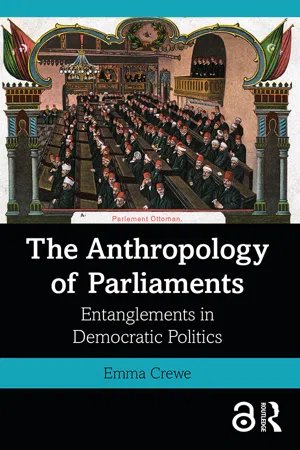 eBook - ePub
The Anthropology of Parliaments
Entanglements in Democratic Politics
- Emma Crewe(Author)
- 2021(Publication Date)
- Routledge(Publisher)
House of Lords: Party and Group Strengths and Voting, LLN 2012/026 , 27 June 2012.8 https://www.parliament.uk/business/lords/whos-in-the-house-of-lords/house-of-lords-expenses/ , accessed 13 October 2020.9 Earl Russell, HL Debates, 13 October 1998, col. 1324.10 Interview with Emma Crewe, spring 2000.11 To be more precise members are elected within parties and then approved by the Committee of Selection and then the House itself whereas Chairs are elected by the whole House.12 Madeleine Westerhout, Personal Secretary to Trump, in ‘Settling into the White House’, The Trump Show episode 1, 12 October 2020, BBC, https://www.bbc.co.uk/programmes/p08v2sq0 , accessed 14 November 2020. Passage contains an image
3
Representing
DOI: 10.4324/9781003084488-3This is a wonderful place, filled overwhelmingly by people who are motivated by their notion of the national interest, by their perception of the public good and by their duty – not as delegates, but as representatives – to do what they believe is right for our country.(John Bercow speaking in the UK House of Commons, 9 September 2019)1What is political representation?
When the Speaker of the UK House of Commons announced his resignation in 2019 he referred to MPs as representatives and not delegates of the public – elected representatives who should use their own judgement in deciding what is best for the country. He was referring to what has become a sacred text for the trustee approach to representation, the words of former English MP Edmund Burke:It ought to be the happiness and glory of a representative to live in the strictest union, the closest correspondence, and the most unreserved communication with his constituents. Their wishes ought to have great weight with him; their opinion, high respect; their business, unremitting attention. It is his duty to sacrifice his repose, his pleasures, his satisfactions, to theirs; and above all, ever, and in all cases, to prefer their interest to his own. eBook - PDF
- David Feldman(Author)
- 2013(Publication Date)
- Hart Publishing(Publisher)
3 Lawyers in the House of Commons DAVID HOWARTH T HE RELATIONSHIP BETWEEN law and politics is complex. It contains a set of legal issues (what is the law about politics?), a set of questions of descriptive political science (which types of decision does a particular political system leave to the law?), a set of normative problems (to what extent should political issues be decided by legal pro-cesses?) and a set of conceptual questions (is law a subset of politics, an input into it, a process within it or an output of it?). It is also a relationship between two sets of people and two sets of institutions, between lawyers and politicians. This chapter will concentrate on this final aspect of the relationship. It examines the intersection between the world of law-yers and the world of politicians, in particular those lawyers who take a direct part in British politics by becoming or attempting to become members of the House of the Commons. I LAWYERS IN THE MODERN House of Commons Max Weber once observed, ‘Modern democracy has been inextricably linked to the modern advocate.’ 1 Nearly a century later, Weber’s hypothesis has become conventional wisdom. Comments of the sort ‘most MPs are lawyers’ or ‘most of the House is composed of those who have served either as barristers or as solicitors’ are commonplace. Indeed, a Google search on the phrase ‘most MPs are lawyers’ returns more than 1400 results. Nor is that view restricted to the often delusional world of internet commentary. If one asks groups of stu-dents, even of students interested in British politics, what proportion of British members of parliament are lawyers, one frequently hears estimates of 60 per cent or more. The truth is different. Lawyers are a minority in British national politics. In the House of Commons elected in 2005, 11.7 per cent of members had practised as barristers or solici-tors. In the House elected in 2010, the figure crept up to 13.8 per cent.
- Woodrow Wilson(Author)
- 2019(Publication Date)
- Columbia University Press(Publisher)
84 CONSTITUTIONAL GOVERNMENT IN UNITED STATES under the laws; and the significant difference between English and American political development is that in America Congress has become part of the Government, while in England Parliament has not. Parliament is still, as it was originally intended to be, the grand assize, or session, of the nation, to criticize and control the Govern-ment. It is not a council to administer it. It does not originate its own bills, except in minor matters which seem to spring out of public opinion or out of the special cir-cumstances of particular interests, rather than out of the conduct of government. Every legislative proposition of capital importance comes to it from the ministers. The duties of the ministers are not merely executive: the ministers are the Government. They look to Parliament, not for commands what to do, but for support in their own programs, whether of legal change or of political policy. What the House of Commons does, therefore, is not to act in any strictly originative way as the law-making body of the nation, but to make and unmake Governments, to prefer now one, and again another, committee of its lead-ing members as its guides, not itself leading but choosing how it shall be led, insisting that the king make the leaders of its own choice the ministers of the crown. It is not the Government, but its leaders are. In the supreme act of in-sisting that they and no others shall be chosen by the crown for the executive posts of government it exhausts its originative force. Thereafter it follows and criticizes as of old. Our Congress, on the contrary, does not make or unmake our Government. The people do that in their selection of a President. And because Congress cannot make or unmake the Government at its pleasure, it usually makes THE HOUSE OF REPRESENTATIVES 85 it a point of pride not to be led by the Government in what it regards as its proper and exclusive sphere, the making of laws. eBook - ePub
- Woodrow Wilson(Author)
- 2017(Publication Date)
- Routledge(Publisher)
It is the reaction of the several parts of government upon one another that gives each part its final form and character. It is useless to study any living structure of government anatomically, in its separate parts. Its character and significance come to light, as I have already several times insisted, only when we study it as an organic whole, living and acting from day to day. Our present study must at every stage be a study of the synthesis of power in the government on the one hand, and of the people's control of the government on the other; for there can be no power which is not synthetic, which does not operate with organic unity; and there can be no constitutional government where the organs of government are not constantly under the control of public opinion. We shall get our completest understanding of the House of Representatives, therefore, if we look at it from two points of view: from the point of view of its synthesis with the other parts of the Government, and from the point of view of its relations to opinion.If you were to ask an Englishman to describe the government of England, he would of course include the Parliament in his description. Indeed, it is likely that he would have more to say of the House of Commons than of anything else. But if you were to speak to him of 'The Government,' he would not think of the House of Commons but only of the ministers, of what we should call the administration, I can make the part played by the House of Representatives in our system clearest by contrasting it with the English House of Commons, and in order to make that contrast carry its full significance it is necessary that we should bear these two meanings of the word government in mind and never confuse them. When I said in a previous lecture that it was not necessary for the full realization of constitutional government that representative assemblies should become a part of the Government,' I meant, of course, a part of the administrative organ of government, the organ that is looked to for initiative, which makes choice of policy and actually controls the life of the nation under the laws; and the significant difference between English and American political development is that in America Congress has become part of the Government, while in England Parliament has not. Parliament is still, as it was originally intended to be, the grand assize, or session, of the nation, to criticize and control the Government. It is not a council to administer it. It does not originate its own bills, except in minor matters which seem to spring out of public opinion or out of the special circumstances of particular interests, rather than out of the conduct of government. Every legislative proposition of capital importance comes to it from the ministers. The duties of the ministers are not merely executive: the ministers are the Government. They look to Parliament, not for commands what to do, but for support in their own programs, whether of legal change or of political policy.
Index pages curate the most relevant extracts from our library of academic textbooks. They’ve been created using an in-house natural language model (NLM), each adding context and meaning to key research topics.

