Politics & International Relations

Johann Baptist Metz
Johann Baptist Metz was a German Catholic theologian known for his contributions to political theology and critical theory. He emphasized the importance of engaging with political and social issues from a theological perspective, particularly in relation to the suffering and struggles of marginalized and oppressed groups. Metz's work has had a significant impact on the intersection of theology, ethics, and politics.
Written by Perlego with AI-assistance
Related key terms
1 of 5

3 Key excerpts on "Johann Baptist Metz"
 eBook - PDF
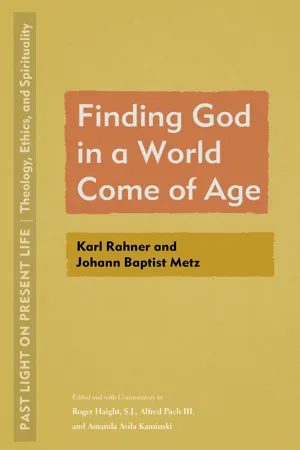
Finding God in a World Come of Age
Karl Rahner and Johann Baptist Metz
- Roger Haight, Alfred Pach, Amanda Avila Kaminski(Authors)
- 2024(Publication Date)
- Fordham University Press(Publisher)
Walter Benjamin and Ernst Bloch helped Metz “to articulate the incipient apocalyptic sensibility that defines for him the ‘mystical’ element in Christianity.” 26 He was also attentive to the Christian–Marxist dialogue that was taking place in Europe at the time. As Metz put it, the Christian–Marxist dialogue and members of the Frankfurt School “ ‘politicized me out of’ the existential and transcendental enchantment of theology.” 27 Metz came to realize that politics and political culture had to play a role in his thought about God. At the same time, political culture needed religion, for without it politics would yield to the dynamics of the survival of the fittest and the INTRODUCTION 17 mighty would prevail and bury pluralism. Political freedom can survive only under transcendent ethical values. Metz also became preoccupied by a concern with human suffering. Theology has to be historically conscious, and thinking in terms of history has to confront historical catastrophes such as the Holocaust. This is theology’s new dilemma: how to find a meaningful logic of history without jumping over or excluding these events. 28 After retiring from Münster in 1993, Metz served as a visiting professor at the University of Vienna until 1997. He then returned to live in Münster until his death in 2019. 29 Some Basic Concepts of Metz. Metz had a global outlook. New theological challenges were arising outside the West. As the influence of Western thinking lost some of its relevance, the voice of suffering around the world gained authority. Concern for social trauma outweighed the quest for logic and coherence. Intellectual credibility was relativized by a need for social moral credibility in the face of human suffering. Metz said that he respected and obeyed “the authority of those who suffer.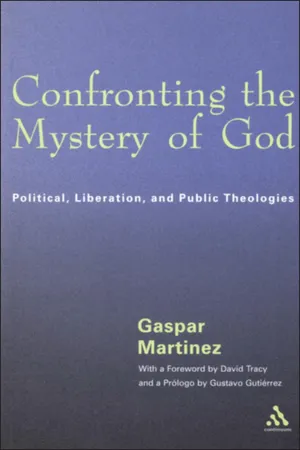 eBook - PDF
Confronting the Mystery of God
Political, Liberation, and Public Theologies
- Gaspar Martinez(Author)
- 2002(Publication Date)
- Continuum(Publisher)
180 With respect to the biblical God, Metz stresses the one-sidedness of Israel in relation to the surrounding high cultures, expressed in its incapacity to distance itself, mythologically or compensatorily, from the terror of reality. 74 Johann Baptist Metz: Political Theology Israel remains an example for Christianity as the people who do not allow themselves to be consoled by myths, as a people, hence, poor in the spirit, prepared to pay the price for their radical monotheism, remaining always a land of screams, unconsoled, always going back to their God, like Job, and asking, Why? There is always an eschatological hope in Israel, a hope based not on a rescuing God beyond history but, in all historical radicalness, on a God who comes to bring history to its end and who, therefore, constitutes history, time-consciousness, and historical responsibility. 181 Metz stresses the importance of history and responsibility through the apocalyptic expectation. Christianity and the church must retrieve that tensional, dramatic expectation in order to be meaningful in the postmodern time. In the apostolic era, Christians lived in and by the near expectation of the definitive coming of the Lord. Christology and apocalyptic, interruptive eschatology belonged together at that time. Christian theology, however, has too often left aside the historical, eschatological, imminent aspect of salva-tion, mainly due to having partially accepted the influence of the Gnostics, through a notion of universal eschatology, later assimilated and passed on by the Neoplatonists. 182 The Metz who confronts postmodernity is a Metz who intensifies his the-ology of history and makes the very concept of history and time dependent on the radicality of the end of history and of the end of time.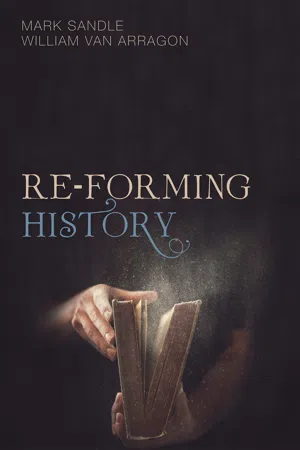 eBook - ePub
- Mark Sandle, William Van Arragon(Authors)
- 2019(Publication Date)
- Cascade Books(Publisher)
2Six Lessons from Johann Baptist Metz
So far, we have argued, the historical profession is in crisis and our methodologies and practices are similarly skewed. So what do we do? The next few chapters lay out some suggestions for how we might re-form and reanimate our liturgies as Christian historians. This short chapter sets the stage by introducing the concept of Christian antihistory , a term that may sound forbidding and adversarial at first. And perhaps it is. This idea comes from German Catholic theologian Johann Baptist Metz, and there are several purposes for unpacking it in this chapter. We offer this brief introduction to Metz’s thought as an example of the ways in which theology can influence and direct the practice of history, and how it can provide insights into renewed historical liturgies based on sacred practices. We will examine the notion of Christian history as antihistory or dangerous memory , concepts which are derived from Metz’s work. We do so to begin asking what a historically minded theologian might have to say to theologically minded Christian historians about the practice of history. We are proposing that Christian history ought somehow to be different—why embark on the project of Christian history otherwise? As asked by William Katerberg, the conversation revolves around this question: Is there such thing as Christian history?43 In other words, are there distinctively or peculiarly Christian practices evident in the work of Christian historians? Is Christian history different —ontologically, ethically, aesthetically, ideologically?44 Do Christian historians know something about the past that non-Christian historians don’t? Do they do history differently? How should it be different?One theologian whose work offers a guide to doing Christian history differently is Metz. We will begin to simply introduce his work and ideas by deriving six lessons from his life and thought, especially circling around his concepts of “antihistory” and “dangerous memory.”45
Index pages curate the most relevant extracts from our library of academic textbooks. They’ve been created using an in-house natural language model (NLM), each adding context and meaning to key research topics.

