Politics & International Relations

Stanley Hauerwas
Stanley Hauerwas is a prominent American theologian and ethicist known for his contributions to Christian ethics and political theology. He is recognized for his emphasis on the importance of the church's role in shaping moral and political life, as well as his critique of liberal democracy and the separation of church and state. Hauerwas's work has had a significant impact on discussions about the intersection of religion and politics.
Written by Perlego with AI-assistance
Related key terms
1 of 5
8 Key excerpts on "Stanley Hauerwas"
 eBook - ePub
Social Selves and Political Reforms
Five Visions in Contemporary Christian Ethics
- C. Melissa Snarr(Author)
- 2007(Publication Date)
- T&T Clark(Publisher)
CHAPTER 3
Stanley Hauerwas and the Church Social
Stanley Hauerwas is one of the most influential ethicists of the late twentieth and early twenty-first centuries, a strong representative of a “communitarian” alternative in Christian ethics, and an abiding critic of academic Christian ethicists’ captivity to (what he names as) the liberal democratic projectAccording to Hauerwas’s read of the history of twentieth-century academic Christian ethics, the story of Christian social ethics in America is the story of democratizing society as part of Christianizing America.1 It would be an understatement to say Hauerwas is not pleased with this story. Indeed, he has built much of his career on criticizing Christian ethicists’ captivity to liberalism and to the project of “Christian America,” including support of democracy as a Christian ideal. Hauerwas sets up much of his framework for the social self, moral formation, and political participation by criticizing the influence of (what he names as) the “liberal theory” of the contemporary political realm and its contamination/ perversion of the church and Christian ethics.In this chapter, I analyze Hauerwas’s understanding of the social self’s formation and his views on politics, political participation, and political reform in four stages. First, I review Hauerwas’s intellectual biography and locate him within current debates over the relation of theology and ecclesiology to Christian ethics. Second, I examine his understanding of the social self’s relation to moral agency, and I explore how this connection provides the foundation for his interpretation of polis and ecclesiology. Here I contend that Hauerwas sees the self as socially formed yet institutionally semi-autonomous, or what I call “socially particularist.” For while Hauerwas maintains that the self “names a relation,” his vision of the social self takes on its Christian character, in part, through its immersion in eccle-sial practices and narratives and relative separation from other institutional formations. Hauerwas therefore grounds his vision of moral formation and agency in ecclesiology by arguing that the church must be a countercultural polis to the formative power of the secular polis. With “training” in Christian traditions, the social self can resist society and the state when these institutions counter the Christian self. eBook - ePub
Moved by God to Act
An Ecumenical Ethic of Grace in Community
- Wm. Carter Aikin(Author)
- 2014(Publication Date)
- Cascade Books(Publisher)
1Stanley Hauerwas
Stanley Hauerwas and Contemporary Theological Ethics The Place of Stanley Hauerwas in the Present TreatmentS tanley Hauerwas rightly refocuses the attention of theological ethics on the importance of community, the distinctiveness of Christian language, and the necessary bond between Christian convictions and their concrete performance. Additionally, his contribution has directed the discourse to look again for the work of an entirely transcendent God amongst the banality of dynamics internal to the Christian worshipping community. He places Jesus Christ at the center of Christian theological ethics and draws from Wesleyan notions of sanctification to argue for the importance of God’s grace for Christian transformation. Even given the great importance he grants to the categories of narrative and tradition, Christian ethics is not merely an ethical system well informed by a storied reality, but is rather the possibility of moral action created anew by means of God’s redeeming and sanctifying grace as given through Jesus Christ. For Hauerwas, Christian ethics is a linguistic retraining of vision and the ability to recognize the eschatological self in a truthful story within a community of memory. In these ways, Hauerwas’ work adds much to the potential for articulating an ecumenical ethic of grace in community.For Hauerwas, Christian ethics is a radical relationship with God’s transforming grace through transformed vision, language, praxis, and community. This trajectory heralds a different consideration of ethics in the contemporary discourse. Christian ethical transformation is a connection between free, authentic human action and God’s redeeming agency. In Hauerwas’ efforts toward this cooperative and relational framework for ethics he places himself in a larger stream of theologians across the centuries who have strived to articulate that same framework for the Christian ethical life. In the present chapter, I hope to situate Hauerwas with regard to this project and show those places in which his theology points to the need for this connection between divine and human agency in the moral life, and articulate the means through which he sees this transformative connection occurring. At the same time, I hope to show how much he can benefit from other theologians who share this overall conviction about the nature of Christian ethics, but articulate the connection with complementary language around the shape of human agency, as such, which would take this ideal of an ethic of grace much further. I contend that the goal to which Hauerwas points the contemporary discourse could be sped along by a close conversation with the theology of Thomas Aquinas and the more complete picture of the causal dependence in human action and its connection with God’s grace that Aquinas can provide. eBook - ePub
Gathered on the Road to Zion
Toward a Free Church Ecclesio-Anthropology
- Daniel Lee Hill(Author)
- 2021(Publication Date)
- Pickwick Publications(Publisher)
1 ).347 . See Dermange, “Église et communautarisme,” 99 –102 . Particularly, Hauerwas is critical of Christian liberalism’s confidence in the ability of political systems to embody principles abstracted from Christian doctrine and the ability of the church to Christianize the world. Instead, Hauerwas argues the church is simply a witness to the truth. Insofar as it pertains to the world, the church’s role is to be the church, remain faithful to their witness, provide a foretaste of the kingdom, and demonstrate to the world its true identity as belonging to God (Hauerwas, Peaceable Kingdom , 100 ).348 . Throughout this chapter, I will use the terms “humanity,” “human creatures,” and “human beings” synonymously. Hauerwas has objected to appealing to the term “person” as a universally accessible category for Christian ethics because he believes that making such a move isolates human creatures from their situatedness in their particular narratives (Hauerwas, “Must a Patient?,” 598 –601 ). However, I would submit that both Balthasar and Zizioulas use “person” in a way that is theologically informed, thus avoiding Hauerwas’s critique. With that being said, Hauerwas frequently uses the term in his writing but does not clarify the specific theological connotations he is bringing to bear on it (See, e.g., Brock and Hauerwas, Beginnings , 10 ; Hauerwas, Approaching the End , 161 ; Hauerwas, Against the Nations , 131 ; Hauerwas, Better Hope , 180 –84)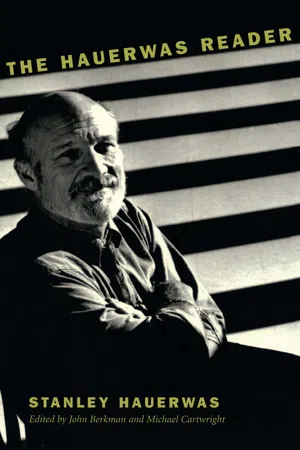 eBook - PDF
- Stanley Hauerwas, John Berkman, Michael Cartwright(Authors)
- 2001(Publication Date)
- Duke University Press Books(Publisher)
The editors hope that this collection of Hauerwas’s essays and the various and sundry scholarly tools will serve to elevate the debate as to the significance of the work of Stanley Hauerwas. Ideally, it will contribute to clearer and more thoughtful evaluations of his contribution, both to the church and to the academy. Hauerwas has undoubtedly charted much new territory. We look to some to trace his steps more carefully and precisely; to others to explore a direction in which Hauerwas has merely pointed; and finally, to others to articulate why Hauerwas’s route is not to be followed. May these debates be of service to the pilgrim people of God. 16. The most comprehensive—though not exhaustive—bibliography of Stanley Hauerwas’s published writings can be found in Samuel Wells, Transforming Fate into Destiny: The Theo-logical Ethics of Stanley Hauerwas (London: Paternoster, 1998), 181–98. Stan the Man: A Thoroughly Biased Account of a Completely Unobjective Person William Cavanaugh Anthologies of an academic’s work do not usually include a characterization of the author as a person. Such is normally reserved for a given professor’s Festschrift, when his or her former students produce a résumé-padding col-lection of their own essays, prefaced by some brief unctuous flattery of the beloved old gasbag. The assumption seems to be that academics’ character and personality have little to do with the work they produce and need appear only in more ‘‘personal’’ tributes. If Stanley Hauerwas is correct, however, in saying that the only interesting arguments are ad hominem, then it is crucial to understand who Stanley is in order to understand what Stanley thinks. If ethics is not just about rules and choices but rather about the narrative-based formation of persons over time, then the story of Stanley Hauerwas will be an aid to cultivating the kind of moral vision that his work has developed. eBook - ePub
Hauerwas the Peacemaker?
Peacebuilding, Race, and Foreign Policy
- Nathan Scot Hosler(Author)
- 2020(Publication Date)
- Pickwick Publications(Publisher)
I take Hauerwas to often sound more ambivalent than he is on the manner of political engagement. His projected ambivalence seeks to break American Christians free of the idolatry of the state. While strongly affirming local “politics” of the congregation, he assumes that the church will collaborate with others on larger issues but will not wholly buy into a particular movement. 273 So while the church and Christians are engaged in public life, there remains a primacy of the church and a hesitation or tentativeness towards nation-state politics. Hauerwas would be in general agreement with Marsha Aileen Hewitt when she states: The term “political theology” is by its nature ambiguous and potentially misleading, for at least two main reasons. The first rests on the assumption that there is something distinctive or uniquely different about a theology that is “political,” as if some or most theology were not in any case “political,” the idea that theology is apolitical is blind to the inner contradiction between repressive and emancipator impulses within theology that become visible through critical self-reflection eBook - ePub
Hauerwas
A (Very) Critical Introduction
- Nicholas M. Healy(Author)
- 2014(Publication Date)
- Eerdmans(Publisher)
Hauerwas’s place within the church is also unusual, at least for someone who is so church-oriented. He is a layperson who writes as a churchman, as one who has been and remains an often very engaged member of various congregations and churches. He was brought up Methodist, has been strongly influenced by Anabaptist theology and polity, displays some sympathies for a certain kind of Catholicism, is now an active Anglican, and gives evidence of a deep concern for the ecumenical church’s life and well-being. Yet while Hauerwas’s Christianity is clearly the product of his background to some degree, it is also very much his own, so much so that he cannot be made to fit within any particular church tradition. In this he perhaps reflects a more general trend in contemporary church culture in which denominational differences are played down in favor of a broader orthodoxy, though his strong emphasis upon certain aspects of Methodism and his appropriation of themes from the Radical Reformation tradition suggest that this may not be quite the case. But he does borrow material from all over. One example of this, as we will see, is Hauerwas’s admiration for a now largely bygone form of Roman Catholicism in which the clergy led and formed an obedient and passive laity, yet he avoids living under anything like that kind of authority himself. Hauerwas’s church is the one he worships in, but he seems to prefer, and talk more about, the one he constructs for himself. Perhaps he is like many of us in this regard, except he is more open and honest about it.Hauerwas is very much an academic, in spite of what he sometimes writes about the university, and obviously thrives in the academic environment. I mean this only as an observation, not at all negatively; academic theological work is necessary, given the present structures of society and the church. It is beneficial when done well, and Hauerwas often does his academic work very well. His work began within the academy as an attempt to change theoretical and methodological presuppositions within the American social ethics tradition. Broadening since far beyond traditionally ethical matters — indeed, he has virtually redefined the term “ethics” — his work has continued to be largely academic in form and content, addressed, that is, to academics who are Christians or who are sympathetic to Christianity in some way. And he has written quite a lot about the academy and its relation to the state and the church.Yet, apart from his earlier work, he does not usually write like a typical academic. His work is never so measured, careful, or dry that it becomes dull. He generally avoids academic jargon and never indulges in the obscurities of Christian metaphysical avant-gardisme. His writings are for the most part occasionalistic and unsystematic. His books are mostly collections of talks and essays in which he does not attempt to lay out a more or less complete treatment of the implications of whatever he is writing about, but instead develops one or two sharply pointed insights. Rhetorically his work is somewhat on the daring side. He believes that “theology not only must risk appearing funny, but it should risk being funny” even as it is also “serious,” “in order to attract some readers who are not accustomed to reading Christian theology” (DF eBook - ePub
Witness Is Presence
Reading Stanley Hauerwas in a Nordic Setting
- Miika Tolonen(Author)
- 2014(Publication Date)
- Resource Publications(Publisher)
A protruding example of such a difference in Hauerwas’s own writings is his insistence on nonviolence. In other words, moral life looks different to a Christian pacifist compared to someone not committed to pacifism. More specifically, the alternatives for morally acceptable behavior in a given situation (e.g. a conflict) differs between the two. With this quote it also becomes obvious that Hauerwas thinks that Christian ethics brings a unique contribution to other ethical perspectives in society: Christian ethics is not for Hauerwas the same as every other ethic. On this view Christian convictions open up a new perspective that would not otherwise be available.Hauerwas further claims that trying to reflect on ethics in a way that does not explicitly flow out of a tradition or community can distort the way “the moral life as well as moral rationality” is understood.671 Ethics based on an alleged natural law, at least in some formulations, comes close to the kind of ahistorical ethics that Hauerwas is critical of.672 Following his reading of Christian tradition (with the need for initiation), and Alasdair MacIntyre’s emphasis on the unavoidability of tradition, Hauerwas above implicitly maintains that it is an illusion to do Christian ethics in a manner that seeks to bypass the role of tradition.Hauerwas also, to continue comparing and contrasting his view with typical Lutheran perspectives, maintains that we do not get to make Christianity up: it “is a given, albeit a complex given.”673 Christians need, on this view, to be initiated into the Christian story. Therefore I would argue that Hauerwas’s perspective is a “first-person perspective” (Kurtén), but one in which the “person” undergoes initiation and therefore transformation.674 There is, according to Hauerwas, a distinct Christian way of seeing and living to be learned, which shapes the way an individual acts.675 eBook - PDF
- H. Seckinelgin, H. Shinoda, H. Seckinelgin, H. Shinoda(Authors)
- 2001(Publication Date)
- Palgrave Macmillan(Publisher)
3 International Politics as Ethical Life 1 Kimberly Hutchings The most notable feature of standard understandings of the meaning of ethics in relation to international affairs, as Walker points out, 2 has been that such understandings are invariably characterised in terms of ethics and or of international affairs, with `ethics' on the one hand and `inter- national affairs' on the other being defined in mutually exclusive terms. The task of international ethics has been seen as the task of bringing an alien (better) ethical vocabulary to tame the recalcitrant actual political (worse) world. This characterisation owes much to the Hobbesian posi- tivist position which identifies right and justice with the remit of the sovereign state, and therefore takes it as axiomatic that inter-state rela- tions are essentially amoral. According to this realist tradition there are no grounds for effective moral judgement beyond the boundaries of states and therefore no point in bringing the vocabularies of ethics and international affairs together. However, the alienation between the ethical and the international is just as much testified to by the explicitly ethical traditions in international relations theory as by real- ism. There are three primary traditions of ethical thinking, all of them closely linked with the economic, social, and political history of liberal- ism. Firstly, there is liberal contractarianism, which grounds the rights of states on the prior natural rights of individuals and sees the state as a voluntary contractual association. Secondly, there is the Kantian trad- ition, which takes on the mantle of the older paradigm of Christian natural law, and which claims that there are universal, transcendentally legislative moral laws, which precede and have priority over any account of the grounds of particular political authorities, and which accords a unique moral status to the human individual on grounds of the capacity to know and enact the moral law.
Index pages curate the most relevant extracts from our library of academic textbooks. They’ve been created using an in-house natural language model (NLM), each adding context and meaning to key research topics.

