Psychology

Gunderson et al 2013 study
The Gunderson et al 2013 study investigated the impact of mindfulness-based cognitive therapy (MBCT) on individuals with a history of depression. The study found that MBCT was effective in reducing the risk of depressive relapse, particularly for those with a history of childhood trauma. These findings suggest that MBCT may be a valuable intervention for preventing recurrent depression in at-risk populations.
Written by Perlego with AI-assistance
Related key terms
1 of 5
8 Key excerpts on "Gunderson et al 2013 study"
 eBook - PDF
De-Medicalizing Misery
Psychiatry, Psychology and the Human Condition
- M. Rapley, J. Moncrieff, J. Dillon, M. Rapley, J. Moncrieff, J. Dillon(Authors)
- 2011(Publication Date)
- Palgrave Macmillan(Publisher)
Despite the heterogeneity of these criteria the DSM committee was successful in constructing a hegemonic meaning with clearly defined borders; controversy was smoothed over with a standardized definition. The Advisory Committee used Gunderson’s description of borderline per- sonality, which he primarily diagnosed in hospitalized women and 76 From Bad Character to BPD which identified borderline personality as a manifestation of severe pathology (Kernber, in Cauwels, 1992). Millon formulated the border- line personality as ‘a disintegrated mix of Histrionic, Dependent and Passive–aggressive personalities, in which the individual’s personal cohesion and interpersonal competence were insidiously deteriorated’ (Millon 1983: 812). Hysteria, which had been the third most popular diagnosis in 1975, was an obscurity by the mid 1980s (Blashfield & McElroy, 1987). BPD was, instead, the most commonly diagnosed of the personality disorders by 1984 (Gunderson & Zanarini, 1987). The prevalence of BPD is now estimated to be ten per cent in outpatient mental health settings, 15–20 per cent in inpatient settings and 30–60 per cent among patients with a diagnosis of personality disorder (Skodol et al., 2002). More recent developments The essential ambiguity of the personality disorder construct has been put to use in policing deviance under a new guise in the last decade. The UK government created the term Dangerous and Severe Personality Disorder (DSPD) in 2001, which created a new class of individual defined – in law – by three criteria: that they must have an identifiable severe personality disorder; pose a high risk of causing serious harm to others; and for these two factors to be causally linked (Seddon, 2008). Such an individual is to be understood within the discourse of risk which ‘dissolves the notion of a subject or a concrete individual, and put[s] in its place a combinatory of factors, the factors of risk’ (Castel, 1991: 281). No longer available
Clinical Handbook of Psychological Disorders
A Step-by-Step Treatment Manual
- David H. Barlow(Author)
- 2021(Publication Date)
- The Guilford Press(Publisher)
Per- sonal Mental Health, 11(3), 157–163. Grant, B. F., Chou, S. P., Goldstein, R. B., Huang, B., Stin- son, F. S., Saha, T. D., et al. (2008). Prevalence, correlates, disability, and comorbidity of DSM-IV borderline person- ality disorder: Results from the Wave 2 National Epidemi- ologic Survey on Alcohol and Related Conditions. Journal of Clinical Psychiatry, 69(4), 533–545. Gunderson, J. G. (1984). Borderline personality disorder. Washington, DC: American Psychiatric Press. Hancock-Johnson, E., Griffiths, C., & Picchioni, M. (2017). A focused systematic review of pharmacological treat- ment for borderline personality disorder. CNS Drugs, 31, 345–356. Harley, R., Sprich, S., Safren, S., Jacobo, M., & Fava, M. (2008). Adaptation of dialectical behavior therapy skills training group for treatment-resistant depression. Journal of Nervous and Mental Disease, 196(2), 136–143. Harned, M. S., Chapman, A. L., Dexter-Mazza, E. T., Mur- ray, A., Comtois, K. A., & Linehan, M. M. (2008). Treat- ing co-occurring Axis I disorders in recurrently suicidal women with borderline personality disorder: A 2-year ran- domized trial of dialectical behavior therapy versus com- munity treatment by experts. Journal of Consulting and Clinical Psychology, 76(6), 1068–1075. Harned, M. S., Korslund, K. E., Foa, E. B., & Linehan, M. M. (2012). Treating PTSD in suicidal and self-injuring women with borderline personality disorder: Develop- ment and preliminary evaluation of a dialectical behavior therapy prolonged exposure protocol. Behaviour Research and Therapy, 50, 381–386. Harned, M. S., Korslund, K. E., & Linehan, M. M. (2014). A pilot randomized controlled trial of dialectical behavior therapy with and without the dialectical behavior therapy prolonged exposure protocol for suicidal and self-injuring women with borderline personality disorder and PTSD. Behaviour Research and Therapy, 55, 7–17. Harned, M.
- Carl W. Lejuez, Kim L. Gratz(Authors)
- 2020(Publication Date)
- Cambridge University Press(Publisher)
In H. E. Adams & P. B. Sutker (Eds.), Comprehensive Handbook of Psychopathology (pp. 509–531). Boston: Kluwer Academic Publishers. Widom, C. S., Czaja, S. J., & Paris, J. (2009). A prospective investi- gation of borderline personality disorder in abused and neg- lected children followed up into adulthood. Journal of Personality Disorders, 23(5), 433–446. Wiggins, J. S. (1991). Agency and communion as conceptual coordinates for the understanding and measurement of inter- personal behavior. In D. Cicchetti & W. M. Grove (Eds.), Think- ing Clearly about Psychology: Essays in Honor of Paul E. Meehl (pp. 89–113). Minneapolis, MN: University of Minnesota Press. ENVIRONMENTAL AND SOCIOCULTURAL INFLUENCES 63 Wood, W., & Eagly, A. H. (2012). Biosocial construction of sex differences and similarities in behavior. In J. M. Olson & M. P. Zanna (Eds.), Advances in Experimental Social Psychology (Vol. 46, pp. 55–123). Burlington, VT: Academic Press. Woodward, H. E., Taft, C. T., Gordon, R. A., & Meis, L. A. (2009). Clinician bias in the diagnosis of posttraumatic stress disorder and borderline personality disorder. Psychological Trauma: Theory, Research, Practice, and Policy, 1(4), 282–290. World Health Organization [WHO]. (2010). International Statis- tical Classification of Diseases and Related Health Problems (10th ed.). Geneva: WHO Press. Yang, J., McCrae, R. R., Costa, P. T., Yao, S., Dai, X., Cai, T., & Gao, B. (2000). The cross-cultural generalizability of Axis-II constructs: An evaluation of two personality disorder assess- ment instruments in the People’s Republic of China. Journal of Personality Disorders, 14(3), 249–263. Yang, K., & Bond, M. H. (1990). Exploring implicit personality the- ories with indigenous or imported constructs: The Chinese case. Journal of Personality and Social Psychology, 58(6), 1087–1095. Zhong, J., & Leung, F. (2009). Diagnosis of borderline personality disorder in China: Current status and future directions. eBook - PDF
Time and Body
Phenomenological and Psychopathological Approaches
- Christian Tewes, Giovanni Stanghellini(Authors)
- 2020(Publication Date)
- Cambridge University Press(Publisher)
Cambridge, UK: Cambridge University Press. Sadikaj, G., Moskowitz, D. S., Russell, J. J., Zuroff, D. C., & Paris, J. (2013). Quarrelsome behavior in borderline personality disorder: Influence of behavioral and affective reactivity to perceptions of others. Journal of Abnormal Psychology, 122(1), 195–207. doi:10.1037/a0030871 206 10 Nobody? Disturbed Self-Experience in Borderline Personality Disorder and Four Kinds of Instabilities Philipp Schmidt Borderline personality disorder (BPD) is a complex psychological condition that severely affects many different aspects of the life of persons suffering from it. Its broad impact is reflected in the Diagnostic and Statistical Manual of Mental Disorders (DSM) criteria of diagnosis, which applies if five out of the nine following symptoms are present: unstable personal relationships, identity disturbances, impulsivity, self-mutilation, affective instability due to reactivity of mood, chronic feelings of emptiness, intense anger or difficulties in controlling anger, peculiar behavior to avoid abandonment, and paranoid ideation. Such a variety of symptoms implies heterogeneity in the manifestation of BPD across individuals. Yet in all cases, BPD appears to consist in “a pervasive pattern of instability of interpersonal relationships, self-image, and affects, and marked impulsivity” (American Psychiatric Association, 2013, p. 663), as the DSM’s definition suggests. While there is general acknowledgment of the BPD instability pattern in the clinical literature, two related questions have remained unanswered.
- Michel Hersen, Jay C. Thomas(Authors)
- 2007(Publication Date)
- SAGE Publications, Inc(Publisher)
The authors thank the clinical assessors of the Behavioral Research and Therapy Clinics for their knowl-edge and expertise and all the subjects who have participated in our past and current studies. R EFERENCES Akhtar, S. (1995). Quest for answers: A primer of understanding and treating severe personality disorders. Northvale, NJ: Jason Aronson. Akhtar, S., Byrne, J. P., & Doghramji, K. (1986). The demographic profile of borderline personality disorder. Journal of Clinical Psychiatry, 47 (4), 196–198. Akiskal, H. S. (2004). Demystifying borderline personality: Critique of the concept and unorthodox reflections on its natural kinship with the bipolar spectrum. Acta Psychiatrica Scandinavica, 110, 401–411. American Psychiatric Association. (2000). Diagnostic and statistical manual of mental disorders (4th ed., Text rev.). Washington, DC: Author. American Psychiatric Association Work Group on Borderline Personality Disorder. (2001). Practice guideline for the treatment of patients with borderline personality disorder. American Journal of Psychiatry, 158 (10), 1–52. Bateman, A., & Fonagy, P. (1999). Effectiveness of partial hospitalization in the treatment of borderline personality disorder: A randomized controlled trial. American Journal of Psychiatry, 156, 1563–1569. Bateman, A., & Fonagy, P. (2001). Treatment of borderline personality disorder with psychoanalytically oriented partial hospitalization: An 18-month follow-up. American Journal of Psychiatry, 158 (1), 36–42. Beck, T. A., Freeman, A., Davis, D. D., & Associates. (1990). Cognitive therapy of personality disorders (2nd ed.). New York: Guilford. Benazzi, F. (2006). Borderline personality–bipolar spectrum relationship . Progress in Neuro-Psychopharmacology and Biological Psychiatry, 30 (1), 68–74. Bjorklund, P. (2006). No man’s land: Gender bias and social constructivism in the diagnosis of borderline personality disorder . Issues in Mental Health Nursing, 27, 3–23. Black, D.
- Galen, Gillian, Aguirre, Blaise(Authors)
- 2013(Publication Date)
- New Harbinger Publications(Publisher)
In the next section, we will examine how BPD is defined. Defining Borderline Personality Disorder Since 1938, when many of the recognizable features of modern BPD were first described, the criteria for defining BPD have changed. Borderline Personality Disorder 11 Here we will look at how BPD is seen today and then characterize it in a way that will be useful beyond today’s definitions. In part 3 of the book we will expand more on the lived experience of BPD and how mindfulness helps to reduce the suffering associated with the symptoms. BPD and the DSM The diagnostic criteria for BPD are outlined in the American Psychiatric Association’s Diagnostic and Statistical Manual of Mental Disorders: DSM-IV-TR (2000), also known as the DSM. For a person to be diagnosed with BPD, the DSM requires that at least five of nine symptoms be present. One problem with this requirement is that there are 256 possible combinations of symptoms that someone with BPD might experience, which means that you could be in a room with 255 other people struggling with BPD, and each of you could have a different set of symptoms. There are very few, if any, other conditions in medicine where there is so much potential variation. Then, within these 256 possible types, how these people function in life can be very different, so there might be some people with BPD who, despite their difficulties, have stable relationships and are employed or completing their education. Others with BPD have a very difficult time holding on to a job, make repeated suicide attempts, or struggle with impul- sivity and have chaotic relationships. For them, visible scars from self- injury and their ways of behaving make it obvious to others that they are struggling with some form of mental illness. As you can see, there can be tremendous variability in the symp- toms that someone with BPD has to deal with. No longer available |Learn more
Career, Work, and Mental Health
Integrating Career and Personal Counseling
- Vernon Zunker(Author)
- 2008(Publication Date)
- SAGE Publications, Inc(Publisher)
Not all of the “grand theories of personality” are obsolete, however; many are currently being actively tested by researchers (Ryckman, 2004). Each personality theory contributes to our understanding of how personalities are developed and how they influence our daily functioning. Helpers must recognize the pervasive nature of personality development, especially the potential influence that personality disorders may have on all life roles. It is generally accepted that personality disorders begin in early child-hood and are chronic in nature; that is, they continue into adulthood (Barlow & Durand, 2005). The goal of this chapter, however, is not to concentrate wholly on the different perspectives of how personality disorders are devel-oped but to adopt more limited perspectives that are interrelated to career choice and development. To accomplish this goal, we return to the study of personality development per se to gain a fuller understanding of the common ground between personality and career development. In the next section, I discuss some personality factors in perspective: genetic, social–cognitive and learning, social relationships, personal goals, and cultural diversity issues. Some Personality Factors in Perspective ________________ The first perspective of personality development—inherited genetic predis-positions—suggests that inherited traits exert some influence on personality development. This position has been widely accepted, but not all theorists agree on the degree of influence from inherited genetic predispositions. Influences are thought to be generated from an interaction between genetic factors and environmental experiences. Thus, the degree of influence of inherited genetic predispositions is unique for each individual. Some person-ality theorists, however, are perfectly clear in their beliefs that some tem-peraments and factors of personality dimensions are influenced by predispositions that were inherited.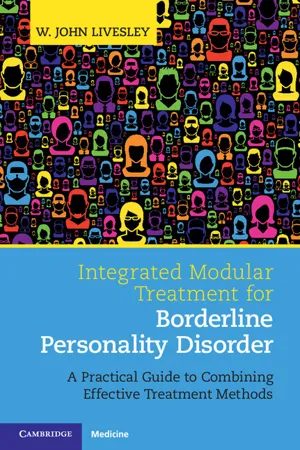 eBook - PDF
Integrated Modular Treatment for Borderline Personality Disorder
A Practical Guide to Combining Effective Treatment Methods
- W. John Livesley(Author)
- 2017(Publication Date)
- Cambridge University Press(Publisher)
Finally, it provides an overview of IMT to orientate the reader to the approach. 1.1 Borderline Personality Disorder BPD occurs in 0.5 to 3.9 per cent (median 1.4 per cent) of the population. 2 Estimates vary because of differences in samples and in definition and assessment methods. Also diagnostic thresholds – the DSM-5 requires the presence of five out of nine criteria – are arbitrary and a different threshold (four or six criteria) would lead to different prevalence rates. Nevertheless, it is obviously a common disorder. Individuals with BPD tend to have significant health and social problems leading to heavy demands on social and health care services. Interestingly, health problems are not confined to mental health difficulties: BPD is associated with a higher incidence of medical conditions that do not appear to be directly related to the disorder. The condition is also associated with increased mortality. Some of this increase is due to suicide – approximately 9 per cent complete suicide. 3 However, suicide does not totally explain increased mortality – other factors contribute as well, including alcohol and substance misuse. 1.1.1 Major Characteristics Throughout this book, BPD is conceptualized as a pervasive pattern of instability and dysregulation involving unstable emotions, unstable and conflicted relationships, unstable sense of self or identity, unstable cognitive processes, and behavioural instability that is assumed to result from the interaction of genetic predispositions and multiple environ- mental influences. The instability is so pervasive and consistent that patients with the disorder have been described as “stably unstable.” 4 However, instability is not the only pervasive feature. The disorder is also characterized by intense conflict and equally intense rigidity.
Index pages curate the most relevant extracts from our library of academic textbooks. They’ve been created using an in-house natural language model (NLM), each adding context and meaning to key research topics.

