Psychology

Preventive Mental Health
Preventive mental health refers to efforts aimed at promoting mental well-being and preventing the onset of mental health issues. This approach focuses on early intervention, education, and support to reduce the risk of developing mental health problems. It encompasses strategies such as stress management, resilience building, and promoting healthy lifestyles to enhance overall mental wellness.
Written by Perlego with AI-assistance
Related key terms
1 of 5
7 Key excerpts on "Preventive Mental Health"
 eBook - ePub
- Michael T. Compton(Author)
- 2009(Publication Date)
- American Psychiatric Association Publishing(Publisher)
1 Prevention in Mental Health An Introduction From the Prevention Committee of the Group for the Advancement of Psychiatry Michael T. Compton, M.D., M.P.H. Carol Koplan, M.D. Christopher Oleskey, M.D., M.P.H. Rebecca A. Powers, M.D., M.P.H. David Pruitt, M.D. Larry Wissow, M.D., M.P.H.An Introduction to Prevention
In recent decades, psychiatrists, psychologists, preventionists, and allied professionals have learned a great deal about risk and protective factors related to mental illnesses, as well as the development of evidence-based interventions addressing such factors and disorders. These developments in the prevention of behavioral disorders, which parallel the medical profession’s increased knowledge about preventing infectious diseases and chronic illnesses, were reviewed in detail in the 1994 Institute of Medicine (IOM) report titled Reducing Risks for Mental Disorders: Frontiers for Preventive Intervention Research (Institute of Medicine 1994). More recently, developments in the field and an overview of worldwide approaches have been described in two World Health Organization publications, Prevention of Mental Disorders: Effective Interventions and Policy Options (World Health Organization 2004a) and Promoting Mental Health: Concepts, Emerging Evidence, Practice (World Health Organization 2004b). These three resources are essential reviews of the expanding knowledge base on mental illness prevention and mental health promotion.In the past, prevention has been the mainstay of the field of public health; however, this population-based approach is now being embraced by the general health sector and is becoming more widely accepted in the mental health field. Both general medicine and psychiatry are primarily involved in individual-level treatment, but with the widespread prevalence of chronic medical and psychiatric illnesses, and an aging population, there has been increased recognition of the importance of a population-based prevention approach. We have previously described what is meant by prevention psychiatry eBook - PDF
Child Psychopathology
From Infancy to Adolescence
- Barry H. Schneider(Author)
- 2014(Publication Date)
- Cambridge University Press(Publisher)
The subsequent section is devoted to reasons for involving the community in the basic design of interventions, not just their delivery. A history of Preventive Mental Health in North America and Europe appears next. The subsequent section is devoted to methodological issues in the evaluation of prevention programs. Guidelines for the successful implementation of prevention programs appear next, followed by several examples of successful prevention programs. Defining prevention Considerable energy has been invested in defining prevention and in delineating different levels of intervention that can be considered preventive. For a program to be considered preventive, it must: (1) be group-oriented; (2) be implemented before the targeted pathology becomes manifest; and (3) be intentional – that is, the purpose of the program must be explicitly prevention-oriented (APA Dictionary of Psychology, 2007 ; Cowen, 1996 ). Although the difference between prevention and treatment may at first seem clear, at times it can be difficult to differentiate the two (O’Connell, Boat and Warner, 2009 ). This is largely due to the fact that experiencing a mental, behavioral or emotional disorder increases the risk of future dysfunction, and so from a developmental perspective, all treatment could be considered prevention because it prevents the individual’s mental health from getting worse (O’Connell et al., 2009 ). In a report on mental health prevention in children and adolescents, O’Connell et al. ( 2009 ) discuss the differences between treatment and prevention. First, it is important to note that treatment and prevention are complementary and are both directed at reducing the long-term suffering caused by mental illness (O’Connell et al., 2009 ). Nonetheless, the two services are quite distinct: Treatment is directed at people already suffering Prevention and mental health promotion 10 eBook - ePub
Counseling Across the Lifespan
Prevention and Treatment
- Cindy L Juntunen, Jonathan P. Schwartz, Cindy L Juntunen, Jonathan P. Schwartz(Authors)
- 2015(Publication Date)
- SAGE Publications, Inc(Publisher)
Of course, mental illness and the appropriate treatment of mental disorders have long been a focus of the national health agenda. However, in the past decade, concerns about mental illness have been increasingly accompanied by recommendations to address health promotion, prevention, and early intervention to support mental health. The cause of this focus is related to the staggering cost of health care, approximately 2 trillion dollars each year, causing President Obama to state that unless there is a “radical shift” to prevention and public health, it will have a negative impact on rising health care costs and ultimately health outcomes (Obama, 2008). In addition, increasing attention is being paid to health and mental health disparities. Research on mental health disparities suggest that only a small percentage of those with mental illness receive appropriate services (U.S. Department of Health and Human Services, 1999, 2001). Mental health disparities are particularly troubling, given the increased support in the research on the efficacy of prevention in meeting mental health and health needs (Crepaz et al., 2006; Durlak & Wells, 1997; Greenberg, Domitrovich, & Bumbarger, 2001).Focusing on prevention, early intervention, and health promotion are consistent with the long-held belief that mental health care students and professionals need to be proficient in interventions appropriate for multiple points along the health and development continuum, including prevention and health promotion (Atkinson, 2002; Vera, Buhin, & Isacco, 2009). The increased attention to prevention is accompanied by several important changes in conceptualizations of health and health care, such as the patient-centered medical home promoted by the Patient Protection and Affordable Care Act (2010). Of particular relevance to this chapter and book are three issues related to mental health promotion and the prevention or treatment of mental illness: attending to the developmental context of health and illness, implementing programs and treatments at multiple points along the continuum of intervention, and developing competencies to work in interprofessional settings.To put these issues in context, it is important to note that the parameters of mental health explicitly include mental, emotional, and behavioral health (O'Connell et al., 2009), drawing attention to the role of lifestyle factors, behaviors, social contexts, and relationships in overall health. Similarly, social and societal determinants of health are emphasized in policies proposed by Healthy People 2020 (Secretary's Advisory Committee, 2010) and the World Health Organization (2008). Societal determinants include environmental factors, such as poverty; infrastructure; and national, regional, and local policies. These factors are related to social networks, which can heavily influence individual choices and, eventually, health. As noted in Healthy People 2020, “Achieving health requires more than just controlling disease. It requires us to assure conditions in which people can be healthy. Health results from the choices that people are able to make in response to the options that they have” (Secretary's Advisory Committee, 2010, p. 4). The recognition of social and societal determinants of health in major national and global policy development reinforces the critical health promotion and illness prevention role of counselors, psychologists, social workers, and other mental health care workers, and is congruent with a social justice perspective on the reduction of health disparities (Vera et al., 2009). Furthermore, acknowledging the interactions between individuals and their environment is consistent with several major theories of development, which are subsequently linked to various interventions presented in this text. eBook - PDF
- George W. Albee, Thomas P. Gullotta(Authors)
- 1996(Publication Date)
- SAGE Publications, Inc(Publisher)
3 4 PRINCIPLES OF PREVENTION Increasingly, it has become clear that the something major must be a new direction, a new approach to the problem of mental and emotional disorders. The old approach—efforts at individual treat-ment—does nothing to reduce the rate, the incidence (new cases), in the population. Only by preventing new cases from occurring can we begin to catch up with the problem. To understand primary prevention, let's begin with the definition used by President Jimmy Carter's President's Commission on Mental Health (1978): Primary prevention in mental health is a network of strategies that differ qualitatively from the field's past dominant approaches. Those strategies are distinguished by several essential characteristics. This . . . section highlights primary prevention's essences using the direct contrast style of saying what it is and what it is not. (1) Most fundamentally, primary prevention is proactive in that it seeks to build adaptive strengths, coping resources, and health in people; not to reduce or contain already manifest deficit. (2) Primary prevention is concerned about total populations, and not about the provision of services on a case-by-case basis. (3) Primary prevention's main tools and models are those of educa-tion and social engineering, not therapy or rehabilitation, al-though some insights for its models and programs grow out of the wisdom derived from clinical experience.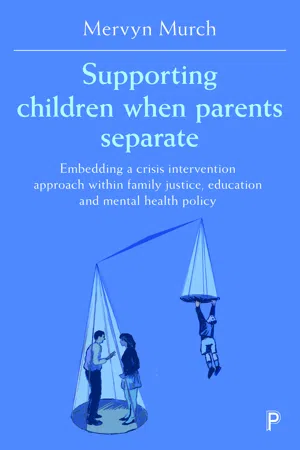 eBook - PDF
Supporting Children when Parents Separate
Embedding a Crisis Intervention Approach within Family Justice, Education and Mental Health Policy
- Murch, Mervyn(Authors)
- 2018(Publication Date)
- Policy Press(Publisher)
Moreover, as reported in the Observer newspaper, a health select committee warned in 2014 that: In many areas early intervention services are being cut or are suffering from insecure or short-term funding. 304 The Institute of Public Policy’s study demonstrates that: ‘The only way to achieve sustained long-term improvements in mental health is 302 M Knapp, D McDaid and M Parsonage (eds) (April 2011) Mental Health Promotion and Mental Illness Prevention: The Economic Case www.lse.ac.uk, Department of Health and LSE PSSRU. 303 C P Cowan and P A Cowan (2012) ‘Prevention: intervening with couples at challenging family transition points’ in A Balfour, M Morgan, C Vincent (eds) How Couple Relationships Shape Our World: Clinical Practice, Research and Policy Perspectives Karnac Books, London at p13. 304 D Boffey (22 December 2015) ‘A&E hit by children’s mental health crisis’ The Observer . 121 to invest more in early intervention and prevention in order to stem the flow of people who need access to more prolonged and expensive forms of treatment.’ 305 The question that therefore needs answering is this: if as a nation we now accept the concept and effectiveness of a preventive approach to reduce known risks in a range of community services, from flood prevention to public health (through inoculations against disease, clean water supply etc), why when it comes to preventing psychosocial dysfunction in conflicted family relations, where the causes and consequences are increasingly well understood through research, are we apparently reluctant to invest in preventive services until matters have reached an emergency level? As my former colleagues and I pointed out elsewhere: One might use a medical diagnosis analogy here: we do not wait for a tumour to get very big before taking action to excise it. Of course early diagnosis does not prevent fatality in every case but it certainly improves the chances of survival. eBook - PDF
School Mental Health
Global Challenges and Opportunities
- Stan Kutcher, Yifeng Wei, Mark D. Weist(Authors)
- 2015(Publication Date)
- Cambridge University Press(Publisher)
Stan Kutcher, Yifeng Wei and Marc D. Weist. Published by Cambridge University Press. © Cambridge University Press 2015. recognizing that the mental health sector alone could not achieve desired outcomes (Parham, 2007). Additional discussions focused on the aims of actions to be taken. Should the focus be on building resilience at the individual level, or should we be concerned with altering social and economic environments and in so doing focus on the prevention of illness at its source? In addition, if we are to build resilience while at the same time addressing the environments that impact negatively on health, then which professions have a role to play in this work? The resultant framework addressed a spectrum of required policies, programs, organizations, and workforce development in order to promote mental health and prevent escalating levels of mental illness, as well as identify the range of required services. This breadth of national mental health policy development that included mental health promotion was a unique characteristic of the Australian focus. Capacity mapping for mental health promotion in four European countries in early 2000 did not find this breadth of action (Jané-Llopis and Anderson, 2005). While these researchers did identify policies about mental health, it was established that mental health promotion was less a priority than the policies indicated, with low levels of resources available in all but one of the countries. For young people, within this policy and strategic approach, concern has not only been about service provision, but early intervention, awareness-raising promotion, and prevention. Additionally, unlike many other countries’ approaches, mental health promotion focusing on mental health and wellbeing (rather than mental illness) for populations as well as individuals, has been an integral component. eBook - PDF
Introduction to Clinical Psychology
Bridging Science and Practice
- Douglas A. Bernstein, Bethany A. Teachman, Bunmi O. Olatunji, Scott O. Lilienfeld(Authors)
- 2020(Publication Date)
- Cambridge University Press(Publisher)
In Review | Illness Prevention and Treatment Programs Target of Prevention and Treatment Examples Cardiovascular disease Programs in schools and workplaces, and through public health campaigns to promote healthy lifestyles and discourage unhealthy ones. Pain Use of biofeedback, progressive relaxation training, cognitive behavior therapy. Cancer Progressive relaxation training, promotion of social support networks, stress management, acceptance-based therapy and cognitive restructuring. HIV/AIDS Training programs to promote safe-sex practices and resist pressure for unsafe practices; medication adherence programs, clean needle exchanges, condom distribution, and public health campaigns. Psychotherapy for patients who are HIV/AIDS positive. Test Yourself 1. The need for health psychologists’ non-pharmacological treatments for pain has dramatically increased because of what has been called the ______ epidemic in the United States. 2. Health psychologists cannot cure cancer, but they are helping cancer patients to _____ their illness. 3. As drugs have reduced nausea associated with cancer chemotherapy, health psychologists have focused on helping patients deal with other disease side effects such as _____, ______, and ______. You can find the answers in the Answer Key at the end of the book. 412 | Clinical Psychology, Health, and Well-Being Psychological interventions aimed at disease prevention or symptom reduction often result in immediate improvements in healthy behav- iors, but unfortunately, these changes may not be maintained long enough to promote a health- ier life. Maintaining behavior change remains one of the most vexing problems in health psychology. For example, smoking cessation pro- grams and anti-smoking medications usually result in significant rates of abstinence, but more than half of smokers who quit resume their habit within a year (e.g., Roberts, Kerr, & Smith, 2013; Robles, Singh-Franco, & Ghin, 2008).
Index pages curate the most relevant extracts from our library of academic textbooks. They’ve been created using an in-house natural language model (NLM), each adding context and meaning to key research topics.

