Psychology

Stages of Sleep
The stages of sleep are divided into non-rapid eye movement (NREM) and rapid eye movement (REM) sleep. NREM sleep consists of four stages, with each stage representing a different level of depth. Stage 1 is light sleep, while stage 4 is the deepest sleep. REM sleep is characterized by rapid eye movements, increased brain activity, and vivid dreams.
Written by Perlego with AI-assistance
Related key terms
1 of 5
11 Key excerpts on "Stages of Sleep"
 eBook - PDF
- Olga Petre-Quadens(Author)
- 2012(Publication Date)
- Academic Press(Publisher)
As a rule, a single variable will not suffice to define a state; a cluster of attributes whose simultaneous and repeated occurrence is highly unique must be present. It is commonly accepted that there are two, and only two states of sleep. They are called REM and NREM sleep and appear to be present in nearly all mammals. The word stage usually refers to a relatively precise, but arbitrary sub-division in the course of a continuously progressing quantitative change. Thus, H 2 0 in the liquid state between o° and io° C could be called stage 1, from io° to 20 0 could be called stage 2, and so on. It is obvious that almost any number of stages could be defined arbitrarily within a state. In the case of the sleeping human, only four stages defined by the EEG have been commonly accepted as subdivisions of NREM sleep. There are no commonly accepted subdivisions of REM sleep. This is not to say that other possibilities have not been proposed. Stage designations, as opposed to state, become a part of discipline and its language only when they have functional significance and/or outstanding use-fulness. The putative functional significance of the NREM EEG stages is that they represent levels in a NREM continuum of depth-of-sleep. These stages also show quantitative changes in several clinical conditions. It may be as-sumed that no stage subdivision of REM sleep has been widely accepted because a clear-cut functional significance does not exist, or has not yet been conclusively shown to exist. Certain divisions of REM sleep have been used from time to time to facilitate an experimental approach. Most frequently, such a division is used for the study of the correlation between a REM sleep-associated variable and some aspect of dreaming. For example, epochs of REM sleep have been differentially classified according to the absolute fre-quency of individual eye movement potentials, heart rate changes, respiratory changes, and so forth. eBook - ePub
Medical Internet of Things
Techniques, Practices and Applications
- Anirban Mitra, Jayanta Mondal, Anirban Das, Anirban Mitra, Jayanta Mondal, Anirban Das(Authors)
- 2021(Publication Date)
- Chapman and Hall/CRC(Publisher)
8 ]. Finally, poor sleep damages various parts of the body, leading to heart failure, brain stroke and several neurological disorders.Normally, sleep behavior is characterized by changes in respiration and heart rate, brain behavior and muscle movements. Currently, there are two sleep stages used during sleep staging analysis, non-rapid eye movement (N-REM) and rapid eye movement (REM), with the third stage being wakefulness (W). The first sleep handbook was edited by Rechtschaffen and Kales (R&K) in 1968 [9 ]. R&K further divided the N-REM sleep stage into four sub-sleep stages: S1, S2, S3 and S4. Clinicians used these sleep standards during analysis of sleep irregularities until 2008, when the American Academy of Sleep Medicine (AASM) [10 ] published a new sleep handbook with small modifications to the R&K rules. AASM further segmented N-REM into three sub-sleep stages: N-REM1, N-REM2 and N-REM3 [10 ]. The sleep cycle generally repeats at regular intervals between NREM stages to REM stages, and each sleep cycle is around 90–110 minutes [11 ]. The quality of sleep ratio differs from person to person according to their age. Stage 1 of N-REM sleep (N-REM1) is light, where the subject’s eye movements and muscle movements are slow. During the N-REM2 sleep stage, eye movements completely stop, and brain response becomes slower. Both N-REM1 and N-REM2 sleep stages are categorized as light sleep stages. Similarly, the N-REM3 and N-REM4 stages are called deep sleep, in which no eye movements occur and some muscle movements appear [12 ]. Finally, in the REM stage breathing increases, and physical movements are rapid.Sleep staging is normally examined using polysomnographic (PSG) recordings from an admitted subject in a clinic. During the PSG test, different physiological recordings are collected from the subject to measure sleep quality during the night. The major recordings include electroencephalogram (EEG), electromyogram (EMG), electrooculogram (EOG) and electrocardiogram (ECG) [13 ]. Among these, the first priority is the EEG signal because it provides information about the brain activity and behavior of the subject during sleep. It can help to characterize the behavior during the different sleep stages by measuring different frequency ranges of EEG signals, which are segmented into the delta band (<3.5 Hz), theta band (4–7 Hz), alpha band (8–13 Hz), beta band (14–30 Hz) and gamma band (30–80 Hz). Ultimately, it can demonstrate the characteristics of different Stages of Sleep [14 eBook - PDF
- George Spilich(Author)
- 2023(Publication Date)
- Wiley(Publisher)
346 C H A P T E R 1 3 Sleep, Dreaming, and Circadian Rhythms NREM Stage 1: Stage 1 (NREM1) is the border between wakefulness and sleep. The eyes open and close and skeletal muscles are still active. People awakened from this stage will often report that they were not actually sleeping. At times, a person in NREM1 will experience the feeling of falling, which may cause an abrupt muscle contraction known as hypnic myoclo- nus, or the myoclonic jerk. NREM1 lasts 5–10 minutes. NREM Stage 2: During Stage 2 (NREM2), the eyes are closing and there is an accompa- nying increase in theta activity. The body is preparing to enter deep sleep. NREM2 typically lasts 10–25 minutes. NREM Stage 3: This stage is characterized by relaxed muscles, slow deep breathing, and a drop in blood pressure. NREM3 is also known as slow-wave sleep or deep sleep; in this stage, the sleeper is exhibiting delta activity in their EEG and is relatively unresponsive to their envi- ronment. An individual awakened from slow-wave sleep may need several minutes to come to full alertness. NREM3 lasts 20–40 minutes and alternates with REM sleep. NREM Stage 4: This is the deepest level of sleep. Many sleep researchers today feel that the distinction between NREM3 and 4 is arbitrary. All sleep beyond NREM2 is defined as phys- ical immobility coupled with slow-wave EEG and relative insensitivity to external stimulation. Once the sleeper reaches NREM3/4, it is typical that they ascend briefly to NREM2, enter a period of REM sleep, and then return to NREM3/4 to complete an NREM–REM cycle. These NREM–REM cycles take about 70–100 minutes at first, but the cycles may lengthen to 90–120 minutes as the night progresses. The cyclical nature of sleep is illustrated by a specialized graph known as a hypnogram. Figure 13.7 shows a typical hypnogram with five different REM episodes spread across 8 hours of sleep. Another of Kleitman’s graduate assistants was a young medical student by the name of William Dement. eBook - PDF
- Simon Green(Author)
- 2017(Publication Date)
- Red Globe Press(Publisher)
To resolve these issues, the American Academy of Sleep Medicine (2005) has introduced a more systematic system. NREM sleep is divided into three stages – N1, N2 and N3: ■ NI is equivalent to stage 1 NREM, when the person is in relaxed wakefulness, between sleeping and waking. There may be loss of conscious awareness and the EEG is dominated by alpha waves. ■ N2 is equivalent to stage 2 NREM, when the person is fully asleep and the EEG is dominated by theta waves along with the occurrence of sleep spindles. ■ N3 is deep slow wave sleep, with the EEG showing at least 20% delta waves. It therefore covers both stages 3 and 4 NREM. N3 NREM is the equivalent of SWS. 48 Biological Rhythms, Sleep and Hypnosis This system has not yet come into widespread use, but is likely to become more popular over the coming years. However, it is not without its critics. Comparisons with the previous system (Rech-tschaffen and Kales, 1968) have found that the new system produces scores for various aspects of sleep that are not highly correlated with scores from the earlier system (Novelli et al., 2009). These discrepan-cies will have to be resolved. For the moment, we shall stay with the classic four stages of NREM sleep, remembering that only stages 3 and 4 represent slow wave sleep. REM sleep EEG shows fast desynchronized activity Rapid eye movements are observed Loss of muscle tone Increases in heart rate and blood pressure Stage 1 NREM Relaxed wakefulness Synchronized EEG Alpha waves, 8–12 Hz Stage 2 NREM Light sleep Theta waves, 4–7 hz Sleep spindles Stage 3 NREM Full sleep Appearance of delta waves, 1–4 Hz Stage 4 NREM Deepest stage of sleep EEG dominated by delta waves Figure 3.1 Stages of Sleep 49 Sleep The progression from drowsiness to stage 4 NREM takes about 75 minutes. At that point, sleep lightens and we move back up into stage 2 NREM. It is at this stage that we move into the fifth stage of sleep, REM sleep. eBook - PDF
Routledge Library Editions: Sleep and Dreams
9 Volume Set
- Various(Author)
- 2021(Publication Date)
- Routledge(Publisher)
In this theory, the canonical sleep stages define functionally dif- ferent states and electrophysiological variations within any given instance of a stage can also define further functional states of the particular stage. On this account two instances of a stage with the same label. such as stage REM, are not On Dream Psychophysiology 159 necessarily functionally equivalent states, even on average. This claim directly challenges the assumption of traditional cognitive epistemology that the expressions "being awake" and "being asleep" can be given a univocal interpretation by means of electrophysiological procedures. We have recently reported data which support Koukkou and Lehmann's approach. We have used digital period amplitude analysis to quantify the EEG (C3, C4), EOG, and EMG activity of eight adult males during sleeping and waking, four of whom were self-reported high frequency dream re callers 5 dreams recalled per week) and four were self-reported low frequency dream recallers I dream recalled per week). These subjects participated in a dream psychophysiology study, the methodolo- gical details of which have been reported elsewhere (53). The experimental awakenings from stage REM in this study oc- curred after 5 minutes in the stage and were followed by a four-minute postawakening rehearsal interval prior to the dream report. The quantitative measures gathered during each 30-second epoch of sleeping and waking are presented in Table 3. For all stage REM awakenings which produced a dream report we correlated the various EEG, EOG, and EMG measures with each other, averaged across hemispheres and preawakening epochs among the four subjects in each group. The results for the self-reported high frequency recallers are presented in Table 4 and for the self-reported low frequency recallers in Table 5. eBook - ePub
Teaching the World to Sleep
Psychological and Behavioural Assessment and Treatment Strategies for People with Sleeping Problems and Insomnia
- David R. Lee(Author)
- 2023(Publication Date)
- Routledge(Publisher)
This stage is again characterised by a reduction in the frequency and an increase in the amplitude of the brain’s electrical waveforms but is identified by the appearance of K-Complexes and Spindles (see Figure 1.1 below), and by a loss of alpha and a predominance of theta wave activity. These K complexes and spindles are enigmatic in their own right with uncertainty about their true function, but they are probably resultant from brainstem control mechanisms that may serve as an external noise suppression feature to allow us to maintain sleep and progress into our deeper “restorative” sleep. These deeper stages three and four of non-REM sleep are collectively known as deep sleep, delta wave sleep, or slow wave sleep (SWS) the latter being the most popular (Rechtschaffen & Kales, 1968). Recently stages three and four have been grouped together and we now refer to stage three only as SWS. Slow wave sleep is again characterised by a reduction in the frequency and an increase in the amplitude of the brain’s electrical wave activity. If one compares these waves to those characteristic of wakefulness in Figure 1.1 below there is a striking difference. These big, deep, and slow waves are the waves that we need to get every twenty-four hours to restore, refresh, and enable us to live functional lives. Without them we suffer the consequences, this kind of sleep is fundamental, and we have got some pretty good evidence as to why. We will look into these after a quick word or two about REM sleep. So sleep stages one to three collectively comprise state of consciousness two—non-REM sleep. State of consciousness three is REM sleep. REM looks like wakefulness (please see Figure 1.1 again), which is why it has sometimes been referred to as “paradoxical” sleep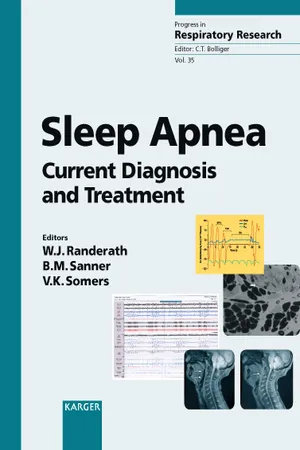 eBook - PDF
Sleep Apnea
Current Diagnosis and Treatment
- W. J. Randerath, B. M. Sanner, V. K. Somers, J. J. F. Herth(Authors)
- 2006(Publication Date)
- S. Karger(Publisher)
All physiological functions are embedded in the circadian day-night cycle. The sleep-wake cycle is closely linked to the circadian cycle and both influence each other. For the newborn child, the adaptation of the sleep-wake cycle to the circadian cycle takes some time and is part of the develop-ment process. With aging, the sleep period mostly occurs during the night phase and becomes as short as 8 h on average. Sleep Structure and Sleep Stages Sleep itself is not a steady state of unconsciousness but has an internal structure with a cyclical time course. To clas-sify sleep, recommendations have been introduced in 1968 by a committee chaired by Rechtschaffen and Kales [2]. They introduced discrete sleep stages based on the observed electroencephalographic (EEG) waves and patterns as well as electrooculographic (EOG) patterns and mental or sub-mental muscle tone derived by electromyography (EMG). The EEG, EOG, and EMG electrodes are attached at well standardized positions. The specific patterns of the sleep stages are described in figure 1. Sleep recording is classi-fied into epochs of 20 or 30 s duration. At the very begin-ning of sleep when the person is still awake, sleepy characteristic EEG waves, alpha waves with 8–12 Hz can be observed. At the onset of sleep, on average about 10–20 min after relaxed wakefulness, muscle tone decreases and on the Randerath WJ, Sanner BM, Somers VK (eds): Sleep Apnea. Prog Respir Res. Basel, Karger, 2006, vol 35, pp 1 3–20 Physiology of Sleep and Dreaming Thomas Penzel Karl Kesper Sleep Laboratory, Department of Internal Medicine, Hospital of Philipps University, Marburg, Germany EEG the alpha waves vanish and slower frequencies, theta waves (4–7 Hz), appear. In addition, specific short patterns called vertex sharp waves can be observed. The EOG shows slow eye movements with eyes closed. This sleep stage, NREM 1, is transitional and does not last long. Often this phase is not perceived as sleep when the person is asked. eBook - PDF
Psychology
Modules for Active Learning
- Dennis Coon, John Mitterer, Tanya Martini, , Dennis Coon, John Mitterer, Tanya Martini, (Authors)
- 2021(Publication Date)
- Cengage Learning EMEA(Publisher)
(a) Average proportion of time adults spend daily in REM sleep and NREM sleep. REM periods add up to about 20 percent of total sleep time. (b) Typical changes in Stages of Sleep during the night. Note that dreams mostly coincide with REM periods. Light sleep (Stage 1 sleep) Marked by small, irregular brain waves and some alpha waves. Sleep spindles Distinctive bursts of brain-wave activity that indicate a person is asleep. Delta waves Large, slow brain waves that occur in deeper sleep (Stages 3 and 4). Deep sleep The deepest form of normal sleep. Rapid eye movements (REMs) Swift eye movements during sleep. REM sleep Stage of sleep marked by rapid eye movements, high-frequency brain waves, and dreaming. Swiss artist Henry Fuseli drew on hypnopompic imagery as an inspiration for his famous painting The Nightmare . SuperStock/SuperStock Copyright 2022 Cengage Learning. All Rights Reserved. May not be copied, scanned, or duplicated, in whole or in part. Due to electronic rights, some third party content may be suppressed from the eBook and/or eChapter(s). Editorial review has deemed that any suppressed content does not materially affect the overall learning experience. Cengage Learning reserves the right to remove additional content at any time if subsequent rights restrictions require it. PSYCHOLOGY MODULES FOR ACTIVE LEARNING 202 experiences that might otherwise seem supernatural or paranormal (Cheyne & Girard, 2009). How important are REM sleep and dreaming? To an-swer this question, sleep expert William Dement awakened volunteers each time they entered REM sleep. Soon, their need for “dream time” grew more urgent. By the fifth night, many had to be awakened 20 or 30 times to prevent REM sleep. When the volunteers were finally allowed to sleep un-disturbed, they dreamed extra amounts. This effect, called REM rebound , explains why alcoholics have horrible night-mares after they quit drinking.
- Kelly Bulkeley Ph.D.(Author)
- 2017(Publication Date)
- Praeger(Publisher)
Sleeping individuals are said to “descend” through the four NREM stages in that their sleep becomes deeper, they become more remote from the external environment, and stronger stimuli are required to wake them up. As shown in figure 5.1, when people fall asleep they descend from stage 1 NREM to stage 2 and then stage 3, and finally stage 4. (In recent years, researchers have decided to collapse stages 3 and 4, so there are only three total stages of NREM sleep.) After being asleep for an hour or so, people will start moving “up” through the NREM stages until, approx- imately 90 minutes after sleep onset, the first REM period of the night begins. Brain wave activity increases dramatically, muscle tone dimin- ishes, heartbeat and respiration become irregular, and blood flow to the genitals increases (resulting in enlargement of the clitoris in women and erection of the penis in men). This first REM period lasts for ten minutes Awakening Sleep stages REM sleep Non-REM stage 1 Non-REM stage 2 Non-REM stage 3 Hours 0 1 2 3 4 5 6 7 8 Figure 5.1 Sleep Laboratories, REM Sleep, and Dreaming 63 or so, and then the sleeping person descends again through the NREM stages to the “deepest” levels of stages 3/4, before rising up to the next REM period. Throughout the night this cyclical alternation between NREM and REM sleep continues, with an average of 90 minutes between the onset of one REM period and the next. As the night goes on, the REM periods increase in duration, and by the end of the night, they may last as long as an hour. Con- versely, the NREM periods become shorter. Stages 1, 3, and 4 more or less dis- appear, and the sleeper alternates almost exclusively between stage 2 NREM sleep and REM until awakening. On average, then, adult humans experience four or five periods of REM sleep each night, which amounts to approxi- mately one-quarter of their total sleep time. eBook - PDF
- Alexander Golbin, Howard Kravitz, Louis G. Keith, Alexander Golbin, Howard Kravitz, Louis G. Keith(Authors)
- 2004(Publication Date)
- Taylor & Francis(Publisher)
ACKNOWLEDGEMENT This presentation is partially supported by Grant RFFI 02-04-49351. References 1. Hobson J. Sleep. New York: Scientific American Library, 1989:1 2. Berger H. Ueber das Elektroenkephalographalogramm des Menchen. J Psychol Neurol 1930;40:160–79 3. Harvey EN, Loomis AL, Hobart GA. Cerebral states during sleep as studied by human brain potentials. Science 1937;85:443–4 4. Aserinsky E, Kleitman N. Regularly recurring periods of eye motility, and concomitant phenomena, during sleep. Science 1953;118:273–4 5. Rechtschaffen A, Kales A. A Manual of Standardized Terminology, Techniques and Scoring System for Sleep Stages of Human Subjects. Los Angeles: BIS/BRI;UCLA, 1968 6. Anders T, Emde R, Parmelee AH, eds. A Manual of Standardized Terminology, Techniques and Criteria for Scoring of States of Sleep and Wakefulness in Newborn Infants. Los Angeles: UCA Brain Information Service, NINDS Neurological Information Network, 1971 7. Scher MS. A developmental marker of central nervous system maturation. Part II. Pediatr Neurol 1988;4:329–36 8. Chase MH. Sleep mechanisms. In Kryger MH, Roth T, Dement WC, eds. Principles and Practice of Sleep Medicine, 3rd edn. Philadelphia: WB Saunders, 2000:93–168 9. Steriade M, McCormic DA, Sejnowski TJ. Thalamocortical oscillation in the sleeping and aroused brain. Science 1993;262:679–85 10. Moore RY, Abrahamson EA, Van Den Pol A. The hypocretin neuron system: an arousal system in the brain. Arch Ital Biol 2001;139:195–205 11. Feinberg I, Campbell I. Kinetics of non-rapid eye movement delta production across sleep and waking in young and elderly normal subjects: theoretical implications. Sleep 2003;26:192–200 Sleep Psychiatry 40 12. Karni A, Tanne D, Rubenstein BS, et al. Dependence on REM sleep of overnight improvement of a perceptual skill. Science 1994;265:679–82 13. Wilson MA, McNaughton BL. Reactivation of hippocampal ensemble memories during sleep. Science 1994;265:676–9 14. DeKoninck J, Christ G, Hebert G, et al. eBook - PDF
- Jon C. Horvitz, Barry L. Jacobs(Authors)
- 2022(Publication Date)
- Cambridge University Press(Publisher)
Between the biological clock and these zeitgebers, we stay, more or less, on a 24- hour sleep–wake cycle. As we fall asleep, we first enter non-REM sleep, when slow synchronized neuronal firing produces EEG of progressively higher amplitude. As we enter the dream state of REM sleep, cortical activity becomes desynchronized, and EEG resembles that of the alert waking state. KEY CONCEPTS • Insomnia is the most common complaint regarding sleep. Both pharmacological and cognitive/behavioral approaches can be effect- ive in treating it. Most drugs used to treat insomnia interact with brain GABA receptors. • Narcolepsy involves intense daytime sleepiness. Some of its symptoms (cataplexy, hypnagogic hallucinations, and sleep paralysis) can be characterized as REM sleep that has escaped into the waking period. Loss of orexin neurons has been identified as a major causal factor leading to narcolepsy. • Those with sleep apnea suffer a loss of oxygen while sleeping due to a blockade of airway passages. This is effectively treated by introducing additional air into the sleeper’s throat. • REM Sleep Behavior Disorder includes a return of muscle tone during REM sleep, which allows the individual to “act out” dreams. This may be dangerous to the sleeper and others. Recent evidence indicates that RBD may be an initial sign of a larger brain pathology that includes Parkinson’s disease and dementia. • Sleep is not merely a passive state that interrupts our waking activities. Many critical processes and functions occur during sleep, including restoration and repair of brain and body, immune system strengthen- ing, memory consolidation, and disposal of the brain’s waste products. TEST YOURSELF 1. How do benzodiazepines work to help overcome insomnia? 2. Why do those with sleep apnea fail to get a full night of deep sleep? 3. What are four important benefits that occur during sleep?
Index pages curate the most relevant extracts from our library of academic textbooks. They’ve been created using an in-house natural language model (NLM), each adding context and meaning to key research topics.

