Technology & Engineering

Non Ferrous Alloys
Non-ferrous alloys are metallic alloys that do not contain iron as a primary component. They are known for their desirable properties such as lightweight, corrosion resistance, and non-magnetic characteristics. Common non-ferrous alloys include aluminum, copper, titanium, and nickel-based alloys, which are widely used in various engineering applications due to their specific properties and performance advantages.
Written by Perlego with AI-assistance
Related key terms
1 of 5

12 Key excerpts on "Non Ferrous Alloys"
 eBook - ePub
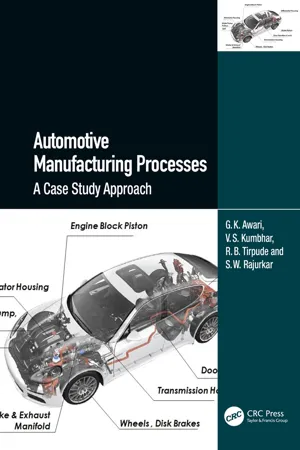
Automotive Manufacturing Processes
A Case Study Approach
- G.K. Awari, V.S. Kumbhar, R.B. Tirpude, S.W. Rajurkar(Authors)
- 2023(Publication Date)
- CRC Press(Publisher)
2 Nonferrous MaterialsDOI: 10.1201/9781003367321-2Learning Objectives
- To understand the details of conventional and modern non ferrous materials their distinctive features and their vehicular applications.
- To cite distinctive physical and mechanical characteristics of nonferrous alloys.
- To understand the details of material decision making process
- To understand the business factors affecting material selection.
2.1 Introduction
Nonferrous metals are those which do not contain iron as the base material. The range of these nonferrous metals includes low-strength metals like aluminium and copper, and high-temperature resistant and high-strength alloys like titanium, molybdenum, etc. There are wider applications of nonferrous metals due to the following advantages:- Anticorrosive properties
- Good magnetic and electrical properties
- Ease of cold forming
- Fusibility and castability
- Lower density
- Attractive colour
- Good formability.
2.2 Nonferrous Materials and Their Alloys
Nonferrous metals are alloys or metals that do not contain any appreciable amounts of iron. All pure metals are nonferrous elements, except for iron (Fe), which is also called ferrite from the Latin “ferrum”, meaning “iron”. Nonferrous metals tend to be more expensive than ferrous metals but are used for their desirable properties, including light weight (aluminium), high conductivity (copper), and nonmagnetic properties or resistance to corrosion (zinc). Some nonferrous materials are used in the iron and steel industries, such as bauxite, which is used for flux in blast furnaces. Other nonferrous metals, including chromite, pyrolusite and wolframite, are used to make ferrous alloys. However, many nonferrous metals have low melting points, making them less suitable for applications at high temperatures. The details of copper, aluminium, lead, zinc, tin and nickel are presented in the following section.
- J. T. Black, Ronald A. Kohser(Authors)
- 2019(Publication Date)
- Wiley(Publisher)
106 CHAPTER 7 106 Nonferrous Metals and Alloys 7.1 Introduction Nonferrous metals and alloys have assumed increasingly important roles in modern technology. Because of their num- ber and the fact that their properties vary widely, they provide an almost limitless range of properties for the design engineer. Although they tend to be costlier than iron or steel, these metals often possess certain properties or combinations of properties that are not available in the ferrous metals, such as: 1. Resistance to corrosion 2. Ease of fabrication 3. High electrical and thermal conductivity 4. Light weight 5. Strength at elevated temperatures 6. Color Nearly all of the nonferrous alloys possess at least two of these listed qualities, and some possess nearly all. Figure 7.1 groups some of the nonferrous metals by attractive engineering property. As a whole, the strength of the nonferrous alloys is gen- erally inferior to that of steel, and the modulus of elasticity is usually lower, a fact that places them at a distinct disadvantage when stiffness is required. Ease of fabrication, however, is often attractive. Those alloys with low melting points are easy to cast in sand molds, permanent molds, or dies. Many alloys have high ductility coupled with low yield points, the ideal combination for cold working. Good machinability is also characteristic of many nonferrous alloys. The savings obtained through ease of fabrica- tion can often overcome the higher cost of the nonferrous mate- rial and justify its use in place of steel. Weldability is the one fabrication area where the nonferrous alloys tend to be some- what inferior to steel. With modern joining techniques, however, it is generally possible to produce satisfactory weldments in all of the nonferrous metals. 7.2 Copper and Copper Alloys General Properties and Characteristics Copper has been an important engineering metal for more than 6000 years. As a pure metal, it has been the backbone of the electrical industry. eBook - PDF
Construction Materials, Methods, and Techniques
Building for a Sustainable Future
- Eva Kultermann, William Spence, Eva Kultermann(Authors)
- 2021(Publication Date)
- Cengage Learning EMEA(Publisher)
Nonferrous metals are those containing little or no iron. In other words, all metals other than iron and steel are nonferrous. Nonferrous metals find numerous uses in construction because of their ease of fabrication (by rolling, forging, casting, welding, or machining), their electrical and thermal conductivity, and their light weight. However, they are somewhat costlier and are selected for use only when they possess the properties to satisfy particular requirements. Since nonferrous metals do not contain iron, they are generally more corrosion-resistant than ferrous metals. Some examples of nonferrous metals are aluminum, aluminum alloys, and copper, which are used in applications such as gutters, roof- ing, pipes, and electrical devices. Nonferrous metals also include brass, nickel, silver, terneplate, tin, lead, and zinc. ALUMINUM Aluminum (chemical symbol Al) is a versatile material used widely in building, and the construction industry is one of its largest Nonferrous Metals L E A R N I N G O B J E C T I V E S Upon completion of this chapter, the student should be able to: ● Select nonferrous metals for a wide range of applications. ● Know the properties of nonferrous metals and how these will influence a material’s performance. ● Understand the effects of galvanic corrosion and how to design to eliminate it. consumers. Aluminum is lightweight, having a specific gravity of only 2.7 times that of water and approximately one-third that of steel. Pure aluminum melts at 1220°F (665°C), considerably lower than the melting point of other structural metals. It also is relatively weak as far as mechanical properties are concerned. Aluminum deforms elastically about three times more than steel under comparable loading. It can be strengthened by alloying, cold-working, or strain hardening. Aluminum alloys do not lose ductility or become brittle at cryogenic (low) temperatures. eBook - PDF
Fundamentals of Materials Science and Engineering
An Integrated Approach
- William D. Callister, Jr., David G. Rethwisch(Authors)
- 2016(Publication Date)
- Wiley(Publisher)
compacted graphite iron 13.3 Nonferrous Alloys • 573 Steel and other ferrous alloys are consumed in exceedingly large quantities because they have such a wide range of mechanical properties, may be fabricated with relative ease, and are economical to produce. However, they have some distinct limitations, chiefly (1) a relatively high density, (2) a comparatively low electrical conductivity, and (3) an inherent susceptibility to corrosion in some common environments. Thus, for many applications it is advantageous or even necessary to use other alloys that have more suitable property combinations. Alloy systems are classified either according to the base metal or according to some specific characteristic that a group of alloys share. This section discusses the fol- lowing metal and alloy systems: copper, aluminum, magnesium, and titanium alloys; the refractory metals; the superalloys; the noble metals; and miscellaneous alloys, including those that have lead, tin, zirconium, and zinc as base metals. Figure 13.6 represents a clas- sification scheme for nonferrous alloys discussed in this section. On occasion, a distinction is made between cast and wrought alloys. Alloys that are so brittle that forming or shaping by appreciable deformation is not possible typi- cally are cast; these are classified as cast alloys. However, those that are amenable to mechanical deformation are termed wrought alloys. In addition, the heat-treatability of an alloy system is mentioned frequently. “Heat- treatable” designates an alloy whose mechanical strength is improved by precipitation hardening (Sections 11.10 and 11.11) or a martensitic transformation (normally the former), both of which involve specific heat-treating procedures. Copper and Its Alloys Copper and copper-based alloys, possessing a desirable combination of physical properties, have been used in quite a variety of applications since antiquity. eBook - PDF
Materials Science and Engineering, P-eBK
An Introduction
- William D. Callister, Jr., David G. Rethwisch, Aaron Blicblau, Kiara Bruggeman, Michael Cortie, John Long, Judy Hart, Ross Marceau, Ryan Mitchell, Reza Parvizi, David Rubin De Celis Leal, Steven Babaniaris, Subrat Das, Thomas Dorin, Ajay Mahato, Julius Orwa(Authors)
- 2020(Publication Date)
- Wiley(Publisher)
However, they have some distinct limitations, chiefly (1) a relatively high density, (2) a comparatively low electrical conductivity, and (3) an inherent susceptibility to corrosion in some common environments. Thus, for many applications it is advantageous or even necessary to use other alloys that have more suitable property combinations. Alloy systems are classified either according to the base metal or according to some specific characteristic that a group of alloys share. This section discusses the following metal and alloy systems: copper, aluminium, magnesium, and titanium alloys; the refractory metals; the superalloys; the noble metals; and miscellaneous alloys, including those that have nickel, lead, tin, zirconium, and zinc as base metals. Figure 11.6 represents a classification scheme for nonferrous alloys discussed in this section. FIGURE 11.6 Classification scheme for the various nonferrous alloys. Aluminium alloys Copper alloys Magnesium alloys Titanium alloys Refractory metals (Nb, Mo, W, Ta) Superalloys (Co, Ni, Fe-Ni) Noble Metals (Ag, Au, Pt) Nickel alloys Tin alloys Lead alloys Zirconium alloys Zinc alloys Nonferrous alloys Ferrous alloys Metal alloys On occasion, a distinction is made between cast and wrought alloys. Alloys that are so brittle that forming or shaping by appreciable deformation is not possible typically are cast; these are classified as cast alloys. However, those that are amenable to mechanical deformation are termed wrought alloys. In addition, the heat‐treatability of an alloy system is mentioned frequently. ‘Heat‐treatable’ designates an alloy whose mechanical strength is improved by precipitation hardening (section 11.10) or a martensitic transformation (normally the former), both of which involve specific heat‐treating procedures. Copper and its alloys Copper and copper‐based alloys possessing a desirable combination of physical properties have been used in quite a variety of applications since antiquity.
- Donald Askeland, Wendelin Wright, Donald Askeland(Authors)
- 2020(Publication Date)
- Cengage Learning EMEA(Publisher)
Nonferrous Alloys C H A P T E R 14 Have You Ever Wondered? ● In the history of mankind, which came first: copper or steel? ● Why does the Statue of Liberty have a green patina? ● What materials are used to manufacture biomedical implants for hip prostheses? ● Are some metals toxic? ● What materials are used as “catalysts” in the automobile catalytic converter? What do they “convert”? Chapter Learning Objectives The key objectives of this chapter are to ● Recognize and explain the various designations for different alloys of nonferrous metals. ● Identify the uses for common nonferrous metals and alloys. ● Identify the materials properties of common nonferrous metals and alloys. N onferrous alloys (i.e., alloys of elements other than iron) include, but are not limited to, alloys based on aluminum, copper, nickel, cobalt, zinc, precious metals (such as Pt, Au, Ag, Pd), and other metals (e.g., Nb, Ta, W). In this chapter, we will briefly explore the properties and applications of Cu, Al, and Ti alloys in load-bearing applications. We will not discuss the electronic, magnetic, and other applications of nonferrous alloys. In many applications, weight is a critical factor. To relate the strength of the material to its weight, a specific strength, or strength-to-weight ratio, is defined as Specific strength 5 strength density (14-1) Copyright 2022 Cengage Learning. All Rights Reserved. May not be copied, scanned, or duplicated, in whole or in part. Due to electronic rights, some third party content may be suppressed from the eBook and/or eChapter(s). Editorial review has deemed that any suppressed content does not materially affect the overall learning experience. Cengage Learning reserves the right to remove additional content at any time if subsequent rights restrictions require it. Chapter 14 Nonferrous Alloys 504 Table 14-1 compares the specific strengths of steel, some high-strength nonferrous alloys, and polymer-matrix composites.
- Donald Askeland, Wendelin Wright(Authors)
- 2018(Publication Date)
- Cengage Learning EMEA(Publisher)
Nonferrous Alloys C H A P T E R 14 Have You Ever Wondered? ● In the history of mankind, which came first: copper or steel? ● Why does the Statue of Liberty have a green patina? ● What materials are used to manufacture biomedical implants for hip prostheses? ● Are some metals toxic? ● What materials are used as “catalysts” in the automobile catalytic converter? What do they “convert”? Chapter Learning Objectives The key objectives of this chapter are to ● Recognize and explain the various designations for different alloys of nonferrous metals. ● Identify the uses for common nonferrous metals and alloys. ● Identify the materials properties of common nonferrous metals and alloys. N onferrous alloys (i.e., alloys of elements other than iron) include, but are not limited to, alloys based on aluminum, copper, nickel, cobalt, zinc, precious metals (such as Pt, Au, Ag, Pd), and other metals (e.g., Nb, Ta, W). In this chapter, we will briefly explore the properties and applications of Cu, Al, and Ti alloys in load-bearing applications. We will not discuss the numerous electronic, magnetic, and other applications of nonferrous alloys. In many applications, weight is a critical factor. To relate the strength of the material to its weight, a specific strength , or strength-to-weight ratio, is defined as Specific strength 5 strength mass density (14-1) Copyright 2019 Cengage Learning. All Rights Reserved. May not be copied, scanned, or duplicated, in whole or in part. Due to electronic rights, some third party content may be suppressed from the eBook and/or eChapter(s). Editorial review has deemed that any suppressed content does not materially affect the overall learning experience. Cengage Learning reserves the right to remove additional content at any time if subsequent rights restrictions require it. Chapter 14 Nonferrous Alloys 504 Table 14-1 compares the specific strengths of steel, some high-strength nonferrous alloys, and polymer-matrix composites. eBook - PDF
- John Tien(Author)
- 2012(Publication Date)
- Academic Press(Publisher)
Chapter II HIGH-STRENGTH NONFERROUS ALLOYS Stephen M. Copley D E P A R T M E N T O F M A T E R I A L S S C I E N C E U N I V E R S I T Y O F S O U T H E R N C A L I F O R N I A L O S A N G E L E S , C A L I F O R N I A James C. Williams D E P A R T M E N T O F M E T A L L U R G Y A N D M A T E R I A L S S C I E N C E C A R N E G I E — M E L L O N U N I V E R S I T Y P I T T S B U R G H , P E N N S Y L V A N I A I. I N T R O D U C T I O N In a paper presented at the Third International Conference on the Strength of Metals and Alloys at Cambridge last year, Dr. A. J. Ken-nedy, Director of the British Non-Ferrous Metals Research Association, concluded that the world consumption of nonferrous alloys and the world pattern of their use will not be greatly influenced by foreseeable improvements in their strength (Kennedy, 1973). Although such a state-ment may well be justified, it should be recognized that increased usage is not the only reason for developing alloys with improved strength. Such alloys may be essential, even though used in small quan-tities, for the development of a new device or machine. In this case, it is often the alloy user, not the alloy producer, who must develop a satis-factory alloy. Indeed, the special needs for high-performance alloys in 3 4 Stephen Μ. Copley and James C. Williams TABLE I Strengthening Methods for Nonferrous Alloys Strengthening method Description Solution Solute is added at concentrations less than the solubility limit Precipitation Solute is added at concentrations greater than the solu-bility limit Substructure and interfaces Control of dislocation or grain substructure and inter-phase boundaries Dispersion Dispersoid is added by methods other than precipitation Composite Aligned fibers or plates are added the aerospace industry have concerned the authors for most of their professional careers. Alloys based on the nonferrous metals constitute a rich source of materials with unique and useful properties. No longer available |Learn more
- William D. Callister, Jr., David G. Rethwisch(Authors)
- 2020(Publication Date)
- Wiley(Publisher)
However, they have some distinct limitations, chiefly (1) a relatively high density, (2) a comparatively low electrical conductivity, and (3) an inherent susceptibility to corrosion in some common environments. Thus, for many applications it is advantageous or even necessary to use other alloys that have more suitable property combinations. Alloy systems are classified either according to the base metal or according to some specific characteristic that a group of alloys share. This section discusses the following metal and alloy systems: copper, aluminum, magnesium, and titanium alloys; the refractory metals; the superalloys; the noble metals; and miscel- laneous alloys, including those that have nickel, lead, tin, zirconium, and zinc as base metals. Figure 11.6 represents a classification scheme for nonferrous alloys discussed in this section. On occasion, a distinction is made between cast and wrought alloys. Alloys that are so brittle that forming or shaping by appreciable deformation is not possible typi- cally are cast; these are classified as cast alloys. However, those that are amenable to mechanical deformation are termed wrought alloys. In addition, the heat-treatability of an alloy system is mentioned frequently. “Heat- treatable” designates an alloy whose mechanical strength is improved by precipitation hardening (Section 11.10) or a martensitic transformation (normally the former), both of which involve specific heat-treating procedures. wrought alloy 11.3 NONFERROUS ALLOYS 390 • Chapter 11 / Applications and Processing of Metal Alloys Copper and Its Alloys Copper and copper-based alloys possessing a desirable combination of physical proper- ties have been used in quite a variety of applications since antiquity. Unalloyed cop- per is so soft and ductile that it is difficult to machine; also, it has an almost unlimited capacity to be cold worked. eBook - PDF
Materials Science and Engineering
An Introduction
- William D. Callister, Jr., David G. Rethwisch(Authors)
- 2018(Publication Date)
- Wiley(Publisher)
However, they have some distinct limitations, chiefly (1) a relatively high density, (2) a comparatively low electrical conductivity, and (3) an inherent susceptibility to corrosion in some common environments. Thus, for many applications it is advantageous or even necessary to use other alloys that have more suitable property combinations. Alloy systems are classified either according to the base metal or according to some specific characteristic that a group of alloys share. This section discusses the following metal and alloy systems: copper, aluminum, magnesium, and titanium alloys; the refractory metals; the superalloys; the noble metals; and miscel- laneous alloys, including those that have nickel, lead, tin, zirconium, and zinc as base metals. Figure 11.6 represents a classification scheme for nonferrous alloys discussed in this section. On occasion, a distinction is made between cast and wrought alloys. Alloys that are so brittle that forming or shaping by appreciable deformation is not possible typi- cally are cast; these are classified as cast alloys. However, those that are amenable to mechanical deformation are termed wrought alloys. In addition, the heat-treatability of an alloy system is mentioned frequently. “Heat- treatable” designates an alloy whose mechanical strength is improved by precipitation hardening (Section 11.10) or a martensitic transformation (normally the former), both of which involve specific heat-treating procedures. wrought alloy 11.3 NONFERROUS ALLOYS 362 • Chapter 11 / Applications and Processing of Metal Alloys Copper and Its Alloys Copper and copper-based alloys possessing a desirable combination of physical proper- ties have been used in quite a variety of applications since antiquity. Unalloyed cop- per is so soft and ductile that it is difficult to machine; also, it has an almost unlimited capacity to be cold worked. eBook - PDF
- George Murray, Charles V. White, Wolfgang Weise(Authors)
- 2007(Publication Date)
- CRC Press(Publisher)
Examples of property management techniques are shown in Table 16.9 and Table 16.10. 16.6 OTHER NONFERROUS ALLOYS 16.6.1 S UPERALLOYS (N ICKEL AND C OBALT B ASE ) Nickel-based alloys, although not used in the quantities of the copper and alu-minum alloys, still play a major role in industrial applications, particularly at elevated temperatures. Superalloys have been defined as those possessing good high-temperature strength and oxidation resistance. They are alloys of nickel, cobalt, and iron that contain large amounts of chromium (e.g., 25 to 30%) for oxidation resistance. They are generally classified as iron–nickel-, nickel-, and cobalt-based alloys. For many years cobalt-based superalloys held the lead, but owing to the precarious availability of cobalt, primarily from South Africa, the TABLE 16.9 Typical Mechanical Properties of Representative Nonheat-Treatable Wrought Aluminum Alloys Alloy Nominal Composition Temper Tensile Strength (ksi) Yield Strength (ksi) Elongation (% in 2 in) Hardness (Brinell hardness number [Bhn]) 1199 99.99 + % Al 0 6.5 1.5 50 — H18 17 16 5 — 1100 99 + % Al 0 13 5 35 23 H14 18 17 9 32 H18 24 22 5 44 3003 1.2% Mn 0 16 6 30 28 H14 22 21 8 40 H18 29 27 4 55 5005 0.8% Mg 0 18 6 36 30 H14 23 22 6 41 H18 29 28 4 51 3004 1.2% Mn 0 26 10 20 45 1.0% Mg H34 35 29 9 63 H38 41 36 5 77 5052 2.5% Mg 0 28 13 26 47 H34 38 31 19 68 H38 42 37 7 77 5456 5.1 % Mg 0 45 23 24 70 0.8% Mn H343 56 43 2 94 Ferrous and Nonferrous Metals for Special Applications 467 nickel-based superalloys have now been studied more extensively and have replaced many of the cobalt-based alloys. The physical metallurgy of these alloys is due basically to the precipitation of a very fine distribution of small particles, primarily Ni 3 Al and Ni 3 Ti, that have the generic name gamma prime in a gamma matrix (Figure 16.10). The nickel–iron-based alloys also have a γ phase in the form of a Ni 3 Nb compound. eBook - PDF
Engineering Materials
Research, Applications and Advances
- K.M. Gupta(Author)
- 2014(Publication Date)
- CRC Press(Publisher)
Alloys may also be used instead of metals to make composites. One of the constituents (called reinforcing constituent) may be in particulate form, fibrous form or flake form. Fibrous composites are more common in present-day applications. Whisker-reinforced composites are likely to be the future material. 4 Engineering Materials: Research, Applications and Advances 1.2.7 Classified Groups of Materials and Their Examples and Uses To illustrate the importance of materials, various groups of materials with examples and uses are summarized in Table 1.2. 1.3 Scale of Materials and Size of Devices There are different levels of material structure that vary from the bulk size dimensions of metre to mm and down to 10 −8 m or less. These are macro level (10 −4 to 10 −6 m), sub-micro level (10 −6 to 10 −8 m), crystal level (10 −8 to 10 −10 m), electronic level (10 −10 to 10 −12 m), nuclear level (10 −12 to 10 −15 m) materials, etc. Based on dimensions of these levels, the technology and devices involved are generally called as follows: • Macro technology which is of the order of 10 0 to 10 −3 m or more. Devices of these scales are known as macro or bulk devices such as brute machinery, genetics and heavy machineries. • Microtechnology which is of order of 10 −3 to 10 −6 m. Devices of these scales are known as micro devices such as ICs and microbots. TABLE 1.2 Classified Groups of Materials with Examples and Uses S. No. Group of Materials Examples Uses 1. Ferrous metals Iron and steel Structures, machines, alloy-making tools 2. Non-ferrous metals Cu, Al, Si, Sb, Co Conductors, semiconductors 3. Ferrous alloys Invar, stainless steel, alnico, high-speed steel (HSS) Precision measuring tapes, magnets, cutting tools 4. Non-ferrous alloys Phosphor bronze, brass, duralumin, babbits Bushes of bearings, springs, utensils 5. Ceramics ZrO 2 , SiO 2 , B 2 O 3 , Na 2 O, A1 2 O 3 , glasses Refractories, furnace linings, lens 6.
Index pages curate the most relevant extracts from our library of academic textbooks. They’ve been created using an in-house natural language model (NLM), each adding context and meaning to key research topics.

