- Examines the origins, development and impact of the French Revolution
- Features original contributions from leading historians, including six essays translated from French.
- Presents a wide-ranging overview of current historical debates on the revolution and future directions in scholarship
- Gives equally thorough treatment to both causes and outcomes of the French Revolution
- English
- ePUB (mobile friendly)
- Available on iOS & Android
eBook - ePub
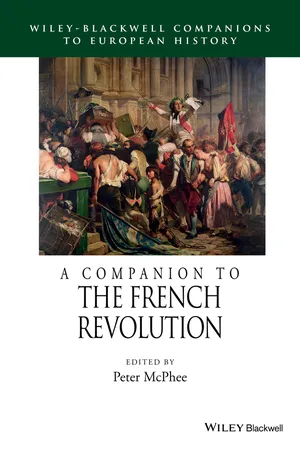
A Companion to the French Revolution
About this book
A Companion to the French Revolution comprises twenty-nine newly-written essays reassessing the origins, development, and impact of this great turning-point in modern history.
Information
PART I
The Origins and Nature of the Crisis of 1789
CHAPTER ONE
Rethinking the Origins of the French Revolution
The origins of the Revolution have been a subject of debate and conjecture since the first year of the Revolution itself. After more than two centuries no one now believes it was primarily a “révolte de la misère,” as Michelet suggested, the very spirit of justice a long time coming, nor a philosophic plot, as the abbé Barruel argued, nor a Jansenist conspiracy (Michelet 1847). It would appear that millions of savages were not in fact launched into revolt and revolution by the babblings of the philosophes, as Hippolyte Taine argued after the Paris Commune of 1871, not least because illiteracy was widespread, education limited, and books very expensive. Nor was it predominantly caused by the rise of a democratic republican ideology that neatly prepared the way for the Third Republic in France, as in Alphonse Aulard’s interpretation a generation later (1910). Echoes of these can still be heard of course, for poor arguments never die, they just get recycled into novels and television. But one major early line of interpretation had a long posterity: the idea that the Revolution was caused by a rising bourgeoisie, harbingers of capitalism, eager for the political power from which the privileged ancien régime society excluded them. From the mid-nineteenth century onwards the notion of a bourgeois revolution was widely accepted; it was given an explicitly capitalist sense by Marx, then a socialist inflection by Jean Jaurès. For Albert Mathiez (1922), the Russian Revolution of 1917 seemed to confirm the diagnosis. The idea came to dominate scholarly work to such an extent that it could be called an orthodox view by the 1950s. As such, it was about to come under a sustained attack. This essay will consider what this view was and how it was undermined by two generations of work in social, cultural, economic, intellectual, and, finally political history.
Can We Explain the Origins?
Before moving ahead with this agenda let us pause for a moment to consider what it means to study the origins of something as shatteringly transformative of state and society as the French Revolution. Most historical arguments about the origins of the Revolution depend on a process of defining the Revolution first – itself a hugely controversial topic – and then reading back into the causes or origins of 1789 the elements that seemed to triumph later. Secondly, the occurrence of the Revolution is often assumed to have been an act of will by particular groups. This too is problematic, because if the notion of deliberate revolutionaries does fit some later revolutions and suits the process of constructing a new state and society by the various assemblies in and after 1789, it is much less clear that the process of the collapse of the ancien régime into revolution shows the same intentionality. The ancien régime collapsed and out of its crisis a revolution developed, but the origins of the collapse and the origins of the Revolution are not the same (Campbell 2006). The collapse should also be seen as a process in itself that fractured society (Cubells 1987), brought more groups into the public sphere, and, as interests became endangered, produced moments of choice for those involved. Even those who chose revolution did so rather late in the day in the early or mid-summer of 1789, for the most part. It is hard to discern bourgeois involvement in 1787 and before the autumn of 1788, while few would deny that the collapse of the state in 1789 opened the door to bourgeois participation in a new politics. Most historians have found a way around this problem of choice or intentionality by assuming that the collapse of state authority and local institutions was merely the occasion for a more intentional revolution, the precipitant of a revolution whose origins lay in impersonal factors like rising social tensions, economic transition, or cultural change. In short, they stress the long-term processes that go beyond the individual and the contingent.
In this way, the participants are seen to be in the grip of historical forces they were not aware of, but were nevertheless furthering. A classic example of this is Alexis de Tocqueville’s Old Regime and the Revolution (1856), in which the Revolution is defined as a further stage in a process of centralization going back to Louis XIV (though it would be a grave injustice to imply that his study argued no more than this). The same could be said about the role of the bourgeois or artisanal “actors” in a revolution that was thought to be essentially about class struggle. It is unsurprising that this approach should continue to dominate historical analysis, because History has long been about meaningful generalization, about finding patterns, and about making sense of the past for the present. The very essence of History is a dialectic of challenge and debate. But caution is required, especially when we are dealing with the problem of motivation. On the one hand we have a revolution that can be conceived as being about what the people at the time thought it was about – and remember they themselves differed in their views – and on the other hand we have a rather different set of revolutions postulated by historians that embodied wider processes of which the participants were partly or largely unaware. The latter approach today looks for example at economic trends and conjunctures, cultural developments, at shifts in the way society and politics were conceptualized in the decades preceding the Revolution and during the Revolution itself. But there is also a return to the role of individuals, to their politics, their strategies, and their emotions. How might we bring the broader conditions together with the role of individuals? Explaining the origins was never going to be easy.
Any attempt to make sense of something as complex as the first major world-changing revolution must encounter major difficulties. Today there is no agreed interpretation of the “causes” (or indeed “origins”) of the Revolution, just as there is no agreed definition of the Revolution itself. The various aspects of the Revolution discussed in this very volume all have different sets of origins. It was a phenomenon of such breadth, reach, and variety that attempts to make sense of it often fall prey to a tendency to oversimplification, or teleology (especially in the case of intellectual history), while any attempt to take into account all the variables would surely be immensely long and confusing. A short essay such as this one can never do justice to all the fine work produced by recent historians, nor can it be more than one scholar’s view, with all the shortcomings that implies.
The Orthodox View
The divisive nature of the Revolution meant that the first generation of memoirists and early historians adopted a range of very different views. From about the 1840s, History was developing as a discipline based on archival sources, but in the nineteenth century the rigorous treatment of documents that we expect today was usually confined to such sources as memoirs, correspondence, pamphlets, and newspapers, which led to a very political and intellectual vision of events. Nevertheless, because the Revolution was so divisive, there was a vehement debate in the sense that different views were put forward, often highly politicized, which were then criticized and evaluated by other scholars. However, with few exceptions the question of the origins has taken second place to the debate over the nature of the Revolution as a whole. In fact, right up until the 1980s relatively few books dealt with just the origins, and most views were expressed in a chapter at the start of a larger book on the Revolution. Instead of there being an explicit field of study known as “the origins debate,” the process seems to have been much more one of setting out positions about the nature of the Revolution, and inferring causes from its nature. For example, in this way Jules Michelet, Louis Blanc, Aulard, and Jaurès put forward influential views. In the century before the 1950s only Marx, Tocqueville, Taine, and Georges Lefebvre really focused on the problem of the origins of the Revolution. From the 1920s to the 1950s the prevailing view was that the Revolution was the product of class struggle.
This socialist viewpoint was expressed in a classic book published in 1939, Quatre-vingt-neuf, translated as The Coming of the French Revolution. In this popular book, Lefebvre, a towering scholar and a socialist, had the great merit of making sense of the complexities. Moreover, he integrated his own research on the peasantry into the more classic Marxist schema. Peasants were restored to conscious and proactive actors, not masters of their own fate but developing strategies in the face of pressures. The field has grown since then with classic studies by Pierre de Saint-Jacob (1960) and John Markoff (1996). Thus the causes of the French Revolution lay in the development of capitalism, which had slowly been generating a rising bourgeois class and its concomitant, a declining nobility, which by its cultural values was less well adapted to capitalism. Nonetheless, the aristocratic opposition to royal reform in 1787 had to be fitted into the schema. Hence the appeal of the notion of a century-long aristocratic reaction by a nobility presumed to have been cut out of power by Louis XIV (which we no longer believe: Campbell 1993; Beik 2005; Chaline 2005). So a sort of last-gasp aristocratic reaction was postulated for the Assembly of Notables in 1787, during which the nobility not only blocked vital royal reforms but also revealed its hand by suggesting a greater role for the nobility in government, with the monitoring of royal policy through the dominance of the estates. The opposition of the noble magistrates in the parlements was interpreted as a part of the same aristocratic reaction (Ford 1953), along with increased exploitation of the vestiges of the feudal system in the countryside to extract more revenue from estates and seigneurial dues. However, the establishment of new representative provincial assemblies in 1788 and then the elections to the Estates-General in 1789 gave the bourgeoisie its opportunity. This rising class of commercial and liberal professions tried to seize the initiative (Kaplow 1965). The intransigence of the nobility in the Estates-General led to a clash with the determined bourgeoisie of the Third Estate, whose ideology was enlightened, liberal, and egalitarian. (And here we must note that the world of ideas, what Marxists call the ideological superstructure of society, was regarded as a product of the economic infrastructure.) The liberal revolution itself was made by the bourgeoisie, in a situation in which the artisans lent their support in a time of great economic distress. For Lefebvre, alongside this bourgeois revolution an autonomous peasant revolution took place; it destroyed feudalism in an act of will and as a consequence of the Great Fear. The bourgeoisie, henceforth in power, soon enacted the principles of liberty and equality that ultimately advanced the cause of capitalism. With the abolition of seigneurialism or “feudalism” the peasantry would have a partially successful revolution; the artisans would play a crucial role in the revolution but would not benefit in the long term. Thus the French Revolution in its origins and nature was a bourgeois revolution against feudalism in favor of capitalism.
This was a neat and elegantly put argument repeated in many a textbook and in standard works. But would it stand up to further research and critical analysis? In France it held sway until the 1970s partly because of the domination of French Revolution studies by historians on the left; many were members of the Communist Party, like Lefebvre’s successor as Professor of the French Revolution at the Sorbonne, Albert Soboul. The attack was launched by British and American historians. For twenty years from the mid-1950s onwards this challenge took the form of the critical redefinition of a series of key terms. Instead of taking the reader through a blow-by-blow account of the evolution of this historiography, I will summarize the conclusions of the research by topic as seen from the perspective of today – at the risk of compressing into a single set of conclusions on each topic much longer processes of research that often took a generation. The word “revisionism” is often used to describe this historiography, but it has nothing to do with its original sense of a left-wing internal critique of Marxism; quite the contrary. Its heyday was the 1970s, and since then different perspectives on causality and history – as well as new research into new areas like political culture and cultural history – have led to a new phase of interpretation.
A Revolutionary Bourgeoisie?
If the Revolution was a bourgeois revolution, then who actually did participate in it, who were the deputies of the Third Estate? In a lecture of 1954 and a book a decade later, Alfred Cobban criticized the concept of the bourgeoisie as being far too elastic and imprecise, an unsuitable category of analysis. He showed that the deputies were in fact overwhelmingly representatives of the non-noble office-holders and legal professions. Such men were often on the way to acquiring nobility, and they were not involved in the commercial and industrial capitalism that the Revolution was supposed to have benefited. Their long-term patterns of investment were the purchase of land and office, and many richer members of the Third Estate held seigneuries just like nobles. Much other research on social mobility under the ancien régime since then has tended to confirm the assessment of these notables of local society as belonging to families that had initially risen through larger-scale commerce but then abandoned trade in favor of investments in land and office (especially in the judiciary and royal finances) that brought them closer to the noble lifestyle. From Cobban’s tables, it is clear that hardly any representatives of manufacturing or capitalism were elected to the Third Estate in the Estates-General (Cobban 1971). Nearly one-third of the “bourgeois” deputies in 1789 were bailiwick judges well versed in local politics (Dawson 1972). This view was more recently confirmed by a more extensive analysis of the Third Estate: most had some political experience and many had published pamphlets (Tackett 1996). Cobban had postulated that such an office-holding class was struggling against a decline in office values during the eighteenth century, but this has since been disproved (Doyle 1995). Overall the “revolutionary bourgeoisie” has come to look not so much a class as a group of ambitious local notables without a particular class identity but with a fair amount of local or regional administrative and judicial experience.
Their aspirations tended toward the noble lifestyle, and if they were frustrated by the ancien régime it was argued that it was more because their social mobility was jeopardized by greater competition for access to the noble order (Lucas 1973). Such men were hardly candidates for the label “capitalists” in Marx’s sense, and Cobban actually thought them anti-capitalist. However, we should note that they were also representatives of a “proprietary capitalism” and so did benefit enormously from the recycling of their investment in office into the purchase of church and émigré property whose sale was decreed by the early Revolution. The argument has turned on the characteristics of the deputies to the Third Estate (and who but the existing ancien régime elites would have been elected to the Estates-General?), and not on the members of the Third Estate in France as a whole, who did indeed play a much greater role in government once the Revolution had begun: as municipal officers, local gove...
Table of contents
- Cover
- Series Page
- Title page
- Copyright page
- Dedication
- Notes on Contributors
- Abbreviations
- Introduction
- PART I: The Origins and Nature of the Crisis of 1789
- PART II: Reshaping France, 1789–91
- PART III: Church, State, and War
- PART IV: Contesting the Limits of Revolution
- PART V: Revolutionary and Counter-Revolutionary Violence
- PART VI: Political Choice and Practice
- PART VII: Searching for Stability, 1794–99
- PART VIII: The Revolution in International Perspective
- PART IX: Change and Continuity in France
- Index
Trusted by 375,005 students
Access to over 1.5 million titles for a fair monthly price.
Study more efficiently using our study tools.
Frequently asked questions
Yes, you can cancel anytime from the Subscription tab in your account settings on the Perlego website. Your subscription will stay active until the end of your current billing period. Learn how to cancel your subscription
No, books cannot be downloaded as external files, such as PDFs, for use outside of Perlego. However, you can download books within the Perlego app for offline reading on mobile or tablet. Learn how to download books offline
Perlego offers two plans: Essential and Complete
- Essential is ideal for learners and professionals who enjoy exploring a wide range of subjects. Access the Essential Library with 800,000+ trusted titles and best-sellers across business, personal growth, and the humanities. Includes unlimited reading time and Standard Read Aloud voice.
- Complete: Perfect for advanced learners and researchers needing full, unrestricted access. Unlock 1.5M+ books across hundreds of subjects, including academic and specialized titles. The Complete Plan also includes advanced features like Premium Read Aloud and Research Assistant.
We are an online textbook subscription service, where you can get access to an entire online library for less than the price of a single book per month. With over 1.5 million books across 990+ topics, we’ve got you covered! Learn about our mission
Look out for the read-aloud symbol on your next book to see if you can listen to it. The read-aloud tool reads text aloud for you, highlighting the text as it is being read. You can pause it, speed it up and slow it down. Learn more about Read Aloud
Yes! You can use the Perlego app on both iOS and Android devices to read anytime, anywhere — even offline. Perfect for commutes or when you’re on the go.
Please note we cannot support devices running on iOS 13 and Android 7 or earlier. Learn more about using the app
Please note we cannot support devices running on iOS 13 and Android 7 or earlier. Learn more about using the app
Yes, you can access A Companion to the French Revolution by Peter McPhee in PDF and/or ePUB format, as well as other popular books in History & French History. We have over 1.5 million books available in our catalogue for you to explore.