- Describes the new theoretical framework of 'worlding'
- Substantially expands and updates the themes of capital and culture
- Includes a unique collection of authors across generations, disciplines, and sites of study
- Demonstrates how references to Asian power, success, and hegemony make possible urban development and limit urban politics
eBook - ePub
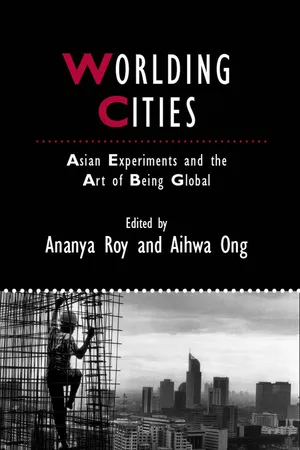
Worlding Cities
Asian Experiments and the Art of Being Global
- English
- ePUB (mobile friendly)
- Available on iOS & Android
eBook - ePub
Worlding Cities
Asian Experiments and the Art of Being Global
About this book
Worlding Cities is the first serious examination of Asian urbanism to highlight the connections between different Asian models and practices of urbanization. It includes important contributions from a respected group of scholars across a range of generations, disciplines, and sites of study.
Information
Part I
Modeling
1
Singapore as Model: Planning Innovations, Knowledge Experts
Introduction
In the short 50 years as an independent city-state-nation, after separation from Malaysia in 1965, Singapore has transformed itself from a declining trading post in the twilight of the British Empire to a First World economy. It would be too easy to dismiss this economic success due to its size; an entirely urban economy without the drag of a rural hinterland of poverty. However, smallness has its disadvantages. Completely devoid of all natural resources, including land and population, it is dependent on the global market for everything – capital, labor, materials, and food – to develop its domestic economy. Opening up to the world is therefore not a choice, but a necessity. Turning this necessity into an opportunity, Singapore is ever alert and receptive to the opportunities that are thrown up by the global economy, from its very founding in the early nineteenth century as a trading post to the contemporary phase of global capitalism. Economically, the world has always been the horizon of relevance for Singapore.
Singapore’s economic success is also often dismissed as on account of its authoritarian political regime. The People’s Action Party (PAP), under the first Prime Minister Lee Kuan Yew, had ruthlessly suppressed dissent and opposition in the decade and a half in its ascendancy to absolute political power. By the early 1970s, the Party had eliminated all effective political opposition and has since governed as a single-party dominant state without any effective opposition in Parliament. Over the years, it has also modified electoral rules and procedures which practically insure the Party’s return to power in the five-yearly general elections (Chua 2007). Empirically, such absolute authoritarian regimes have a general tendency to lead to corruption and economic disasters in much of the Third World. Against this general tendency, Singapore’s economic success is all the more remarkable.1 Undoubtedly, the absence of political opposition shields the government and the civil service from public pressures. However, instead of allowing this insulation to encourage corruption, the government has been able to mold the civil service and other statutory bodies into agencies of development, to capitalize on the stability provided by the unchanging regime to set and implement long-term plans without intermittent disruptions caused by changes in government, factors that have been fundamental to Singapore’s economic success.
Global City
The history of Singapore’s rapid industrialization began even before it became an independent nation. Firmly believing that an independent city-state economy would not be viable, the first-generation PAP leaders were counting on the Malaysian common market for the viability of its nascent industrialization in the early 1960s. Political separation from Malaysia, in 1965, disrupted this trajectory. Apropos the cliché that, in Chinese ideograms, “crisis is also an opportunity” (危机), the potentially dire economic consequences did in fact open up new perspectives and opportunities. First, the negative economic consequences were quickly transformed discursively into the rhetoric of struggle for “survival.” To survive, Singapore needs an armed force of citizen-conscripts, racial harmony must prevail, and political differences and dissensions must be kept to the minimum and under control. But above all, economic growth must be promoted at all costs, including investments in human resource and infrastructure developments, creating a business- and tax-friendly environment to encourage foreign capital investment and establishing state enterprises where private capital fears to tread. “Survival” has thus provided the discursive and governance space for an interventionist or activist state that closely regulates Singaporean everyday life as part of the necessary condition for its highly entrepreneurial pursuit of national economic development, in step with the changing shape of global capitalism.2 Since then, “to survive as a nation” in every sense of the word has become the national ideology, naturalizing the historical into both a motivational and a disciplinary framework for Singapore as a nation and individual Singaporeans.
Second, the loss of the desired Malaysian market led to a spatial and geographic reorientation: the entire “world” became imaginable as Singapore’s “market.” This imagination was felicitously made realizable through an export-oriented industrialization made available at that time by the new international division of labor. It is now a common refrain among ordinary Singaporeans that “the world is our hinterland.” As an independent city-state or an island-nation among a world of nations, “the world” was brought into the visual horizon of its political leadership, causing the then Minister of Foreign Affairs to declare Singapore a “global city” (Rajaratnam 1972), two decades before the concept circulated in freely in urban discourse.
Success as Identity
After five decades of independence, by all conventional measures Singapore has been economically successful beyond anyone’s imagination, including even its first generation of political leaders, who were arguably the engineers of this success. Across the entire population, everyday material life has improved massively and the educational attainment level has increased, while abject poverty and homelessness are uncommon. Amidst this, Singaporeans are also well aware of the many shortcomings of the long-governing, single-party dominant PAP government. The commonplace suggestion that they are “apathetic” to its undemocratic or anti-democratic ways is but a caricature of a people who are well informed about the excesses of the government.3 However, along with the improvements in material life, they share the idea of being part of a “successful” nation, whose history is recent enough for everyone to feel a sense of achievement. Iconic achievements such as being rated the “best” airline and airport and the busiest port in the world, secondary school students being placed well in international mathematics or physics Olympiads or robotic competitions, and international awards for urban planning and public housing development all add up, finally, to a sense of arrival at a First World economy.
“Success” has entered the process of “self-scripting” of Singapore as a nation and of individual Singaporeans; the script is an open frame, with success as the key feature. At the national level, “success” as the defining feature of Singapore has already been in play since mid-1980s, scripted into the titles of two influential books. The first was a semiofficial history of Singapore from 1959 to 1984, entitled Singapore: struggle for success (Drysdale 1984). The second was an edited tome of more than 1,000 pages, entitled Management of Success: the moulding of modern Singapore (Sandhu and Wheatley 1989), assessing comprehensively the different aspects of Singapore’s political, social, economic, and cultural developments. Reflective of the self-confidence that comes with the success, a sequel, Management of Success: Singapore revisited, was issued in 2010 (Chong 2010), to “critically” reassess the success story. This line of framing Singapore’s development story, arguably, reaches its peak with Lee Kuan Yew’s own memoirs, entitled The Singapore Story: from Third World to First (2000). Economic success has become the emblem of the nation.
Individual Singaporeans also frame their subject positions in terms of Singapore’s success, apropos their social class positions. For example, in assessing their wage-earning position, working-class Singaporeans are comforted by the fact that within Southeast Asia, they are much better off than the rest. Middle-class professionals have been reluctant to take up regional postings because of the relatively “underdeveloped” conditions in these locations. In instances when they do seek employment abroad, they will actively market the fact that they are Singaporeans, carrying the label “Singapore” as a brand name that signifies success, with nationally inflected personal qualities of being hardworking, efficient, and effective; the Singapore brand undoubtedly improves their likelihood to be recruited. So too do Singaporean entrepreneurs who venture overseas carrying the Singapore “brand” with them, as a signifier of quality and reliability with financial integrity, meaning without corruption. “Success” as a source of pride has become part of the technologies of the Singaporean self and a constitutive element of the Singaporean identity.
Yet, “failure” haunts success. Fear of failure becomes a motivation for individuals to compete fiercely to maintain – better still to extend – their success. The same fear of failure keeps the government constantly in search of the next niche for development thrown up by shifts in global capitalism. Arguably, it needs to extend success for political legitimacy, as a commonplace opinion is that economic success is the bargain that has been struck between the PAP government and the citizens of Singapore. Should the economy cease to grow or, worse, regress, PAP’s legitimacy of absolute dominance in political power would be severely disrupted. This may explain the PAP government’s addiction to growth, to limitless accumulation of wealth in national reserves which are invested globally for further accumulation.4 Nevertheless, it is sufficiently confident of its path to success that the Singapore Civil Service College established, in 2003, a Civil Service College International (CSCI), as a consultancy with a mission “to share Singapore’s experience in public reforms and good governance with governments around the world to promote good governance and generate goodwill and cooperation across international borders.”5
This aspiration to share the Singapore experience may be said to have been derived from many instances in which Singaporean public policies and state entrepreneurial activities have been studied and copied by other governments. When Tony Blair was Prime Minister of the United Kingdom, he floated, as part of his “Third Way” reforms, the idea of considering Singapore’s compulsory social security savings scheme, the Central Provident Fund (CPF), in lieu of a national pension, although the suggestion was subsequently dropped. In general, the CPF is a model of an individual private account pension savings system that the Bush government tried to introduce in the United States, to ameliorate the foreseeable pension fund crisis due to extended longevity. Singapore’s electronic road pricing system that taxes vehicular entry into the city has also been studied by various global cities, including London, where a version of the system is in place, and New York, where a pricing system was proposed by the mayor but defeated. Admittedly, these false starts and failures in attempts to transplant and institute the urban traffic-control system and the CPF social security system into Western liberal democracies, a very different political and social environment from that of Singapore, show that lessons from Singapore cannot be readily copied. Nevertheless, given these and many other instances, one can suggest that the aspiration of the CSCI is not misplaced. As this chapter will demonstrate, the aspiration has been matched by the expressed desires and actual practices of many cities in Asia which evoke “Singapore as Model” for their own developments.
Singapore as Model
The case of Bangalore is illustrative. According to Bangalore’s urban historian Janaki Nair, the then Chief Minister, Veerendra Patil, made “a strong plea for a fresh vertical orientation for the city after a visit to Singapore in 1970 … since then, dreams of Singapore have dominated the vision of Bangalore’s future” (Nair 2005: 124), the general argument being that, ‘With imaginative planning and foresight, Bangalore can be developed as the Singapore of South India” (Nair 2005: 124). Nair suggests that Singapore “exerts a powerful hold on the imagination of town planner, CEO, politician, and citizen alike. The reasons are not hard to find. Singapore is an achievable ideal, a realizable utopia as the city-state shares the common legacy of colonial rule with Bangalore, is an Asian society with some common social features, and above all, has transformed its spatial and economic identity in less than 40 years” (2005: 124).
At a more expansive national level, political leaders no less than the late Deng Xiaoping, the man credited with the capitalist transformation of China, had instructed the massive Chinese state bureaucracy thus: “Singapore’s social order is rather good. Its leaders exercise strict management. We should learn from their experiences, and we should do a better job than they do.”6 This general instruction has provided an ideological umbrella for practical appropriations of lessons from Singapore in economic, political, and urban planning, management and governance at different managerial and spatial levels, scales, and sites. These range from replicating the practices of “clean and green” in the city of Dalian, examined by Lisa Hoffman in this volume, to joint ventures between Chinese municipal enterprises and Singapore state-owned companies in developing comprehensive estates where the Singapore experience, knowledge, and practice of urban planning are directly applied, often with little modifications, as in the case of the Suchou Industrial Park7 near Shanghai, in 1992, or the Sino-Tianjin Eco-City project, initiated in 2008, where Singapore’s planning practices are being combined experimentally with new technologies of urban sustainability. The success of Suchou Industrial Park is such that, according to the current Singapore Prime Minister, Lee Hsien Loon, during his week-long tour of inland China in September 2010, in every city, “the local Chinese government leaders want an SIP-like park of their own” (Peh 2010). At the managerial level, municipal officers from China have been arriving in Singapore, since 1992, to attend a special program, dubbed “The Mayors’ Class,” to learn of Singapore’s experiences and practices in city government, at the Centre for Public Administration, at the Nanyang Technological University,8 and, finally, at the state level, there have been high-level exchanges between the PAP and the CCP in order to learn from each other (Goh 2009). The Chinese and Bangalore examples are illustrative of the fact that across Asia “Singapore as Model” for lessons of development has been deployed from the merely rhetorical to actual practices in planning and governance to the fantasized without any likelihood of realization – such as in the case of the recently independent but continuingly politically and economically unstable Timor Leste, at different scales in different locations.
Fragmenting Singapore into Discrete Lessons
Singapore’s economic success is the result of a comprehensive package of inextricably linked ideological, political, and economic ...
Table of contents
- Cover
- Series page
- Title page
- Copyright page
- List of Illustrations
- Notes on Contributors
- Series Editors’ Preface
- Preface and Acknowledgments
- Introduction Worlding Cities, or the Art of Being Global
- Part I Modeling
- Part II Inter-Referencing
- Part III New Solidarities
- Conclusion Postcolonial Urbanism: Speed, Hysteria, Mass Dreams
- Index
Trusted by 375,005 students
Access to over 1.5 million titles for a fair monthly price.
Study more efficiently using our study tools.
Frequently asked questions
Yes, you can cancel anytime from the Subscription tab in your account settings on the Perlego website. Your subscription will stay active until the end of your current billing period. Learn how to cancel your subscription
No, books cannot be downloaded as external files, such as PDFs, for use outside of Perlego. However, you can download books within the Perlego app for offline reading on mobile or tablet. Learn how to download books offline
Perlego offers two plans: Essential and Complete
- Essential is ideal for learners and professionals who enjoy exploring a wide range of subjects. Access the Essential Library with 800,000+ trusted titles and best-sellers across business, personal growth, and the humanities. Includes unlimited reading time and Standard Read Aloud voice.
- Complete: Perfect for advanced learners and researchers needing full, unrestricted access. Unlock 1.5M+ books across hundreds of subjects, including academic and specialized titles. The Complete Plan also includes advanced features like Premium Read Aloud and Research Assistant.
We are an online textbook subscription service, where you can get access to an entire online library for less than the price of a single book per month. With over 1.5 million books across 990+ topics, we’ve got you covered! Learn about our mission
Look out for the read-aloud symbol on your next book to see if you can listen to it. The read-aloud tool reads text aloud for you, highlighting the text as it is being read. You can pause it, speed it up and slow it down. Learn more about Read Aloud
Yes! You can use the Perlego app on both iOS and Android devices to read anytime, anywhere — even offline. Perfect for commutes or when you’re on the go.
Please note we cannot support devices running on iOS 13 and Android 7 or earlier. Learn more about using the app
Please note we cannot support devices running on iOS 13 and Android 7 or earlier. Learn more about using the app
Yes, you can access Worlding Cities by Ananya Roy, Aihwa Ong, Ananya Roy,Aihwa Ong in PDF and/or ePUB format, as well as other popular books in Architecture & Urban Planning & Landscaping. We have over 1.5 million books available in our catalogue for you to explore.