Conceived by Chris Grey, the Very Short, Fairly Interesting and Reasonably Cheap series offers an antidote to conventional textbooks. Each book takes a core area of the curriculum and turns it on its head by providing a critical and sophisticated overview of the key issues and debates in an informal, conversational and often humorous way.
Looking beyond the usual colonial narrative of the subject, Amanda Earley encourages the reader to think reflectively and critically about overlooked aspects of International Marketing such as power relations, history, ethics, culture and politics.
Examples are provided throughout with coverage of student-friendly brands such as Apple, Facebook and Google and their role in international marketing practices today. The author draws on history and the colonial era as well as illustrating the failure of American brands to break into other markets. There are also gritty, thought-provoking examples around racial divides in Asia and Australia.
Need another "VSFI" book? Browse the series here
eBook - ePub
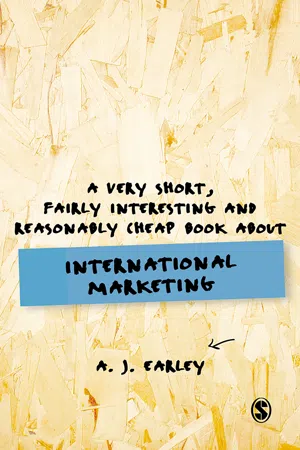
A Very Short, Fairly Interesting, Reasonably Cheap Book About... International Marketing
- 216 pages
- English
- ePUB (mobile friendly)
- Available on iOS & Android
eBook - ePub
A Very Short, Fairly Interesting, Reasonably Cheap Book About... International Marketing
Part I New Foundations
As noted in the Introduction, this Part introduces three additional disciplines which I find are necessary to truly understand international marketing practice: that of history, ethics, and politics. Here, I will provide a very brief note on why these disciplines are important; how they come together; and a bit more detail on what will happen in each chapter.
Following notions of liberal education, it is best to have a foundation that spans the entirety of academic traditions. As we already have learned much from economics, psychology, anthropology, and cultural studies, my project is to identify the most urgent elisions. At a basic level, one could argue for greater integration of history, ethics and politics simply because they are three huge areas of social research which have historically been ignored within marketing thought. In practice, I also find that these three ‘missing’ foundations often tell us more about international marketing than many of the parent disciplines with which we usually associate!
Before jumping in, I should give you a preview of how these three disciplines will come together. To start, we must acknowledge that there are big differences between these three subjects. Each one is an entire academic discipline, and people get PhDs in all of them! Each discipline also brings with it particular methods, which are better-suited for some phenomena, and ill-suited for others. In introducing this material, I try to keep the disciplines as separate as possible, and I try to use cases which are clearly best-explained by one of the three disciplines.
All said, it should be acknowledged that even here, many cases can be fruitfully explored via history, ethics or politics. You may want to explore the multifaceted nature of cases further in your own time. To get some sense of how to do this, I recommend examining later chapters (in Parts II and III), where I allow for more of the natural overlap in disciplines to return.
Through the chapters presented here, it is my hope that you will now have a better sense of not only the concepts from these three areas, but their methods. This is because the different methods used by each will allow you to make different sorts of arguments. Historical arguments can be used to show that practice has not been the same at all times, and in all places. It can be used to think proactively about what the future might be like, given what we know about similar situations or human life more generally. Ethical arguments, meanwhile, are grounded in very abstract principles about ‘right and wrong’. In other words, you should be able to explain your actions in any given situation based on principles which guide your life. Political arguments, meanwhile, concern the viability of various options based on resources and power within a given situation. In achieving any gains in your life, be they business or personal, you must have a realistic understanding of what you can accomplish, and what those in competition with you are trying to achieve. In cases where power is great, responsibility is also great, which means that there is a large amount of ethical burden upon any choice made.
Ultimately, the best approach is one which remains open to the potential of a variety of perspectives, but which can be flexible and decisive when one foundation is of greater use in explaining a particular matter.
I introduce history first, not because I think it can more easily be understood without recourse to the other two disciplines, but because looking at history can provide us with a useful new definition of international marketing based on the historical formations which have produced it, and on accumulated evidence about what international marketing tends to be, in practice. The second chapter, on ethics, presents principles which can guide our actions within this historically determined and politically charged domain of social activity. The third chapter builds upon this, showing how politics gives us language to give a further, deeper definition of what these practices are.
1 Historical Emergence
This chapter presents a history of international marketing practice. The hope that we can understand what international marketing is, before we start making pronouncements about how it should be done (ethics) and how it works in practice (via political analysis).
While most of us will have been subjected to a great number of history classes in our lifetimes, the basic details of what history is are often skipped over, so I will start the chapter by properly introducing what this discipline does. Here, I start from Howell and Prevenier’s (2001) guidance, and cite further references where appropriate. Don’t worry, I won’t be asking you to write a complete history of the world at the end of this text… the point here is to introduce just enough of the theory and method to understand how histories are produced. You can then feel more confident in reading, interpreting and using historical arguments in your day-to-day life.
Next, the chapter presents a chronological explanation of the emergence and spread of international marketing. Here I begin by identifying the ancient origins of international marketing, before moving on to the forms international marketing has taken under mercantilism, early modern capitalism, 20th century global capitalism, and contemporary neoliberalism. Building on the work of Tosh (2009, 2008), I argue that reading histories is valuable not only for documenting what has happened, but also for helping us understand ourselves and what the future is likely to hold. As the old saying goes… those who do not learn from history are doomed to repeat it! Throughout, the principle of international marketing at play is the following:
- Principle 1: The composition, dynamics, and practices of contemporary international marketing are largely shaped by historical relationships and processes.
What Is History?
History sits in an awkward position between the arts and social sciences. While many initially think that history is objective, especially where we see evidence such as direct quotes, it is also an undeniably creative endeavour. With this paradox in mind, critical historiographers provide the best definition of what history really is. They define the historical method as the production of narratives (stories) about events, people, and societies (MacMillan, 2010; Gunn, 2006). It is often found that the stories can be quite inaccurate or biased. While this may seem like it would undermine the potential value of a narrative, this is often what historians are interested in – the ways in which stories are told from particular, invested perspectives. Understanding the meaning of any story requires critical reading practice, taking into account the motivations of the author, and the wider historical context. Here, we should also engage in reflexive practice (awareness of our own potential biases).
Of course, there are cases where producing the ‘best possible’ or ‘most complete’ account is desired – rather than simply engaging in a critical reading of any story. Historians have methods to improve rigour (in other words, to engage in the best possible evidence gathering). More scientific approaches to history begin with a portrait of what the ideal accounts would be (e.g. the stories of all participants at an event), and then work to find the best available subset from that. For some phenomena, there may only be a single individual witness or survivor, which raises questions about corroboration (as there is no one else to confirm what happened). Here we see the value of critical reading once again, as historians collect and analyse evidence about the source and his/her reliability, as well as the socio-historic context. As noted by Ginzburg (1999), the ultimate goal is to better understand the world around us through practices of meaning-making, contextualisation, and theorisation. Here, we should be concerned with relevance as well as verifiability.
The major traditions within history are defined by the types of phenomena they investigate. Claus and Marriott (2012) provide a very valuable introduction to the various types, complete with examples of particularly well-conceived histories, if you are interested in considering the topic further. Here, I will focus on discussing a few types of history which can be relevant to the study of international marketing. To begin, social histories focus on societies, while political histories examine political moments, movements and/or governments. Economic histories show how economic systems came to be. Cultural histories examine how a culture changed over time, and may draw on anthropological methods and evidence as well as that from history. Visual histories study changing conventions of visual representation. People’s histories try to describe events from the vantage point of an average observer (rather than an elite), while feminist histories are interested in the role of gender during historical events. Postcolonial approaches to history shine light upon the struggle of nations for self-determination (Gunn, 2006).
Throughout this text, I rely primarily on global histories, which do just what they say… they examine how historical phenomena are parts of larger, even global social processes. Many different scholars are known for some sort of world systems approach, and I refer to several throughout the chapter. Chronological sections map roughly onto the work of Samir Amin (2014 [1997]). Elsewhere, Wallerstein’s (2004) world systems approach is key, as it examines how an interlocking economic system has emerged. A postcolonial perspective is also brought into the fold, as it is an important counterpoint to the traditional global histories. This approach is likely to be a bit different from those of previous histories you have read, given that it emphasises complex processes that are long in the making, rather than discrete events (as with traditional chronologies).
At the same time, the goals of this chapter require me to consider social, political, economic, and business histories as well. Here, we will take a more dispassionate look at how international marketing practice emerged, which often requires problematising the past conduct of powerful nations. While some may question this move, it is absolutely essential for producing a realistic portrait of what international marketing actually is. Indeed, doing anything else prevents small firms, and those from small nations, from understanding the challenges they face in international market entry.
The ‘Why’ of International Marketing: Origins and Motivations
Trade has crossed cultural and/or national borders for thousands of years, and as such, international marketing practice is much older than we might think. The benevolent narrative often espoused in international marketing texts is that trade emerged because tribes, cultures, and nation-states had different abilities and resources, and as such everyone benefitted from exchanging what they could produce easily for rare goods from others. This was undoubtedly true in early, incomplete economies, and for those who lived in inhospitable climates. But questions remained about why trade would flourish elsewhere…
What about the case of more evenly matched societies, with fairly complete economies? Why would they engage in international trade? What would the point be? Take a minute to think about these questions below. Note: the answer is not (just) profit… how would profit be made?…………………………………………………………………………………………………………………………………………………………………………………………………………………………………………………………………………………………………………………………………………………………………………………………………………………………………………………………………………………………………………………………………………………………………………………………………………………………………………………………………………………………………………………………………………………………………………………………………………………………………………………………………………………………………………………………………………………………………………………………………………………………………………………………………………………………………………………………
In examining the real motivations for international commerce, it is helpful to start with Walby’s (2009) accounts of the evolution of economic systems, from ancient times to the present. Here, we find that benevolence tends to be a motivation in the earliest of international commerce, but starts to fade even in ancient civilisations. Increasingly, we see a handful of governments with disproportionate power, who use this in order to gain trade advantages over other countries. Other potential motivations, such as novelty, are comparatively small and account for a small amount of international marketing to this day. And benevolence, to those who live in inhospitable climates? Forget even that! Increasingly, we take advantage of the disadvantages of other societies, rather than seeking to ‘lift each other up’.
What’s more, historical research on early consumer culture tells us much about the real foundations of international business systems. As noted by Rassuli and Hollander (1986: 5), each of the first big, ancient economies – China, India, Egypt, Sumeria, Assyria, Persia, and Babylonia – emerged alongside imperial socio-economic structures. These are forms of statecraft that brought military and diplomatic force together with business, in order to ensure favourable trading terms for the imperial power. So favourable in fact that early examples of mass consumer cultures could be found at the imperial centres of these trading systems… though much less so in the peripheries of them. Interesting…
In this world of real limits to resources and labour, abundant material wealth tends to exist when a power (or several powers) has the ability to accumulate a disproportionately high amount of material goods and (from ancient Egypt onwards) money. The forms of domination undergirding such systems have varied over time, from the intentionally confusing use of authority (e.g. the use of banking as an explanation for unequal trade) to outright theft and enslavement. Zak Cope (2015) is quick to note that while the former seems comparatively benign, its effects can be equally insidious, as material deprivation of weaker trading partners leads to poverty and often death. The only difference is that… people don’t know why they died. And of course, we all know much about the horrors of international business over time… but do we know all the details? Cope finds that contemporary notions of race were largely developed to justify economic divisions of labour such as slavery. In reality, there is no legitimate foundation of racial categories, and there could be any set of categorisations imaginable (or none!).
Trade continued and developed from ancient times to the present. Nation-states became increasingly wealthy, as did individual business owners, and both products and processes became more sophisticated. New eras of high economic activity were seen in the cases of the Ottoman Empire (1299–1922), China’s Ming Dynasty (1368–1644), and Japan’s Tokugawa era (1603–1868). A new blueprint for international commerce emerged with mercantilisim in Europe. This is an approach where countries strived to be the most powerful exporter of particular goods, because exporting maintains the value of goods domestically, and produces valuable tax revenue for governments. Protectionist economic policies, produced with the hopes of taxing trade partners more than one was taxed, were a common feature. Successful mercantilist governments could use their proceeds to gain further control of weaker countries via military, diplomatic, and business conquest. That said, as a successful mercantilist government was so valuable, power contests within regions and nations were also quite common.
As noted by Kotler and Levy (1969), marketing refers to the processes of bringing goods, services, or ideas to market, by either for-profit or non-profit entities. International marketing is that which occurs across international or intercultural boundaries (Baack et al., 2018). From this look into the early history of international marketing practice, we see that it was rarely motivated by benevolence....
Table of contents
- Cover
- Half Title
- Acknowledgements
- Title Page
- Copyright Page
- Contents
- Preface Why This Book is Different
- Introduction What is International Marketing, Really?
- Part I New Foundations
- 1 Historical Emergence
- 2 Ethical Stakes
- 3 Political Nature
- Part II Rethinking Practices
- 4 International Strategy, Reconsidered
- 5 The Global Orchestration of ‘Consumer’ ‘Behaviour’
- 6 Complication and Contention in Intercultural Interactions
- Part III Envisioning Futures
- 7 New Media Utopia?
- 8 Environmental Dystopia?
- Conclusion
- Appendix
- Appendix
- Recommended Reading
- References
- Index
Trusted by 375,005 students
Access to over 1.5 million titles for a fair monthly price.
Study more efficiently using our study tools.
Frequently asked questions
Yes, you can cancel anytime from the Subscription tab in your account settings on the Perlego website. Your subscription will stay active until the end of your current billing period. Learn how to cancel your subscription
No, books cannot be downloaded as external files, such as PDFs, for use outside of Perlego. However, you can download books within the Perlego app for offline reading on mobile or tablet. Learn how to download books offline
Perlego offers two plans: Essential and Complete
- Essential is ideal for learners and professionals who enjoy exploring a wide range of subjects. Access the Essential Library with 800,000+ trusted titles and best-sellers across business, personal growth, and the humanities. Includes unlimited reading time and Standard Read Aloud voice.
- Complete: Perfect for advanced learners and researchers needing full, unrestricted access. Unlock 1.5M+ books across hundreds of subjects, including academic and specialized titles. The Complete Plan also includes advanced features like Premium Read Aloud and Research Assistant.
We are an online textbook subscription service, where you can get access to an entire online library for less than the price of a single book per month. With over 1.5 million books across 990+ topics, we’ve got you covered! Learn about our mission
Look out for the read-aloud symbol on your next book to see if you can listen to it. The read-aloud tool reads text aloud for you, highlighting the text as it is being read. You can pause it, speed it up and slow it down. Learn more about Read Aloud
Yes! You can use the Perlego app on both iOS and Android devices to read anytime, anywhere — even offline. Perfect for commutes or when you’re on the go.
Please note we cannot support devices running on iOS 13 and Android 7 or earlier. Learn more about using the app
Please note we cannot support devices running on iOS 13 and Android 7 or earlier. Learn more about using the app
Yes, you can access A Very Short, Fairly Interesting, Reasonably Cheap Book About... International Marketing by A. J. Earley in PDF and/or ePUB format, as well as other popular books in Business & Marketing. We have over 1.5 million books available in our catalogue for you to explore.