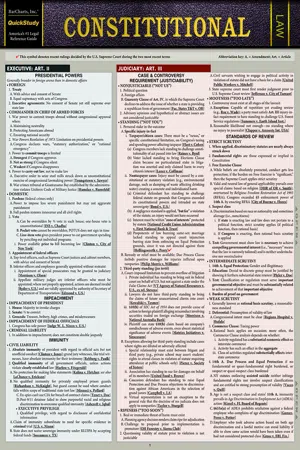
Our company was founded on law guides created by the owner, designed to understand the significance of details within the larger scheme of the law, as a daily refresher, and to review before the Bar Exam. Twenty five years later we keep those guides up to date for students, paralegals and practicing lawyers to have the most handy legal reference to the most important points of the law possible in 6 laminated pages. Suggested uses:
• To understand proportion and relevance within Constitutional Law
• Quick and constant refreshers before classes and exams
• As the last review before taking the Bar Exam[DESCRIPTION][/DESCR
eBook - ePub
About this book
Information

14TH AMENDMENT
The Incorporation Doctrine makes the Bill of Rights, fundamental to an Anglo-American scheme of justice, applicable to states
DUE PROCESS (LAW AFFECTS ALL) PROCEDURE • SCOPE - Limited to guarantees of fair decision-making process; individuals are entitled to a fair procedure(hearing) before being deprived of a life, liberty, or property interest
- Question #1:
- Is there a property interest (legitimate claim of entitlement) or liberty interest (free from physical restraint or “stigma plus” [damages to reputation plus some additional harm, such as inability to obtain further employment because of the stigma])?
- If liberty or property interest is violated, then
- Question #2:
- What process is due? Mathews v. Eldridge balancing test: Private interest affected and risk of erroneous deprivation vs. government’s interest
- Adequate method of notice: FBI’s notice of cash forfeiture of property by certified mail to inmate’s prison address satisfied Due Process [Dusenbery v. U.S.]
- Significant governmental restraints on physical freedom, exercise of fundamental rights, and freedom of choice or action require a procedural safeguard
- 30-day delay in holding vehicle impoundment hearing does not violate procedural Due Process [City of Los Angeles v. David]
- Imprisonment
- Involuntary transfer to mental hospital from jail violated protected liberty interest [Vitek v. Jones]
- Statute contained legitimate expectation
- Involuntary commitment involved greater degree of confinement, imposition of treatment, and possibility of stigmatizing consequences
- Generally, intentional action requires Due Process whereas negligence does not
- Involuntary transfer to mental hospital from jail violated protected liberty interest [Vitek v. Jones]
- Fundamental rights include freedom of association, right to interstate travel, right to privacy (including freedom of choice in family decisions), right to vote, and access to courts
- When seeking to deprive parent of custody of child, government must prove parental unfitness by clear and convincing evidence at Due Process hearing [Santosky v. Kramer]
- Right to assistance in committing suicide is not protected by Due Process Clause [WA v.Glucksberg]
- State “fusion” ban on multiparty candidates does not violate association rights [Timmonsv. Twin Cities], but state’s blanket primary violates political party’s right of association [CADemocratic Party v. Jones]
- State law requiring Boy Scouts to admit homosexuals violates Boy Scouts’ right of association [BSA v. Dale]
- Title II of Americans with Disabilities Act of 1990 (ADA)’s access allowance of suits vs. states is valid to prevent breach of the fundamental right of access to courts [TN v. Lane]
- Freedom of Information Act exemption recognizes family’s right to privacy regarding relative’s death images [National Archives & Records Administration v. Favish]
- 2nd A. right to bear arms is incorporated as against the states through Due Process Clause [McDonald et al. v. City of Chicago]
- Defense of Marriage Act defining marriage as a legal union between man and woman unconstitutional as deprivation of equal liberty, protected by 5th A. [U.S. v. Windsor]✔
- Freedom of choice
- Dismissed government employee does not lose liberty interest [Board of Regents v. Roth], except where dismissal forecloses other employment opportunities [Codd v. Velger]
- A hearing is required prior to government action revoking a professional license [In reRuffalo] or a driver’s license [Bell v. Burson]
- Attorney does not lose liberty interest in practicing law while being searched during client’s grand jury testimony [Conn v. Gabbert]
- Distinction of right vs. privilege or entitlement vs. expectancy
- Hearing is required prior to termination in interest that exists where benefit has been received on a continual basis and applicable statute has established criteria for continuation
- Hearing is not required where benefit has not yet been received or where benefit is known to be terminable and, therefore, no interest exists
- Public housing authorities can terminate tenancy whether or not tenant “knew or should have known” of drug-related activity [Department of Housing & Urban Development v. Rucker]
- Violation of Due Process when government sells real property to satisfy tax deficiency without property owner’s actual notice [Jones v. Flowers]
- Government jobs [Cleveland Board of Education v. Loudermill]
- Entitlement: Prior notice and subsequent hearing, except when charged with felony [Gilbertv. Homar]
- Whistleblower can sue for damages without going through arbitration [Norris v. HawaiianAirlines, Inc.]
- State employees may recover money damages when state fails to comply with Family and Medical Leave Act (FMLA) [NV Department of Human Resources v. Hibbs]
- Welfare benefits [Goldberg v. Kelly]
- Hearing prior to termination
- States must place 5-year limit on benefits and may require recipients to work (Personal Responsibility and Work Opportunity Act)
- Employer cannot fire workers to save on welfare benefit plan [Inter-Modal v. Atchison]
- Paying new residents lower welfare benefits violates Privileges and Immunities Clause [Saenzv. Roe]
- Disability benefits [Mathews v. Eldridge]
- Prior notice and subsequent hearing
- Claimant with earnings at pre-injury level is entitled to nominal disability compensation to hold open the door for upward modification if injury will cause diminished capacity in future [Metropolitan Stevedore Co. v. Rambo]
- Disability claimant seeking court reversal of agency decision denying benefits may appeal order remanding case to agency [Forney v. Apfel]
- For property interest in payment of medical benefits to attach under state law, employee must prove (1) employer is liable for work-related injury and (2) medical treatment at issue is reasonable and necessary [American Manufacturers’ Mutual Insurance Co. v. Sullivan]
- Under Federal Employer’s Liability Act, state railroad workers can get mental-anguish damages for work-related exposure to asbestos [Norfolk & Western Railway Co. v. Ayers]
- KY’s failure to impute additional years for disability does not constitute age-related disparate treatment against workers who become disabled after becoming eligible for retirement [KY Retirement Systems v. EEOC]
- Debtor/creditor [Sniadach v. Family Finance Corp.]
- Prior notice and hearing before wages garnished
- Postattachment hearing with statutory safeguards
- Individual Social Security payments may be withheld to repay more than 10-year-old federally insured student loans [Lockhart v. U.S.]
- Determination that the substance of a law (the restrictions that the regulation seeks to impose) affecting all people is valid under the Constitution
- Generally, most substantive issues are reviewed under Equal Protection grounds
- All laws must be non-arbitrary (i.e., reasonable)
- Government act does not violate Due Process if it rationally relates to a legitimate governmental interest; closing estate tax loophole retroactively is valid [U.S. v. Carlton]
- Presumption of validity unless legislature has acted in an arbitrary and irrational manner
- Burden on challenger to prove invalid
- Patent et al. Clarification Act’s abrogation of states’ sovereign immunity is invalid because it cannot be sustained under Due Process [FL Prepaid Postsecondary Education ExpenseBoard v. College Savings Bank]
- Historically applied to economic legislation
- Applied to social welfare legislation as long as fundamental rights are not impinged
- Loitering ordinance, which does not provide sufficient limitations of police discretion, is unconstitutionally vague and an arbitrary restriction on personal liberty [City of Chicago v.Morales]
- Applied where fundamental rights are infringed by law [Griswold v. CT]; fundamental rights for the purpose of substantive Due Process include sex, marriage, and children issues
- Right to privacy
- Marriage [Loving v. VA]
- Contraception [Eisenstadt v. Baird...
Table of contents
- EXECUTIVE: ARTICLE II
- JUDICIARY: ARTICLE III
- LEGISLATIVE: ARTICLE I
- TAXATION
- 5TH AMENDMENT
- STATE POWERS
- 14TH AMENDMENT
Trusted by 375,005 students
Access to over 1.5 million titles for a fair monthly price.
Study more efficiently using our study tools.
Frequently asked questions
Yes, you can cancel anytime from the Subscription tab in your account settings on the Perlego website. Your subscription will stay active until the end of your current billing period. Learn how to cancel your subscription
No, books cannot be downloaded as external files, such as PDFs, for use outside of Perlego. However, you can download books within the Perlego app for offline reading on mobile or tablet. Learn how to download books offline
We are an online textbook subscription service, where you can get access to an entire online library for less than the price of a single book per month. With over 1.5 million books across 990+ topics, we’ve got you covered! Learn about our mission
Look out for the read-aloud symbol on your next book to see if you can listen to it. The read-aloud tool reads text aloud for you, highlighting the text as it is being read. You can pause it, speed it up and slow it down. Learn more about Read Aloud
Yes! You can use the Perlego app on both iOS and Android devices to read anytime, anywhere — even offline. Perfect for commutes or when you’re on the go.
Please note we cannot support devices running on iOS 13 and Android 7 or earlier. Learn more about using the app
Please note we cannot support devices running on iOS 13 and Android 7 or earlier. Learn more about using the app
Yes, you can access Constitutional Law by in PDF and/or ePUB format, as well as other popular books in Law & Law Theory & Practice. We have over 1.5 million books available in our catalogue for you to explore.