There is a wealth of research and literature explaining suburban sprawl and the urgent need to retrofit suburbia. However, until now there has been no single guide that directly explains how to repair typical sprawl elements. The Sprawl Repair Manual demonstrates a step-by-step design process for the re-balancing and re-urbanization of suburbia into more sustainable, economical, energy- and resource-efficient patterns, from the region and the community to the block and the individual building. As Galina Tachieva asserts in this exceptionally useful book, sprawl repair will require a proactive and aggressive approach, focused on design, regulation and incentives. The Sprawl Repair Manual is a much-needed, single-volume reference for fixing sprawl, incorporating changes into the regulatory system, and implementing repairs through incentives and permitting strategies. This manual specifies the expertise that’s needed and details the techniques and algorithms of sprawl repair within the context of reducing the financial and ecological footprint of urban growth.
The Sprawl Repair Manual draws on more than two decades of practical experience in the field of repairing and building communities to analyze the current pattern of sprawl development, disassemble it into its elemental components, and present a process for transforming them into human-scale, sustainable elements. The techniques are illustrated both two- and three-dimensionally, providing users with clear methodologies for the sprawl repair interventions, some of which are radical, but all of which will produce positive results.
- 331 pages
- English
- ePUB (mobile friendly)
- Available on iOS & Android
eBook - ePub
Sprawl Repair Manual
About this book
Information
Topic
ArchitectureSubtopic
Architecture GeneralCHAPTER ONE : INTRODUCTION
FROM SPRAWL TO COMPLETE COMMUNITIES
This manual provides guidance for transforming fragmented and inefficient development into complete communities that are livable and robust. Polemical as well as practical, the manual will equip design professionals, developers, regulators, and citizens with strategies drawn from successful built projects.
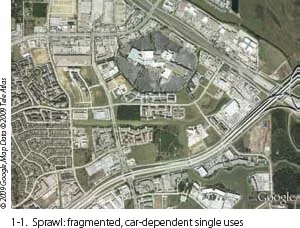
Sprawl is a pattern of growth characterized by an abundance of congested highways, strip shopping centers, big boxes, office parks, and gated cul-de-sac subdivisions—all separated from each other in isolated, single-use pods (figure 1-1). This land-use pattern is typically found in suburban areas, but also affects our cities, and is central to our wasteful use of water, energy, land, and time spent in traffic. Sprawl has been linked to increased air and water pollution, greenhouse gas emissions, loss of open space and natural habitat, and the exponential increase in new infrastructure costs. Social problems related to the lack of diversity have been attributed to sprawl, and health problems such as obesity to its auto-dependence.
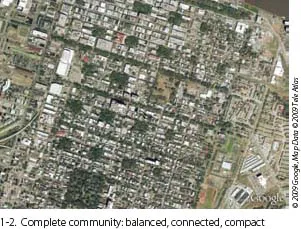
In contrast, complete communities have a mix of uses and are walkable, with many of a person's daily needs—shops, offices, transit, civic and recreational places—within a short distance of home. They are compact, so they consume less open space and enable multiple modes of transportation, including bicycles, cars, and mass transit. A wide variety of building types provides options to residents and businesses, encouraging diversity in population. This mix of uses, public spaces, transportation, and population makes complete communities economically, socially, and environmentally sustainable (figure 1-2).
The promise of suburbia has been eroding for decades, but reached a critical point with the mortgage meltdown of 2008. A record number of homes went into foreclosure and entire subdivisions and commercial developments began to fail. Yet the expanse of sprawl represents a vast investment, and cannot be simply abandoned or demolished. Pragmatism demands the reclamation of sprawl through redevelopment that introduces mixed uses and transportation options. It must be acknowledged, however, that portions of sprawl may remain in their current state, while others may devolve, reverting to agriculture or nature. The design and regulatory strategies and incentives shown here are intended for the places that are best suited to be urbanized because of location or existing investment.
The history and consequences of suburban development, specifically sprawl, are well documented. Numerous books articulate the trajectory of sprawl within its historical context—from the Federal Housing Administration's mortgages for new construction, the subsidies of the interstate highway system, and the tax laws allowing accelerated depreciation of commercial development, to the evolution of Euclidean zoning's separation of uses and the cultural mandate for separation by race. Recent publications put forward the need to redevelop sprawl and what specifically should be repaired; among these are Greyfields into Goldfields and Malls into Main Streets, reports by the Congress for the New Urbanism. Retrofitting Suburbia: Urban Design Solutions for Redesigning Suburbs, by Ellen Dunham-Jones and June Williamson, explains why we need to retrofit sprawl and documents successful examples of retrofits through illuminating and comprehensive analysis.
The Sprawl Repair Manual seeks to expand the literature as a guide that illustrates how to repair the full range of suburban conditions, demonstrating a step-by-step design process for the creation of more sustainable communities. This is a framework for designing the interventions, incorporating them into the regulatory system, and implementing them with permitting strategies and financial incentives.
The proposed approach addresses a range of scales from the region down to the community, street, block, and building. The method identifies deficiencies in typical elements of sprawl, and determines the best remedial techniques for those deficiencies. Also included are recommendations for regulatory and economic incentives.
Lessons learned from history guide this methodology. Rather than the instant and total overhaul of communities, as promoted so destructively in American cities half a century ago, this is a guide for incremental and opportunistic improvement.
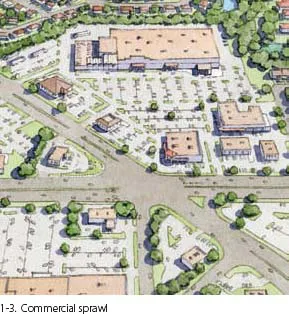
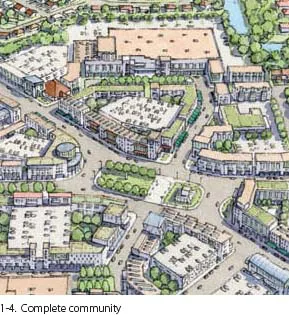
Most of the diagrams have been conceptualized and generalized to make them applicable to a wider range of situations. In some cases the real conditions were simplified to make the components and their deficiencies easily identifiable, and the techniques explicit. All techniques are shown with two- and three-dimensional drawings and diagrams, in a declension from the most general to the most specific (figures 1-3 and 1-4).
CHOICES
There are two primary options for growth: conventional sprawl development and complete communities.
Sprawl abandoned the neighborhood structure in favor of car-dependent patterns. When driving is mandatory for almost all daily activities, carbon emissions are higher. With the price of gasoline rising, long commutes to or from exurban locations become economic disadvantages. Because sprawl developments are not compact, they consume excessive amounts of farmland and valuable natural areas.
Studies have shown that sprawl is damaging to both physical and social health, isolating people in car-dominated environments where they are deprived not only of the physiological benefits of walking, but also of the natural human interactions typical of complete communities.1 This is especially relevant to aging residents, who lose their independence when they can no longer drive, and need to leave their suburban houses for retirement communities. Children and younger adults are also vulnerable to the car-dependence of sprawl. In 1969, 90 percent of all children walked to school, as schools were part of complete neighborhoods, but in 2002 only 31 percent walked to school.2
Sprawl developments, particularly in exurban areas, suffered some of the highest foreclosure rates, and many have also seen dramatic increases in crime rates, some greater than 30 percent.3 Many homes, and even entire subdivisions, have been abandoned, creating the effect of sporadic and dispersed occupancy typical of the consequences of natural disasters. Christopher Leinberger, visiting fellow at the Brookings Institution, predicts that the suburbs on the fringes, poorly served by public transport, will sufer a very visible decline as low-income populations move in and these areas become “magnets for poverty, crime, and social dysfunction.”4
Nonetheless, the development industry continues to produce sprawl, with the support of the financial industry, planning practices, and government policies. Sprawl remains cheaper to plan, easier to finance, faster to permit, and less complicated to build, primarily due to the regulations governing development. It is simpler to attach the freestanding, isolated, single-use components of sprawl to the already subsidized and prolific highway system than to assemble these elements into real neighborhoods and towns. Sprawl is extremely inflexible and will not mature into vibrant urbanism on its own. Without precise design and policy interventions, sprawl might change—a strip shopping center might be scrapped and replaced with a lifestyle center when the next owner comes along—but it is unlikely to produce walkable, sustainable urbanism.
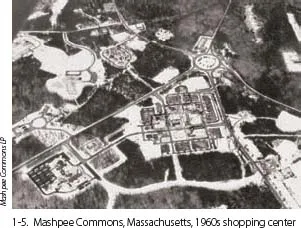
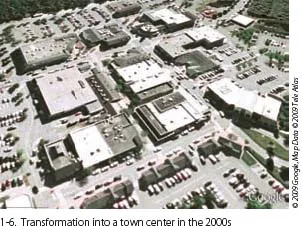
In contrast to sprawl, complete communities are economically robust because they include a variety of businesses that support daily needs, and nearby residents work at and patronize those businesses. They are socially healthy because many generations with diverse incomes and backgrounds live and interact within them. Complete communities are livable because of their comfortable human scale. They are environmentally superior because they are compact, saving land and natural resources. Vehicle miles traveled (VMT) are reduced by as much as 30 percent, resulting in less pollution and less energy used.5
Complete communities also support walking and physical activity, which have been proven important to public health and general well-being. A multi-disciplinary team of researchers from the University of Miami has determined that communities with a mix of uses and good connectivity, block structure, public spaces, and transit proximity have residents
who are more likely to walk, less likely to be overweight, and have greater social and community interactions.6 The researchers worked with the Florida Department of Health to create evidence-based criteria for the Surgeon General's Seal of Walkability so the general public would know what to look for in a community.
The demand for complete communities is greater than the current supply. According to Todd Litman, founder of the Victoria Transport Policy Institute, in 2009 North-American households were evenly divided in their preferences for sprawl or smart growth in the form of walkable, diverse neighborhoods. He predicts that by 2030, more than two-thirds will prefer smart growth.7 This manual shows one way to meet the growing needs for walkable environments by repairing sprawl into complete communities.
SPRAWL REPAIR DEFINED
Sprawl repair transforms failing or potentially failing, single-use, and car-dominated developments into complete communities that have better economic, social, and environmental performance.
The objective of the sprawl repair strategy is to build communities based on the neighborhood unit, similar to the traditional fabric that was established in towns and cities prior to World War II. The primary tactic of sprawl repair is to insert needed elements—buildings, density, public space, additional connections—to complete and diversify the mono-cultural agglomerations of sprawl: residential subdivisions, strip shopping centers, office parks, suburban campuses, malls, and edge cities. By systematically modifying the reparable areas (turning subdivisions into walkable neighborhoods, shopping centers and malls into town centers) and leaving to devolution those that are irreparable (abandonment or conversion to park, agricultural, or natural land), sprawl can be reorganized into complete communities.
To identify the proper targets for repair, it is essential to understand the form and structure of sprawl in the American built environment. Sprawl can take place in intensely urban areas, but most is found in suburban areas. There are three generations of suburbia that vary in form as related to urbanity and walkability: pre-war suburbs, post-war suburbs, and the late 20th-century exurbs. While the pre-war suburbs are often complete communities, the latter two types abandoned the pedestrian-centered neighborhood structure in favor of auto-centric dispersion.
The pre-war suburbs include patterns of growth that can be defined as suburban, but are not sprawl per se (figure 1-7). In the U.S., the first suburbs sprang up in the nineteenth century along the newly built railroad lines, as compact, middle-class communities assembled around stations (examples include Lake Forest and Riverside in Illinois and Forest Hills in Queens, New York) (figure 1-8). These were modeled after the suburbs built in England in the eighteenth century to serve the London bourgeoisie, and inspired development outside of cities in other parts of the world.8 With the invention of the electric streetcar, another group emerged closer to the city and accessible to a more diverse economic and social population than the railroad suburbs (examples include Cleveland Park in Washington, DC, the Country Club District in Kansas City, Missouri, and Brookline, outside of Boston, Massachusetts).9 These developments depended on their proximity to rail stops, and maintained an urban structure for pedestrian walkability and a mixture of daily uses. In the beginning of the 20th century, yet another type of development joined the suburban echelons; communities such as Bloomfield Hills, Michigan, and Coral Gables, Florida, were desi...
Table of contents
- Cover Page
- Title Page
- Copyright Page
- Contents
- Acknowledgments
- Chapter One : Introduction
- Chapter Two: The Sprawl Repair Method
- Chapter Three: Repair at the Regional Scale
- Chapter Four: Repair at the Community Scale
- Chapter Five: Repair of Thoroughfares and Parking
- Chapter Six: Repair at the Block Scale
- Chapter Seven: Repair at the Building Scale
- Postscript
- Endnotes
- Recommended Reading
- Index
Trusted by 375,005 students
Access to over 1.5 million titles for a fair monthly price.
Study more efficiently using our study tools.
Frequently asked questions
Yes, you can cancel anytime from the Subscription tab in your account settings on the Perlego website. Your subscription will stay active until the end of your current billing period. Learn how to cancel your subscription
No, books cannot be downloaded as external files, such as PDFs, for use outside of Perlego. However, you can download books within the Perlego app for offline reading on mobile or tablet. Learn how to download books offline
Perlego offers two plans: Essential and Complete
- Essential is ideal for learners and professionals who enjoy exploring a wide range of subjects. Access the Essential Library with 800,000+ trusted titles and best-sellers across business, personal growth, and the humanities. Includes unlimited reading time and Standard Read Aloud voice.
- Complete: Perfect for advanced learners and researchers needing full, unrestricted access. Unlock 1.5M+ books across hundreds of subjects, including academic and specialized titles. The Complete Plan also includes advanced features like Premium Read Aloud and Research Assistant.
We are an online textbook subscription service, where you can get access to an entire online library for less than the price of a single book per month. With over 1.5 million books across 990+ topics, we’ve got you covered! Learn about our mission
Look out for the read-aloud symbol on your next book to see if you can listen to it. The read-aloud tool reads text aloud for you, highlighting the text as it is being read. You can pause it, speed it up and slow it down. Learn more about Read Aloud
Yes! You can use the Perlego app on both iOS and Android devices to read anytime, anywhere — even offline. Perfect for commutes or when you’re on the go.
Please note we cannot support devices running on iOS 13 and Android 7 or earlier. Learn more about using the app
Please note we cannot support devices running on iOS 13 and Android 7 or earlier. Learn more about using the app
Yes, you can access Sprawl Repair Manual by Galina Tachieva in PDF and/or ePUB format, as well as other popular books in Architecture & Architecture General. We have over 1.5 million books available in our catalogue for you to explore.