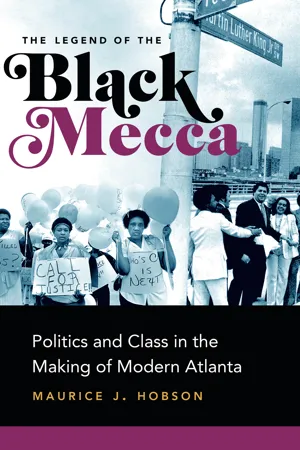
For more than a century, the city of Atlanta has been associated with black achievement in education, business, politics, media, and music, earning it the nickname “the black Mecca.” Atlanta’s long tradition of black education dates back to Reconstruction, and produced an elite that flourished in spite of Jim Crow, rose to leadership during the civil rights movement, and then took power in the 1970s by building a coalition between white progressives, business interests, and black Atlantans. But as Maurice J. Hobson demonstrates, Atlanta’s political leadership — from the election of Maynard Jackson, Atlanta’s first black mayor, through the city’s hosting of the 1996 Olympic Games — has consistently mishandled the black poor. Drawn from vivid primary sources and unnerving oral histories of working-class city-dwellers and hip-hop artists from Atlanta’s underbelly, Hobson argues that Atlanta’s political leadership has governed by bargaining with white business interests to the detriment of ordinary black Atlantans.
In telling this history through the prism of the black New South and Atlanta politics, policy, and pop culture, Hobson portrays a striking schism between the black political elite and poor city-dwellers, complicating the long-held view of Atlanta as a mecca for black people.
eBook - ePub
The Legend of the Black Mecca
Politics and Class in the Making of Modern Atlanta
- 336 pages
- English
- ePUB (mobile friendly)
- Available on iOS & Android
eBook - ePub
About this book
Information
1 Building Black Atlanta and the Dialectics of the Black Mecca
Since the Emancipation Proclamation, Atlanta, Georgia, has boasted a history of black people thriving through the establishment of black-owned businesses and black education. Yet many were excluded from Atlanta’s rising black bourgeoisie. Atlanta’s moniker as the black Mecca is inextricably linked to the course of the American Civil War, when General William Tecumseh Sherman burned the city down as he marched to the sea. Newly freed blacks followed him on his way and found refuge in Atlanta thanks to the presence of Union troops and the Fourteenth Amendment. Atlanta offered black people some reprieve from the recalcitrance of “southern honor.” As we will see in this chapter, the history of Atlanta after the Civil War set the foundation for the public’s narrative of post-1965 black Atlanta, even as racial tensions in the city and black bourgeois prosperity that left the poor behind were many years in the making.
Contested New Souths
On 22 December 1886, Henry Grady, managing editor of the Atlanta Constitution and member of the Atlanta Ring of Democratic leaders, spoke before the New England Society of New York. His speech detailed the coming of a “New South,” in which he advocated industrial development as a solution to the postwar South’s economic and social troubles. In particular, Grady promoted the economic development potential of Atlanta, Georgia. Though Grady was not the first to sell business interests on Atlanta, his pitch was a success. By dispelling any leftover enmity dating back to the Civil War and advocating unity and trust between the North and South, he whetted the appetite of northern investors for Atlanta’s industries.
Grady’s notion of a New South was not universally admired by southerners. To some southern whites, Grady’s advice to raise cotton prices for additional revenue was a way of selling out southern farmers to the benefit of northern interests. Grady’s idea struggled further as race relations, troubled by oppression and white terror toward blacks during the nadir of American race relations, were ignored by robber barons interested in southern industrial investments. In several articles, Grady purported that blacks experienced “fair treatment” throughout the South in general and Georgia in particular. This discourse appeased northerners insofar as, previously, only a handful of northern investors had considered the South because of its sordid history of black disenfranchisement and oppression in the midst of white terror. But for black southerners, Grady’s New South idea did little to displace the Old South’s hegemonic order of white supremacy. Yet, for all its shortcomings, the New South idea provided an ideological framework that centered Atlanta as the burgeoning symbol of the New South.1 More important, Grady’s New South paradigm epitomized how whites held fast to the traditions of the Old South and fine-tuned those traditions to create a New South.
At the time of Grady’s New South sales pitch, Atlanta was home to a diverse and resilient black community. If anything set Atlanta’s black community apart from other southern cities, it was the select few who were able to achieve positions of political and economic power far beyond the expectations of the black masses in the rest of the South. Still, for the rank and file of black people in Atlanta, life was marked by the prevailing notions of American racism and white supremacy that left black Atlantans, in the main, at the bottom of the economic, political, and social life of the city.
There was no firm basis for the popular myth that white Atlantans, through their charity and kindness, were responsible for black progress in the city. Most of Atlanta’s affluent blacks fought their way up from the bottom rung on their own, although there had been steadfast and significant support from a faction of the white population in the city. Blacks in Atlanta flourished because cadres of the community educated themselves and carved out a place in the city’s business life. They built a black educational juggernaut that came to be a center for black education not only in Georgia and the rest of the country but also in the entire world as the institutions of higher education recruited students of African descent from around the world. No other city could boast several black institutions of higher learning in close proximity as Atlanta.
In 1837, what would become the city of Atlanta was called Terminus. However, in 1847 the city was renamed Atlanta, a shortened version of the Atlantica-Pacifica, the name of the railroad lines that connected Savannah to the Midwest and West. The 1850 U.S. census indicated that Atlanta had a total population of 2,569, consisting of 2,058 whites and 511 blacks, of which 493 were bondsmen and 18 were free blacks.2 During the decade that followed, white merchants and “mechanics” grew alarmed at the number of free blacks, primarily of mixed heritage, who worked as dentists, barbers, and blacksmiths. City council minutes from the era detailed white Atlantans’ grievances to city government about competition from free blacks. The most infamous was Roderick Badger, a free black, who as early as 1859, was the target of protests by white tradesmen who filed a complaint with the city council for “tolerating the black man” in Atlanta. Badger remained in Atlanta and became one of the city’s most prominent dentists with a large white clientele.3
Enslaved Africans were still bought and sold in Atlanta during the Civil War. Most strikingly, advertisements in a local newspaper showed slave traders still in the business of dealing in human beings as late as May 1864—approximately fifteen months after Abraham Lincoln issued the Emancipation Proclamation. During general William Tecumseh Sherman’s siege of Atlanta, blacks were forced to work on construction gangs that built breastworks and parapets. Masters seemed to have little to no fear that the city’s bondsmen would revolt. In fact, enslaved Atlantans deserted their masters only when federal troops entered the city.
In the wake of the war, the southern economy was all but destroyed and the economic ruin spawned a great migration by blacks into Atlanta. They took up residence in the areas along the railroad tracks known as the bottoms, a name that signaled the location’s poor living conditions due to coal dust from trains, which created respiratory problems, and frequent flooding, which caused typhoid fever. Most freedmen could not find work in the city’s textile industry, and poor whites held deep resentment for those who did because of the pressure they placed on the already devastated labor market. Evidence of this can be seen in the Fulton Bag and Cotton Mill strike in 1897, when white mill workers struck, refusing to work alongside blacks.4 Even so, blacks migrated to Atlanta because, unlike other southern locales, the Union troops offered some form of protection against whites, and the Freedmen’s Bureau provided limited but much-needed assistance.
Black determination to find work intensified hostility and fears among poor white Atlantans. Entrepreneurial and industrious blacks were able to gain entrance to professional workplaces as barbers, mechanics, dentists, drug salesmen, and doctors. Among the most successful of these was Alonzo Herndon, founder of the Atlanta Life Insurance Company. Herndon was born into slavery in 1858 and came to Atlanta from Social Circle (Walton County), Georgia, in 1876. Upon arriving in the city, he opened a barbershop in the Markham House.5 By 1908, he had accumulated property valued at $80,000.6
During Reconstruction and with the passage of the Thirteenth, Fourteenth, and Fifteenth Amendments (known as the Reconstruction Amendments), Atlanta’s city council implemented due process and equal protection under the law by passing ordinances that made blacks subject to the same laws as whites, against the overwhelming opposition of white Atlantans. Blacks also attained suffrage.7 In 1871, William Finch and George Graham became the first blacks to be elected to the Atlanta City Council. Finch would prove a particularly influential city politician, working tirelessly for free education for black children.
It was also during the Reconstruction years that blacks in Atlanta were able to make the greatest strides in education, particularly in higher education. Atlanta University was founded in 1865; Morehouse College, initially located in Augusta and named the Augusta Bible College, moved to Atlanta as the Atlanta Bible College, opening its doors in 1867; Clark College was founded in 1869. Other black institutions founded after Reconstruction were Spelman College and Morris Brown College, both founded in 1881, and the Gammon Theological Seminary founded in 1886. No force in the city had more political, social, cultural, and historical significance for blacks than the founding of these institutions of higher education.
Sociologist Joseph Jewell asserts that as early as 1865, James Tate and Granithan Daniels, both former slaves, opened Atlanta’s first public school in Atlanta for black children on Gilmer Street. It later became the Storrs School headed by the American Missionary Association. Blacks who had previously been quasi-members of white churches during slavery founded their own churches during Reconstruction. In time, these churches would produce some of the most remarkable black “leaders” of the era. Blacks were elected to the Georgia General Assembly and helped write the Georgia post–Civil War Constitution of 1868. This caused more resentment between blacks and whites, and black politicians found it difficult to obtain political power and, once they did, to provide effective leadership.8 Subsequently, lack of support from white Republicans as well as the unrelenting efforts of white Democrats to regain control undermined black political gains.
By 1872, southern redeemer whites were back in control of the state government. In the 1880s a series of decisions by the U.S. Supreme Court flattened almost all the social gains blacks had made since Reconstruction. Examples include U.S. v. Reese and U.S. v. Cruikshank, decisions made in 1876 that reasserted the white supremacist dogma of states’ rights.9 The southern redeemers also targeted black education. Georgia State Schools commissioner Gustavus Orr argued that college education for blacks was far in advance of the demands of the then-present conditions of black societies and thus refused to fund public education for black students.10 In this period, the south’s black masses sought work in the city’s factories and only a select few sought a college education.
As the quality of black life declined, Atlanta’s business and industrial strength bolstered the “coming of the New South” for whites. In 1895, as a sign of its progress, Atlanta hosted one of the finest examples of the city’s efforts toward boosterism, the Cotton States and International Exposition, a well-publicized fair that celebrated the supposed progress of the South since the Civil War and the resumption of white control over blacks. The fair was held in Piedmont Park, which was also the site where Booker T. Washington delivered his speech to northern philanthropists. The talk was later dubbed the “Atlanta Compromise” by the scholar W. E. B. Du Bois. Washington advised southern blacks to concentrate on vocational training rather than civil and political rights. He connected the interests of blacks with the prosperity of the region and proposed that blacks focus on commerce, an area he believed would give them more opportunities in the South than the North. The white press reported the speech as a major sensation. However, for blacks, Washington had dealt a deafening blow in the name of white power. For more than two decades, he would cast a long shadow over development in the South. He did so, however, in the face of criticism from other black leaders such as Du Bois, a professor at Atlanta University, who had founded a center to examine the social aspects of black life in America in 1896.11 Others, including John Hope, president of Morehouse College, and activists T. Thomas Fortune and Jesse Redmon Fauset, challenged Washington’s plan to give up black civil liberties. Even so, Washington’s speech was so well-liked by whites that the words he uttered on that summer day in September became the basis for the “separate but equal” legal language that resulted in the 1896 U.S. Supreme Court Plessy v. Ferguson decision.12
The violence and terror against blacks during these years was profound. Between 1888 and 1903, 241 blacks were lynched in Georgia, making it second only to Mississippi (294) in the number of deaths caused by mob violence.13 Yet, in the midst of this hostility, Atlanta’s black merchants established businesses serving black clientele. By 1900, blacks in Georgia had amassed property assets valued at around $14 million, mainly in Atlanta. This opened the path to the emergence of several black-owned, black-operated firms that served Atlanta’s black community over the next two decades. Of these businesses, Alonzo Herndon’s Atlanta Life Insurance, founded in 1905, the Atlanta Savings Bank founded in 1909, and the Citizens Trust Company founded in 1921 would have the most influence in black America in coming years.14
As the twentieth century dawned, much of Atlanta’s black community watched in horror as the city stood at the center of a national trend toward race hate and terror. On 22 September 1906, racial hostility reached a fever pitch with the Atlanta race riot, a four-day nightmare during which mobs shot, stabbed, and dragged black people from vehicles while looting and burning black neighborhoods. By the end of the riot, twenty-five blacks and two whites had been killed, and at least seventy blacks had been injured.15 Characteristically, the spark for the riot was economic competition between blacks and whites, even as its perpetrators claimed they were only protecting southern white women from sex-crazed black men.
The next blow to black prosperity and citizenship was dealt in 1908, when Georgia governor Hoke Smith fulfilled a campaign promise to pass laws preventing blacks from voting in primary elections. By 1913, state laws required segregation in almost every aspect of public life and death, even in cemeteries.
Yet in spite of the violence and disenfranchisement, blacks continued to seek a better life in Atlanta. Black migration into Atlanta during the early decades of the twentieth century was indicative of the farm-to-city trend seen nationwide. From 1900 to 1920, Atlanta’s black...
Table of contents
- Cover
- Title Page
- Copyright
- Dedication
- Contents
- List of Illustrations
- Acknowledgments
- Introduction
- 1: Building Black Atlanta and the Dialectics of the Black Mecca
- 2: The Brawn of the Black Mecca and the Black New South
- 3: The Sorrow of a City
- 4: The Bravado of the Black Mecca and Blackness Abroad
- 5: Speaking to the Spirit of the Games
- 6: The Sound of the Fury
- Afterword
- Appendix: Archives and the Atlanta Child Murders
- Notes
- Bibliography
- Index
Trusted by 375,005 students
Access to over 1.5 million titles for a fair monthly price.
Study more efficiently using our study tools.
Frequently asked questions
Yes, you can cancel anytime from the Subscription tab in your account settings on the Perlego website. Your subscription will stay active until the end of your current billing period. Learn how to cancel your subscription
No, books cannot be downloaded as external files, such as PDFs, for use outside of Perlego. However, you can download books within the Perlego app for offline reading on mobile or tablet. Learn how to download books offline
Perlego offers two plans: Essential and Complete
- Essential is ideal for learners and professionals who enjoy exploring a wide range of subjects. Access the Essential Library with 800,000+ trusted titles and best-sellers across business, personal growth, and the humanities. Includes unlimited reading time and Standard Read Aloud voice.
- Complete: Perfect for advanced learners and researchers needing full, unrestricted access. Unlock 1.5M+ books across hundreds of subjects, including academic and specialized titles. The Complete Plan also includes advanced features like Premium Read Aloud and Research Assistant.
We are an online textbook subscription service, where you can get access to an entire online library for less than the price of a single book per month. With over 1.5 million books across 990+ topics, we’ve got you covered! Learn about our mission
Look out for the read-aloud symbol on your next book to see if you can listen to it. The read-aloud tool reads text aloud for you, highlighting the text as it is being read. You can pause it, speed it up and slow it down. Learn more about Read Aloud
Yes! You can use the Perlego app on both iOS and Android devices to read anytime, anywhere — even offline. Perfect for commutes or when you’re on the go.
Please note we cannot support devices running on iOS 13 and Android 7 or earlier. Learn more about using the app
Please note we cannot support devices running on iOS 13 and Android 7 or earlier. Learn more about using the app
Yes, you can access The Legend of the Black Mecca by Maurice J. Hobson in PDF and/or ePUB format, as well as other popular books in Social Sciences & North American History. We have over 1.5 million books available in our catalogue for you to explore.