eBook - ePub
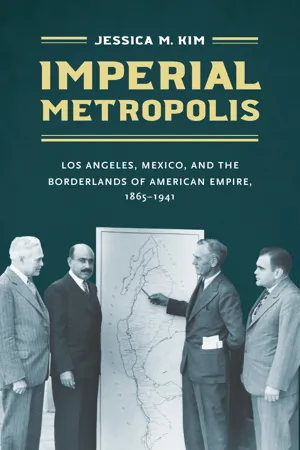
Imperial Metropolis
Los Angeles, Mexico, and the Borderlands of American Empire, 1865–1941
- 304 pages
- English
- ePUB (mobile friendly)
- Available on iOS & Android
eBook - ePub
Imperial Metropolis
Los Angeles, Mexico, and the Borderlands of American Empire, 1865–1941
About this book
In this compelling narrative of capitalist development and revolutionary response, Jessica M. Kim reexamines the rise of Los Angeles from a small town to a global city against the backdrop of the U.S.-Mexico borderlands, Gilded Age economics, and American empire. It is a far-reaching transnational history, chronicling how Los Angeles boosters transformed the borderlands through urban and imperial capitalism at the end of the nineteenth century and how the Mexican Revolution redefined those same capitalist networks into the twentieth.
Kim draws on archives in the United States and Mexico to argue that financial networks emerging from Los Angeles drove economic transformations in the borderlands, reshaped social relations across wide swaths of territory, and deployed racial hierarchies to advance investment projects across the border. However, the Mexican Revolution, with its implicit critique of imperialism, disrupted the networks of investment and exploitation that had structured the borderlands for sixty years, and reconfigured transnational systems of infrastructure and trade. Kim provides the first history to connect Los Angeles’s urban expansionism with more continental and global currents, and what results is a rich account of real and imagined geographies of city, race, and empire.
Kim draws on archives in the United States and Mexico to argue that financial networks emerging from Los Angeles drove economic transformations in the borderlands, reshaped social relations across wide swaths of territory, and deployed racial hierarchies to advance investment projects across the border. However, the Mexican Revolution, with its implicit critique of imperialism, disrupted the networks of investment and exploitation that had structured the borderlands for sixty years, and reconfigured transnational systems of infrastructure and trade. Kim provides the first history to connect Los Angeles’s urban expansionism with more continental and global currents, and what results is a rich account of real and imagined geographies of city, race, and empire.
Tools to learn more effectively

Saving Books

Keyword Search

Annotating Text

Listen to it instead
Information
1 Pueblo, City, Empire
Between the 1880s and the height of the Mexican Revolution, a span of two and a half decades, over 150 businesses incorporated in Los Angeles County explicitly to do business in Mexico. Combined, the companies’ initial stock offerings totaled over $70 million and involved the investments, large and small, of thousands of Angelenos. These business schemes included a dizzying array of industries in Mexico. Angelenos funneled money into the mining of gas, coal, silver, gold, copper, zinc, lead, borax, iron, gypsum, tin, salt, and marble. Extracting subsoil resources spawned secondary investments in mining supplies and general merchandising enterprises in Mexico. Ranching and irrigation of Mexican farmland also proved attractive to Angelenos who eagerly purchased agricultural land and began planting cash crops, many that had already proved extraordinarily lucrative in California, including grain, sugarcane, hardwood, corn, nuts, oranges, lemons, limes, pineapples, dates, figs, and cotton. Money invested in agriculture also led Angelenos to spend money on raising stock in Mexico, including cattle, pigs, chickens, and horses. Ownership of land also led to real estate speculation on the part of Angelenos, who developed Mexican subdivision, irrigation, and colonization schemes much as they had in the previous decade or so before in Southern California. The necessity of moving people to property and goods to market as well as the call of connecting periphery to core also resulted in investments in the technologies of travel and transportation, from railroad lines to roads, sailing vessels, wharves, piers, warehouses, steamship lines, and hotels.1
These significant investment ties between Los Angeles and Mexico did not come about by accident or happenstance. A zealous pro-growth press daily extolled the virtues of urban and commercial growth. Ever the mouthpiece of urban development, the Los Angeles Times beseeched city investors to connect to Mexico. Headlines read, “Commerce of Mexico and Our Interest Therein” and “How to Gain Mexican Trade” or “Mexico, a Country of Unsurpassed Fertility.”2 Institutions sprouted to put this type of growth into action, including the Los Angeles Chamber of Commerce and the city’s Merchants and Manufacturers Association, both designed to promote regional economic growth. As a result, Angelenos hustled across the border in a fairly well coordinated campaign to construct not just a financial relationship between their city and a Mexican hinterland, but an imperial relationship, one that intersected with urban development in the West as well as emerging campaigns to advance America’s place in the global economy.

Bankers and railroad executives in front of a special train chartered to transport them from Los Angeles to investment properties on the California–Baja California border, early twentieth century. Colorado River Land Company Collection, Sherman Library.
The urban dimensions of empire and capitalism arose from deep imperial roots in Los Angeles. As explored in the first section of this chapter, Los Angeles was born of empire, first as a colonial outpost of the Spanish crown, then as a point of conflict between Mexicans and expansionistic Americans bent on continental domination, and finally as a nascent Anglo-American city built on the controlled labor of colonized Mexicans. The long history of overlapping empires and imperial expansion that overlay Los Angeles and the borderlands in the nineteenth century meant that the city and its residents were never far from ideas of expansionistic growth, international commerce, and transnational politics. As a result, when Anglo-Americans arrived in a trickle and then a torrent following the American Civil War, they already understood Los Angeles as situated at the intersection of the United States, Mexico, the rest of Latin America, and the Pacific world. Los Angeles was not just the remote edge of the United States. It was also the portal to empire and the hemisphere.
As a result, as Los Angeles became more and more Anglo-American from the 1860s through the 1890s, Angeleno investors began to couple urban growth with the spread of American empire in Mexico. They crossed the border with a set of imperial projects, ranging from international diplomacy to cross-border commerce, and prioritized urban growth with personal financial benefits. Connecting core to periphery took place at multiple scales—the international, the regional, and the local—and wrought an exchange in everything from borax to oranges to chickens to oil between Los Angeles and Mexico in the decades leading up to the Mexican Revolution. Several scales of empire building converged in the Los Angeles–Mexico borderlands precisely to “secure a share of the prize” and to transform Mexico, particularly the northern portion of the country, into Los Angeles’s “tributary territory.” Tracing the relationship between Los Angeles investors up, toward U.S. international policy, as well as down, to individual relationships between Los Angeles capitalists and Mexican officials, reveals an imperial and expansionist philosophy infused with ideas of an “informal” or commercial empire and operating at multiple levels but always emanating from Los Angeles and placing its growth and boosters first. Bridging recent studies of American empire that foreground the local, on-the-ground functioning of imperial exploits with the rich history of capitalist development in the U.S.-Mexico borderlands, this chapter explores the ways in which privileging urban growth shaped borderlands relationships between an urban core in Los Angeles and a periphery in Mexico.3
First, at the level of national diplomacy, Angelenos wanted the United States to have a rigorous trade relationship with Mexico without the formal ties of traditional imperial endeavors. Epitomized by the efforts of Civil War general and Los Angeles–based investor William Rosecrans, Los Angeles investment schemes were deeply embedded in the schema of American global expansion following the American Civil War. Los Angeles, long the outpost of several empires, was home to investors attuned to the growing role and power of capital in the American West, in the borderlands, and around the world. As explored through Rosecrans’s role as ambassador to Mexico following the Civil War and his simultaneous investments in the Los Angeles–Mexico borderlands, Angeleno investors embarked on urban and imperial adventures at the same time investors and policymakers began articulating the formation of an American commercial empire. As famously expressed by Secretary of State William Seward, who purchased Alaska for the United States in 1867, “the flag would follow trade” in this philosophy of global capital connections. Racial philosophies colored this advance of American commercial interests around the globe; an aversion to absorbing nonwhite peoples into the American body politic sparked much heated political debate over American control over places such as Hawaii or the Philippines. On the edge of the American continental empire, Los Angeles investors, eager to expand the commercial reach of their city, regionalized this highly racialized approach to trade and empire building and hoped to expand commercial connections between Los Angeles and Mexico without formally annexing additional portions of Mexico or absorbing more of its nonwhite population.
At a more regional level, Los Angeles investors actively cultivated a dense set of relationships between commercial and civic leaders in Southern California and brokers, investors, and government officials in Mexico. Like agents of empire around the world, they believed that a network of relationships, as well as formalized commercial and governmental ties between Southern California and Mexico City, would expand Los Angeles’s influence and economic supremacy. These relationships, both informal and formal, took the form of friendship between some of Los Angeles’s most powerful investors and high-ranking Mexican officials such as Díaz. Others pursued close working relationships with Mexican American and Mexican investors and brokers such as Los Angeles lawyer Ignacio Sepúlveda and Mexican investor Guillermo Andrade to facilitate business dealings south of the border. These relationships culminated in a campaign to formalize a commercial relationship between an urban core in Southern California and a Mexican periphery. This came in the form of a Mexican consulate office located in Los Angeles primarily to attend to the economic relationship between Los Angeles and Mexico. While Angelenos did not want a formal imperial relationship between the United States and Mexico during this period (and actively reassured the Mexican government that annexation of Mexico was not their ultimate goal), they did want formalized commercial ties between city and hinterland and sought these in the establishment of an outpost of the Mexican government within the geographic bounds of the city. In this, Angeleno investors mirrored efforts of American capitalists, traders, exporters, and investors who looked to expand both private corporate and national power and informal or commercial imperial endeavors overseas following the American Civil War.4
Born of Empire
The philosophy of urban empire propagated by Los Angeles boosters emerged in a city long bound up in the building of empires. Founded in 1781, El Pueblo de Nuestra Señora La Reina de Los Angeles de Porciuncula began as an outpost of the Spanish crown. A motley group of settlers traversed the parched deserts of northern New Spain from Sonora and Sinaloa into Alta California to establish the pueblo. Once in the Los Angeles basin, the colonists set about the first project of most colonial endeavors—controlling and converting a region’s native population, in this case, the Tongva people. While busy with the forceful control of indigenous populations at the local level, the pueblo’s founders also found themselves swept into the global dimensions of empire. As historian Louise Pubols so succinctly argues, “Los Angeles was born a global city.”5 The very founding of the town came as a mandate from a Spanish crown that wanted to restructure its American empire to better defend it from European challengers. Between its founding in 1781 and the start of the Mexican-American War in 1846, Los Angeles’s population remained relatively small but closely linked to global political and economic shifts. An international trade in the products of ranches and cattle made up an important portion of the pueblo’s economy, and Angelenos, particularly those with political and economic power, Californios or gente de razón, participated in Mexico’s movement for independence and its transition from colony to republic in the first decades of the nineteenth century.
The dynamics of a different empire overtook the city and the borderlands in the middle of the nineteenth century in the form of the Mexican-American War. Soaked in the ideology of Manifest Destiny, exuberant American expansionists believed it the providence of their nation to span the continent. This imperial impulse brought about the next dramatic shift in the history of Los Angeles. Manifest Destiny and its more profane counterparts—ideas of racial superiority, American settler colonialism, and military conquest—brought new territories into the American nation, including California and its southern outpost, Los Angeles. Again, broader continental and global forces aligned to transform a place far from traditional centers of power. Annexation to the United States brought waves of ambitious Anglo migrants and booster designs for conjuring cities out of manufactured real estate booms.6
On the ground in Los Angeles, the close of the Mexican-American War in 1848 brought with it tides of new Anglo settlers, awash in high economic expectations and a desire to connect Los Angeles to the greater United States and the Pacific world. As a result, these arrivals set the stage for further American military and economic forays into the borderlands and beyond. Pio Pico, California’s last Mexican governor, lamented, “We find ourselves suddenly threatened by hordes of Yankee emigrants, who have already begun to flock into our country and whose progress we cannot arrest.”7 Anglo-Americans in the postwar period arrived anticipating open tracts of land ready for claim and ripe for development. Instead they found Californios, the Mexican American political and economic class who had long controlled Southern California property in the form of expansive ranchos and who rightly anticipated maintaining their property under the provisions of the Treaty of Guadalupe Hidalgo, which guaranteed citizenship and property rights to the territory’s population. Taxes and prolonged legal proceedings to prove ownership under American law with Mexican documents proved disastrous for the Californios, who found themselves faced with the difficult challenge of protecting properties from an onslaught of aggressive American capitalism and a racialized American legal system. By the end of the nineteenth century, a few Anglo-American capitalists based in Los Angeles and San Francisco controlled most of Southern California’s ranches. Given this wide-scale transfer of wealth and property in Southern California from Californios to Anglo-Americans between 1848 and the 1880s and the city’s already established ties with international trade and Mexico, it is not difficult to understand why Los Angeles’s Anglo-America...
Table of contents
- Cover
- Series Page
- Title Page
- Copyright
- Dedication
- Contents
- List of Illustrations, Map, Table
- Acknowledgments
- Map
- Introduction: City-Empire
- 1. Pueblo, City, Empire
- 2. Organizing Capital and Controlling Race and Labor
- 3. Revolution around the Corner and across the Border
- 4. Like Cuba and the Philippines
- 5. Against Capital and Foreigners
- 6. Highway for the Hemisphere
- Epilogue: Global City
- Appendix. List of Companies Incorporated in Los Angeles County to Conduct Business in Mexico, 1886–1931
- Notes
- Bibliography
- Index
Frequently asked questions
Yes, you can cancel anytime from the Subscription tab in your account settings on the Perlego website. Your subscription will stay active until the end of your current billing period. Learn how to cancel your subscription
No, books cannot be downloaded as external files, such as PDFs, for use outside of Perlego. However, you can download books within the Perlego app for offline reading on mobile or tablet. Learn how to download books offline
Perlego offers two plans: Essential and Complete
- Essential is ideal for learners and professionals who enjoy exploring a wide range of subjects. Access the Essential Library with 800,000+ trusted titles and best-sellers across business, personal growth, and the humanities. Includes unlimited reading time and Standard Read Aloud voice.
- Complete: Perfect for advanced learners and researchers needing full, unrestricted access. Unlock 1.4M+ books across hundreds of subjects, including academic and specialized titles. The Complete Plan also includes advanced features like Premium Read Aloud and Research Assistant.
We are an online textbook subscription service, where you can get access to an entire online library for less than the price of a single book per month. With over 1 million books across 990+ topics, we’ve got you covered! Learn about our mission
Look out for the read-aloud symbol on your next book to see if you can listen to it. The read-aloud tool reads text aloud for you, highlighting the text as it is being read. You can pause it, speed it up and slow it down. Learn more about Read Aloud
Yes! You can use the Perlego app on both iOS and Android devices to read anytime, anywhere — even offline. Perfect for commutes or when you’re on the go.
Please note we cannot support devices running on iOS 13 and Android 7 or earlier. Learn more about using the app
Please note we cannot support devices running on iOS 13 and Android 7 or earlier. Learn more about using the app
Yes, you can access Imperial Metropolis by Jessica M. Kim in PDF and/or ePUB format, as well as other popular books in History & Mexican History. We have over one million books available in our catalogue for you to explore.