Biological Sciences

Carbohydrates
Carbohydrates are organic compounds made up of carbon, hydrogen, and oxygen. They serve as a primary source of energy for living organisms and are essential for various cellular processes. Carbohydrates can be found in foods such as fruits, vegetables, grains, and dairy products, and they play a crucial role in the structure of cells and tissues.
Written by Perlego with AI-assistance
Related key terms
1 of 5

11 Key excerpts on "Carbohydrates"
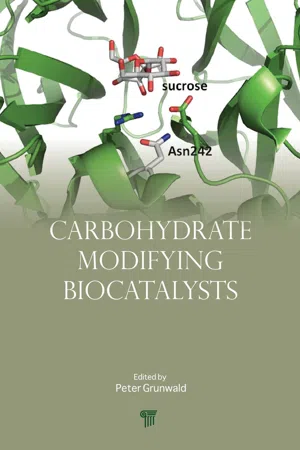 eBook - PDF
- Peter Grunwald(Author)
- 2011(Publication Date)
- Jenny Stanford Publishing(Publisher)
Chapter 1 BASICS IN CARBOHYDRATE CHEMISTRY Heinrich Hühnerfuss Department of Organic Chemistry, University of Hamburg, D-20146 Hamburg, Germany [email protected] 1.1 INTRODUCTION The terms carbohydrate , saccharide , and sugar are being used as synonyms: carbohydrate refers to the classical assumption that this class of compounds exclusively consists of the elements C, H, and O, where the latter two elements exhibit the same relation as encountered in water, i.e., a relation of 2:1. Accordingly, a general formula of C n (H 2 O) n was derived which was actually in line with the formulae of several basic sugars such as glucose (C 6 H 12 O 6 ) or ribose (C 5 H 10 O 5 ). However, though more detailed structural studies revealed that these compounds did not contain intact water molecules, the term Carbohydrates persists. Furthermore, it was shown that many natural Carbohydrates contain additional elements, e.g., nitrogen or sulphur. Saccharide stems from the word sugar in several early languages ( sarkara in Sanskrit, sakcharon in Greek, and saccharum in Latin). Carbohydrates are the most abundant class of bioorganic compounds in the biological world, making up more than 50% of the dry weight of the Earth’s biomass (Bruice, 2004). They play a Carbohydrate-Modifying Biocatalysts Edited by Peter Grunwald Copyright © 2012 Pan Stanford Publishing Pte. Ltd. www.panstanford.com 2 Basics in Carbohydrate Chemistry crucial role in various functions in living organisms. For example, several Carbohydrates serve as a major source of metabolic energy. Grass, leaves, fruits, seeds, stems, and roots of plants contain Carbohydrates that plants use for their own metabolic needs and that also serve the metabolic needs of animals that eat the plants. Other Carbohydrates can be found as structural components in cells or they act as recognition sites on cell surfaces.
- Morris Hein, Scott Pattison, Susan Arena, Leo R. Best(Authors)
- 2014(Publication Date)
- Wiley(Publisher)
Grafissimo/iStockphoto 27.1 Carbohydrates: A First Class of Biochemicals 27.2 Classification of Carbohydrates 27.3 Importance of Carbohydrates for Life 27.4 Common Monosaccharides 27.5 Structure of Glucose and Other Aldoses 27.6 Cyclic Structures of Common Hexoses 27.7 Hemiacetals and Acetals 27.8 Pentoses 27.9 Structures and Properties of Disaccharides 27.10 Sweeteners and Diet 27.11 Redox Reactions of Monosaccharides 27.12 Polysaccharides Carbohydrates Bread is the staff of life because it is mainly carbohydrate. C H A P T E R O U T L I N E W hat is the most abundant organic chemical in the world? The answer is not petroleum products, plastics, or drugs. Rather, it is cellulose. An amazing 10 billion tons of cellulose are formed daily in the biosphere. Aggregates of cellulose allow the California redwoods to stretch hundreds of feet toward the sky and make a Brazil nut a “hard nut to crack.” Products as diverse as the paper in this book and cotton in clothing are derived from cellulose. So, perhaps it is not surprising that this carbohydrate is the most widespread organic chemical in the world. Carbohydrates are molecules of exceptional utility. They provide basic diets for many of us (starch and sugar), roofs over our heads, and clothes for our bodies (cellulose). They also thicken our ice cream, stick postage stamps to our letters, and provide biodegradable plastic trash sacks. From relatively simple components (carbon, hydrogen, and oxygen), nature has created one of the premier classes of biochemicals. C H A P T E R 27 27.1 • Carbohydrates: A First Class of Biochemicals 695 27.1 Carbohydrates: A FIRST CLASS OF BIOCHEMICALS Describe the general characteristics of a carbohydrate. Carbohydrates are among the most widespread and important biochemicals. Most of the matter in plants, except water, consists of these substances. Carbohydrates are one of the three principal classes of energy-yielding nutrients; the other two are fats and proteins. No longer available |Learn more
- (Author)
- 2014(Publication Date)
- Learning Press(Publisher)
Carbohydrates perform numerous roles in living things. Polysaccharides serve for the storage of energy (e.g., starch and glycogen) and as structural components (e.g., cellulose in plants and chitin in arthropods). The 5-carbon monosaccharide ribose is an important component of coenzymes (e.g., ATP, FAD, and NAD) and the backbone of the genetic molecule known as RNA. The related deoxyribose is a component of DNA. Saccharides and their derivatives include many other important biomolecules that play key roles in the immune system, fertilization, preventing pathogenesis, blood clotting, and development. In food science and in many informal contexts, the term carbohydrate often means any food that is particularly rich in the complex carbohydrate starch (such as cereals, bread and pasta) or simple Carbohydrates, such as sugar (found in candy, jams and desserts). Structure Formerly the name carbohydrate was used in chemistry for any compound with the formula C m (H 2 O) n . Following this definition, some chemists considered formaldehyde CH 2 O to be the simplest carbohydrate, while others claimed that title for glycolaldehyde. Today the term is generally understood in the biochemistry sense, which excludes compounds with only one or two carbons. Natural saccharides are generally built of simple Carbohydrates called monosaccharides with general formula (CH 2 O) n where n is three or more. A typical monosaccharide has the structure H-(CHOH) x (C=O)-(CHOH) y -H, that is, an aldehyde or ketone with many hydroxyl groups added, usually one on each carbon atom that is not part of the aldehyde or ketone functional group. Examples of monosaccharides are glucose, fructose, and glyceraldehyde. eBook - PDF
- Allan Blackman, Steven E. Bottle, Siegbert Schmid, Mauro Mocerino, Uta Wille(Authors)
- 2022(Publication Date)
- Wiley(Publisher)
CHAPTER 22 Carbohydrates LEARNING OBJECTIVES After studying this chapter, you should be able to: 22.1 define Carbohydrates 22.2 describe monosaccharides using aldose/ketose terminology 22.3 understand and describe the cyclic structure of monosaccharides 22.4 describe the chemical reactions of monosaccharides 22.5 explain disaccharides and oligosaccharides 22.6 define polysaccharides and describe starch, glycogen and cellulose. Carbohydrates is probably the chemical term that is most widely used by the general public. Commonly referred to as ‘carbs’, it seems everyone has an idea of how much, or how little, or what type we should be consuming in our diets. Carbohydrates are in fact a major class of organic molecules that are important not only in food, but more broadly in biochemistry, medicines, agriculture and even as structural materials. Carbohydrates act as storehouses of chemical energy (glucose, starch, glycogen) and are components of supportive structures in plants (cellulose), crustacean shells (chitin) and connective tissues in animals (polysaccharides). Carbohydrates are also essential components in the nucleic acids RNA(d-ribose) and DNA (2-deoxy- d-ribose), and they play crucial roles in cell surface and membrane recognition that are necessary for cell function. Small carbohydrate molecules, such as glucose, are readily soluble in water and so can be transported through the vascular system to meet a plant’s or animal’s energy requirements. Chemists are increasingly interested in Carbohydrates as a potential solution for many of the problems caused by the burning of fossil fuels for energy. Increasing research efforts are being focused on ‘biofuels’, largely ethanol, derived from cellulose. Cellulose accounts for approximately three-quarters of the dry weight of the plant, where it is used to provide plant cell walls with strength and rigidity.
- Michael EJ Lean(Author)
- 2006(Publication Date)
- CRC Press(Publisher)
Carbohydrates Carbohydrates constitute one of the three main classes of ‘macro-nutrients’. They occur in food as sugars and starches, which are a major source of energy in the diet, and as cellulose which is the main non-starch polysaccharide. Sugars are produced in plants as the end product of photosynthesis, from carbon dioxide and water. At the same time oxygen is evolved, as shown in the equation for the formation of the simple carbohy-drate glucose: Water appears on both sides of this equation because it has been shown that all the oxygen evolved ori-ginates from the water. The oxygen atoms in the glucose and water molecules on the right-hand side of the equation are those which were originally com-bined with carbon in the carbon dioxide. The equa-tion is a comparatively simple one, but it shows only the starting materials and final products of a series of complex reactions. The building-up of carbohydrate molecules by plants is accomplished by photosynthesis. Energy is required to transform the carbon dioxide and water into Carbohydrates and this is supplied by the action of sunlight on chlorophyll in the leaves.Consequently, photosynthesis does not take place in the dark. Animals, including man, are unable to synthesize Carbohydrates, and this is one of the fundamental differences between animals and plants. The sugars formed by photosynthesis are transported within the plant as sucrose, which is soluble in water. Sucrose is subsequently converted by the plant to polysacchar-ides, the most important of which are starch and cel-lulose. Starch is the principal energy reserve of most plants stored in tubers and elsewhere, whereas cellu-lose, which is the main component of plant walls, provides structural support and synthesized in growing plants of plants.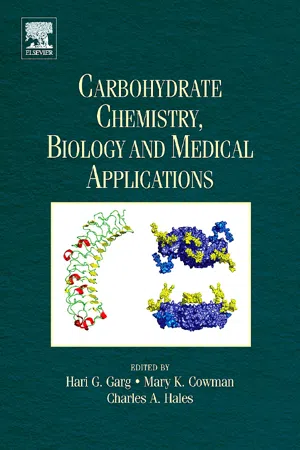
- Hari G. Garg, Mary K. Cowman, Charles A. Hales(Authors)
- 2011(Publication Date)
- Elsevier Science(Publisher)
Chapter 1 The Development of Carbohydrate Chemistry and Biology DEREK HORTON Department of Chemistry, American University, Washington, DC 20016, USA I. Early History A major proportion of the organic matter on Earth is plant tissue (“biomass”) and is composed of Carbohydrates, principally cellulose. This is the structural support polymer of land plants and the material used since ancient times in the form of cotton and linen textiles, and later as paper. Chitin is a polymer related to cellulose that has skeletal function in arthropods and fungi. Other polymeric Carbohydrates constitute the structural support framework for marine plants and the cell walls of microorganisms. The sweet carbohydrate of sugar cane, now termed sucrose, has been a dietary item for at least 10 millennia. Ranking alongside cellulose in abundance is starch, a biopolymer that is the food-reserve carbohydrate of photosynthetic plants, and the closely related glyco-gen, the storage carbohydrate in the animal kingdom. Starch occurs as microscopic granules in plant storage tissue (cereal grains, tubers), and the process for its isola-tion was clearly described by Cato the Elder (1): steeping the grains in cold water to swell them, straining off the husks, and allowing the milky suspension to settle to afford, after drying, a white powder. This procedure is essentially the same as the modern corn wet-milling process, and the resultant starch powder is essentially pure carbohydrate whose molecular formula can be expressed as C 6 (H 2 O) 5 , hence the term carbohydrate. It was used as early as 4000 BCE in Egypt as an adhesive with the cellulosic fiber of the papyrus plant to make writing material, and early in the first millennium CE for sizing paper and to stiffen cloth (2). eBook - PDF
Visualizing Nutrition
Everyday Choices
- Mary B. Grosvenor, Lori A. Smolin(Authors)
- 2021(Publication Date)
- Wiley(Publisher)
2. Classify Carbohydrates as simple or complex. 3. Describe the types of complex Carbohydrates. 4. Distinguish soluble fiber from insoluble fiber. Chemically, Carbohydrates are a group of compounds made up of one or more sugar units that contain carbon (carbo) as well as hydrogen and oxygen in the same two-to-one pro- portion found in water (hydrate, H 2 O). Carbohydrates made up of only one sugar unit are called monosaccharides, those made up of two sugar units are called disaccharides, and those made up of more than two sugar units are called polysaccharides. Simple Carbohydrates Monosaccharides and disaccharides are classified as simple Carbohydrates. The three most common monosaccharides in the diet are glucose, fructose, and galactose. Each contains 6 carbon, 12 hydrogen, and 6 oxygen atoms (C 6 H 12 O 6 ), but these three sugars differ in the arrangement of these atoms (Figure 4.4a). Glucose, the sugar referred to as blood sugar, is the most important carbohydrate fuel for the human body. The most common disaccharides in our diet are maltose, sucrose, and lactose (Figure 4.4b). Complex Carbohydrates Complex Carbohydrates are polysaccharides; they are gener- ally not sweet tasting the way simple Carbohydrates are. They include glycogen in animals and starches and fibers in plants sugar unit A sugar molecule that cannot be broken down to yield other sugars. monosaccharide A carbohydrate made up of a single sugar unit. disaccharide A carbohydrate made up of two sugar units. polysaccharide A carbohydrate made up of many sugar units linked together. glucose A six-carbon monosaccharide that is the primary form of carbohydrate used to provide energy in the body. glycogen The storage form of carbohydrate in animals, made up of many glucose molecules linked together in a highly branched structure. eBook - PDF
Nutritional Sciences
From Fundamentals to Food, Enhanced Edition
- Michelle McGuire, Kathy Beerman(Authors)
- 2017(Publication Date)
- Cengage Learning EMEA(Publisher)
In fact, a person with this disease must be vigilant when it comes to blood glucose control. What insights did you gain from Laura’s story about what it is like to have type 1 diabetes? What do you think your biggest challenges would be if you had this condition? 115 What Are Simple Carbohydrates? What Are Simple Carbohydrates? A carbohydrate is an organic compound made up of one or more sugar mol- ecules (Figure 4.1). Most people think of sugar as a substance used to sweeten their foods. Although this is true, sugars encompass far more than this. For example, cells use a special type of sugar, glucose, for an important source of energy. Carbohydrates are abundant in a wide variety of foods, and there are many different types. A carbohydrate consisting of a single sugar molecule is called a monosaccharide; a carbohydrate made of two sugar molecules is a disaccharide. Because of their small size, monosaccharides and disaccha- rides are called simple Carbohydrates or simple sugars. MONOSACCHARIDES ARE SINGLE SUGAR MOLECULES Monosaccharides are single-sugar molecules that are made up of carbon, hydrogen, and oxygen atoms in the ratio of 1:2:1. For example, if a sugar has 6 carbon atoms, it also has 12 hydrogen and 6 oxygen atoms (written C 6 H 12 O 6 ). Because the number of carbon atoms and the arrangement of atoms can vary, monosaccharides typically have different shapes and sizes. There are hun- dreds of different naturally occurring monosaccharides, but the three most plentiful in food are glucose, fructose, and galactose. Although the structures of these sugars differ, they all have one thing in common: each contains six carbon atoms. Therefore these monosaccharides are referred to as hexose (hexa, meaning six) sugars. Although glucose, fructose, and galactose have the same molecular formula (C 6 H 12 O 6 ), each has a different arrangement of atoms (Figure 4.2). eBook - PDF
- Marie Boyle(Author)
- 2022(Publication Date)
- Cengage Learning EMEA(Publisher)
Milk is the only animal-derived food that contains significant amounts of carbohydrate. Carbohydrates are divided into two categories: complex Carbohydrates and simple Carbohydrates. Com- plex Carbohydrates include starch and fiber. Starches make up a large part of the world’s food supply, mostly as grains. For example, such staples as wheat, rice, and corn are rich sources of starch. Fiber is found abundantly in plants, especially in the outer portions of cereal grains, and in fruits, legumes, and most vegetables. Simple Carbohydrates include naturally occurring sugars in fresh fruits, in some vegetables, in milk and milk products, and as added sugars in concentrated form, such as in honey, corn syrup, or sugar in the sugar bowl. All of these Carbohydrates have characteristics in common, but they are of dif- ferent merit nutritionally. 4.2 The Simple Carbohydrates: Monosaccharides and Disaccharides All Carbohydrates are composed of single sugars—known as monosaccharides — alone or in various combinations, and all Carbohydrates but fiber can be converted to glucose in the body. Green plants make glucose from carbon dioxide and water through a process known as photosynthesis in the presence of chlorophyll and sun- light, as illustrated in Figure 4-2. Glucose is not a very sweet sugar, but plants can rearrange its atoms to form another sugar, fructose, which is sweet to the taste. Fructose is found mostly in fruits, in honey, and as part of another sugar—table sugar. Glucose and fructose are the most common monosaccharides in nature. Some sugars are double sugars—known as disaccharides—made by bonding two monosaccharides together. When glucose and fructose are bonded together, they form sucrose, or table sugar, the product most people refer to when they use the term sugar. The sweet taste of sucrose comes primarily from the fructose in its structure. Available until 31 Aug |Learn more
Visualizing Nutrition
Everyday Choices
- Mary B. Grosvenor, Lori A. Smolin(Authors)
- 2017(Publication Date)
- Wiley(Publisher)
Carbohydrates made up of only one sugar unit are called monosaccharides, those made up of two sugar units are called disaccharides, and those made up of more than two sugar units are called polysaccharides. Simple Carbohydrates Monosaccharides and disaccharides are classified as simple Carbohydrates. The three most common monosaccharides in the diet are glucose, fructose, and galactose. Each contains 6 carbon, 12 hydrogen, and 6 oxygen atoms (C 6 H 12 O 6 ), but these three sugars differ in the arrangement of these atoms (Figure 4.4a). Glucose, the sugar referred to as blood sugar, is the most important carbohydrate fuel for the human body. The most common disaccharides in our diet are maltose, sucrose, and lactose (Figure 4.4b). polysaccharide A carbohydrate made up of many sugar units linked together. glucose A six-carbon monosaccharide that is the primary form of carbohydrate used to provide energy in the body. Calo Carbohydrate (g) ries Vitamin C (mg) Folate (μg) Calcium (mg) 0 50 100 150 200 250 Kiwi Red licorice FIGURE 4.3 Added versus naturally occurring sugars Choosing three kiwis rather than four pieces of red licorice is a more nutrient-dense choice. The kiwis are an unrefined source of sugar that also provides fiber and vitamin C, folate, and calcium. Most of the calories in the licorice are from added sugars; licorice is lower in nutrient density because it provides almost no other nutrients other than sugar. M. Price / Wiley 86 CHAPTER 4 Carbohydrates: Sugars, Starches, and Fibers Glycogen CH 2 OH C O OH C C C C H OH H H OH H OH Glucose H Starches Different types of starch consist of either straight chains or branched chains of glucose. We consume a mixture of starches in grain products, legumes, and other starchy vegetables. The polysaccharide glycogen is made of highly branched chains of glucose. This branched structure allows glycogen, which is found in muscle and liver, to be broken down quickly when the body needs glucose. eBook - PDF
- Mary B. Grosvenor, Diana Bedoya(Authors)
- 2014(Publication Date)
- Wiley(Publisher)
The three most common mono- saccharides in our diet are glucose, fructose, and galac- tose. Each contains six carbon, 12 hydrogen, and six oxygen atoms (C 6 H 12 O 6 ), but these three sugars differ in the arrangement of these atoms (Figure 4.4a). Glucose, of- ten called blood sugar, is the most important carbohydrate fuel for the human body. Under normal conditions, the brain and red blood cells rely solely on glucose to fuel their activity. The most common disaccharides in our diet are maltose, sucrose, and lactose (Figure 4.4b). glucose A six-car- bon monosaccharide that is the primary form of carbohydrate used to provide en- ergy in the body. Complex Carbohydrates Complex Carbohydrates are polysaccharides; they are gen- erally not sweet-tasting the way sim- ple Carbohydrates are. They include glycogen in animals and starches and fibres in plants (Figure 4.4c). Glycogen is the storage form of glu- cose in humans and other animals. It is found in the liver and muscles, but we don’t consume it in our diet because the glycogen in animal muscles is broken down soon after the animal is slaughtered. Starch is made up of glu- cose molecules linked together glycogen The stor- age form of carbohy- drate in animals, made up of many glucose molecules linked together in a highly branched structure. starch A carbohy- drate found in plants, made up of many glucose molecules linked in straight or branched chains. THE PLANNER ✓ ✓ b. Beans contain soluble fibre and small polysaccharides that cannot be broken down by human digestive enzymes. Both of these pass into the large intestine, where their digestion by bacteria creates gas. Over-the-counter enzyme tablets and solutions (such as Beano®) can be taken to digest the small polysaccharides and thus reduce the amount of gas produced. a. Jams and jellies are thickened with pectin, which is a soluble fibre found in fruits and vegetables. Some foods are thickened with gums, which combine with water to keep solutions from separating.
Index pages curate the most relevant extracts from our library of academic textbooks. They’ve been created using an in-house natural language model (NLM), each adding context and meaning to key research topics.
