Biological Sciences

Diatoms
Diatoms are a type of algae known for their intricate silica cell walls, which give them a unique glass-like appearance. These single-celled organisms are a crucial component of marine and freshwater ecosystems, playing a significant role in the global carbon cycle by producing a substantial amount of oxygen through photosynthesis. Diatoms are also important as primary producers, forming the base of many aquatic food webs.
Written by Perlego with AI-assistance
Related key terms
1 of 5
12 Key excerpts on "Diatoms"
 eBook - PDF
- Das, Mihir Kumar(Authors)
- 2021(Publication Date)
- Daya Publishing House(Publisher)
Keywords : Diatom, Nanomaterials, Nanotechnology. 1. Introduction Diatoms are the major group of eukaryotic algae, and are one of the most common types of phytoplankton. Most Diatoms are unicellular, although they can exist as colonies in different shape of filaments or ribbons ( e.g. This ebook is exclusively for this university only. Cannot be resold/distributed. Fragillaria ), fans ( Meridion ), zigzags ( Tabellaria ), or stellate colonies ( Asterionella ). A characteristic feature of diatom cell is that they are encased within a unique cell wall made of silica (hydrated silicon dioxide) called frustule. These frustules show a wide diversity in form. Some are quite beautiful and ornate, and usually consist of two asymmetrical sides with a split between them, hence the group is named 'Diatom' which literally means cut into two halfs. Fossil evidence suggests that they originated during, or before, the early Jurassic Period. Diatom communities are a popular tool for monitoring environmental conditions, and are commonly used in studies of water quality. Diatoms belong to a large group called the heterokonts, including both autotrophs ( e.g. golden algae, kelp) and heterotrophs ( e.g. water moulds). Their yellowish-brown chloroplasts are typical of heterokonts, with four membranes and containing pigments such as fucoxanthin. Individuals usually lack flagella, but they are present in gametes and have the usual heterokont structure. Most Diatoms are non-motile, although some move via flagellation. 2. The Biology and Ecology of Diatoms Diatoms are unicellular organisms of the kingdom Protista, characterized by a silica shell of often intricate and beautiful sculpture. Traditionally Diatoms are divided into two orders: centric Diatoms (Centrales), which are radially symmetric, and pennate Diatoms (Pennales), which are bilaterally symmetric. eBook - ePub
Microalgal Biotechnology
Bioprospecting Microalgae for Functional Metabolites towards Commercial and Sustainable Applications
- Jeyabalan Sangeetha, Svetlana Codreanu, Devarajan Thangadurai, Jeyabalan Sangeetha, Svetlana Codreanu, Devarajan Thangadurai(Authors)
- 2023(Publication Date)
- Apple Academic Press(Publisher)
CHAPTER 2 Diatoms: Commercial Applications and Prospective Trends MANJITA MISHRA and SHANTHY SUNDARAMAdvanced Laboratory for Phycological Assessment (ALPHA Plus), Center of Biotechnology, University of Allahabad, Prayagraj, Uttar Pradesh – 211002, IndiaABSTRACT
Diatoms are single-cell aquatic microalgae exhibiting remarkable self-assembled patterns of micro and nanoporous three-dimensional silica cell walls called frustules. The structure is quasi-periodically and extremely fine porous network on the surface of these Diatoms makes them an attractive tool for various applications based on photonic and optic properties. This has been used in various other areas also like in nanotechnology which includes drug delivery, biosensing, biomimetics, molecular biology, food industries and bioremediations of contaminated water. All these features of Diatoms lead us to move ahead in the research where Diatoms could be an economical, lucrative source of many novel substances that will be beneficial in the field of medical and health sector in our near future.2.1 INTRODUCTION
Almost 3 billion years ago, photosynthetic bacteria created the synthesis of oxygen which has been sustained by some of its progeny which gave rise to the aerobic life on to the earth. In an early human history, some of the photoautotrophs which were related with land-dwelling were mainly cultivated for agriculture and economic use. In recent times, global interest is towards the marine algae of the ocean where novel biomolecules and biomasses are comparatively untouched and unexplored. Diatoms are the major players for biomass production and lower the greenhouse gases (GHGs ) from the atmosphere. Studies indicate that these photosynthetic organisms generated all primary production up to 20–23% (Field et al., 1998 ) and total level of marine production is approx. 40% (Falkowski et al., 1998 ), which make them the most prominent group of organisms that help as a sequestering agent for carbon from the environment. Diatoms are extremely robust which inhabit the photic zones from equator to hostile sea ice where they can be used as an eminent indicator for changes in environmental condition and provide the rapid response by reacting with frozen sea by their ice-binding proteins (IBPs) molecules “natural antifreeze” (Janech et al., 2006 eBook - ePub
- Mihai Irimia-Vladu, Eric D. Glowacki, Niyazi S. Sariciftci, Siegfried Bauer(Authors)
- 2017(Publication Date)
- Wiley-VCH(Publisher)
5 [3], although their classification and taxonomy is still debated [4].Images of silica shells of various Diatoms.Figure 11.1These microorganisms are unique in the unicellular algae world and are attractive for applications in nanotechnology because of their nanostructured rigid cell wall, calledfrustule, made of amorphous hydrated nanoporous silica. The frustule constrains and encloses the eukaryotic protoplast, protecting it from the aqueous environment and from dangerous light wavelengths and, at the same time, controls nutrient uptake and secretion of cellular products through an intricate pattern of pores and slits on its surface. The frustule looks like a micro pillbox composed of two valves (the epitheca and the hypotheca), connected by lateral rings (girdles) that confer flexibility to the structure (Figure 11.2 ) [5]. Owing to their unique structure, Diatoms have been defined as “living cells in glass houses” [2b].Schematic cross section through a box-like diatom frustule (G, girdle bands).Figure 11.2Both valves and girdles have a specie-specific “layer-by-layer” hierarchical architecture in which every layer has a periodic nanotexturized topography with an ordered disposition of pores (areolae) whose diameter increases passing from the internal to the external layers. In spite of the fluctuation in higher taxonomic categories, a classification of Diatoms can be made on the basis of frustule shape and symmetry of pore patterns: centric are all Diatoms whose frustule has radial symmetry, while pennate are those in which valves are bilaterally symmetric [6]. A schematic three-dimensional (3D) cross section of a frustule of centric Diatoms is shown in Figure 11.3 eBook - PDF
Environmental Assessment of Estuarine Ecosystems
A Case Study
- Claude Amiard-Triquet, Philip S. Rainbow(Authors)
- 2009(Publication Date)
- CRC Press(Publisher)
241 12 Diatoms Modern Diatom Distribution in the Seine and Authie Estuaries Florence Sylvestre 12.1 INTRODUCTION Diatoms (order Bacillariophyceae) are eukaryotic, single-celled, photosynthetic algae that are present in almost every habitat on Earth (Figure 12.1). Diatoms are particu-larly known for the intricate geometries and spectacular patterns of their silica-based cell walls. These patterns are species-specific and are precisely reproduced during each cell division cycle, demonstrating genetic control of this biomineralization pro-cess (Kröger et al. 2000). Diatoms are also well known for their ecological significance. In temperate oceans, Diatoms dominate phytoplankton assemblages and blooms and are respon-sible for a considerable proportion of the world’s primary net production. In estua-rine and shallow coastal environments, Diatoms are considered the most important components of the benthic microalgal assemblages (McLusky 1989). Exposed mud-flats and sandflats are often described as “unvegetated” simply because vascular plants such as seagrasses are absent. However, the use of this adjective is inaccurate because a diverse assemblage of cyanobacteria and eukaryotic microalgae thrive in such sediments. This microphytobenthos has been recently reviewed and referred to as a “secret garden” (MacIntyre et al. 1996; Miller et al. 1996). In Western Europe, where inter-tidal mudflats are generally devoid of macrophytic vegetation (McLusky 1989), microphytobenthos often becomes the main primary producer (Admiraal 1984; Colijn and de Jonge 1984; Underwood and Kromkamp 1999). It thus represents a CONTENTS 12.1 Introduction .................................................................................................. 241 12.2 Materials ....................................................................................................... 243 12.3 Methods ........................................................................................................ eBook - ePub
Marine Algae Extracts
Processes, Products, and Applications
- Se-Kwon Kim, Katarzyna Chojnacka, Se-Kwon Kim, Katarzyna Chojnacka(Authors)
- 2015(Publication Date)
- Wiley-VCH(Publisher)
Asterionella). The Diatoms are more than 40 different types of species on micro-algae isolated in different parts of the world. The 8 major classes and 32 genera of cultured algae are currently used to feed for aquatic organisms.Diatoms are classified into two categories based on frustule regularity: pennate and centric forms. Pennate forms display joint symmetry and tend to inhabit benthic microalgal assemblages and centric Diatoms are radically symmetrical.Diatom cells are covered with a cell wall made up of silica (hydrated silicon dioxide) called frustules . These frustules show a wide diversity in form, but are usually almost bilaterally symmetrical. The symmetry is not perfect since one of the valves is slightly larger than the other allowing one valve to fit inside the edge of the other. Identification of a marine diatom morphology is done using a light microscope and DNA sequencing, especially for the molecular structure. Various assessments and tests to explore the potential for molecular-based diatom identification in the diatom flora of Berlin [2] and 541 taxa are mentioned in Lake Tegel [3], and 18S region is going to be amplified for investigation, as this marker has most often been used for phylogenetic analyses.Salts and nutrients contain trace amount of metals or other contaminants that may inhibit diatom species. In addition, trace metal impurities in major salt solutions prepared from reagent grade chemicals may exceed the nominal metal concentrations of some media. In these cases, it is necessary to remove impurities from the chemical reagents by the passing of macronutrients and some of micronutrients through a resin Chelex 100 column (Bio-Rad Laboratories) [4]. Diatom is a bioindicator of pollution, acidification, and sterilization in routine water quality assessments.Axenic (bacterial free) cultures are essential for studies on the specific skin of diatom. Axenic cultures employ physical and chemical methods for separating bacteria from the Diatoms cells. Treatment of diatom and isolation of individual diatom cells for monoclonal culturing are done using an unusual antibiotic [5–10]. The identification of diatom taxonomy [11], ribosomal sequences [12], and more characteristically diatom morphology, shape of frustules, and extracellular silica cell walls have been done by Mann et al. [13] and Karthick et al. [14]. In diatom culture, identification of normal and abnormal cells is very important; this work was carried out by Falasco et al eBook - PDF
Diatom Photosynthesis
From Primary Production to High-Value Molecules
- Johannes Wilhelm Goessling, João Serodio, Johann Lavaud(Authors)
- 2024(Publication Date)
- Wiley-Scrivener(Publisher)
In this context, Diatoms support oxygen production both on board the spacecraft and in future colonies, in next generation bioregenerative life support systems (BLSS), i.e., artificial ecosystems providing oxygen and food. Furthermore, the chapter will assess the benefits and risks of such space endeavours, including the potential impli- cations of introducing living material to space and its celestial bodies. Finally, we reach the point that treasuring the resources and environment on Earth should be prioritized—also through investments—over escape strategies. By this approach, we ensure a healthier planet for next generations while safeguarding naturally available resources that could address future challenges through frontier technologies and serve as inspiration. 18.2 The Living Diatom Diatoms are microscopic eukaryotes with a relatively recent evolutionary history, emerg- ing around 200 million years ago during the late Jurassic period. Remarkably, they have evolved into one of the most abundant groups of photosynthetic microalgae in contempo- rary times. Their significance lies in their pivotal role within the biogeological processes, particularly in the cycling of oxygen and carbon dioxide resulting from their photosyn- thetic activity. Diatoms provide nutrition to aquatic food webs [18.8], supporting organ- isms over many trophic levels, spanning from bacteria to microscopic invertebrates to top predators and mammals [18.56] [18.123]. The organic by-products of Diatoms, including lipids, isoprenoids, pigments, and other secondary metabolites [18.98] [18.109] [18.148], can be harvested and used. While they could be invaluable for pharmaceutical and medical applications [18.68], or the preparation of biofuel [18.162], we will focus in this chapter on the silica shell, the frustule, because of its potential application to nanotechnology. The individual parts of the frustule are perforated with nano- to micrometer sized pores or slits (Figure 18.2). eBook - ePub
Oceans and Human Health
Risks and Remedies from the Seas
- Patrick J. Walsh, Sharon Smith, Lora Fleming, Helena Solo-Gabriele, William H. Gerwick(Authors)
- 2011(Publication Date)
- Academic Press(Publisher)
et al ., 2005). Because of their large cell size and rapid sinking rate, they also play an important role as part of the “biological pump” that removes carbon dioxide from the atmosphere and places it at depth, thus helping to moderate the increasing levels of carbon dioxide associated with climate change.The name diatom comes from the Greek word diatomos (dia = “through” + temnein = “to cut”), meaning “cut in two.” This is because a diatom cell is composed of two overlapping halves (thecae) that fit together like a petri dish: the upper half is called the “epitheca” and the lower half the “hypotheca” (Fig. 12-1 ). The theca is composed of an upper (epi-) or lower (hypo-) valve, plus girdle bands that encircle the middle of the cell to hold the two halves together. Each valve possesses a slit, called a “raphe,” that runs along the whole length of the valve and is reinforced on the interior side with bridges, called “fibulae.” The valves are ornamented with striae (strips containing rows of small poroids), alternating with narrower riblike strips called “interstriae.” The entire diatom shell is called the “frustule” and is composed of silica (SiO2 = glass) that is covered by an organic membrane through which nutrients pass for cell growth. Based on how the silica ribs on the valve radiate, Diatoms (division Heterokontophyta, class Bacillariophyceae) are placed into two orders: radially symmetric (round) cells are called centric Diatoms and longitudinally symmetric (long, narrow) cells are pennate (from the Latin penna, meaning “feather”) Diatoms. Pseudo-nitzschia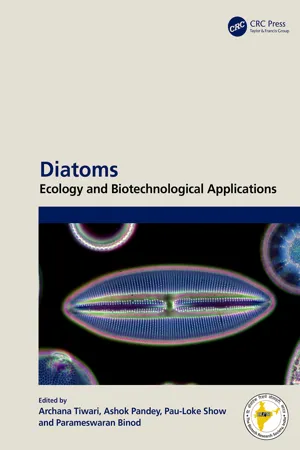 eBook - ePub
Diatoms
Ecology and Biotechnological Applications
- Archana Tiwari, Ashok Pandey, Pau-Loke Show, Parameswaran Binod, Archana Tiwari, Ashok Pandey, Pau-Loke Show, Parameswaran Binod(Authors)
- 2023(Publication Date)
- CRC Press(Publisher)
https://www.jstor.org/stable/24107252- Snoeijs, P. , S. Busse and M. Potapova. 2002. The importance of diatom cell size in community analysis. Journal of Phycology , 38(2): 265–281. 10.1046/j.1529-8817.2002.01105.x
- Sørensen, M. , G. M. Berge, K. I. Reitan and B. Ruyter. 2016. Microalga Phaeodactylum tricornutum in feed for Atlantic salmon (Salmo salar)—Effect on nutrient digestibility, growth and utilization of feed. Aquaculture , 460: 116–123. 10.1016/j.aquaculture.2016.04.010
- Sorgeloos, P. , P. Dhert and P. Candreva. 2001. Use of the brine shrimp, Artemia spp., in marine fish larviculture. Aquaculture , 200(1–2): 147–159. 10.1016/S0044-8486(01)00698-6
- Syafaat, M. N. , M. N. Azra, K. Waiho, H. Fazhan, A. B. Abol-Munafi, S. D. Ishak, M. Syahnon, A. Ghazali, H. Ma and M. Ikhwanuddin. 2021. A review of the nursery culture of mud crabs, genus Scylla: current progress and future directions. Animals , 11(7): 2034. 10.3390/ani11072034
- Tanaka, T. , K. Yoneda and Y. Maeda. 2022. Lipid Metabolism in Diatoms. In The Molecular Life of Diatoms , ed. A. Falciatore, and T. Mock, 493–527. Switzerland: Springer, Cham.
- Tiwari, A. and T. K., Marella. 2019. Potential and application of Diatoms for industry-specific wastewater treatment . In Application of Microalgae in Wastewater treatment, ed. S. K. Gupta and F. Bux, 321–339. Switzerland: Springer, Cham.
- Trushenski, J. T. and R. T. Lochmann. 2009. Potential, Implications and Solutions Regarding the Use of Rendered Animal Fats in Aquafeeds. American Journal of Animal and Veterinary Sciences , 4(4): 108–128.
- Uriarte, I. , M. Astorga, J. C. Navarro, M. T. Viana, C. Rosas, C. Molinet, J. Hernández, J. Navarro, I. Moreno-Villoslada, R. Amthauer and G. Kausel. 2019. Early life stage bottlenecks of carnivorous molluscs under captivity: a challenge for their farming and contribution to seafood production. Reviews in Aquaculture , 11(3): 431–457. 10.1111/raq.12240
 eBook - ePub
- Grethe R. Hasle, Erik E. Syvertsen, Karen A. Steidinger, Karl Tangen, Carmelo R. Tomas(Authors)
- 1996(Publication Date)
- Academic Press(Publisher)
Gaul et al. (1993) lists papers containing electron micrographs of Diatoms and is thus useful to those studying the fine structure of the diatom frustule.Despite these recent publications, teaching experience tells us that there is still a need to fill in respect to the global aspect of the identification of marine planktonic Diatoms at the specific level. We hope to fill a part of this need with this chapter.GENERAL CHARACTERISTICS
Systematics: Class Bacillariophyceae in the division Chromophyta.Closest relatives: Chrysophyceae and Xanthophyceae. (See Round et al., 1990 , p. 122.)Number of species: 10,000–12,000, approx 50,000 (Round & Crawford, 1984 , p. 169), or in excess of 100,000 (Round & Crawford, 1989 , p. 574); or in marine plankton approx 1400–1800 (Sournia et al., 1991 , p. 1085).Size: ca. 2 μm–ca. 2 mm.Level of organization: Unicellular, often in colonies.Cell covering: Siliceous wall and organic layer.Flagella: Male gametes with one flagellum with stiff hairs.Chloroplasts: Lamellae with three thylakoids, girdle lamella, and four membranes around the chloroplast.Pigments: Chlorophylls a and c , betacarotene, fucoxanthin, diatoxanthin, and diadinoxanthin.Mitochondria: Tubular type.Storage products: Chrysolaminarin and oil.Motility: Present in pennate Diatoms with a raphe.Biotopes: Marine and freshwater, plankton, benthos, epiphytic, epizoic (e.g., on whales and crustaceans), endozoic (e.g., in foraminifera), endophytic (e.g., in seaweed), on and in sea ice, and “air Diatoms.”Geological age: Centrics: Jurassic (a few species) and Early Cretaceous (Gersonde & Harwood, 1990 ). Araphid pennates: Late Cretaceous (Medlin et al., 1993 , with references). Raphid pennates: Middle Eocene (Medlin et al., 1993 , with references).LIFE CYCLES
Reproduction (Figs. 1a and 1b )Diatoms reproduce vegetatively by binary fission, and two new individuals are formed within the parent cell frustule. Each daughter cell receives one parent cell theca as epitheca, and the cell division is terminated by the formation of a new hypotheca for each of the daughter cells. This type of division, with formation of new siliceous components inside the parent cell, leads to size reduction of the offspring. The possible size range of the diatom cells seems to be species dependent, and the specific variation may be as large as 8 to 10 times the length of the apical axis or the diameter.
- David L. Hawksworth(Author)
- 2003(Publication Date)
- CRC Press(Publisher)
There is a problem in identifying recent changes where there may not be older records for comparison or where a species may have previously been overlooked. This is further complicated by the great advances in identification, the use of electron microscopy, and the revision of species and genera in the last 25 years. Diatoms will surely continue to play a part in our environmental predictions.1 Introduction
Whitton (1974) reviewed the then recent changes in British freshwater algae and remarked that ‘it is becoming clear that some changes in diatom species composition are particularly good indicators of eutrophication’. This useful characteristic has led to a positive bloom of studies of diatom assemblages in recent sediments in Britain, and the onset of the ‘acidification debate’ in the 1980s also directed attention to those taxa characteristic of oligotrophic, acidic waters (Battarbee et al. 1990).2 The value of long-term algal observations
How do we know that there have been changes, since not many water-bodies are studied at all, much less observed routinely? In the spring of 1973, Dr J.W.G. Lund noticed the sudden appearance of a large population of a small-sized Stephanodiscus in Blelham Tarn. As he had been monitoring the phytoplankton populations in this small Cumbrian lake since 1945, he could be confident that this was a new phenomenon (Lund 1979). This provided an opportunity for monitoring the way in which the biological material of a spring diatom bloom became incorporated into the sediment surface (Haworth 1976) and was a lake-wide improvement on an experiment that added a marine diatomite (Coscinodiscus sp.) to one of the prototype ‘Lund tubes’ to provide a marker horizon (Pennington et al. 1977). After three seasons, numerous valves of S. minutulus could be found, to varying depths within the upper 10 cm of sediment depending on location within the lake (Haworth 1979: Fig. 2). This identified the material as relating to those years and showed remarkably good stratigraphic distribution, with a lack of bioturbation, as might be expected from the known paucity of benthic animals (Jones 1980). A stratigraphic profile was also analysed to see how closely the sedimentary record actually reflected the diatom plankton populations monitored by Lund (1979). The result was a diatom-based timescale where successive sedimentary peaks of different species could be assigned dates according to the long-term data (Haworth 1980). This showed how stepwise changes in the Diatoms, Cyclotella praetermissa, Asterionella formosa, Aulacoseira subarctica, Fragilaria crotonensis, F. crotonensis var. prolongata and Stephanodiscus minutulus had followed nutrient enrichment of the lake since the 1950s (Lund 1979). Earlier there had been no form of absolute dating for core material less than 1000 years old but a new method of dating sediments was just being assessed (Pennington et al. 1976), using lead isotopes – a comparative analysis of 210 lead and 226 eBook - PDF
Reconstructing the Tree of Life
Taxonomy and Systematics of Species Rich Taxa
- Trevor R. Hodkinson, John A.N. Parnell(Authors)
- 2006(Publication Date)
- CRC Press(Publisher)
At present, diatom species are assigned to around 350 genera 17,18 , with another approximately 150 genera for fossil groups 13 ; only a handful (no more than 30) of higher taxa, classes, subclasses, orders and families, are recognised 1 , or at least in use. Rarely do diatomists refer to a specimen’s family, for example, as characters for higher taxa have rarely been documented. In short, Diatoms are poorly known and poorly accounted for in their phylogenetic relationships (higher-level taxo-nomy), their current classification (numbers of higher taxa) and biodiversity estimates, regardless of the agreed vast number of species that remain to be described. So much for definitions, solutions are of more immediate concern, particularly solutions accounting for diatom diversity, both in terms of documenting and understanding it. Whilst it is clear that many of the problems are simply practical, devising a strategy, should one wish to approach the problem in that way, requires further consideration. Below we deal with the understanding of diatom diversity by examining three aspects. First, we briefly examine the history and understanding of alpha taxonomy as it has developed and how algal taxonomy progressed within these changing paradigms. Second, we present some more numbers for direct comparison within both the stramenopile clade as well as other plant and animal groups. Finally, we propose some options for dealing with large genera within Diatoms, focusing studies on the geographical dimension, a poorly examined aspect of diatom studies, which, in some circles, is considered a pointless endeavour 19,20 . FIGURE 19.1 Light micrograph of the Miocene fossil Amphorotia americana (Kain et Schultz) D.M. Williams & G. Reid. (From lectotype slide, BM-Adams D. 846, Atlantic City, NJ. For further details see Williams and Reid 65 .) Large and Species Rich Taxa: Diatoms, Geography and Taxonomy 307 19.2 THERE ARE TAXA, AND THEN THERE ARE TAXA . eBook - ePub
Algae Refinery
Up- and Downstream Processes
- Sanjeet Mehariya, Pradeep Verma, Sanjeet Mehariya, Pradeep Verma(Authors)
- 2023(Publication Date)
- CRC Press(Publisher)
3 resulting in a thin nanostructured silica layer so similar to the granular nanostructured diatom cell wall. It is an experimental biomimetic approach (Noll et al. 2002).8.5.7 Biomanufacturing Technology
The functionality and intricacy of naturally structured nano- or microparticles are better than the artificial devices making it a more suitable matter for biotechnological biomanufacturing. The great ornamentation, 3D shapes, large surface area, exclusive optical properties, and multi-level nanopores make Diatoms a potential biomanufacturing component. Some experimented manufactured devices are drug delivery devices, biosensor biocarrier, solar cells, battery electrodes, and electroluminescent display devices, etc. In the use of original frustules, Diatoms can limit the function due to a certain size, and arranging bonding techniques limits the detection stability. To improve the device functionality, the bonding pattern, modification, and assembly play an important role. As biogenic silica is compatible, it can fix itself well to a creature’s body without any allergic reaction, in the field of tissue engineering and biodetection. These bio-manufactured items are preassembled to avoid assembling problems. As an example, we can address fuel cells with multiple channels; incorporated circuits; logical operation performing light processors and diatom cloths with multifunctions like air-conditioning, humidity adjustment, and light warming (De Yuan et al. 2012 ).8.6 Challenges Encountered in Diatom-Inspired Nanostructure Technologies
8.6.1 Photonic Nanotechnology
Diatoms are photosynthetic marine alga with a pair of valves in their skeletal structure, which are made up of hydrated amorphous silica. These are called frustules and possess hierarchical micro- or nano-scaled photon crystal-like pores (Kong et al. 2016). They can absorb or intake volatile substances like hydrocarbons and solvents, etc., which is an important characteristic of an optical transducer. They should be with a large surface where the gases and vapours can be induced to condense. The chemical vapour in the silicon shell and the organic molecular air as a substitution cause an average refractive index to increase because of capillary condensation. It is detected by several optical mechanisms (Spanier and Herman 2000 , De Stefano et al. 2009 ). It is observed that the silicon shell of diatom, which is cleaned with concentrated sulphuric acid solution and wet deposited on silicon water that is intrinsic and single polished, contributes a negligible amount of photoluminescence signal at a considered wavelength. A minimal amount of NO2 is used as a gaseous texture for observing the quenching effect, but it becomes reversible in the presence of air. The wavelength peak can be shifted due to the gaseous absorption through the diatomaceous nanopores that can increase the average refractive index of a silicon optical device (De Stefano et al. 2009, De Stefano et al. 2004
Index pages curate the most relevant extracts from our library of academic textbooks. They’ve been created using an in-house natural language model (NLM), each adding context and meaning to key research topics.

