Biological Sciences

Epigenetics
Epigenetics is the study of changes in gene expression that do not involve alterations to the DNA sequence. These changes can be influenced by environmental factors and can be passed down to future generations. Epigenetic mechanisms, such as DNA methylation and histone modification, play a crucial role in regulating gene activity and are important in development, disease, and evolution.
Written by Perlego with AI-assistance
Related key terms
1 of 5
10 Key excerpts on "Epigenetics"
 No longer available |Learn more
- (Author)
- 2014(Publication Date)
- Research World(Publisher)
________________________ WORLD TECHNOLOGIES ________________________ Chapter- 5 Epigenetics In biology, and specifically genetics, Epigenetics is the study of heritable changes in phenotype (appearance) or gene expression caused by mechanisms other than changes in the underlying DNA sequence, hence the name epi-(Greek: επί - over, above) -genetics . These changes may remain through cell divisions for the remainder of the cell's life and may also last for multiple generations. However, there is no change in the underlying DNA sequence of the organism; instead, non-genetic factors cause the organism's genes to behave (or express themselves) differently. The best example of epigenetic changes in eukaryotic biology is the process of cellular differentiation. During morphogenesis, totipotent stem cells become the various pluripotent cell lines of the embryo which in turn become fully differentiated cells. In other words, a single fertilized egg cell – the zygote – changes into the many cell types including neurons, muscle cells, epithelium, blood vessels etc. as it continues to divide. It does so by activating some genes while inhibiting others. ________________________ WORLD TECHNOLOGIES ________________________ Etymology and definitions Epigenetic mechanisms Epigenetics (as in epigenetic landscape) was coined by C. H. Waddington in 1942 as a portmanteau of the words genetics and epigenesis . Epigenesis is an old word which has more recently been used to describe the differentiation of cells from their initial totipotent state in embryonic development. When Waddington coined the term the physical nature of genes and their role in heredity was not known; he used it as a conceptual model of how genes might interact with their surroundings to produce a phenotype. Robin Holliday defined Epigenetics as the study of the mechanisms of temporal and spatial control of gene activity during the development of complex organisms. No longer available |Learn more
- (Author)
- 2014(Publication Date)
- White Word Publications(Publisher)
________________________ WORLD TECHNOLOGIES ________________________ Chapter 1 Epigenetics In biology, and specifically genetics, Epigenetics is the study of heritable changes in phenotype (appearance) or gene expression caused by mechanisms other than changes in the underlying DNA sequence, hence the name epi-(Greek: επί - over, above) -genetics . These changes may remain through cell divisions for the remainder of the cell's life and may also last for multiple generations. However, there is no change in the underlying DNA sequence of the organism; instead, non-genetic factors cause the organism's genes to behave (or express themselves) differently. One example of epigenetic changes in eukaryotic biology is the process of cellular differentiation. During morphogenesis, totipotent stem cells become the various pluripotent cell lines of the embryo which in turn become fully differentiated cells. In other words, a single fertilized egg cell – the zygote – changes into the many cell types including neurons, muscle cells, epithelium, blood vessels etc. as it continues to divide. It does so by activating some genes while inhibiting others. ________________________ WORLD TECHNOLOGIES ________________________ Etymology and definitions Epigenetic mechanisms Epigenetics (as in epigenetic landscape) was coined by C. H. Waddington in 1942 as a portmanteau of the words genetics and epigenesis . Epigenesis is an old word which has more recently been used to describe the differentiation of cells from their initial totipotent state in embryonic development. When Waddington coined the term the physical nature of genes and their role in heredity was not known; he used it as a conceptual model of how genes might interact with their surroundings to produce a phenotype. Robin Holliday defined Epigenetics as the study of the mechanisms of temporal and spatial control of gene activity during the development of complex organisms. eBook - PDF
- Nessa Carey(Author)
- 2015(Publication Date)
- Royal Society of Chemistry(Publisher)
1 CHAPTER 1 Epigenetics – What it is and Why it Matters KARL P. NIGHTINGALE* a a Institute of Biomedical Research, Birmingham Medical School, University of Birmingham, Birmingham B15 2TT, UK *E-mail: [email protected] 1.1 Introduction The last few years have witnessed explosive growth in the broad field of epi-genetics, with the emergence of new paradigms, and the discovery of novel regulatory processes and molecules. This offers new approaches to under-standing fundamental biology, but also promises new insight into disease processes, and the potential to modulate the genes involved. What then are epigenetic phenomena? In the broadest sense ‘Epigenetics’ describes a layer of information and processes, which act in combination with the DNA sequence to determine an organism’s characteristics ( i.e. the ‘phenotype’ – hair colour, height, etc. ). This concept is encompassed in the word Epigenetics itself, where the Greek prefix ‘epi-’ suggests these are pro-cesses that are ‘on top of’ or ‘in addition to’ genetic effects. As such, genetic effects describe a change in gene activity and phenotype, due to a change in the DNA sequence ( i.e. when genes are rearranged or mutated). In contrast, an epigenetic change is where gene expression and the phenotype are altered, but without a change in the DNA sequence – although there may be a change in the DNA’s chemical modification or its packaging within the nucleus. RSC Drug Discovery Series No. 48 Epigenetics for Drug Discovery Edited by Nessa Carey © The Royal Society of Chemistry 2016 Published by the Royal Society of Chemistry, www.rsc.org Chapter 1 2 There are three reasons for the intense interest in this field: (i) epigene-tic mechanisms are involved in many fundamental areas of biology, and are often underpinned by novel, interesting mechanisms. (ii) Epigenetic regula-tion plays a central role in gene expression, so is involved in (and occasion-ally responsible for) initiating disease processes. eBook - ePub
- (Author)
- 2019(Publication Date)
- Academic Press(Publisher)
Chapter 1Basics of Epigenetics: It is more than simple changes in sequence that govern gene expression
Shilpy Sharma; Osama Aazmi Department of Biotechnology, Savitribai Phule Pune University (Formerly University of Pune), Pune, IndiaAbstract
It is a widely accepted fact that distinction between species is defined not only by the ensemble of its genes but also more critically by how these genes are regulated such that the expression profiles change over space and time. Two major factors that determine gene expression and, in fact, a particular state of a functional cell, include genetics, the study of heritable changes in the nucleotide sequences, and Epigenetics, the study of mitotically and/or meiotically heritable alterations in gene expression that are not associated with changes in the underlying DNA sequences. Here, we provide an overview about the major epigenetic mechanisms including DNA methylation, histone posttranslational modifications, chromatin modifications, and noncoding RNAs (including miRNAs and lncRNAs) that govern changes in gene expression that are actually dependent on the environment and not on the underlying gene sequence. These mechanisms are potentially reversible and play crucial roles in regulating normal growth and differentiation. Alteration in the epigenetic marks have often been linked with different disease processes; and several attempts have been made to use these epigenetic modifications as a biomarker for the identification of individuals at risk and/or suffering from a disease condition using minimally invasive techniques. Additionally, the reversible nature of these epigenetic marks offers an attractive target for therapy, and hence, several drugs that target epigenetic factors and/or the linked pathways are currently being developed and/or tested in clinical trials. These topics have been extensively discussed through the length of this chapter. eBook - PDF
Genomics
Fundamentals and Applications
- Supratim Choudhuri, David B. Carlson, Supratim Choudhuri, David B. Carlson(Authors)
- 2008(Publication Date)
- CRC Press(Publisher)
Counting 122 3.5.5.2. Choice 122 3.5.6. Pseudoautosomal Regions Escape Inactivation 123 3.6. Epigenetics of Disease and the Scope of Epigenetic Therapy 124 4. CONCLUSION 124 REFERENCES 125 1. INTRODUCTION The term “Epigenetics” was coined by Conrad Waddington in 1942. Historically, the term has been used with different meanings under different contexts. In the context of molecular biology, Epigenetics can be defined as the study of mitotically or meiotically heritable changes in gene function that cannot be explained by changes in the DNA sequence (1). The collection and the combination of all epigenetic factors (epigenome) provide information about the spatial and organizational constraints of the genome that complement genetic instructions to influence the outcome of genome expression. Epigenetic inheritance involves the transmission of information (epigenetic mark) not encoded in DNA, from parent cell to daughter cells and from generation to generation. Epigenetic mark is like a bookmark that flags the chromatin state, “on” or “off”, “open” or “closed”, so that they can be identified and maintained in the daughter cells. In the spirit of genomics, the term “epigenomics” has come into existence and is often used synonymously with the term “Epigenetics”. However, epigenomics is a new frontier that studies epigenetic changes at the level of the entire genome (2). At the present moment, any discussions on epigenomics and Epigenetics are invariably intertwined. 2. MOLECULAR BASIS OF EPIGENETIC REGULATION Factors that chemically modify DNA without altering the sequence may alter chromatin conformation, modulate the accessibility and binding of the transcription machinery, and influence genetic regulatory cross-talk. Since all these events have downstream effects on transcription, they may trigger an epigenetic effect. eBook - ePub
Epigenetics and Public Policy
The Tangled Web of Science and Politics
- Shea K. Robison(Author)
- 2018(Publication Date)
- Praeger(Publisher)
As genetics is already such a significant and well-established element in many public policy narratives, any scientific challenges to our understanding of genetics presented by the knowledge emerging from Epigenetics has the potential to present significant challenges to these already established policy narratives and prescriptions. Beyond these more obvious implications for policy, though, as discussed in the Introduction, the degree that scientific assumptions of genetics are interwoven with the philosophical and metaphysical assumptions of our conventional ethics and politics is also the degree to which the scientific challenges of Epigenetics present equally fundamental challenges to our conventional politics and ethics, which will manifest as substantial differences in policy orientations and prescriptions. Thus, appreciating not only the science and the history but also the underlying philosophical tensions of the emergence of Epigenetics is a critical step for even the most “hard-nosed” and pragmatic policy-based understanding of Epigenetics.However, before any of this, to explain why epigenetic phenomena are just now being recognized as legitimate factors in biological evolution and development, and why Epigenetics constitutes such a significant challenge to the discourses of not only genetics but also our contemporary politics and ethics, requires a brief survey of, first, what genetics is and, second, how Epigenetics is different from genetics at a biological level.GeneticsFirst, in a nutshell, genetics is the biology-based science of heredity conducted primarily through the study of genes. Genes are defined as functional sequences of the molecule DNA, which is found in the nucleus of every cell of every living thing. DNA is composed primarily of a sequence of four chemical bases (adenine, thymine, cytosine, and guanine, abbreviated as A, T, C, G, respectively). The functionality that distinguishes a DNA sequence as a gene is identified by the role of that particular sequence in the production of proteins used in subsequent biological processes.According to the conventional understanding of genetics, the proteins produced by these genes are involved in the eventual production of specific traits such as eye color, blood type, and disease susceptibility, and so on. The different expressions of these genes are called phenotypes. Differences in phenotypes are a main source of distinction between individuals, between species, and between different forms of life. Thus, the possession and the expression of specific sequences of DNA are regarded as unique identifiers both of individuals (whence the power of DNA identification in legal contexts) and of species as distinct from other species. eBook - PDF
Epigenetics and Pathology
Exploring Connections Between Genetic Mechanisms and Disease Expression
- Kasirajan Ayyanathan(Author)
- 2013(Publication Date)
- Apple Academic Press(Publisher)
CHAPTER 1 Epigenetics OF HOST-PATHOGEN INTERACTIONS: THE ROAD AHEAD AND THE ROAD BEHIND ELENA G Ó MEZ-DI ´ AZ, MIREIA JORDA ` , MIGUEL ANGEL PEINADO, and ANA RIVERO WHAT IS Epigenetics? Few areas in biology attract as much current attention and yet require as much presentation as the field of Epigenetics. The term “Epigenetics” was first used by Waddington to describe the process through which genotypes give rise to phenotypes during development [1]. Since then, there has been a burgeoning interest in the field of Epigenetics that has been coupled with a diversification in the use of the term: Epigenetics means different things to the different fields of biology, and even within a given field, different authors may use it in somewhat different contexts, generating a great deal of confusion in the process [2]. Broadly speaking, Epigenetics refers to stimuli-triggered changes in gene expression due to processes that arise independent of changes in the underlying DNA sequence. Some of these processes have been elucidated and include DNA methylation [3], histone modifications and chromatin-remodeling proteins [4], and DNA silencing by noncoding RNAs (ncRNA) [5]. This general definition of “Epigenetics” is, however, used in two broadly different contexts. For some authors, the term “Epigenetics” includes all transient changes in gene expression that occur at the individual cell level, as well as those that are propagated dur-ing mitosis in multicellular organisms and remain stable at the time scale of an individual (Figure 1). For clarity, we refer to this as epigenetic plas-ticity (see [6]). A good example is the development of morphologically different castes of bees from genetically identical individuals through nu-tritionally triggered DNA methylation [7]. Yet for other authors, and most eBook - PDF
- Vikas Mishra(Author)
- 2019(Publication Date)
- Delve Publishing(Publisher)
Deakin, et al., licensee AIMS Press. This is an open access article distributed under the terms of the Creative Commons Attribution Licese (http://creativecommons.org/licenses/by/4.0) Janine E. Deakin 1 , Renae Domaschenz 1,2,3 , Pek Siew Lim 4 , Tariq Ezaz 1 , Sudha Rao 4 1 Institute for Applied Ecology, University of Canberra, Canberra, ACT 2601, Australia 2 Australian Sports Commission, Australian Institute of Sport, Canberra, ACT 2617, Australia 3 The John Curtin School of Medical Research, The Australian National University, Canberra, ACT 2601, Australia 4 Discipline of Biomedical Sciences, Faculty of Education, Science, Technology and Mathematics, University of Canberra, Canberra, ACT 2601, Australia Principles of Epigenetics 100 ABSTRACT Epigenetic mechanisms regulate gene expression, thereby mediating the interaction between environment, genotype and phenotype. Changes to epigenetic regulation of genes may be heritable, permitting rapid adaptation of a species to environmental cues. However, most of the current understanding of epigenetic gene regulation has been gained from studies of mice and humans, with only a limited understanding of the conservation of epigenetic mechanisms across divergent taxa. The relative ease at which genome sequence data is now obtained and the advancements made in epigenomics techniques for non-model species provides a basis for carrying out comparative epigenomic studies across a wider range of species, making it possible to start unraveling the evolution of epigenetic mechanisms. We review the current knowledge of epigenetic mechanisms obtained from studying model organisms, give an example of how comparative epigenomics using non-model species is helping to trace the evolutionary history of X chromosome inactivation in mammals and explore the opportunities to study comparative epigenomics in biological systems displaying adaptation between species, such as the immune system and sex determination.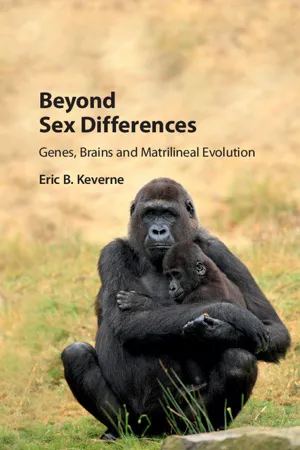 eBook - PDF
Beyond Sex Differences
Genes, Brains and Matrilineal Evolution
- Eric B. Keverne(Author)
- 2017(Publication Date)
- Cambridge University Press(Publisher)
Beyond Sex Differences 34 34 Genetic studies of longevity and the search for genes that might contribute to a longer life have met with little success. In recent years, the studies of longevity have focussed more on the epigenetic processes that might provide a basis for a longer life. It is certainly the case that different individuals show considerable epigenetic variability with ageing. This is reflected across different tissues, and even found to vary for different cells within the same tissue. For the most part these cellular epigenetic patterns of gene expression are locked into each tissue type and are transmitted via mitosis into their developing daughter cells. It is this heritable epi- genetic propagation of cells which potentially provides for more variance than is provided by somatic DNA mutations. Much of this cellular variance is brought about by metabolic factors which provide for an imperfectly maintained cellular milieu, thereby enabling the accumulation of epigenetic drift over time. Monozygotic twin stud- ies have consistently revealed epigenetic-induced expression changes to individual genes not only during their development, but also with ageing. However, cells do tend to apply restraints on ‘epigenetic drift’ via methylation at CpG islands. This results in a lower level of epigenetic variation, but even this is not as stringent as that which occurs via the direct silencing of DNA coding regions. What, there- fore, might be the advantages accruing from epigenetic variability? Considered from an evolutionary perspective, epigenetic variability may carry forward certain advantages by increasing the fitness and survival potential of individuals in ever-changing environments. Cells are able to sense changing environments and different cells become specialised to different environments, translating these differences into specific modulations of the genome via chromatin remodelling. eBook - PDF
Meaning Of Life And The Universe: Transforming
Transforming
- Mae-wan Ho, Peter T Saunders(Authors)
- 2017(Publication Date)
- World Scientific(Publisher)
In the post-genomics era, an increasing number of geneticists have begun to take notice of non-Mendelian inheritance and its invalidation of the basic tenets of biometrical genetics. In a paper published in Behavioral and Brain Sciences , Evan Charney at Duke University speaks of a “paradigm shift” in the science of genetics. He points to recent discoveries of numerous processes that create extensive mutations in genome sequences and structure, as well as epigenetic modifications, which are com -pletely at odds with the Mendelian model of inheritance underpin-ning heritability estimates. 26 Individuals do not have genes that are immutable throughout life, nor do they have the same genes in every cell of the body. He highlights retrotransposons — jump-ing genes that replicate and integrate themselves into different sites in the genome — which alter the sequence and state of activ-ity of many genes; copy number variation and chromosomal abnormalities (aneuploidy) similarly, occur frequently in somatic cells as well as germ cells, both as part of normal development and in response to noxious environmental stimuli. Different tis -sues show distinctly different propensity for change, brain cells being especially prone to such modifications. These add to the already large repertoire of epigenetic processes that modify genes in response to environmental stimuli, 4,12,32–34 and most notably in the brain. 37 The fundamental assumption of twin studies — that monozy-gotic twins share 100% of their genes — is demonstrably false. No Genes for Intelligence in the Fluid Genome 183 MZ twins differ, to begin with, in the mitochondrial DNA (mtDNA) complement allocated in cell division of the original oocyte that generated the twins. The oocyte may have had different sets of mtDNA, a condition referred to as heteroplasmy. MZ twins diverge substantially in epigenetic modifications as well as retro-transposition, copy number variations and aneuploidy through-out life.
Index pages curate the most relevant extracts from our library of academic textbooks. They’ve been created using an in-house natural language model (NLM), each adding context and meaning to key research topics.

