Biological Sciences

Foot and Mouth Disease
Foot and Mouth Disease (FMD) is a highly contagious viral disease that affects cloven-hoofed animals such as cattle, pigs, sheep, and goats. It causes fever, blisters in the mouth and on the feet, and can lead to decreased milk production and weight loss in animals. FMD can have significant economic impacts due to trade restrictions and control measures.
Written by Perlego with AI-assistance
12 Key excerpts on "Foot and Mouth Disease"
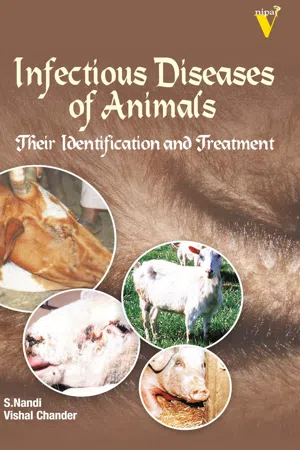
- Nandi S.(Author)
- 2020(Publication Date)
- New India Publishing Agency (NIPA)(Publisher)
1 Foot and Mouth Disease Synonyms : Aphthous fever; Contagious aptha; Panzootic aptha; Vesicular aptha. Foot and Mouth Disease (FMD) is an acute, highly communicable viral disease affecting cloven hoofed animals, both domesticated and wild. It is the most contagious disease known in the animal kingdom. It is characterized by vesicular eruptions in the epithelium of the buccal cavity, tongue, nares, muzzle, feet, teats and udder. Etiology : FMD was first demonstrated by Loeffler and Frosch that a filterable agent caused the disease and this was the first demonstration that a disease of animals was caused by a filterable agent and thus discovered the first vertebrates virus. FMD virus is under the genus Aphthovirus within the family Picornaviridae . It is a single stranded positive sense RNA virus with a protein coat consisting of four capsid proteins named as VP1, VP2, VP3 and VP4. Out of 4 polypeptides, VP1 is the most immunogenic one responsible for conferring protection in immunized animals. The icosahedral shaped FMD virus is about 23 nm in diameter with a molecular weight of 8.6X10 6 daltons and consists of a single molecule of 8 kb RNA enclosed in a protein capsid. The genome of FMD virus is covalently linked to a small protein VPg at 5’ terminus, an internal poly (C) tract and a poly (A) tail at its 3’ end. The intact virion (146S particles) has a sedimentation co-efficient of 146S and degrades into 12S protein subunits when subjected to heat, low pH or low ionic strength. Empty capsids (75S particles) are devoid of RNA and contain 60 copies of each of VP1, VP3 and VP0 ( the precursor of VP2 and VP4). There are seven antigenically distinct types of FMD virus ; O, A, C, Asia-1 SAT-1, SAT-2 and SAT-3. The strains were named as ‘O’ and ‘A’ for Oise valley in France and Alemand in France respectively in 1922. In 1926 another strain could be demonstrated in Germany as ‘C’ strain.
- Alan D.T. Barrett, Lawrence R. Stanberry(Authors)
- 2009(Publication Date)
- Academic Press(Publisher)
Chapter 22 Foot-and-Mouth DiseaseAbstractPeter W. Mason1 2 , Marvin J. Grubman3 ,1 Department of Pathology, University of Texas Medical Branch, Galveston, TX, USA2 Sealy Center for Vaccine Development, University of Texas Medical Branch, Galveston, TX, USA3 U.S. Department of Agriculture, Agricultural Research Service, Plum Island Animal Disease Center, Greenport, NY, USAFoot-and-mouth disease (FMD) is a devastating disease of livestock that has had a significant impact on world economies and public health. Its importance to mankind is confirmed by the fact that FMD virus (FMDV) was the first animal virus discovered, and that FMD was among the first animal diseases for which vaccines were developed. Due to its rapid spread and the high cost of eradication campaigns, countries that are free of the disease are susceptible to huge economic losses if the disease were to be introduced either accidentally or deliberately in an act of agroterrorism. Vaccines developed in the 1950s and 1960s have helped to control this scourge in many nations, and these products have been further developed and refined over the last 30 years. Although these vaccines are very useful as part of eradication campaigns in countries where FMDV is enzootic, it is not feasible to use these products in prophylactic vaccination of entire regions. In addition, these vaccines are not ideally suited to control outbreaks in disease-free countries. Thus, for the portions of the world that are currently FMD free, there is a need for new vaccines that can be applied in the areas surrounding an outbreak to rapidly dampen the spread of infection. Although the market for this type of vaccine is small, there are several groups trying to satisfy this important need. This chapter will detail the history of FMD vaccine development emphasizing recent advances and prospects for future development. eBook - PDF
Epidemiology of Communicable and Non-Communicable Diseases
Attributes of Lifestyle and Nature on Humankind
- Fyson H. Kasenga(Author)
- 2016(Publication Date)
- IntechOpen(Publisher)
Section 1 Epidemiology of Communicable Diseases Chapter 1 Epidemiology and Investigation of Foot‐and‐Mouth Disease (FMD) in the Republic of Korea Hachung Yoon, Wooseog Jeong, Jida Choi, Yong Myung Kang and Hong Sik Park Additional information is available at the end of the chapter http://dx.doi.org/10.5772/63975 Abstract This chapter describes about the experience of dealing with FMD outbreaks in the Republic of Korea. We explain what is FMD, the concept of epidemiological investiga‐ tion on outbreak sites of FMD, including the episode of detecting the index case for seven epidemics occurred since 2000, and information obtained from investigation in Korea. In any case, farmers’ attitude (recognize clinical signs and report suspected cases) played the essential role in determining size and duration of epidemics. A rapid and correct diagnosis including clinical examination and laboratory test for confirmation is also important. Keywords: foot‐and‐mouth disease (FMD), investigation, control measures, surveil‐ lance, Republic of Korea 1. Introduction Foot‐and‐mouth disease (FMD) caused by virus infection of a small non‐enveloped ribonucleic acid (RNA) virus belongs to family Picornaviridae, genus Aphthovirus. FMD virus affects Cloven‐hoofed domestic animals including cattle, pig, sheep, goat, deer, boar, and wild animals. Due to its high contagiousness, FMD has a great potential for causing severe economic loss. There are seven immunologically distinct serotypes of FMD virus: O (Oise Valley), A (Allemand), C, Asia1, SAT (southern African territories)‐1, SAT‐2, SAT‐3. According to the homogeneity of gene sequence of VP1 protein (approximately 639 base pairs, bps), the virus’ topotype (concerns to the location) and lineage (concerns to the ancestor) are further catego‐ © 2016 The Author(s). eBook - PDF
Animal Disease and Human Trauma
Emotional Geographies of Disaster
- I. Convery, M. Mort, J. Baxter, C. Bailey(Authors)
- 2008(Publication Date)
- Palgrave Macmillan(Publisher)
This storytelling, a co-ethnography of the 2001 FMD disaster captures both personally meaningful accounts of trauma and recovery and localized cultural context of experience. First, however, we start by briefly considering the history of FMD in the UK and some of the ‘numbers’ related to the 2001 epidemic. FMD’s social history and organisational context Epizootics, or epidemic outbreaks of disease in an animal population, have for centuries caused devastation in farming communities across the world. There are a number of epizootic diseases which are of par- ticular global importance, these include Avian Influenza, Epizootic Haemorrhagic Disease Virus, Rift Valley Fever, Rinderpest, and FMD. According to Ward et al. (2007) FMD is a highly contagious disease of cloven-hoof animals (among farm stock, cattle, sheep, pigs, goats and deer are susceptible). It is caused by a virus in the family Picornaviridae and genus Aphthovirus (the same family as the common cold virus, Rhinovirus). The virus, which has an incubation period of between 2–14 days, can infect in small doses, with a rapid rate of disease pro- gression (Health and Safety Executive, 2007). Symptoms typically com- mence with fever, followed by the development of vesicles (blisters) mainly in the mouth and on the feet. The virus can be present to a high level in all secretions and excretions of acutely infected animals, including in their breath. It is probably more infectious than any other disease affecting animals (as few as ten infectious virus particles are enough to infect a cow) and spreads rapidly if uncontrolled. The most common route for transmission is through direct contact between infected and susceptible animals. In 2001 FMD in the UK was not a new phenomenon. Reynolds & Tansey (2003) note that the first recognized case of FMD in Britain was in 1839 and statistical records show 27,254 cases during 1870.
- Dongyou Liu(Author)
- 2014(Publication Date)
- CRC Press(Publisher)
655 57 57.1 INTRODUCTION Foot-and-mouth disease (FMD), caused by a single-stranded RNA virus of the Picornaviridae family, is the most econom-ically significant disease for animal farming. While adult animals infected with FMD usually recover from the disease and mortality rates remain low, morbidity within a suscep-tible population is invariably high and farm production losses can become significant. There is little economic benefit in maintaining national herds that become nonproductive, although the level at which production is considered eco-nomically useful or viable varies for any given geographical region. Regions that export animal products have historically included developed countries which remain free of FMD, and the international bans that are imposed upon any countries which lose their disease-free status can significantly affect trade. Consequently, disease-free regions usually become proactive in controlling FMD epidemics through a variety of control measures: these include vaccination, the culling of infected herds and flocks, and various biosecurity measures. Conversely regions where FMD is endemic are gener-ally unable to achieve disease-free status due to persistently high levels of viral challenge against their national herds and flocks. For the countries within these regions, primary objectives focus upon local protection of farming systems that yield high levels of animal products, and protection is typically achieved through regular prophylactic vaccination programmes, alongside biosecurity measures. Many under-developed countries lie within geographical regions of endemic FMD. Semiendemic regions have historically adopted the tra-ditional control measures employed by disease-free coun-tries, particularly where the opportunities exist for regaining disease-free status; during epidemics within semiendemic regions, multiple vaccination administrations tend to be favored above slaughter control. eBook - ePub
Arresting Contagion
Science, Policy, and Conflicts over Animal Disease Control
- Alan L. Olmstead, Paul W. Rhode(Authors)
- 2015(Publication Date)
- Harvard University Press(Publisher)
response to a 2007 outbreak (caused by releases from a vaccine plant) was more rapid and more restrained. The responses of authorities in other countries to recent FMD outbreaks also have been very aggressive. Between November 2010 and March 2011, the South Korean government culled over 3.4 million animals (mostly swine and cattle); authorities drew international condemnation when in their haste they buried 1.4 million pigs alive. The government mobilized over 175,000 personnel, imposed tight travel restrictions, and vaccinated several million animals. When the Koreans ran out of vaccine, the United States sent 2.5 million doses. What prompted this massive response? As of 13 May 2012, authorities had only discovered 153 confirmed cases of FMD. The contagion also attacked other Asian countries. 4 FMD is a highly communicable viral disease of cloven-footed animals. The disease holds a special place in the history of medicine. In 1898, the Germans Paul Frosch and Friedrich Loeffler discovered the FMD virus. This was the first discovery of a vertebrate virus, and the first time that scientists correctly interpreted that the causative agent was a small particle different from a bacterium. Some prominent scientists thus date the origins of virology to Frosch and Loeffler’s work (see Table 2.1). 5 Cattle, hogs, sheep, goats, buffalo, deer, and many other animals (including humans) are susceptible to FMD. Infected animals develop blisters on the mouth and on the tissue above the hoof and between the toes—hence the name “foot-and-mouth disease.” Symptoms include an elevated temperature, lameness, rapid weight loss, spontaneous abortion, sterility, lesions on newborn calves, and reduced milk production. Modern pasteurization procedures will kill the virus, but FMD-infected cows often develop chronic mastitis, which makes their milk unfit for human consumption. 6 The virus is readily transmitted by wind, fluids, utensils, untreated milk, uncooked meat, and hides eBook - PDF
Dolly Mixtures
The Remaking of Genealogy
- Sarah Franklin(Author)
- 2007(Publication Date)
- Duke University Press Books(Publisher)
What was difficult for anyone without experience of a rural econ-172 : CHAPTER FIVE Foot and Mouth Disease ( fmd ), although highly contagious, is not a serious illness for sheep, and rarely affects humans. The slaughter of millions of sheep in Britain in 2001 resulted from the economic division between fmd -free and fmd -affected countries—a distinction that is primarily economic. Reproduced by permission of the Daily Express. omy to understand was the apparent paradox that it is because animal lives are valued that their deaths must be properly managed. Foot and mouth upset the careful balance between animal life and death at the heart of a rural ethics that combined constant proximity to animals and devotion to their care (husbandry) with management of their transformation into useful products to be sold at a profit, something that by definition means ending animal lives prematurely. Control of the foot and mouth epidemic, which required the destruction of millions of animals—including ancient lines of stock owned by gen-erations of families and irreplaceable herds of carefully bred varieties of sheep and cattle—upset the balance of the rural economy in al-most every aspect. Few people would have expected the twenty-first century to dawn with such a forceful demonstration of the ongoing importance of animal bloodlines to the lifeblood of the nation’s econ-omy. Neither were the complex emotions concerning animal life and death a familiar scene on the front pages of the nation’s newspapers, catalyzing an impassioned debate about our intimate connections to livestock. A particularly painful irony of the unprecedented slaughter of mil-lions of British cattle and sheep was that foot and mouth has never posed a risk to human or animal health. Unlike the new form cjd , DEATH : 173 or so-called mad cow disease, foot and mouth is harmless to humans and rarely infects them. eBook - ePub
Veterinary Vaccines
Principles and Applications
- Samia Metwally, Gerrit Viljoen, Ahmed El Idrissi, Samia Metwally, Gerrit Viljoen, Ahmed El Idrissi(Authors)
- 2021(Publication Date)
- Wiley-Blackwell(Publisher)
Epidemiol. Infect. 92 (1): 105–116.- OIE (2018).
Infection with Foot and Mouth Disease Virus. Paris: OIE. www.oie.int/fileadmin/Home/eng/Health_standards/tahm/3.01.08_FMD.pdf- Orsel, K., de Jong, M.C.M., Bouma, A. et al. (2007a). The effect of vaccination on Foot and Mouth Disease virus transmission among dairy cows.
Vaccine25 (2): 327–335.- Orsel, K., Dekker, A., Bouma, A. et al. (2007b). Quantification of Foot and Mouth Disease virus excretion and transmission within groups of lambs with and without vaccination.
Vaccine25 (14): 2673–2679.- Paton, D.J., Gubbins, S., and King, D.P. (2017). Understanding the transmission of foot‐and‐mouth disease virus at different scales.
Curr. Opin. Virol.28: 85–91.- Pega, J., Bucafusco, D., di Giacomo, S. et al. (2013). Early adaptive immune responses in the respiratory tract of foot‐and‐mouth disease virus‐infected cattle.
J. Virol.87 (5): 2489–2495.- Perez‐Martin, E., Zhang, F., Maree, F. et al. (eds.) (2016). FMD virus persistence and transmission in African buffalo. In:
Open Session of the European Commission for the Control of Foot‐and‐Mouth Disease. Portugal: Cascais.- Porta, C., Kotecha, A., Burman, A. et al. (2013). Rational engineering of recombinant picornavirus capsids to produce safe, protective vaccine antigen.
PLoS Pathog.9 (3): e1003255.- Roche, S.E., Garner, M., Sanson, R. et al. (2015). Evaluating vaccination strategies to control foot‐and‐mouth disease: a model comparison study.
Epidemiology and Infection143: 1256–1275.- Scott, K.A., Kotecha, A., Seago, J. et al. (2017). SAT2 foot‐and‐mouth disease virus structurally modified for increased thermostability.
J. Virol.91 (10): e02312–e02316.- Shao, J.J., Wang, J.F., Chang, H.Y., and Liu, J.X. (2011). Immune potential of a novel multiple‐epitope vaccine to FMDV type Asia 1 in guinea pigs and sheep.
Virol. Sin.26 (3): 190–197.- Soria, I., Quattrocchi, V., Langellotti, C. et al. (2018). Immune response and partial protection against heterologous foot‐and‐mouth disease virus induced by dendrimer peptides in cattle.
J. Immunol. Res. No longer available |Learn more
- Michael Carrithers(Author)
- 2009(Publication Date)
- Berghahn Books(Publisher)
‘Superficially, the problem was one of a highly contagious disease – but FMD is not a threat to human health and it is not even normally fatal to animals. From a public policy point of view, foot and mouth is entirely an economic disease.’ (Donaldson, Lowe and Ward, 2002: 32). The (indirect) impact of FMD on human health was therefore largely overlooked. However, Mort et al. (2005) have gathered data from diaries, interviews and group meetings which indicate that the epidemic gave rise to widespread individual and community trauma and has had lasting negative health, economic and social impacts on the people who live in those affected rural areas (see also Nerlich and Döring 2005). The severe social and psychological implications of FMD have also been highlighted in a report prepared by the European Parliament (European Parliament 2002). In this chapter I claim that the social impact of FMD can only be understood if we study FMD not only as a disease and not only as an economic phenomenon, but as a rhetorical and cultural one.FMD: A CULTURAL PHENOMENON
FMD is more than just a veterinary and scientific problem. For farmers the ‘event’ became a ‘crisis’, a ‘plague’, an ‘epidemic’ and a ‘national disaster’ because they feared, yet again, for their livelihood as well as for the welfare of their animals. For food consumers it became a ‘crisis’ because FMD came in the wake of a long list of other health and food scares, such as listeria in eggs, salmonella in chicken, BSE (or mad cow disease), E. coli in meat, swine fever, the panic over genetically modified food (GM food), a resurgence of AIDS, as well as other calamities, such as fuel protests, the breakdown of the rail system, devastating floods, and debates about global warming, industrialization, commercialization, and globalization (see Nerlich 2004b). This conjunction of negative social representations of food and health contributed to an immediate ‘catastrophizing’ of the FMD event by farmers, consumers and the media alike: ‘In good times it would be a disaster, but in times like these it is a catastrophe’ (GU, 26/02/01). eBook - ePub
Veterinary Medicine
A textbook of the diseases of cattle, horses, sheep, pigs and goats
- Peter D. Constable, Kenneth W Hinchcliff, Stanley H. Done, Walter Gruenberg(Authors)
- 2016(Publication Date)
- Saunders Ltd.(Publisher)
Vet Ann . 1982;22:63.Scott GR. Foot-and-mouth disease. Sewell MMH, Brocklesby DW. Handbook on Animal Diseases in the Tropics . 4th ed. Baillière Tindall: London; 1990:309.Thomson GR, Bastos ADS. Foot-and-mouth disease. 2nd ed. Oxford University Press: Cape Town; 2004:1324. Coetzer JAW, Tustin RC. Infectious Diseases of Livestock . Vol. 2.References
1. Paton DJ, et al. Philos Trans R Soc Lond B Biol Sci . 2009;364.2. OIE/FAO Global conference on Foot and Mouth Disease—final recommendations. Asuncion, Paraguay . [Accessed at] http://www.oie.int/en/for-the-media/press-releases/detail/article/oiefao-global-conference-on-foot-and-mouth-disease-final-recommendations/ ; 2009 [Accessed 01.08.2016].3. Yoon H, et al. Transbound Emerg Dis . 2013; 10.1111/tbed.12109 [Epub ahead of print].4. Muroga N, et al. J Vet Med Sci . 2012;74:399.5. Rweyemamu M, et al. Transbound Emerg Dis . 2008;55:57.6. Pacheco JM, et al. Vet J . 2012;193:456.7. Sellers R, Gloster J. Vet J . 2008;177:159.8. Chase-Topping ME, et al. Vet Res . 2013;44:46.9. Juleff ND, et al. Vet Immunol Immunopathol . 2012;15:148.10. Maddur MS, et al. Clin Vaccine Immunol . 2009;16:1832.11. Garland AJ, de Clercq K. Rev - Off Int Epizoot . 2011;30:189.12. Allepuz A, et al. Transbound Emerg Dis . 2013; 10.1111/tbed.12087 [Epub ahead of print].13. Muroga N, et al. BMC Vet Res . 2013;9:150.14. Wernery U, Kinna J. Rev - Off Int Epizoot . 2012;31:907.15. Larska M, et al. Epidemiol Infect . 2009;137:549.16. Chang H, et al. Virol J . 2013;10:81.17. Alexandrov T, et al. Vet Microbiol . 2013; 10.1016/j.vetmic.2013.05.016 [Epub ahead of print; S0378-1135(13)00298-8].18. Mohamed F, et al. Transbound Emerg Dis . 2011;58:358.19. Rhyan J, et al. J Wildl Dis . 2008;44:269.20. Cottam EM, et al. PLoS Pathog . 2008;4:e1000050.21. Toka FN, Golde WT. Immunol Lett . 2013;152:135.22. Pega J, et al. J Virol . 2013;87:2489.23. Carpenter TE, et al. J Vet Diagn Invest . 2011;23:26.24. Arzt J, et al. Transbound Emerg Dis . 2011;58:291.25. Arzt J, et al. Transbound Emerg Dis eBook - ePub
- Sam Hillyard(Author)
- 2007(Publication Date)
- Berg Publishers(Publisher)
This chapter is therefore necessarily selective. The discussion reflects the author’s involvement in an ESRC-funded, two-year project that explored the social and cultural impact of the epidemic (grant no. L144 25 0050). Other literature is drawn upon for its innovative or penetrating application of methods and/or theory to unravel the complexities of the FMD crisis. The chapter concludes by raising a series of questions regarding the future of British agriculture and rural ways of life in the wake of the FMD crisis. These include comments on rural protests, ways of life and the long-term future of farming in the UK.What is FMD? An Overview of FMD in 2001FMD is an acute, infectious viral disease that is manifested in a fever and lesions in and/or on the mouth and hoofs. It affects cloven-hoofed farm animals (such as cattle, pigs, sheep, goats) but not horses1 In 2001, a confirmed case of FMD was announced on 19 February 2001, the first outbreak on the UK mainland since 1968. The last outbreak had run between 1967–68. In 2001, the last case was announced on 30 September. Unlike the 1967 outbreak, the 2001 crisis reached all parts of the UK including England, Scotland and Wales and also Ireland. In reaction and due to the highly contagious nature of the disease, British exports were immediately banned by disease-free importing nations. At home, the then Ministry of Agriculture, Fisheries and Food (MAFF) began to try to trace its spread and eliminate it by applying the traditional methods of slaughter and livestock movement restrictions. By the end of March, the disease was out of control as infected animals remained alive for days and served to contribute to further spread. In the UK media coverage was dominated by highly emotive images of rotting carcasses awaiting burial or burning atop pyres.Academic analyses have produced a variety of assessments of the impact of the 2001 FMD crisis. Some figures reveal that 2,000 premises were infected, over 6 million animals were slaughtered and the cost to the public sector was £3 billion (National Audit Office 2002). Whilst such figures speak baldly about the scale of FMD in 2001, why has the FMD epidemic (and the term captures the scale of FMD more aptly than outbreak) received so much attention from the research community? Why did this epidemic attract so much attention in 2001 and why does it continue to be discussed in academic, scientific and policy circles? The case of FMD is complex, due to the legacy of historical treatments of the disease, the policy context and the very virulence of the disease itself. However, it also coincides with shifts inside rural societies and the place of the rural within society’s cultural imagination. That is, the farming industry has changed in the time that has elapsed since the last outbreak of FMD on the UK mainland, policy has also begun to shift and, finally, the perceptions of agriculture and rural living have also been reconfigured. FMD served to bring some of these issues to the fore and this ‘crisis’ allows them to be examined and analysed. The chapter considers some of these changes and attempts to draw some conclusions about the way social scientists approached the problem of FMD and asks, finally, what rural sociology can learn from the applied case study of FMD in 2001. eBook - PDF
Harm's Way
Disasters in Western Canada
- Anthony Rasporich, Max Foran(Authors)
- 2004(Publication Date)
- University of Calgary Press(Publisher)
In an era of declining British trade its over-all economic impact was not substantial. The impugning of a national reputation was another matter entirely. 7 Of all diseases, foot and mouth, also known as aphthous fever, is regarded by far the most dangerous threat to livestock health. Although considered a disease of cattle, foot and mouth affects all cloven-footed 182 MAX FORAN animals. It was first detected in Europe in the eighteenth century and by 1839 had made its appearance in Great Britain. 8 Carried by a barely detectable and highly resistant virus which comes in six diverse forms, foot and mouth is extremely contagious, and its rapid spread to almost all exposed susceptible animals leads to heavy economic losses. Infection may be spread from direct contact with diseased animals that are highly contagious long before they show visible symptoms. Indirect contamination, however, is far more dangerous because of the range of carriers and the fact that the virus can live for extended periods outside an animal’s body. According to F. E. Mollin, Secretary of the American Cattleman’s Association, foot and mouth virus remained in Californian soil for 345 days following an outbreak there. The virus may reside on manure, hay, utensils, drinking troughs, railway cars, stockyards, barnyards, or pastures. Human beings, although rarely infected, may carry the virus on their hands and clothing. It may also be carried by rats, dogs, cats, chickens, and other birds either on their bodies or in their excretions. Even milk in a raw state may also transmit the disease to animals fed with it. 9 Indeed, the virus endures many of the processes used in dairy products, including high temperature and short-term pas-teurization. It also survives in both processed and frozen meats. 10 In the outbreak under discussion, the later infections were caused by viruses in the melting spring snows.
Index pages curate the most relevant extracts from our library of academic textbooks. They’ve been created using an in-house natural language model (NLM), each adding context and meaning to key research topics.

