Geography

Green Belt
A Green Belt refers to an area of open land, often surrounding urban areas, that is protected from development to prevent urban sprawl and promote environmental conservation. These areas typically contain parks, forests, and agricultural land, providing a buffer between urban and rural areas. Green Belts help to maintain biodiversity, provide recreational space, and improve air quality within urban regions.
Written by Perlego with AI-assistance
Related key terms
1 of 5

12 Key excerpts on "Green Belt"
 eBook - ePub
- Mark Scott, Nick Gallent, Menelaos Gkartzios, Mark Scott, Nick Gallent, Menelaos Gkartzios(Authors)
- 2019(Publication Date)
- Routledge(Publisher)
tabula rasa by making productive rural activities visible. This accessible perspective seems only set to improve with the convergence of big data and real-time mapping.Sustainable livelihoods within the Green Belt plan areaFinally, one of the lessons from the Toronto Greenbelt has been the need to consider how to create and maintain rural areas. The aesthetic appeal of the scenic countryside exists largely because of the existence of working farms and other productive rural uses using environmental land management strategies that enhance the beauty of the scenic countryside. To support long-term livelihood strategies of those working there, state programmes and other means are needed. The danger exists that the Greenbelt will be designated as rural on paper but will not continue to be a functional rural system, instead owned by exurbanites and maintained as the pastiche of a working landscape (Abrams and Gosnell, 2012; Morse et al., 2014).ConclusionA Green Belt is a simple idea that sells the promise of permanent rural landscape protection. At the same time, it hides from most people the complexities of its designation. A single-goal Green Belt does not live up to the potential of the Green Belt concept. For example, a Green Belt that is just an urban boundary (where the Green Belt is a wide green line) is a central city containment strategy but is not a positive plan for the lands within it or beyond it. A Green Belt that is just a protected area designed for agricultural land protection is too narrowly defined as the value hinges on farming potentially at the expense of other rural landscape uses. A Green Belt that is meant for just natural environment protection – just as green infrastructure or just as a linear greenway – also runs the risk of being too narrowly defined; while environmental science supports boundaries and provides a rationale for protection seemingly away from political criticism, the lands must be managed as ecological or as recreational and may be at odds with other desirable rural uses. When designed to be more than a single-goal protected area designation, Green Belts can provide flexibility in the public interest over the long term. The rural–urban fringe is hybrid, multifunctional, contains multiple geographies and every fringe of every city is as unique as the landscapes and cultures and processes that have shaped the city’s region. Green Belts are a powerful planning tool as they transcend localised land-use conflicts and remain aligned with the persistent spatial imagination of an interconnected city and countryside. eBook - ePub
Planning for Good or Ill
A Review of the UK Planning System 1944 to the Present Day
- Clive Brook(Author)
- 2023(Publication Date)
- Brown Dog Books(Publisher)
The third myth is that Green Belt is an environmental policy rather than simply a policy to control the spread of urban development. Many members of the public, and even a few planning authorities, consider Green Belt designation has an environmental basis or provides a direct recognition of the environmental qualities of the land included in the designation. There is a strong tendency in planning discussions and public consultations, and in public examinations and inquiries, to align Green Belts with environmental policies. Environmental designations and the policies that protect them have one thing in common with Green Belts and that is they are very often a constraint on development. Any similarity ends there as environmental designations are selected and defined based on their qualities, such as landscapes of character and visual beauty (national parks and AONBs) and areas protected for their biodiversity and habitat qualities (Nature Reserves, Ancient Woodlands). The land to be included in Green Belts is not selected on any qualitative basis though it may include local nature reserves, attractive woodland, and other environmental features. Green Belt boundaries have historically been selected based on the general width of the land area required to constrain urban growth and to keep towns separate from one another. Most planning authorities have extended this purpose of separating settlements to include villages, an approach to which national government has acquiesced, without giving specific policy support. The only environmental factor included in the five purposes of Green Belt, as defined in the NPPF (paragraph 134), applies to the preservation of the setting and special character of historic towns. The number of towns/cities meriting this level of protection are limited in number and include York, Chester, Bath, and Oxford.I have experienced planning authorities applying the presence of a Green Belt as a site-selection criteria in combination with environmental designations in a discrete stage of the selection process rather than treating this designation and its purposes as a wholly separate and subsequent stage where it is the sole criterion to be applied.The fourth misconception is that the designation of Green Belts has in some way provided much greater access to recreation for urban dwellers. While Howard and the early proponents of Green Belts envisaged that public recreation would be both a main role and a benefit of designation, they generally allied this aim with a programme of public acquisition of the land to facilitate this. The great majority of Green Belt land is privately owned, and the major land use is agriculture. Local planning authorities have generally not sought to negotiate access agreements with landowners. However, this position could and should be radically changed as a result of the introduction of the new statutes covering agriculture and the environment. The introduction of these statutes leads to a need to adapt planning policy and development management relating to land use, including land in the Green Belt. eBook - ePub
Cities and Natural Process
A Basis for Sustainability
- Michael Hough(Author)
- 2004(Publication Date)
- Routledge(Publisher)
8 Greenbelts have a number of purposes: to protect watersheds, groundwater, aquifers and other biophysical components of the landscape; protect the countryside and farmland from urban encroachment; prevent neighbouring towns from merging together; preserving the physical setting and special character of historic towns; and assisting in urban regeneration by encouraging the reuse of derelict urban land. Boundaries also need to be clearly defined to ensure the long-term viability of agriculture, recreation and amenity, by using physical features such as roads, streams or woodland edges.Figure 7.2 The current fourteen greenbelts in the UK totalling 1,555,700 hectares.The government policies for the countryside are set out in the White Paper Rural England; A Nation Committed to a Living Countryside,9 requiring that the countryside be managed sustainably. This entails accommodating necessary change to rural areas, encouraging economic diversity and employment, reducing travel by car, maintaining the character of the countryside and the quality of rural towns and villages – in effect, safeguarding distinctive landscapes.It is at the local county level, however, that policies and principles are implemented, and that local needs and issues and the peculiar environmental and political conditions of local districts come face to face with national greenbelt policies. This was borne out in 1996 hearings in which representations were made to a panel that was conducting a public examination of the County of Dorset Structure Plan (to the year 2011). With regard to the issue of settlement patterns, a question under debate was whether the boundaries of the south-east Dorset greenbelt should be adjusted to allow for additional development. The following are examples of the comments from participants on this question. eBook - ePub
- Nick Gallent, Johan Andersson, Marco Bianconi(Authors)
- 2006(Publication Date)
- Routledge(Publisher)
2 ), with planning having had apparently less influence, planning controls being flouted, or development control and enforcement turning an apparently blind eye to contraventions of planning regulations. For society at large, and for planning in particular, the fringe can sometimes appear to be out of sight, and out of mind. But in other instances, the existence of statutory Green Belts suggests that planning has more of a direct, hands-on, concern for what happens at the fringe: containment of this type may create an apparently more regulated landscape, reinforcing the division between town and country.The original concept of clear physical boundaries between large cities and their surrounding countryside dates back to the late nineteenth century when Howard introduced his proposals for managing growth in London and maximizing accessibility to adjacent green land. His ideas were further developed by Raymond Unwin in the 1930s and by Patrick Abercrombie in the Greater London Plan of 1945. Circular 42/55 (1955)—introduced by Duncan Sandys and the Conservative Government—called upon local authorities to consider formal designation of Green Belts where it was desirable to restrict urban growth (Elson, 1986:3–15). Today, Green Belts cover one and a half million hectares (13%) of England and the policy is regarded by many as one of planning’s greatest achievements. According to the latest policy statement (the revised PPG 2, published in 2001) the purposes of the Green Belt Policy in England are: to check the unrestricted sprawl of large built-up areas; to prevent neighbouring towns from merging into one another; to assist in safeguarding the countryside from encroachment; to preserve the setting and special character of historic towns; and to assist in urban regeneration, by encouraging the recycling of derelict and other urban land (DETR, 2001b: Para. 1.5) Put simply, Green Belts are viewed as a generic intervention, designed to achieve wider objectives, without a specific purpose tied to the area of designation itself. eBook - PDF
- Murat Ozyavuz(Author)
- 2012(Publication Date)
- IntechOpen(Publisher)
Mar y land Greenprint Pro g ram; Chatfield Basin Conservation Network— Denver, Colorado, metropolita n area Green fingers Purif y stormwater throu g h bioswales. Buffalo Ba y ou and Be y ond fo r the 21st Centur y Pla n , Housto n , Texas, area Green links Connect separated greenspace. Gree n Links initiative to connect isolated patches of habitat throughout the lower mainland of Britis h Columbia Greenspace or g ree n s p ace Protect lands from development. Countless s y stems (usuall y called “o p e n s p ace” ) across North America Green structure or greenstructure Connect separated areas o f greenspace and provide a structure around which development may occur. Term is commonl y used i n Euro p e. Greater Copenhagen Green Structure Plan Table 1. Urban green space systems in the different countries (Hellmund and Smith, 2006) Urban Green Space System Planning 111 Green Belt land is contributing to the healthy ecosystems which underpin many natural processes supporting a range of services including pollination, soil fertility, flood defense, air filtration and carbon capture and storage. Without the Green Belt designation it is likely that a proportion of this land would have been lost to urban development and associated infrastructure. Green Belt landscapes have been fragmented by development in a number of locations over time, however, and there may be a correlation between this and the relative lack of large and/or nationally important nature conservation areas. Green Belt land needs to be recognized as an integral part of ecological networks, forming healthy, functioning ecosystems to benefit wildlife and the people who live in adjacent towns and cities (Anonymous, 2010). Fig. 1. Green Belts in England (http://www. buildinglanduk. co. uk/greenbelt-land-uk. htm) Greenways are being designated as green network in cities and countryside throughout North America and elsewhere. eBook - PDF
- Christopher Boone, Ali Modarres(Authors)
- 2009(Publication Date)
- Temple University Press(Publisher)
Government policies adopted Green Spaces, Green Governance, and Planning 177 in the postwar period gave local authorities in Britain the power to con-trol development and implement greenbelt plans, although the govern-ment’s view of the purpose of greenbelts moved away from preserving amenity or providing recreation space. In 1961 the minister of housing and local government, Henry Brooke, explained the function of the greenbelt as “a stopper.” “It may not all be very beautiful and it may not all be very green,” he argued, “but without it the town would never stop, and that is the case for preserving the circles of land around the town” (Gault 1981). The British public has viewed greenbelts as inviolable, but govern-ment policies prove that they are anything but. During the Thatcher years, policies “loosened the belt” to accommodate home building while para-doxically paying lip service to greenbelt land as sacrosanct. During the 1980s urban planners pointed to a new role for greenbelts—to assist in urban revitalization, particularly in regions of the country (e.g., the West Midlands) where deindustrialization had led to urban decline. Twenty years later the same arguments are being voiced in support of greenbelts, and the same battles over the development of greenbelt land for housing are being waged. Greenbelts now cover about 13 percent of England, although around .02 percent of greenbelt land in that country is lost every year to development (Stone-Lee 2004). In 2004 Scotland’s government announced plans to review its greenbelt policy in light of pressures on the greenbelt from building developers (Denholm 2004). As the Cam-paign to Protect Rural England suggests, greenbelts are still working, but they remain under threat (Campaign to Protect Rural England 2001). One criticism of greenbelts is that they can encourage “leapfrogging,” or development beyond the greenbelt. eBook - ePub
- John Ratcliffe, Michael Stubbs, Miles Keeping(Authors)
- 2009(Publication Date)
- Routledge(Publisher)
Such ideas have not found favour with the government, which in past years has expressed a desire to maintain Green Belt policy but not to widen its geographical scope beyond current limits around the major cities, mostly due to its highly restrictive schedule of what may be developed. The 1995 guidance links Green Belt policy with the promotion of sustainable patterns of development so that planning authorities should ‘consider the consequences for sustainable development (for example in terms of the effects on car travel) of channelling development towards urban areas inside the inner Green Belt boundary, towards towns and villages inset within the Green Belt, or towards locations beyond the outer Green Belt boundary’. 16 Green Belt policy may contribute to such sustainable objectives, although in isolation from other strategies it will have little real impact on development patterns beyond its own boundaries. Most certainly the government’s own push towards ‘recycling’ urban and/or previously developed land for development (in PPS3 of 2006) has arguably been more successful in redirecting development patterns to urban areas than the essentially negative anti-sprawl restriction on development as promoted by the Green Belt. Green Belts or concrete collars? Green Belt policy will continue to operate for many years to come due more to the political popularity of such a policy and its easy understanding by the public, instead of its effectiveness in redirecting development to the urban area. This policy is not without its critics, however, who are positioned at either end of the planning and environmental spectrum. At one end, it is suggested that such a policy should be scrapped in favour of free market economics in which the market would itself recognize the importance of undeveloped and open countryside on the edge of cities (Pennington 2002) eBook - ePub
Cities
An Environmental History
- Ian Douglas(Author)
- 2013(Publication Date)
- I.B. Tauris(Publisher)
73 By 2012, England’s 14 Green Belts covered over a tenth (13 per cent) of the land, and provide a breath of fresh air for 45 million people. Altogether, 88 per cent of the population lives in the urban areas within Green Belt boundaries.Similar policies were adopted in many European countries. Belgium had its Plan Vert in the 1960s. The Netherlands links green and blue (water) spaces in planning, developing an Ecological Main Structure, the Green Heart (Figure 9.8 ) and Buffer Zones.74 These areas involve links to the cities through green wedges, particularly in Amsterdam where the 1,000 ha Amsterdamse Bos Park creates a green wedge between highly developed urban fingers.75 Freiburg in Germany also operates a ‘green wedge’ planning strategy to link the city centre to the surrounding countryside. Helsinki, Finland, has a 10 km long central park extending northwards from the city centre to an old growth forest. Copenhagen, Denmark, has a finger plan strategy where green wedges alternate with built-up areas, creating a greenspace network which 90 per cent of its residents can reach within a 15 minute walk.76 These Nordic cities, like many others, have had the challenges of involving citizens in the planning of open spaces, and providing multi-seasonal spaces for a postmodern citizenry.77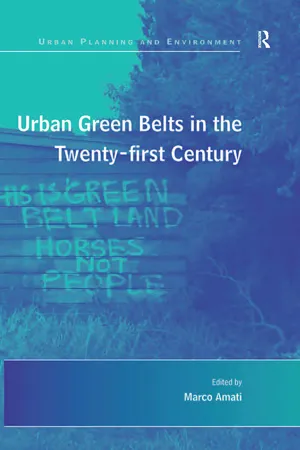 eBook - ePub
- Marco Amati(Author)
- 2016(Publication Date)
- Routledge(Publisher)
CHAPTER 1Green Belts: A Twentieth-century Planning Experiment
Marco AmatiThe general public creates an outcry if any attempt is made to invade this Green Belt and that is something we want to get into planning – the creation of public interest. We want to get them to know something of our work and support us in our activities(Abercrombie, 1948, 13)The implementation of Green Belts in many countries can be regarded as one of the most internationally famous attempts to control urban growth. Green Belts have ringed major cities to prevent them sprawling. Planners have used them to separate satellite ‘new towns’ from the urban core, safeguarding land for recreation, agriculture and forestry. Green Belts have also provided sites for more utilitarian uses such as salvage yards, incinerators and quarries. In some places, areas of the Green Belt have suffered through illegal dumping or through neglect.The popularity of Green Belts among planners during the twentieth century is due to the alignment of their attributes with some of the assumptions that underpinned modernist planning. These assumptions were that strict divisions between different land-uses could be unproblematically drawn, and that planners’ actions could be justified by normative conventions and a search for universal truths.As planners began to grapple with the messy realities of urban growth during the twentieth century, Green Belts gave them a tool to realise a normative geography that a city has natural limits, that urban and rural areas should be separated and that settlements should be balanced and evenly-spaced. Green Belts were used as part of a project to construct a universal planning canon, being employed regardless of the contingencies that affect urban growth in different cities around the world. They also contributed to the construction of planning as a discipline, as the open space they preserved could be linked directly to a who’s who of famous UK planners such as Patrick Abercrombie and Raymond Unwin (Gault, 1981). eBook - ePub
Green Belts
Past; present; future?
- John Sturzaker, Ian Mell(Authors)
- 2016(Publication Date)
- Routledge(Publisher)
Wherever practicable, a Green Belt should be several miles wide, so as to ensure an appreciable rural zone all round the built-up area concerned …’ (paras 3–4). 1957 MHLG Circular 50/57 The Green Belt ‘inner boundary … will mark a long-term boundary for development’ (p. 1). 1960 MHLG Circular 37/60 ‘The aim should be to encourage employment as well as people to move out from the large cities to places beyond the Green Belt’ (p. 2). 1984 DoE Circular 14/84 Green Belts ‘have a broad and positive planning role in checking the unrestricted sprawl of built-up areas, safeguarding the surrounding countryside from further encroachment, and assisting in urban regeneration … The Government reaffirms the objectives of Green Belt policy and the related development control policies set out in Ministry of Housing and Local Government Circular 42/55 …’ (p. 1). eBook - ePub
Neighbourhood Planning
Place, Space and Politics
- Janet Banfield(Author)
- 2019(Publication Date)
- Routledge(Publisher)
Table 3.3 suggests that in general terms and consistent with its framing in the NPPF, the local plan frames the Green Belt as a constraint on development, which can only be overcome if exceptional circumstances can be established to justify deleting land from the Green Belt for development purposes. However, the Green Belt study effectively enables it to be framed as a potential resource if parcels of land within the Green Belt can be shown to contribute less effectively to the purposes of the Green Belt. This perceived process of division and metrication thus seemingly allows the local plan to respect the purposes of the Green Belt but not the Green Belt itself as a singular entity by rendering different parts of the Green Belt more or less important. By contrast, residents do not draw on differential notions of Green Belt purposes but value the Green Belt simply because it is there. They recognise the role that the Green Belt plays in controlling development and protecting the rural and open character of their area and, because they do not tend to consider the different ways in and degrees to which different areas contribute to its purposes, they see the Green Belt in more uniform terms as an essential and valued quality of their area. It is also clear from the public consultation on the WSHWNP that the Green Belt is not simply about land that is currently or might be developable but is about access to, identification with and active engagement in the Green Belt (WSHWNPSG, 2018). Local residents do not simply look at the distribution of the Green Belt on a map and they do not critique its formal contribution to its aims: they live in the Green Belt, and they live in settlements that gain much of their character from the Green Belt and the character of which is in turn protected by the Green Belt. Local support for the Green Belt is often perceived as NIMBYism and an outright rejection of any form or level of development, but in this case this is inaccurate, as it is not development itself that is the focus of community resistance but the predicted impact of that development on the character and perceived quality of their settlement and its environs. Residents appreciate the role that the Green Belt plays in establishing and protecting their lived space, and they perceive that such a designation is the only thing that does protect that character and perceived quality. For residents, then, the Green Belt is singular and absolute, not differentiated and graduated.The decision on the part of the LPA to accept a proportion of Oxford’s unmet housing need and to allocate that development to Green Belt land is especially interesting given that Green Belt designation is valid grounds for declining to cooperate on such matters under the terms of the Localism Act 2011 (DCLG, 2011). Personally, I find it inexplicable that the city cannot build at its edges because of Green Belt constraints that prevent urban sprawl but development for the city can leapfrog over the most immediate Green Belt and impose itself on Green Belt land slightly further away. To me, this leapfrogging of development is simply a different form of sprawl that increases transport pressures by locating accommodation for the city away from the city that it is intended to serve, making it anything but sustainable irrespective of any locally felt injustice. The resistance voiced locally is not (generally-speaking) resistance to development in principle and is certainly not resistance to development within the proposed Strategic Development Site at Dalton Barracks and Abingdon Airfield, which received broad support in the WSHWNP consultation despite the site being in the Green Belt (WSHWNPSG, 2018). Instead, residents are resistant to the deletion of land from the Green Belt as an easy way of delivering what is perceived as unnecessary and excessive development that is intended not to meet local need but to fuel economic growth elsewhere. This is not a case of NIMBYism, then, but of consideration of what constitutes an appropriate scale and location of development given the local social, economic and environmental conditions. eBook - ePub
- V. Kelly Turner, David H. Kaplan, V. Kelly Turner, David H. Kaplan(Authors)
- 2021(Publication Date)
- Routledge(Publisher)
We begin with a brief overview of green infrastructure. We then continue our review of green infrastructure and green space theory and practice in the context of four key geographic concepts: 1) scale, 2) mapping distribution, 3) place and locale and 4) equity and access. We conclude that geographers, with spatial and scalar skills in landscape analysis, are uniquely positioned to contribute to advancing urban sustainability planning in these important ways.Part I. Green infrastructure
“Green infrastructure” is a term that has come into common use within the last twenty years. Generally, this this term has gained prominence as a way to talk about the services provided by natural systems and to convey the need to manage and maintain these systems like other types of infrastructure – roads, electrical lines, water distribution systems.However, green infrastructure is a highly contested term and has multiple definitions. Some scholars, such as Bolund and Hunhammar (1999) broadly define green infrastructure as vegetation, soils, and bioengineered systems that provide ecological services such as microclimate regulation, air quality improvements, habitat, and stormwater management. Benedict and McMahon (2006) updated this definition along similar lines calling green infrastructure ““an interconnected network of natural areas and other open spaces that conserves natural ecosystem values and functions, sustains clean air and water, and provides a wide array of benefits to people and wildlife”’ (Benedict and McMahon, 2006, p. 12). However, others utilize the term much more specifically, as a synonym for stormwater Best Management Practices, referring to green roofs, permeable pavements, rain gardens, stormwater treatment swales and the like (EPA, 2014). Along these lines, Mell (2012) notes that there are substantial regional variation in the focus of green infrastructure programs.There is also great variety in the scale of green infrastructure. Weber, Sloan, and Wolf (2006) and others discuss green infrastructure as interconnected networks of large parks, greenbelts, and wetlands. Others focus on small-scale green amenities that can improve the urban environment and provide aesthetic amenities when “decentralized” and distributed throughout the cityscape (Tzoulas et al., 2007). Examples include street trees and other vegetation, green roofs, green façades, permeable pavements. Such decentralized efforts provide a “greening” option even in dense and largely built-out urban areas where available land is scarce or expensive (Montalto et al., 2007). Indeed, green infrastructure should “operate at all spatial scales from urban centres to the surrounding countryside” and offers differentiated functionality dependent on location (Gill, Handley, Ennos, & Pauleit, 2007, p. 116).
Index pages curate the most relevant extracts from our library of academic textbooks. They’ve been created using an in-house natural language model (NLM), each adding context and meaning to key research topics.

