Geography

Suburban Sprawl
Suburban sprawl refers to the uncontrolled expansion of urban areas into surrounding rural or undeveloped land. It is characterized by low-density, car-dependent development, often resulting in the loss of agricultural or natural areas. Suburban sprawl can lead to increased traffic congestion, environmental degradation, and a decline in community cohesion.
Written by Perlego with AI-assistance
Related key terms
1 of 5

12 Key excerpts on "Suburban Sprawl"
 eBook - PDF
Smart Growth Entrepreneurs
Partners in Urban Sustainability
- Erik Solevad Nielsen(Author)
- 2016(Publication Date)
- Palgrave Macmillan(Publisher)
35 © The Author(s) 2017 E.S. Nielsen, Smart Growth Entrepreneurs, DOI 10.1007/978-3-319-41027-2_2 CHAPTER 2 Sprawl and Smart Growth Growing up in the 1980s and 1990s, suburbia became synonymous with American ordinariness: a homogenous dream that everyone was to aspire to in which everyone was a homeowner and automobile driver, owning and maintaining a homogenous green lawn, complete with picket fences and gardens. The term sprawl described the spread of this, often, one- to two-story development type. Commercial buildings that housed stores like Wal-Mart, Borders, Best Buy, and others were large, spacious build- ings—practically warehouses—that were also very low density. This trend of building cities was predominant from the 1940s to the 2000s, tak- ing a hit from the property and financial market crashes, online retailers, and demographic shifts. As my generation, the Millennials, entered the workforce or graduated college to then start our adult lives, the suburban dream seemed less appealing and inorganic. For longer than a decade, there has been a discernable trend among both young adults and, interest- ingly, the elderly toward living near city downtowns, near regional centers, or closer to transit services. While “urbanization” has been the focus of much commentary, cit- ies across the world are witnessing a dramatic shift in their populations migrating from city centers into suburbs. Suburbanization, and its land use type, sprawls outward from city centers gobbling up land on the fringes. Sprawl can be defined as a type of urbanization distinguished by leapfrog patterns of development, commercial strips, low-density, single- family detached housing, separated land uses, and automobile dependence (Ewing 1994; Gillham 2002; Calthorpe 2012). eBook - ePub
The Interstitial Spaces of Urban Sprawl
Geographies of Santiago de Chile’s Zwischenstadt
- Cristian A. Silva(Author)
- 2022(Publication Date)
- Routledge(Publisher)
Sieverts, 2003 , p. 12). Yet urban sprawl deserves a closer inspection to define more balanced narratives around its composition and explore what other elements can contribute to a more comprehensive understanding of urban sprawl.Since its inception – and although the definition is still contested – ‘urban sprawl’ is used to describe extended suburban landscapes largely characterised by low-density residential neighbourhoods, high levels of car-dependency, single land uses, and lack of physical continuity (Jaret et al., 2009 ). Land fragmentation and dispersion of infrastructures are also components of sprawling growth (Altieri et al., 2014 ; Trubka et al., 2010 ). In terms of geographical delimitation, it is also accepted that urban sprawl embraces developments beyond suburbia, in which a range of terms have been used to identify its scope including ‘exurbia’ (Bruegmann, 2005), ‘technoburbs’ (Fishman, 1987 ), ‘edge cities’ (Garreau, 1991 ), ‘edgeless cities’ (Lang, 2003 ), ‘satellite towns’ (Abubakar & Doan, 2017 ) and ‘post-suburbs’ (Phelps & Wood, 2011); all constitutive of Sieverts’ Zwischenstadt: a distinctive geography of transition between the proper city and the open countryside that amalgamates the characteristics and dynamics of both. The Zwischenstadt is a realm ‘which separates itself from the city (…) and achieves a unique form of independence’ (Sieverts, 2003, p. 6). This multifaceted geography has ramifications across several scales, notably in terms of governance. This issue has been identified by Rauws and de Roo's notion of the ‘third type of landscape’ (Sieverts, 2011 ), something ‘which cannot solely be understood in terms of progressive intensification of urban functions in the rural environment’ (Rauws & de Roo, 2011 , p. 269), and ‘be distinguished in terms of its own specific dynamics and characteristics (…), a spatial system in its own right’ (ibid, p. 270). This distinction becomes relevant while stepping on the ontologies around ‘urban sprawl’: does it refer to ‘the sprawl of the urban’ or ‘the sprawl of the city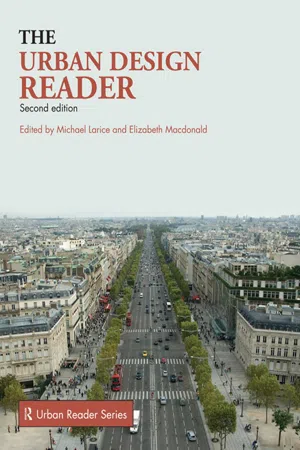 eBook - ePub
- Michael Larice, Elizabeth Macdonald, Michael Larice, Elizabeth Macdonald(Authors)
- 2013(Publication Date)
- Routledge(Publisher)
(As we shall subsequently see, this form of urbanization can occur anywhere within or adjoining a metropolitan region, without any necessary connection to the core city.) The defining attributes of sprawl addressed earlier are also common to most types of late-twentieth-century suburban development. For this reason, we can add a secondary definition of sprawl: With this definition in hand, we can now explore the meaning of another very important term_ suburbanization. The Merriam-Webster Online Dictionary defines suburbanization as “making suburban” or “giving a suburban character to.” 17 Planners have sometimes used this term to describe the spreading of suburbs or suburban patterns across a region or a nation. 18 If we take this to mean specifically late-twentieth-century suburban development, then we can make the following definition: The terms sprawl and suburbanization will be used interchangeably throughout this book. Suburbanization is the spread of suburban development patterns across a region or a nation – that is, the proliferation of sprawl forms of urbanization across a region or a nation. Sprawl (whether characterized as urban or suburban) is the typical form of most types of late-twentieth-century suburban development. What Makes Sprawl? The aforementioned definitions of sprawl and suburbanization still do not tell the whole story. While we now have an idea of what sprawl looks like and what its principal traits are, we still don’t know why it is the way it is or exactly what goes into its construction eBook - PDF
Urban Sprawl in Europe
Landscape, Land-Use Change and Policy
- Chris Couch, Gerhard Petschel-Held, Lila Leontidou, Chris Couch, Gerhard Petschel-Held, Lila Leontidou(Authors)
- 2008(Publication Date)
- Wiley-Blackwell(Publisher)
Definitions based on land use tend to associate sprawl with the spatial seg-regation of land uses, and with the extensive mono-functional use of land for single-family residential development, freestanding shopping malls and industrial or office parks. Ewing and others have devised alternative methods of defining urban sprawl based upon its impacts. Under this approach ‘poor accessibility among related land uses’ or ‘a lack of functional open space’ would be examples of the defining characteristics of urban sprawl (Ewing, 1994). Chin argues that this approach creates a temptation to label any devel-opment with negative impacts as sprawl, thus creating a tautology that is unhelpful. Many definitions use the notion of low density to identify urban sprawl, however, according to Chin, this is frequently neither quantified, nor explained, adequately (Chin, 2002, p. 5). In addition, there are defini-tions based upon example, in which ‘Los Angeles is often given a place of honour,’ and aesthetics, in which sprawl is ugly development (Galster et al. , 2001, p. 683). Introduction: Definitions, Theories and Methods of Comparative Analysis 5 Amongst the most recent definitions, Peiser (2001) proposes that: ‘the term is used variously to mean the gluttonous use of land, unin-terrupted monotonous development, leapfrog discontinuous development and inefficient use of land’. (Peiser, 2001, p. 278) In a similar vein, Squires defines sprawl as: ‘a pattern of urban and metropolitan growth that reflects low-density, automobile-dependent, exclusionary new development on the fringe of settled areas often surrounding a deteriorating city’. (Squires, 2002, p. 2) Galster et al. (2001), suggest that the term has variously been used to refer to: patterns of urban development; processes of extending the reach of urbanised areas; causes of particular practices of land use; and to the consequences of those practices (Galster et al. , 2001, p. 681). eBook - ePub
Handbook of Regional and Urban Economics
Cities and Geography
- V. Henderson, J.F. Thisse(Authors)
- 2004(Publication Date)
- North Holland(Publisher)
Appendix: Proofs of propositions References1 Introduction
In the early part of the 20th century, cities grew upward. Tenements and luxury apartment buildings replaced brownstones. Skyscrapers came to adorn urban landscapes. But at the end of the 20th century, urban growth has pushed cities further and further out. The compact urban areas of 1900 have increasingly been replaced by unending miles of malls, office parks and houses on larger and larger lots. At first, people continued to work in cities but lived in sprawling suburbs. But the jobs followed the people and now metropolitan areas are characterized by decentralized homes and decentralized jobs. In 2003 America, urban growth and sprawl are almost synonymous and edge cities have become the dominant urban form.In this essay, we review the economic literature on sprawl and urban growth, and make four points.• First, despite the pronouncements of academic theorists, dense living is not on the rebound. Sprawl is ubiquitous and expanding.• Second, while many factors may have helped the growth of sprawl, it ultimately has only one root cause: the automobile. Suburbia, edge cities and sprawl are all the natural, inexorable, result of the technological dominance of the automobile.• Third, sprawl’s negative quality of life impacts have been overstated. Effective vehicle pollution regulation has curbed emissions increases associated with increased driving. The growth of edge cities is associated with increases in most measures of quality of life.• Fourth, the problem of sprawl lies not in the people who have moved to the suburbs but rather the people who have been left behind. The exodus of jobs and people from the inner cities have created an abandoned underclass whose earnings cannot support a multi-car-based lifestyle.1.1 Plan of the paper
In Section 2 eBook - ePub
- Jean-Marc Zaninetti(Author)
- 2013(Publication Date)
- Wiley-ISTE(Publisher)
The American city has a unique geography: it is strongly influenced by cars and capitalism. To understand the geographical reality of the population of the United States, it is necessary to examine it in the context of the metropolitan area.The American metropolitan area is a city spread out like no other city in the world. Urban sprawl is an old phenomenon in the United States. It began with the arrival of mechanized transport when the first trams and railways were built, during the second half of the 19th century. Nowadays, housing is mostly individual and high density is seen as restrictive in metropolitan areas. These urban regions are also socially fragmented and polarized, with strong racial and community segregation (see Chapter 4 ). Social contrasts are often stark between one neighborhood and another, and this contributes to greater inequalities since high crime rates and low-quality education tend to coexist with poverty. Since crime and poor education services are two flaws that the middle class flee, unlimited and chaotic urban sprawl ensues. Generally, the American city is politically fragmented. Metropolitan areas usually have several suburban municipalities (incorporated areas), which compete fiercely with each other to attract high-income populations and non-polluting companies. Competition between a city’s center and its suburbs is one of the engines of urban sprawl, as well as a factor of the crisis of the American city that is emptied of its taxpayers by the flight of the white middle class towards the suburbs (white flight). This situation is not new to the United States [MAS 93]. One theory of research advocates returning to a model for a city that is closer to European ideals (Congress for New Urbanism). David Rusk recommends the annexation of suburbs as a political solution to the problem of the crisis of cities [RUS 03].American cities are also very diverse. For David Rusk, the crisis of the city is more severe in the highly fragmented metropolises of the Northeast, with their older urban policies, than in what he calls the elastic cities of the South and West which were able to continue annexing wide stretches of land, thanks to more recent urbanization. It would be misleading, however, to say that the political unification of a county is enough to solve the problems of the city. First, the scale of urban sprawl is such that metropolitan areas now spread over several counties, sometimes even several states, increasing the complexity of political fragmentation and making the establishment of true metropolitan governance unrealistic. Second, even within the framework of a unified city government, economic, social, cultural, and racial polarization exists in all US cities; therefore the problems of poverty and neighborhood isolation, poor education, access to employment, and security issues actually concern all big cities.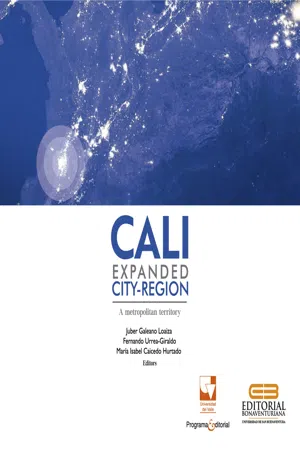 eBook - PDF
Cali, expanded city-region
A metropolitan territory
- Fernando Urrea Giraldo, Júber Galeano Loaiza, María Isabel Caicedo Hurtado(Authors)
- 2020(Publication Date)
- Programa Editorial Universidad del Valle(Publisher)
The expansion of the urban sprawl has been explained by various authors who analyze regional urban growth as a consequence of economic develop-ment (e.g., Myrdal, 1957; Hirschman, 1958; Richardson, 1975; and Garnier, 1976). These authors, as well as the analyses of ECLAC (2000), coincide in conclusions in which morphological and structural transformations of cities are related to the patterns of capitalist development that are spatially expressed by the concentration of land in the periphery and the consequent promulga-tion of intensive activities in land occupation, which slow down the develop-ment of other activities and the deconcentration of the population in the ur-ban peripheries of the municipalities adjacent to the main city. Authors such as Bordorsf and Hidalgo (2009), mention as determining factors of the spatial growth of Latin American cities the differentiated phases of development: in-ternal migration and rural exodus until 1970. In the 2000s, a contemporary city was conceived which, in response to globalization, brought about new ways of overcoming distances with transport systems and road infrastructure. As a result, “the internal disposition of agglomerations is greatly affected, a macro-segregation of the social space where thriving cities and poor cities are separated” (Borsdorf & Hidalgo, 2009). In the subregion of Northern Cauca the growth of the urban sprawl, by migratory or natural economic phenomena, is not the main driver, it is the guidelines of public policy to induce economic growth aimed at meeting the needs of a population affected by natural phenomena the main cause of the orientation and urban growth towards the area. It should also be noted that the feasibility of this public policy is given by the distance and connectivity to the main center of the region which is the main market for the products of companies located in the area subject to intervention.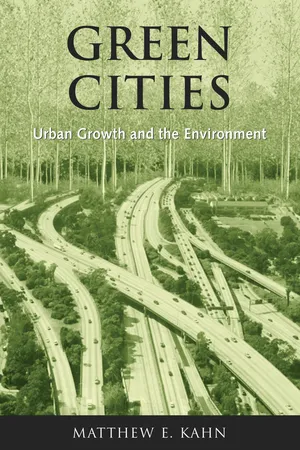 eBook - PDF
Green Cities
Urban Growth and the Environment
- Matthew E. Kahn(Author)
- 2007(Publication Date)
- Brookings Institution Press(Publisher)
Since the end of World War II, most of the growth in U.S. metropolitan areas has taken place in the suburbs. 1 In 1940, 48 percent of the U.S. population lived in a metropolitan area, and 68 per-cent of metropolitan area residents lived in center cities. By 1990 the first figure had grown to 78 percent, and the second had fallen to 40 percent. 2 In 1970 the average urbanite lived in a community with 10,452 people per square mile. By 2000 urban population density had fallen over 25 percent, with the average metropolitan area resident liv-ing at a density of 7,358 people per square mile. 3 This chapter examines the environmental costs of this trend, which has come to be labeled “urban sprawl.” Sprawl, which I define as the migration of homes and jobs to low-density areas, poses several sustain-ability challenges. It typically increases land consumption and vehicle use, which in turn increases carbon dioxide production and requires the building of new roads. In addition, sprawl increases the proportion of middle-class households that are likely to oppose policies, such as expanding mass transit, that improve urban sustainability. Instead, these voters have a strong incentive to support policies that subsidize private transportation. 7 Spatial Growth: The Environmental Cost of Sprawl in the United States chapter 110 1. Margo (1992); Mieszkowski and Mills (1993); Glaeser and Kahn (2004). 2. Altshuler and others (1999). 3. This calculation is based on all census tracts within twenty-five miles of a major central business district. Explaining Sprawl Over the last one hundred years, a variety of forces have contributed to urban sprawl. Transportation innovations have sharply reduced the total cost of commuting within metropolitan areas, as vehicles have become faster and cheaper in real terms. 4 This development has allowed workers to hold on to city center jobs while moving their families to the suburbs in search of a higher quality of life.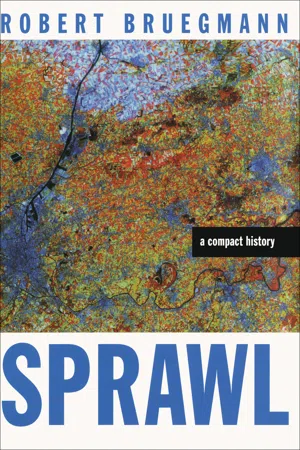 eBook - PDF
Sprawl
A Compact History
- Robert Bruegmann(Author)
- 2008(Publication Date)
- University of Chicago Press(Publisher)
61 How can the vast expansion of exurban settlement around Youngstown be considered anything other than unneces-sary and illogical? Actually it is not necessarily either. That the land is not really needed for agri-culture is evident from the way that, even with no residential expansion, farm-ers have been abandoning large tracts of cropland for decades now. Affluent residents of Youngstown who move to the exurban fringe are merely exploiting one of the most important assets available in the metropolitan area—a large supply of attractive land at low prices. Although at first glance it appears that the dispersal to the edges does little other than eviscerate the central cities and displace agriculture, in many cases, the possibility of building a house on a large tract of inexpensive land in the exurban fringe is the one thing that contin-ues to attract middle-class residents who might otherwise flee to more dynamic regions. If, as is quite likely, Youngstown’s downtown and central residential districts revive, it will not be despite sprawl but because sprawl has made it possible for the metropolitan area to retain residents during extremely difficult years. Moreover, as industry and working-class families leave the center, they relinquish space for other individuals and activities that might benefit from a location downtown. Although this possibility is probably difficult to imagine for most visitors to Youngstown today, it is likely that the process is already underway. Is this exurbia really different from suburbia or just an extension of it? Is it sprawl? It is difficult to answer these questions or even characterize land-use patterns that run so counter to our traditional categories of land use. Most people would call a subdivision of two-acre ranchettes with mowed front lawns merely an extension of the suburban fringe and an example of sprawl. eBook - ePub
When City and Country Collide
Managing Growth In The Metropolitan Fringe
- Tom Daniels(Author)
- 2013(Publication Date)
- Island Press(Publisher)
CHAPTER 7Divided We Sprawl: The Role of State and Local Governments
Township, county, and state programs need to work together to achieve a balance in planned land use to meet all goals and provide a future for the next generation. —Citizen, Cuyahoga County, Ohio Unchecked sprawl has shifted from an engine of California’s growth to a force that now threatens to inhibit growth and degrade the quality of life. —Beyond Sprawl: New Patterns of Growth to Fit the New California (1995)Suburban Sprawl fans out from every major American city, and, in most places, it will continue to eat into fringe areas. At the same time, scattered low-density residential and commercial sprawl will consume bits and pieces of the outer-fringe countryside. Sprawl does not further the national goals of racial integration, energy efficiency, affordable housing, environmental quality, or economic competitiveness. Yet the federal government has given state and local governments little direction about how to control sprawl. Instead; federal tax policies, regulations, and spending programs have been powerful contributors to sprawl.Decisions about land use are made mainly by municipal and county governments. These local governments need to understand how their comprehensive plans, property tax policies, zoning regulations, and spending programs induce sprawl. But as Henry Diamond and Patrick Noonan point out, “Many communities continue to rely on a legislative framework that was created for a very different pre—World War II America. As a result, the planning and growth management mechanisms in force in most states in the 1990s are woefully out-of-step with the times.”1 eBook - PDF
Government Intervention and Suburban Sprawl
The Case for Market Urbanism
- Michael Lewyn(Author)
- 2017(Publication Date)
- Palgrave Macmillan(Publisher)
This paper unfortunately includes no pagination. I have tried to list paper sections and table numbers, so that readers will be able to find the portions of the paper being referenced. 203 Id., Table 1. Compare supra notes 2–3 and accompanying text. 204 I must add one significant qualification to this data: I am not sure to what extent European cities have grown by annexing suburbs. Some European cities, like many American cities, may have concealed the extent of suburbanization by annexing suburbs. 2 SPRAWL AS WHERE WE GROW: OR, HOW GOVERNMENT SPREADS SUBURBIA 67 European Union had 259 kilometers of highways; in 2010, they had 67,779 kilometers. 205 During that period, these nations reduced their railway network by 72,000 kilometers. 206 And in Europe, as in the USA, highways spurred suburban growth: the Spanish study found that each highway route reduced central city population by 4 per- cent. 207 Thus, it appears that in Europe, as in the USA, highways have reduced central city populations. In sum, Europe has not sprawled in the same way and to the same extent as the USA. And where European cities have lost population, their suburbanization can be traced to pro-sprawl highway policy. 205 See Garcia-Lopez et. al., supra, at Table 3. 206 Id. (noting decline from 297,942 kilometers to 225,333). See also Michael Lewyn, Sprawl in Europe and America, 46 SAN DIEGO L. REV. 85, 102 (2009) (listing statistics for several nations) (“Sprawl Europe”). 207 See Garcia-Lopez et. al., supra, Abstract. 68 GOVERNMENT INTERVENTION AND Suburban Sprawl eBook - ePub
- Reid Ewing, Shima Hamidi(Authors)
- 2017(Publication Date)
- Routledge(Publisher)
Meanwhile, researchers continue to debate the benefits of compact development, and some have demonstrated that social capital is not diminished by Suburban Sprawl. Brueckner and Largey (2006), for example, regressed individuals’ social-interaction variables on census-tract density in a study using the Social Capital Benchmark Survey data. Their analysis showed that high density had a negative effect on all friendship and group-involvement variables.Most recently, Nguyen (2010) related our earlier county compactness/sprawl index to social-capital factors from the Social Capital Community Benchmark Survey. This study found that urban sprawl may support some types of social capital while negatively affecting the others. So the evidence on the effects of sprawl on social capital is clearly mixed, but it certainly could represent a pathway between sprawl and upward mobility.In this study we use the social capital index (SCI) from the Chetty et al. database (2014a) as the measure of social capital. It was originally measured by Rupasingha and Goetz (2008) and employed by Putnam (2007). This index is comprised of voter turnout rates, the fraction of people who return their census forms, and various measures of participation in community organizations in the area.Racial Segregation
The evidence regarding sprawl’s impact on racial segregation is mixed. Some studies point to the cost of housing/land as the primary contributors to black–white residential segregation. Kahn (2001) has shown that, controlling for household income and metropolitan patterns of racial segregation, sprawl was significant in closing the gap between black and white rates of suburban homeownership between 1980 and 1990. In other words, sprawling metropolitan areas provide greater opportunities for suburban homeownership by black households. The study also found that blacks are more likely to own larger homes in sprawling regions. This is said to be a direct result of more affordable housing in sprawling metropolitan areas.Galster and Cutsinger (2007) analyzed the relationship between land-use patterns and levels of black and white segregation in 50 U.S. metropolitan areas. They found a direct correlation between sprawl and desegregation. They surmised that “the dominant relationship observed is that, on several measures, more sprawl-like land use patterns are associated with less segregation” (Galster and Cutsinger 2007). They identified the land/housing price effect as the dominant mechanism through which land-use patterns influence black and white segregation measures.
Index pages curate the most relevant extracts from our library of academic textbooks. They’ve been created using an in-house natural language model (NLM), each adding context and meaning to key research topics.

