Geography

Salford Quays
Salford Quays is a waterfront area in Salford, Greater Manchester, England. It was once a bustling dockyard but has been transformed into a modern cultural and residential hub. The area is known for its iconic architecture, including The Lowry arts complex and the Imperial War Museum North, and is a popular destination for leisure, culture, and business.
Written by Perlego with AI-assistance
Related key terms
1 of 5

3 Key excerpts on "Salford Quays"
 eBook - ePub
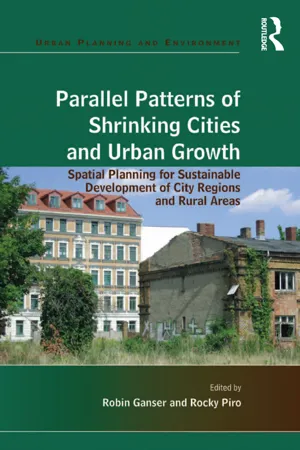
Parallel Patterns of Shrinking Cities and Urban Growth
Spatial Planning for Sustainable Development of City Regions and Rural Areas
- Rocky Piro, Robin Ganser(Authors)
- 2016(Publication Date)
- Routledge(Publisher)
The relationships between private investors’ interventions and public control have been a way to combine public interests with economic viability of developments. Urban regeneration, therefore, theoretically, needs to combine collective needs with private interests. New paradigms have consolidated their importance in every typology of urban design in the last decades and are almost consensual, such as the need for diversity in use, sustainability, accessibility and the importance of connections with public transport. However, some are controversial and reflect how much society is dependent on the market and on consumerist behaviours, in such a way that it has been seen as almost unconceivable that new urban regeneration projects escape from the need to create large areas for retail and from increasing property speculation. Public life has been linked so tightly to consumption that this new scenario of economic crisis might also establish new perspectives towards the production of urban space.In the following sections, the history behind the creation of Gunwharf Quays is discussed, along with the questions of (1) how it can be analysed within the premises discussed above, and (2) how it avoided further decline to become a thriving development. Within this framework, key arguments, such as how this project attempted to respond to the context of the site, city and region as part of its strategy to enhance local cultural and socio-economic aspects, are of special interest. Moreover, it is fundamental to look at the discourses on sustainability that informed this development.From HMS Vernon to Gunwharf Quays
In the past few decades, regions and cities across Europe have had to redefine their identities by reinventing major areas within them to attract investment and be competitive internationally. This was also the case of Portsmouth, one of the major ports on the south coast of United Kingdom. Originally a Roman port, where goods entered the island of Great Britain, Portsmouth has grown due to its location on a natural harbour, and is still one of the important strategic ports of the United Kingdom and home for Naval ship building. Its population peak occured in the 1930s, when the city population reached 26,000. Between 1931 and 1981 there was a decline in population in each consecutive census. The 1980s and 1990s saw some fluctuations in the population of the city, which reached 188,000 by the end of the millennium. (Portsmouth City Council 2011a; Portsmouth City Council 2011b). eBook - ePub
Tourism and Urban Regeneration
Processes Compressed in Time and Space
- Alberto Amore(Author)
- 2019(Publication Date)
- Routledge(Publisher)
fait accompli on the regeneration of the waterfront (Doorne, 1998b).Arguably, the delivery of the urban entrepreneurial vision for leisure and tourism is likely to be unopposed in derelict areas home to abandoned factories and brownfields. This was the case of the Royal Albert Docks in Liverpool, United Kingdom, which had been left vacant for nearly 60 years before being incorporated as part of the Merseyside Development Corporation regeneration agenda (Spirou, 2010). As Selby (2004, p. 18) explains, rebranding Liverpool through the regeneration of the Docks was a priority “to develop a distinctive and positive brand image, emphasizing a high quality of life for both residents and visitors.” Other former industrial cities in the United Kingdom embarked on a similar urban entrepreneurial agenda for tourism and leisure (Bramwell & Rawding, 1996; Law, 1992, 2000). The quayside regeneration in Newcastle and Gateshead, in particular, was successful in enhancing a sense of identity among residents, “as the developments appear to be reinforcing a certain sense of pre-existing local pride” (Bailey et al., 2004, p. 59). That being said, there are critics who argue about the risks related to the commercialization of the past and nostalgia business (Mellor, 1991; Park, 2013).Urban spaces are expressions of the “highly political view of planning and planners” (Allmendinger, 2009, p. 148), the fragmented nature of institutional networks with respect to tourism development (Hall & Jenkins, 1995), the centrality of governance (Amore & Hall, 2016a; Dredge & Jenkins, 2007) and the importance of multi-scalar relationships between the public and the private stakeholders (Hall, 2008b). The governance in urban regeneration and tourism is “intimately involved with relations of power and the exercise of power” (Fischer & Forester, 1993, p. 7), which frames the relations between stakeholders, decision making processes, structure and the hegemonic contemporary urban discourse. Lukes (2005) provides a rather useful framework to illustrate the intricate concept of power, place, identity and site contestation in urban regeneration and tourism. His notion of power as a multi-dimensional construct acknowledges the relevance of over, cover and hegemonic forms of power and provides a valid analysis of the political dimensions of tourism and urban regeneration (Amore, 2017; Doorne, 1998b; Hall & Jenkins, 1995).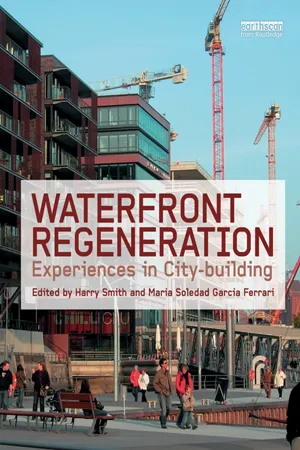 eBook - ePub
Waterfront Regeneration
Experiences in City-building
- Harry Smith, Maria Soledad Garcia Ferrari(Authors)
- 2012(Publication Date)
- Routledge(Publisher)
Fundamentally, these dynamics of place competition show the need for generating highly competitive environments that aim to express innovation and technological progress in order to attract global capital. Waterfronts are, in this context, considered as opportunities for the city as a whole. The restructuring of these areas becomes the expression of present and future aims, and at the same time they are reconnections between the past of the city and its future through present actions (Marshall, 2001). The redevelopment of these areas generally expresses physical signs of a wealthy industrial past, the social and economic structures of which no longer exist – the physical structures often existing but no longer used. Simultaneously, these places express the emerging connections between the city and its water edge, which are conditioned by the needs and possibilities of contemporary economic and social activities. The competitive advantage of these areas and their potential to attract wealth is a key issue and needs to be expressed in the project of regeneration. Obsolete harbours are, in general, highly visible areas of the city and their redevelopment not only affects the recovered area, but most significantly can influence the image of the city as a totality by expressing new city aspirations and identities (Marshall, 2001).Globalization and waterfrontsReturning to the first wave of globalization and focusing on the case of Europe, which was at the centre of the first two waves of ‘Northern’ globalization, de Vries (1984) found that the major contributors to urban growth during the 1500 to 1800 period were capital cities, port cities and cities which were both. Growth was more continuous in capital cities than in port cities, however, with the fortunes of the latter depending more on changes in world trade patterns and geopolitics. In broad terms, there was a shift in relative levels of activity from Southern to Northern Europe, and from the Mediterranean Sea to the Atlantic Ocean. Waterfronts were the focal points of social and economic life for the urban areas which grew up around them and were often also fully integrated within the urban fabric (a paradigmatic example being Amsterdam) – though in some cases this urban fabric was that of a town which was separate from the main city that later absorbed it (as, for example, in Edinburgh or Valencia).
Index pages curate the most relevant extracts from our library of academic textbooks. They’ve been created using an in-house natural language model (NLM), each adding context and meaning to key research topics.

