History

Anti-Imperialist League
The Anti-Imperialist League was a political organization in the United States that opposed the expansion of American influence and control overseas, particularly in the Philippines, Cuba, and Puerto Rico. Formed in 1898, the league advocated for non-interventionism and the preservation of democratic principles. Its members included prominent figures such as Mark Twain, Andrew Carnegie, and William James.
Written by Perlego with AI-assistance
Related key terms
1 of 5

6 Key excerpts on "Anti-Imperialist League"
 eBook - PDF
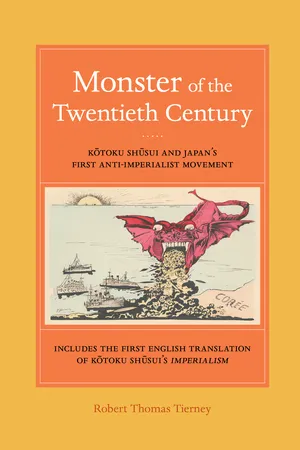
Monster of the Twentieth Century
Kotoku Shusui and Japan's First Anti-Imperialist Movement
- Robert Thomas Tierney(Author)
- 2015(Publication Date)
- University of California Press(Publisher)
ANTI-IMPERIALISM IN A GLOBAL FRAME Unlike the “scramble for Africa” that began in the 1880s, the turn of the twentieth century imperialism triggered global movements of resistance by intellectuals. Anti-imperialists in Europe and the United States included many representatives of elite groups skeptical about the merits of imperialism. Thanks to their endeav-ors, the nominal “imperialist” survives today almost exclusively as a pejorative term. 32 Tierney: Kōtoku Shūsui and Anti-Imperialist Thought In the Shadow of Revolution 33 Anti-imperialists were a heterogeneous coalition. In the United States, the American Anti-Imperialist League included Samuel Gompers, a prominent labor leader, but also Andrew Carnegie, members of the business elite, clergymen, the writer Mark Twain, and the president of Harvard University. These men opposed the American annexation of the Philippines and Hawaii on the grounds that impe-rialism violated the fundamental principle of republican government: that it should derive from “the consent of the governed.” 59 The group appealed to owners of small businesses and professionals and most of its leaders were from New England. To be sure, the league failed to build a broad-based coalition or move-ment, or block the Senate approval of the Treaty of Paris that made the United States a sprawling empire. In addition, support for anti-imperialism plummeted after the movement backed William Jennings Bryan as the Democratic candidate in the 1900 presidential election. Gompers and Carnegie both left the U.S. Anti-Imperial League by 1900, while those remaining turned to the less popular stance of supporting the independence struggle in the Philippines. In the early decades of the twentieth century, imperialism became a popular cause in the United States after the election of Theodore Roosevelt. 60 In general, the same can be said of anti-imperialist movements in England and the European continent. eBook - PDF
Financial Missionaries to the World
The Politics and Culture of Dollar Diplomacy, 1900-1930
- Emily S. Rosenberg, Gilbert M. Joseph(Authors)
- 2004(Publication Date)
- Duke University Press Books(Publisher)
Although the anti-imperialist voices of the 1920s never came together in one political organization, the movement drew support from acade-mia, the popular press, specific reform organizations, labor locals, and a strong congressional group of insurgents. Ideologically diverse groups worked for the Progressive party candidacy of LaFollette for president in 1924, for legislation that would prevent dollar diplomacy-style loan con-tracts and bar the government from acting as a debt collector, and on behalf of fact-finding missions and public symposia. Anti-imperialists in both the United States and in borrowing countries began to forge a transnational cultural movement that challenged claims about mutual benefit and progress with a narrative about exploitation and destruction. Opposition to Financial Imperialism, 1919–1926 149 They insisted that the greatest threats to peace and justice were the powerful large banks that made loans abroad and would ultimately press the U.S. government to support their debt collections. Historians have tended to label people active in the anti-imperialist movement of the mid-1920s as “isolationist,” a term usually counter-posed to the more positive “internationalist.” Yet this isolationist-inter-nationalist dichotomy looks backward from the era of World War II and presents a misleading context for the 1920s. 85 It was not isolationism that shaped critiques of U.S. foreign policy during the 1920s so much as anti-imperialism, that is, opposition to dollar diplomacy and to banker-government cooperation in foreign policy. During the 1930s, anti-impe-rialists themselves would split between being isolationist and being in-ternationalist; people with views as diverse as Nearing, Balch, Barnes, Inman, and Shipstead can look like unlikely allies from the standpoint of the isolationist-internationalist debates of the World War II era. eBook - PDF
The Tricontinental Revolution
Third World Radicalism and the Cold War
- R. Joseph Parrott, Mark Atwood Lawrence(Authors)
- 2022(Publication Date)
- Cambridge University Press(Publisher)
The Wilsonian Moment proved fleeting, but non-leftist radicals adopted the language of nationalism to demand clean breaks from European control. Specific visions linking cultural renewal with independ- ent nations motivated some of the most successful interwar movements. 59 See Michele Louro et al., “The League Against Imperialism: Lives and Afterlives,” in Louro et al., The League Against Imperialism. 60 Minkah Makalani – after Mignolo – argues this “heretical intellectualism” emerged from the inability of Eurocentric, modernist Marxism to fully conceptualize the Southern experience of empire. Makalani, In the Cause of Freedom: Radical Black Internationalism, 1917–1939 (Chapel Hill: University of North Carolina Press, 2011), 8; Walter D. Mignolo, “Delinking: The Rhetoric of Modernity, the Logic of Coloniality and the Grammar of De-coloniality,” Cultural Studies 21:2–3 (2007), 483–484. 61 Oleksa Drachewych and Ian McKay, “Left Transnationalism?” in Drachewych and McKay, eds., Left Transnationalism: The Communist International and the National, Colonial, and Racial Questions (Montreal: McGill-Queen’s University Press, 2020), 32. 62 See Michele Louro, “An Anti-Imperialist Echo in India” and Dónal Hassett, “An Independent Path: Algerian Nationalists and the League Against Imperialism,” in Louro et al., The League Against Imperialism. 28 R. Joseph Parrott Perhaps most famously Gandhi’s vision for India set out in Hind Swaraj rejected foreign rule, Western civilization, and aspects of modernization in ways that contrasted with pre-war Pan-Asian movements and frustrated allies like Nehru. In the Middle East, suspicion of secularism meant local and Pan-Arab nationalists radicalized the anti-imperial movement in Syria and Egypt. Even the Baath Party, which cohered around Paris-trained radicals, adopted a specifically Arabic view of socialism that did not seriously incorporate Marxist elements until the Tricontinental era.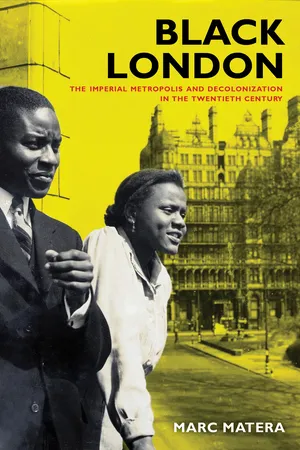 eBook - PDF
Black London
The Imperial Metropolis and Decolonization in the Twentieth Century
- Marc Matera(Author)
- 2015(Publication Date)
- University of California Press(Publisher)
In practice, socialists, communists, League of Nations Union members, and antislavery and other human-rights activists frequently worked together on particular causes, from the Scottsboro petition movement to aiding Spanish republi-cans and refugees. During the final years of the decade, however, the issue of appeasement undermined this incipient unity, often making for odd bedfel-lows. Debates over international organization and appeasement were also about imperialism and the structure and goals of the British Empire. The notion of an egalitarian British Commonwealth of Nations gradually sup-planted the old “language of empire,” particularly in socialist and antifascist circles. The colonial secretary and former Labour Party member Malcolm 76 • Bl ack I n t er nat iona lism a n d E m pi r e MacDonald told colonial administrators at the 1938 summer school at Oxford: “The trend is towards the ultimate establishment of the various colonial communities as self-supporting and self-reliant members of a great commonwealth of free peoples and nations.” A term used originally to dis-tinguish between the self-governing white dominions and colonial depend-encies with large non-European majorities, in its new guise, the Commonwealth reflected a new imagining of the British Empire as a family consisting of “trustees” and “wards” but devoid of the explicit racial chauvin-ism of Victorian and Edwardian imperialism. 32 While a small minority opposed internationalism to empire, many others, including British socialists and proponents of the new Commonwealth ideal, advocated the internationalization of colonial administration or interimperi-alism to ease competition for resources and territory between the major pow-ers. eBook - ePub
Activism across Borders since 1870
Causes, Campaigns and Conflicts in and beyond Europe
- Daniel Laqua(Author)
- 2023(Publication Date)
- Bloomsbury Academic(Publisher)
Especially after the Six-Day War of 1967, some solidarity activists viewed the Palestinian case as an anti-imperial struggle, in some cases supporting the armed resistance of the Palestinian Liberation Organization and other militant groups. 209 In Europe itself, some forms of left-wing solidarity with Irish nationalism in Northern Ireland could also be cast in such terms. This discourse is illustrated by the claims of a British Maoist faction that cast Northern Ireland in terms of an ‘imperialist struggle’, arguing that Ireland’s partition had been carried out ‘to leave the south as a desolate backwater – an agricultural hinterland with little industry of its own, and a prey to neo-colonialist plunder’. 210 While coming from a small, marginal group, it illustrated a wider phenomenon: as the historian Stephen Howe has argued, during the Troubles, ‘the discourse of anticolonialism became truly widespread in, and in relation to, Ireland’ and Frantz Fanon became ‘an increasingly ubiquitous father-figure for analyses of an Irish “colonial situation”’. 211 Thus, the language of anti-imperialism could be applied to a range of different settings and scenarios. Combating neo-colonial relations in a postcolonial world Anti-imperialism did not depend on formal colonial rule or even military action: it could also involve a critique of economic forms of domination. A variety of activists denounced European and North American practices as ‘neo-colonialist’ or ‘neo-imperialist’. 212 In some ways, empire continued to be a frame for activists even in the 1990s and 2000s eBook - PDF
Portrait of a Patriot
Selected Writings
- Mohammad Hatta(Author)
- 2019(Publication Date)
- De Gruyter Mouton(Publisher)
The fact that people are busy working in this direction can be seen everywhere. Nationally and internationally The Congress in Brussels in the light of world history 199 people are setting about building and extending the organization. Thus people came spontaneously upon the idea of shaping a broader organization, from which would flow the world unity of oppressed peoples and races. The setting up of the League against Imperial-ism, against Colonial Oppression and for National Independence, on the 15th February 1927 in Brussels, fits very well into this. Since this League includes within it at the same time both Western workers' organizations and fighters against imperialism, thus fight-ers of all shades, it is of great importance, very briefly, to take ac-count of the awakening and the increasing consciousness of the proletariat and of the emergence of other anti-imperialist movements in the West. Recht en Vrijheid, Year 1, nos 16, 18 and 20, 1928. 1. As regards the stillborn Geneva Protocol of 1924 we will simply keep silent. It only demonstrates the inability of the League of Nations to give any guarantee of the maintenance of the world peace, so earnestly longed for by humanity. 2. Some light is shed on this for us by the article by L., a competent English author, in Foreign Affairs, January 1927, entitled: 'Downing Street and Arab Potentates'. C.f. Nieuwe Rotterdamsche Courant, morning paper of 17 March 1927: 'Arabie*. 3. Toybee and Kirkwood, Turkey, page 100. 4. Glair Price, The Rebirth of Turkey, page 188. 5. René Grousset, The Awakening of Asia, page 36. io A retrospective account of the Second Congress of the League against Imperialism and for National Independence held in Frankfurt It is difficult to give a full account of the second Congress of the League, which took place from the 20th-27th July this year in Frankfurt, in the limited space available in our magazine.
Index pages curate the most relevant extracts from our library of academic textbooks. They’ve been created using an in-house natural language model (NLM), each adding context and meaning to key research topics.

