History

Assembly of Notables
The Assembly of Notables was a gathering of high-ranking nobles and clergy in France, convened by the king to seek their advice and consent on important matters. These assemblies were used during the Ancien Régime to address financial and political issues, and they played a role in the lead-up to the French Revolution.
Written by Perlego with AI-assistance
Related key terms
1 of 5
5 Key excerpts on "Assembly of Notables"
 eBook - PDF
The Notables and the Nation
The Political Schooling of the French, 1787–1788
- Vivian R. Gruder(Author)
- 2008(Publication Date)
- Harvard University Press(Publisher)
The experience of the Notables indicates important changes in attitude among these members of the elite during the last years of the ancien régime. Nostalgia and traditionalism, personal or corporate interests, and localism had not disappeared and were voiced in the debates, but old outlooks were being recast. Loyalty to the sovereign informed their public acts and state-ments, yet thoughts and sentiments harbored privately, even silently, were loosening their allegiance to the existing system of monarchy. Ambitions that they had for themselves and shared with their corporate groups and re-gions they came to associate with the larger body of the nation. New ideas and strategies connected aspirations of groups and local areas to broader vi-sions of provincial and national government, joining self-interest in a web of common, national interests. 49 The convening of the Assembly of Notables helped to accelerate change and sharpen attitudes. From February to May 1787, the Notables gave form under the pressure of their work to a collective consciousness which, until then, they and contemporaries had not been fully aware of, but which now gained resonance in the public. The unity the Notables achieved against the Crown and around a common program astounded some members and on-lookers. “[A]ll the Notables from the dukes and peers to the mayors were in the most perfect unison.” recorded Coeurderoy in his diary. “[The bureaux] have been in close agreement without any communication; it is the most ex-traordinary thing,” commented another Notable, Gérard, the municipal representative of Strasbourg and former ambassador to the new United States. The unity and energy the Notables displayed impressed the Parisian bookseller Hardy, as he noted in a journal entry of March 5.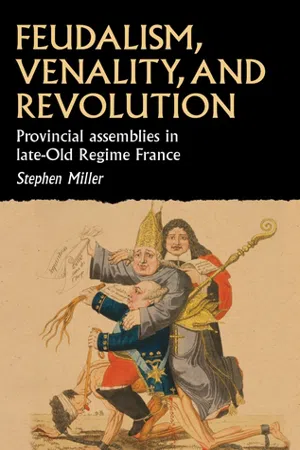 eBook - ePub
Feudalism, venality, and revolution
Provincial assemblies in late-Old Regime France
- Stephen Miller, William G. Naphy, Joseph Bergin, William G. Naphy, Joseph Bergin(Authors)
- 2020(Publication Date)
- Manchester University Press(Publisher)
56The royal court and status issues in the provincial assembliesMembers of the king’s court and councils, who represented royal power in these terms, helped put powerful lords and clergymen in control of the provincial assemblies. Of course, as we have seen, the monarchy also comprised defenders of an administrative monarchy interested in using the provincial assemblies to impose taxes on the privileged orders. At the beginning of 1787, the Assembly of Notables sparked a national movement against these ministers’ heavy-handed refusal to share power. Members of the Assembly such as Loménie de Brienne, the archbishop of Toulouse, asked the crown to loosen the intendants’ grip on the provinces and grant the assemblies autonomous responsibilities.57 The bureau of the comte d’Artois, one of seven into which the Notables were divided, each under the presidency of a member of the royal family, protested that the rules for the assemblies, especially the intendants’ right to evaluate their spending, made it impossible for them to play a constructive role in government.58Several months later, the bishop of Nancy, president of the Assembly of Lorraine, stated that the rights of the assemblies ought to go beyond the arbitration of disputes to encompass binding resolutions not amenable to overruling by the royal council. The duc de Praslin (president of the Assembly of Anjou), the vicomte de Beaune (president of the Assembly of Auvergne), the Assemblies of Dauphiné, Champagne, and Alsace, the nobility of Bordeaux, and the cour des aides of Paris all protested against the subordination of the assemblies to the intendants.59 No longer available |Learn more
- Jeremy D. Popkin(Author)
- 2019(Publication Date)
- Routledge(Publisher)
Subsequent scholars have questioned the reality of this “feudal reaction.” Nobles continued to look out for their economic interests, as they always had, but there is little evidence that this process had become more intense just before 1789 or that most nobles thought their position was in danger. The judges of the parlements and other aristocrats who challenged royal authority during the prerevolution were reacting primarily to a political threat. Like the royal ministers whom they opposed, they recognized the need for reforms. But they argued that the discredited absolutist system could not be trusted to remake itself. They opposed measures that they feared would increase ministerial power and insisted that the French “nation” be consulted about fundamental changes in its constitution. And they saw themselves as the natural spokesmen for the rest of the population.The Assembly of Notables
By convening an assembly of carefully chosen noblemen, clergy, and high officials to examine his reform proposals, Calonne believed that he could enlist the force of public opinion in favor of his proposals. He wanted a new land tax that would be paid by all property owners—nobles, clergy, and commoners—and the establishment of representative assemblies in all of France’s provinces. He also called for all peasant villages to have elected councils, thus affecting the lives of the overwhelming majority of the population. The land tax implied the abolition of privileges that had set the nobles and clergy apart from the rest of the population; the provincial assemblies undermined the fundamental principle of absolutism that authority should flow from the top down. Calonne promised that his proposals would benefit all classes of the population and told the Notables, “Surely no selfish interest will oppose the general interest.” But the 142 delegates who arrived in Versailles in February 1787 reacted to Calonne’s projects with suspicion. Since taking office in 1783, Calonne had borrowed and spent freely, insisting that royal finances were healthy. Now he had suddenly reversed course, announcing that the treasury was empty and asking for new taxes. Few of the Notables were prepared to believe his claims without verification. Before they endorsed proposals that would overturn long-standing traditions and weaken their special privileges, they demanded a precise accounting of government revenue and expenditures.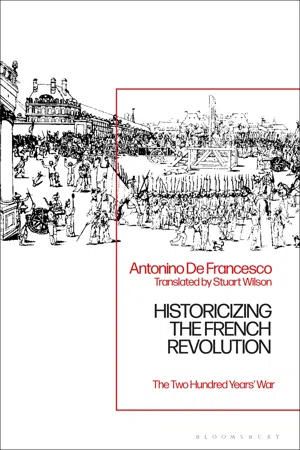 eBook - PDF
Historicizing the French Revolution
The Two Hundred Years’ War
- Antonino De Francesco(Author)
- 2022(Publication Date)
- Bloomsbury Academic(Publisher)
Convening the Assembly of Notables, he had revealed to the eyes of the people what should never be shown to them, the lack of wisdom, even more than the lack of money. The nation could not find a single statesman in this assembly; and the government lost our confidence forever. This is what will happen every time that the ministers consult the people. 18 In this controversy, which indicated the unpreparedness of the ancien régime ’s ruling class as the real reason for the disaster, a new counter-revolutionary generation joined the fray. Their position was different compared to that of the original wave of monarchists: while they maintained the precondition regarding the sacredness of the 18 Historicizing the French Revolution monarchy, they also believed that the Estates General had been an unavoidable step to escape from the crisis into which Court policy itself had plunged the entire nation. These were opinions that Rivarol was sustaining from the columns of his Journal politique-national , which appeared on the very eve of the taking of the Bastille and lasted until November 1790. Despite his profound knowledge of Montesquieu and Rousseau, he launched an attack on the philosophers, holding them responsible for the overthrow of the natural order of things. He denounced the elimination of the founding values of society and repeatedly demonized the revolutionaries’ rejection of the civilizing heritage of previous centuries. However, these were considerations that he developed gradually, only after seeing the failure of the attempts to make 1789 an opportunity for the monarchy’s revival. The reactionary shift occurred with the taking of the Bastille, to become fully formed in September, when the Constituent Assembly rejected the proposal of a parliamentary monarchy along English lines. eBook - ePub
- Pamela Pilbeam(Author)
- 2012(Publication Date)
- Routledge(Publisher)
Not only did they refuse to rubber-stamp his policies, but they even began to question his integrity, comparing the massive deficit of 1787 with the surplus reported by Necker in his compte rendu of 1781. Calonne replied with a direct appeal to the people in the form of the avertissement read from the pulpits in April, accusing the notables of defending their own selfish interests. It was a last desperate gamble and it failed; on 8 April 1787 he was dismissed. His replacement was one of his chief critics, Lomenie de Brienne, a worldly archbishop strongly suspected of atheism. Brienne was as skilled in intrigue as he was ill-versed in finance, and Louis was obliged to correct his minister’s sums before a new fiscal package could be presented to the notables. With extra taxation the only realistic option available, Brienne could only add a new gloss to Calonne’s original programme. Not that it mattered. The Assembly proved no more amenable than before, and on 25 May it was dismissed. The crown was now forced to employ its traditional strategy of registration in the Parlement of Paris. Since 1756, it had been common practice to impose unpopular taxation at a lit de justice, where the king presided in person. After the ceremony, the parlementaires would protest about the insult to the fundamental laws of the kingdom and arbitrary government, while the crown collected its taxes. By summoning an Assembly of Notables, the king had refused to play by these old rules, and in July and August 1787 the Parlement did the same. Not only did it declare the forced registration of Brienne’s edicts to be illegal, but it also echoed the notables by calling for the convocation of the Estates General. The ancient representative body of the nation had last met in 1614, but according to the government’s critics it was the only body qualified to grant new taxation
Index pages curate the most relevant extracts from our library of academic textbooks. They’ve been created using an in-house natural language model (NLM), each adding context and meaning to key research topics.

