History

Baltic Sea
The Baltic Sea is a brackish water body in Northern Europe, bordered by nine countries. It has been a significant trade route and has played a crucial role in the history of the region, particularly during the medieval and early modern periods. The sea has also been a site of military and political conflicts, shaping the history of the surrounding nations.
Written by Perlego with AI-assistance
Related key terms
1 of 5
11 Key excerpts on "Baltic Sea"
 eBook - ePub
Post-Cold War Identity Politics
Northern and Baltic Experiences
- Marko Lehti, David J Smith, Marko Lehti, David J Smith(Authors)
- 2004(Publication Date)
- Routledge(Publisher)
12 However, it is also important to recognize that there are obviously disputes about the relevance of historical experience for today’s politics. In this regard, one might polemically state that the Hansa seems to be a good experience, whereas the Baltic states’ fear of Russia is seen as one that should be excluded.The theoretical solution would be to offer a comprehensive historical perspective on the Baltic Sea region. On the level of historiography, however, we are still not very far out of the starting blocks in this respect.13 My remarks here must hence remain rather tentative.THE Baltic Sea AREA AS A HISTORICAL REGION
If we proceed from the assumption that history may indeed contribute to region-building in the area, as Marko Lehti argues, we first need to discuss which historical facts and structures constitute the Baltic Sea Area as a historical region.14 Today, all historians of the Baltic Sea region refer with good reason to Fernand Braudel’s notion of the Mediterranean World, which first appeared in print in 1949.15 However, a lively debate on the Baltic Sea Area as a historical region had already emerged during the first half of the twentieth century. Whilst German historians of the time referred primarily to the role of the Hansa in shaping a German sea, Polish historians looked for elements of a sea culture dating back to the pre-Hanseatic era.16 There was also an early attempt to cultivate international co-operation in Baltic Sea historiography, and this was fostered by the past policies of the authoritarian Ulmanis regime in Latvia.17 After the Second World War this discussion was continued by Polish and German historians, whereas in Scandinavia debate clearly focused on Norden.18 All of these discussions were, of course, shaped to a large extent by political interests. Nevertheless, we can derive from them a debate about the historical constituents of the Baltic Sea region. Further attempts to discern a Baltic World— inspired by Braudel—have been made by Matti Männikkö and Klaus Zernack since the 1970s and, subsequently, by David Kirby, Matti Klinge and Stefan Troebst.19 These authors all agree that the region constitutes a historical unit, but differ with regard to periodization. German discussion of the region has been heavily influenced by the work of Zernack, who developed the concept of ‘Northeastern Europe’ as a synonym for a Baltic Sea Area that explicitly includes Russia. This marked a clear departure from earlier German historiography, which had sought to exclude Russia.20 Stefan Troebst has recently enlarged this concept to include the Barents Sea region, thereby underlining the importance of cohabitation with Russia in the Northern Calotte (Nordkalotte) in particular.21 Ralph Tuchtenhagen, on the other hand, has presented a narrower understanding, defining north-eastern Europe as a border zone between Scandinavia, Russia and the Baltic states (excluding Lithuania). Although he does not draw any explicit parallel, Tuchtenhagen’s depiction of the region thus appears closer to more limited conceptions such as Baltoscandia.22 eBook - ePub
Between the Seas
Island Identities in the Baltic and Mediterranean Seas
- Deborah Paci(Author)
- 2023(Publication Date)
- Bloomsbury Academic(Publisher)
The Mediterranean and the Mediterranean World in the Age of Philip II ([1949] 2008) given that the discourse on the ‘Mediterranean of the North’ seeks to dismantle stereotyped images like those suggesting that the history of the Baltic region was shaped by wars and that this maritime basin was for many years an arena of confrontation and rivalries for power. The expression ‘Mediterranean of the North’ acts as a narrative device whose purpose is to fully evoke the metaphor of peace, prosperity and cooperation. This political brand alludes to the ancient vocation of the region as a communication route between all of the countries bordering the Baltic (Grzechnik 2012: 334). As the Latvian diplomat and journalist Alfrēds Bīlmanis wrote in 1945, ‘the Baltic Sea has a certain analogy with the Mediterranean: it separates and at the same time it unites the riparian Baltic countries – Germany, Denmark, Sweden, Finland, Russia, Estonia, Latvia, Lithuania, and Poland – just as the Mediterranean separates and unites the continents of Europe, Africa, and Asia Minor (3–4)’.There is a strand of the historiography of the Baltic area, whose main exponents are Matti Klinge (1994) and David Kirby (1995), which claims that the ‘Baltic World’ constitutes a shared cultural sphere comparable with Braudel’s Mediterranean. The books of both scholars carry a title inspired by Braudel. While Braudel’s structuralist approach assigned the Mediterranean the function of living entity, the aforementioned historiography was convinced of the idea that the sea was an integrative factor for the states and societies around its shores. From this perspective, the Cold War represented an exception within an age-old integration process. Very different arguments were put forward by Bo Stråth (2000: 199–214), who warned the community of historians away from a kind of environmental determinism, that is, an approach implying a unitary vision of the history of the Baltic world, reminding them to bear in mind the heritage of disintegration and the continuous conflict around the Baltic rim (Stöcker 2018: 3).Braudel’s longue durée, in a perspective of cooperation, legitimized the vision of a united Baltic Sea region. 1991 saw the institution of the inter-parliamentary Baltic Sea Parliamentary Conference (BSPC), a forum for political dialogue between parliamentarians from the Baltic Sea region. It was given the role of promoter of transnational democracy. In 1992, the former President of the Nordic Council, Ilkka Souminem, declared at the Second Parliamentary Conference on Co-operation in the Baltic Sea Area that No longer available |Learn more
- Linda Kaljundi, Tuomas Lehtonen, Tuomas Lehtonen, Linda Kaljundi(Authors)
- 2016(Publication Date)
- Amsterdam University Press(Publisher)
While many Baltic Sea coastal waterways are treacherous because of shoals and reefs, they are also sheltered from storms and of fer good harbours, especially for smaller and shallower vessels. As direct traf f ic and moving bulk cargoes are much easier over the sea than over land, the Baltic Sea region has been a highway of maritime trade at least since the Viking era – and even more so during the high and late Middle Ages and during the Hanseatic domination, with traf f ic and urbanization increasing as the region was ever more tightly tied to the north European and emerging At-lantic markets. In general, trade within the Baltic Sea region was marked by the exchange of northern and eastern raw and agricultural products (furs, skins, metals, fish, butter, wax, hemp) for southern and western ref ined products of manufacture (textiles, tools, beverages). Notable exceptions to this pattern are the import of salt from the west to the salt-poor Baltic Sea region, and the export of Baltic and Polish grain to heavily urbanized Dutch and Flanders – and because of the harsh northern ecology, even to Sweden and Finland. 4 As will be shown in this chapter, the movement of goods involved con-stant traf f ic of people – notably skippers and ship crews – over established routes between regions and port towns. Furthermore, trade involved a still larger number of sedentary merchants who communicated with their 4 Dollinger, Die Hanse , pp. 17-22, 49-56, 278-80, 401-2. 72 ILKKA LESKELä colleagues through written or oral messages carried by the skippers. Such trade and communication even involved priests, some of whom were skippers themselves. In addition, and especially over narrow waterways, migration of merchants, artisans, and even servants took place, not to mention the enlistment of mercenaries and Teutonic knights. Such traf f ic and communication fostered a dif fusion of ideas in the Baltic Sea region. eBook - ePub
Europe's Changing Geography
The Impact of Inter-regional Networks
- Nicola Bellini, Ulrich Hilpert(Authors)
- 2013(Publication Date)
- Routledge(Publisher)
Part IIIEurope's new regionalization
The integration of regional activities through macro-regions
 Passage contains an image
3
The Baltic Sea region
Who cooperates with whom, and why?Carsten SchymikDefinitions of the Baltic Sea region
There are many seas that surround Europe but there is only one sea that is completely surrounded by Europe – the Baltic Sea. The Baltic Sea Region (BSR) unites nine riparian states: the Nordic states of Denmark, Sweden and Finland, the Baltic republics of Estonia, Latvia and Lithuania, as well as Poland, Germany, and Russia that extends to the Baltic Sea at two different points: the greater St. Petersburg area in the mouth of the Gulf of Finland, and the Kaliningrad district in the south-eastern corner of the Baltic Sea proper. The ‘Baltic Sea’ region should not be confused with the ‘Baltic’ region, even though both terms are often used synonymously. However, in this chapter the term ‘Baltic’ will only be used to designate the combined territories of the three Baltic states of Estonia, Latvia and Lithuania at the eastern rim of the Baltic Sea, whereas the term ‘Baltic Sea region’ exceeds the Baltic lands to include the entire area around the Baltic Sea.It is impossible to exactly determine the boundaries of the BSR because the region is a social construct. However, it is possible to distinguish between at least four different concepts or definitions of the BSR.The Baltic Sea as a maritime area, defined by geography and culture
The geographical centre of the BSR is the sea in its middle. Fifteen million people live within a radius of 10 kilometres along the Baltic coastline, and 29 million within a radius of 50 kilometres. This minimalist conception is hardly mentioned in the political and academic discourse of the BSR. However, it is important to mention because it reveals an essentialist core that is present in all of the more prominent, and constructivist, definitions of the region. It is also fair to claim that the BSR basically represents a maritime culture in the sense that peoples’ livelihoods around the sea have essentially been determined by the sea and its resources, i.e. by maritime trade and war, peculiar climate and natural conditions, shipping, fisheries, tourism etc. eBook - ePub
The Geopolitics of Region Building in the Black Sea
A Critical Examination
- Yannis Tsantoulis(Author)
- 2020(Publication Date)
- Routledge(Publisher)
utter diversity … a mosaic in terms of cultural and societal aspects, and not least economic structures” (2004, 3) or, as Westin (1993) observes, it is at a sort of crossroads of Christianity and a miniature “Tower of Babel” characterised by different cultures and languages, albeit a region that does serve as the meeting place of different societies with different needs. Romano Prodi said in one of his speeches in 2002 that the Baltic Sea is “given different names depending upon the shores it washed up against” and Tassinari pointed out that “the very term Baltic Sea translates as “Eastern Sea” in the Scandinavian languages, German, and Finnish, and as “Western Sea” (Läänemeri) in Estonian” (2004, 140). It would not be an exaggeration to argue that the idea of a “Baltic Sea Region” meant different things in different contexts and to different people. A clear and undisputed definition of “northernness” or of a Baltic Sea region simply did not and does not exist. To use a provocative statement by Jasper von Altenbockum (quoted in Albert, 2000, 11):There is nothing, which doesn’t exist at the Baltic. A politician would however struggle if asked: is there a Baltic? Because he would have to say: Oh yes, there are Baltic programs, Baltic concepts, Baltic sub-regions, Baltic councils and Baltic conferences. [As] said: there is nothing which doesn’t exist at the Baltic Sea. Something for everyone and nothing for all.At the same time, however, according to Etzioni, “[t]here is no region in Europe and few exist in the world where culture, tradition, language, ethnic origin, political structure, and religion – all ‘background’ and identitive elements – are as similar as they are in the Nordic region” (1965, 220–221). In some cases, geography was included as a uniting element. As cited in Neumann’s article (1994, 168):The close ties between the peoples [of the Baltic Sea region] are bound by the social standards, temperaments and social characteristics which in the last instance stem from the living conditions of the North: The landscape, the climate, the maritime environment and the settlement patterns. We have a stable temperament, we are not gregarious, rather a bit inaccessible, yet reliable. Our sense of social justice is well advanced … The common background of the Northern European countries covers a broad spectrum and has deep roots.
- Singh, M P(Authors)
- 2021(Publication Date)
- Daya Publishing House(Publisher)
Baltic Sea Region The Baltic states–including Estonia, Latvia, and Lithuania–occupy a strategic location as transit centers for Russia’s northern oil exports. In addition, Belarus is a major transit center for Russian natural gas exports to Europe. General Background Alone among the former Soviet republics, the Baltic Sea region states of Estonia, Latvia, and Lithuania were quick to adopt market economies and to implement democratic reforms. As a result, they largely have avoided the economic and political crises that have beset other regions in transition from a centrally planned economy, including the Balkan region and southeastern Europe. Privatization in the Baltics is nearly complete, and in 2001, despite the downturn in the global economy, the three countries posted an average 6.3 per cent increase in their real gross domestic product (GDP). Table 11.1: Economic and Demographic Indicators for Selected Baltic Sea Region Countries Country Gross Domestic Product (Nominal GDP), 2001E (Billions of U.S. $ Market Exchange Rate) Real GDP Growth Rate, 2001 Estimate Real GDP Growth Rate, 2002 Projection Per Capita GDP, 2001E (Market Exchange Rate) Population 2002E (Millions) Estonia $5.4 5.4% 5.3% $4,000 1.4 Latvia $7.5 7.6% 4.8% $3,190 2.3 Lithuania $12.0 5.9% 5.9% $3,444 3.5 Subtotal/weighted average $24.9 6.3% 5.4% $3,458 7.2 Belarus $12.2 4.1% 4.6% $1,228 9.9 Total/weighted average $37.1 5.6% 5.2% $2,170 17.1 This ebook is exclusively for this university only. Cannot be resold/distributed. With a combined population of only 7.2 million people, Estonia, Latvia, and Lithuania have achieved greater presence in the international community by joining forces in a number of political and economic arenas. In November 2002, Estonia, Latvia, and Lithuania received invitations to join the North Atlantic Treaty Organization (NATO) in 2004. eBook - PDF
European Regions and Boundaries
A Conceptual History
- Diana Mishkova, Balázs Trencsényi, Diana Mishkova, Balázs Trencsényi(Authors)
- 2017(Publication Date)
- Berghahn Books(Publisher)
The varia-tions of Balticum became adopted as the name of this sea in English, Romance languages, Slavic languages, and also Baltic languages (Latvian and Lithua-nian). A number of European nations, however, use a name that refers to the relative geographical location of the sea. For Germans ( Ostsee, but historically also Baltisches Meer ), Dutch ( Oostzee ), Swedes ( Östersjön ), Danes ( Østersøen ), Norwegians ( Østersjøen ), and Icelanders ( Eystrasalt ), it is naturally “the East-ern Sea,” but curiously also the Finns, who live on its eastern coast, have 58 Pärtel Piirimäe translated the Swedish term ( Itämeri ). The Estonian Läänemeri (the West Sea), on the other hand, refers to its correct relative geographical location. 1 On the eastern shores of the sea, a relatively coherent political entity has ex-isted since the fourteenth century, when the king of Denmark sold his posses-sions in Northern Estonia to the Livonian branch of the Teutonic Order. The Order was the leading player in the confederation of small states that formed the Livonian confederation known as Livland. 2 The word “Baltic,” however, was not applied to any land area before the nineteenth century. The common identity of Livland was largely lost when the confederation collapsed in the Livonian wars (1558–83) and its territories were split up between Sweden, Poland, and Denmark. These partitions formed the seeds for the provincial division between Estland and Livland that was essentially preserved until the establishment of Estonian and Latvian ethnic provinces after the February Revolution of 1917. In 1561, the Swedes acquired the Teutonic Order’s pos-sessions in current Northern Estonia, which formed the bulk of the province of Estland. The dynastic union state of Poland-Lithuania acquired the terri-tories in current Southern Estonia and Northern Latvia, which formed the province of Livland. eBook - ePub
- Harald Baldersheim, Krister Ståhlberg(Authors)
- 2019(Publication Date)
- Routledge(Publisher)
This period, stretching from the middle of the 16th century to the beginning of the 18th century, partly coincided in time with that of the Hanseatic League. In fact, Sweden took over the dominance of the Baltic Sea, dominium maris Baltici, from the Hansards and when order was based on military, mainly naval, strength. The Swedes exercised their power over the Baltic Sea Region through various measures, one being toll payments for merchants passing the numerous river mouths in the region. Other areas round the Baltic Sea, such as Finland, Estonia and parts of present-day Latvia, were also Swedish provinces. The Swedish power was later crushed by the Russians who did not, however, achieve ascendancy over the Baltic Sea. The Swedish power relied on the dominance of one country and is, therefore, an unlikely model for the future (Dellenbrant, 1988). During the inter-war period 1918-39 the contacts between the countries around the Baltic Sea increased. The recently independent states of Estonia, Latvia and Lithuania became new actors in the region. The connections between Sweden and Finland on the one hand, and Estonia and Latvia on the other, increased. However, the contacts were never very intense. The Nordic countries directed their commerce towards Western Europe. In 1934, only 0.2 per cent of the total value of Estonian imports came from Sweden. The corresponding figure for Finland was 0.7 per cent and the percentages for Latvia and Lithuania were even lower. Estonian exports to Sweden contributed to 0.2 per cent of the total value of exports and those to Finland to 0.5 per cent. The figures for Latvia and Lithuania were even lower. The major trading partners for the Baltic countries seem to have been Germany, Great Britain and the United States (Baltic Statistical Yearbook, 1936: 66 ff.). Further, the exchanges between the three Baltic states also appear to have been surprisingly scarce eBook - ePub
Coastal Waters of the World
Trends, Threats, and Strategies
- Don Hinrichsen(Author)
- 2013(Publication Date)
- Island Press(Publisher)
CHAPTER 4The Baltic and North Seas
In Dire StraitsThe Baltic and North seas are among the most overexploited and polluted seas on earth. Both are fringed by dense human populations crowded along highly industrialized coastlines. As of 1997, some 240 million people lived in their combined catchment areas. Demographic projections indicate that over the next thirty years northern Europe’s coastal zones will continue to harbor most of its population and industry (seetable 4.1 ).This entire region has been a center for trade and industry since the early Middle Ages, when the Hanseatic League stitched together a loose-knit federation of independent trading cities stretching from the British Isles in the West to Russia’s Novgorod in the East. At the height of its influence, in the fourteenth century, the league incorporated two hundred mercantile cities.Despite the proliferation of heavy industries along the Baltic and North seas in the nineteenth and early twentieth centuries—particularly iron and steel mills, metal smelters, chemical plants and refineries, pulp and paper mills, cement factories, and big engineering firms—the water quality in the seas did not begin to deteriorate dramatically until Europe’s postwar economy accelerated into high gear after the formation of the European Common Market in 1958. At the same time, eastern Europe was being fitted with an “iron corset” of heavy, polluting industries stretching in a wide arc from the Baltic port city of Rostock (in former East Germany) through Gdansk, Poland, and the Baltic states to Leningrad (now St. Petersburg) in the former Soviet Union. Rapid industrialization and the continued concentration of economic activities in coastal areas resulted in tremendous pressures on coastal resources (seefigure 4.1 ).The Baltic
Upwards of 88 million people live in the Baltic’s catchment area, which covers more than 1.3 million square kilometers in northern Europe (see figure 4.2 ). The sea is surrounded by nine highly industrialized countries: Sweden, Finland, Russia, Estonia, Latvia, Lithuania, Poland, Germany, and Denmark (Helsinki Commission 1993). eBook - PDF
Borders in the Baltic Sea Region
Suturing the Ruptures
- Andrey Makarychev, Alexandra Yatsyk, Andrey Makarychev, Alexandra Yatsyk(Authors)
- 2016(Publication Date)
- Palgrave Macmillan(Publisher)
1 © The Author(s) 2017 A. Makarychev, A. Yatsyk (eds.), Borders in the Baltic Sea Region, DOI 10.1057/978-1-352-00014-6_1 CHAPTER 1 Introduction: The Baltic Sea Region—Scars, Seams and Stitches Andrey Makarychev and Klaus Segbers A. Makarychev () • K. Segbers Free University Berlin, Berlin, Germany This book is a result of a networked project designed and implemented by the Centre for East European Studies at the Free University in Berlin and the Johan Skytte Institute of Political Science at the University of Tartu. The research agenda that gave a start to this book in 2014 focused on a variety of bordering and de-bordering practices unfolding in the Baltic Sea Region (BSR), an area that is usually considered to be the most successful example of region-building in a wider Europe. In the literature, the BSR is often referred to as a model for other regions-in-the-making, located at the intersection of the EU and Russia, and a possible source of spill-over effects and sharing of best practices with other regions constituting the EU–Russia common neighbourhood. The contributions to this volume stem from the general assumption that the BSR represents a socially constructed interface where not only the West and the East meet but also where Nordic Europe interlaces with continental Europe. The region develops under the strong influence of major international actors, the EU and NATO, who play crucial roles in shaping security practices and the institutional contours of the region. It is not incidental that quite a number of border-crossing initiatives (the Northern Dimension, the German–Polish–Russian “trialogue”, the Nord Stream and the Eastern Partnership) in one way or another have their “Baltic roots”. Apparently, the BSR possesses a meaningful experience of conflict mediation, prevention and resolution, and its different actors utilize and take advantage of socialization mechanisms engrained in the Baltic Sea regional project.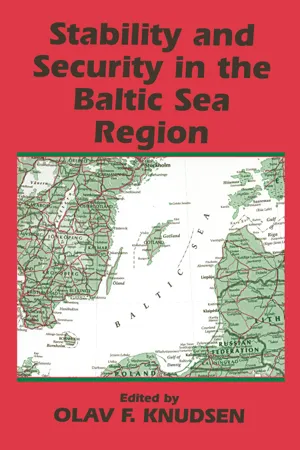 eBook - ePub
Stability and Security in the Baltic Sea Region
Russian, Nordic and European Aspects
- Olav Fagelund Knudsen(Author)
- 2013(Publication Date)
- Routledge(Publisher)
So, the question is: How did the Ponto-Baltic Conflict System evolve, and how did it maintain its stability through such diverse historical conditions? Without a doubt, the role of geographical factors was really important. The southern coast of the Baltic Sea is a typical Scandinavian landscape; starting from the middle of the first millennium AD this territory came under the ethnic and cultural influence of Scandinavia. Vast plains of what later became Central Russia were progressively settled by Eastern Slavs strongly influenced by Byzantium. The Western Slavs of what would become Poland and the Czech lands, and the Magyars inhabiting the Danube plains were under the influence of Western Europe, whereas the steppes to the north of the Black Sea were in the hands of the Islamized nomads, and later of the Ottoman Empire.At first glance, the Ponto-Baltic zone clearly formed a border between religions and civilizations. But to mention this is definitely not enough to explain the conflict system's functioning. There are numerous examples of inter-civilizational borders which did not actually give rise to permanent conflict systems. For example, the coexistence of Islamic and Hindu civilizations in India was relatively peaceful for centuries.Conflict systems are born, I suggest, through specific combinations of different factors, and such a combination did exist in the Ponto-Baltic area. The civilizational factor was complemented and reinforced by the economic one, namely, the existence of such things as the trade route connecting Scandinavia and Byzantium (in Russia it was called ‘the way from the Varangians to the Greeks’). Considerable amounts of money and goods circulated along the route (virtually coinciding with the line of inter-civilizational cleavage) as early as the tenth to eleventh centuries AD. The Middle Ages witnessed a struggle for the possession of key points along this route; later on, with the rise of the Russian state, the control over trade with remote parts of Russia also became of great importance. For anyone who strove to exert such control, the Black Sea and Baltic coasts were crucial strategic areas. It is from this point of view that the foreign policy programmes of Russian tsars were formulated, from Ivan IV to Nicholas II (from the Livonian War to the aspiration to take control of the Bosporus during the First World War).
Index pages curate the most relevant extracts from our library of academic textbooks. They’ve been created using an in-house natural language model (NLM), each adding context and meaning to key research topics.

