History

Galen
Galen was a prominent Greek physician, surgeon, and philosopher in the Roman Empire during the 2nd century AD. He made significant contributions to the fields of anatomy, physiology, and medicine, and his writings greatly influenced medical practice for centuries. Galen's work emphasized the importance of empirical observation and experimentation, and his theories and teachings had a lasting impact on the development of Western medicine.
Written by Perlego with AI-assistance
Related key terms
1 of 5


8 Key excerpts on "Galen"
 eBook - ePub
Physicians, Plagues and Progress
The History of Western medicine from Antiquity to Antibiotics
- Allan Chapman(Author)
- 2016(Publication Date)
- Lion Books(Publisher)
As a doctor who also considered himself to be a philosopher, therefore, Galen would have seen medicine and surgery within a context of responsible behaviour and a duty of care towards one’s patients. This duty of care would not only be displayed in a technical operative capability, but it would also be rooted within a wider context of wise understanding with relation to the nature of things and to eternal truths. His time at the Pergamum arena would have given Galen an excellent grounding for what would become one of the most illustrious medical careers in antiquity, as well as for a writer whose works would constitute the canon of anatomy and physiology both in Europe and in the Arab world for the next 1,400 years. But what were Galen’s enduring contributions to medical knowledge and understanding?GALEN THE ANATOMIST AND PHYSIOLOGISTAs we have seen above, Galen had what in his time was already a 500-year-old tradition of rational Greek medicine to draw upon, and especially research methods pioneered by Herophilus and Erasistratus and their followers in his own alma mater of Alexandria. As his career progressed, from Pergamum on to fame in Rome, culminating in his appointment as physician to Emperors Marcus Aurelius, Commodus, and Septimius Severus after AD 168, Galen not only researched assiduously but wrote prolifically. He supplies us with by far the largest corpus of anatomical and to some degree physiological literature to survive from antiquity. For while Aristotle’s writings were probably bigger in bulk, he wrote on a vast range of topics, and his medical works were but part of a larger output, Galen’s surviving works – around 122 in all – are much more focused upon anatomy, physiology, surgery, and medical autobiography.His anatomical writings would provide benchmarks of excellence for centuries to come. His writings were so precise and elegant that until the development of new experimental techniques in the sixteenth and seventeenth centuries, they were not easy to contradict. We must not berate the centuries falling between AD 200 and 1500 for being slavishly uncritical in their continuing use of Galen’s works, for inevitable errors apart, they were so very good. His skill as a descriptive and taxonomic anatomist becomes even more breath-taking when one remembers that Galen possessed few research aids beyond a sharp scalpel, a sharp pair of eyes, and probably a photographic memory when it came to recalling and recording detail. So what did he say?Fundamental to Galen’s medical writings, as we have seen, was a fascination with the architecture eBook - ePub
An Introduction to the History of Medicine
From the Time of the Pharaohs to the End of the XVIIIth Century
- Charles Greene Cumston(Author)
- 2018(Publication Date)
- Routledge(Publisher)
CHAPTER XIGalen
Galen flourished from A .D . 130 to A .D . 200, and with him Hippocratic medicine was restored; nay, he even made it shine as it never had before. Nevertheless, it must be admitted that through him medicine acquired a new dress rather than was enriched, and the dogmas of Hippocrates really lost force and purity in the hands of Galen, although assuming a more attractive and perhaps a more systematic character.Claudius Galenus, the most illustrious of ancient physicians after Hippocrates, was the son of Nicon, a celebrated architect, as well as a learned and very rich man. Galen was physician, surgeon and pharmacist, since in his book on antidotes he tells us that he had a shop for the sale of drugs (officina) situated on the Via Sacra. This shop was burnt in the reign of the Emperor Commodus, in that great conflagration which reduced the Temple of Peace and several other buildings to ashes.Brought up and educated by his father, Galen developed a pronounced inclination for science, a great love for study, and a profound respect for the great masters, especially for Aristotle. He first gave himself up to the study of the sciences, the cultivation of letters, mathematics, and philosophy and, when in a position to appreciate and judge the teachings of the various sects, adopted the severe principles of Zeno and the Stoics, and the philosophy of Aristotle. It was then that his taste for medicine showed itself, and his one idea was to become a physician. To this end he visited the schools of Greece and Egypt, so as to study science at its source. He stayed at Alexandria, which was then the sanctuary of the sciences and the meeting-place of all learned men. He studied and commented on all the writers and, when he had formed a doctrine of his own based upon theirs, feeling that he was worthy to practise medicine successfully, returned to Pergamus, his native city, where he practised for about two years. Then a very terrible revolution occurred, and he withdrew to Rome, where celebrity and fortune as well as discouragements and injustice awaited him.
- George Sarton(Author)
- 2016(Publication Date)
The latter was at first predominant, while the Latin tradition remained for a few centuries purely oral. In the fifth century, Galen was translated into Latin by Cassius Felix (V-l), even as Soranos was translated by Caelius Aurelianus (V-l). That Latin tradition remained secondary for centuries, and we may say that Galen's fame was built almost exclusively on a Greek foundation. His abundant writings were copied by Greek scribes and then elaborated and commented upon by the early Byzantine physicians, especially the four great ones who flourished from the fourth to the seventh century (we shall get better acquainted with them pres-ently). The Greek world accepted without restriction Galen's authority, and the Galenic writings became its medical bible. Under the pressure of nationalism and of religion, the Greek writings were translated into Syriac by Sergios of Resaina (VI-1) and later into Arabic. In both cases the early translators were unorthodox Christians; a few, Monophysites 18 LECTURE I: MEDICINE like Sergios; most of them, Nestorians. 48 A large number of translators were engaged in the task of decanting Greek experience and wisdom into Arabic vessels. It must suffice to name one, one of the greatest scientific dragomans of all ages, Hunain ibn Ishäq (IX-2), who flourished in Jundlshäpür, then in Baghdad. The whole Galenic corpus was translated by him, or older translations were revised under his direction. We know exactly what he did because he compiled in 856 a list of 129 Galenic treatises known to him, indicating for each item the Syriac and Arabic translations, saying who made or revised each and criticizing briefly their accuracy. That list is one of the most impressive documents of medieval learning. 49 Thanks to Hunain and his school the whole Galenic corpus was available in Arabic before the end of the ninth century.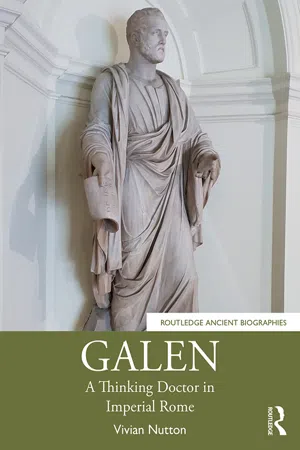 eBook - ePub
Galen
A Thinking Doctor in Imperial Rome
- Vivian Nutton(Author)
- 2020(Publication Date)
- Routledge(Publisher)
2 Galen the RomanMedicine in Rome
Why Galen decided to leave Pergamum and make his way to Rome is a matter for speculation, but for a man of such talent and ambition, as well as independent means, it was hardly surprising. Rome was now a bi-lingual city where, in Galen’s own words, the population of a single block far outstripped that of any town where Hippocrates had lived.1 The “epitome of the whole world”, a description borrowed by Galen from a famous sophist from Asia Minor, had long attracted immigrants from all over the Greek world, from millionaires and regional dynasts eager to make their mark in the politics of empire to humble tradesmen and those who simply sought a better life than that of an Anatolian peasant.2 Those who offered healing had been prominent among them for centuries, for it was no wonder that in such a mega-city illness should be common. Pliny the Elder, writing around 70 CE, had begun the section on medicine in his Natural History with a celebrated polemic against the “filthy Greeks” who had introduced the practice of medicine into Rome, undermining Roman self-reliance and contributing to the debilitating growth of luxury. He drew on many lurid examples of greedy and lascivious Greek doctors who cheated their patients and even got away with murder, citing Cato the Elder’s warning to his son two hundred and fifty years earlier against putting his faith in doctors like this. Pliny’s splendid rhetoric replicated in prose many of the jibes directed against doctors by composers of epigrams in both Greek and Latin, several of them written and circulating in Rome.3 eBook - PDF
Patients and Practitioners
Lay Perceptions of Medicine in Pre-industrial Society
- Roy Porter(Author)
- 2003(Publication Date)
- Cambridge University Press(Publisher)
47 L. Edelstein, Ancient Medicine (Baltimore, 1967), pp. 65—86. 38 Vivian Nutton much a meeting-place for gossip as a medical sanctuary; 48 and his theoretical principles, as well as many of his techniques, were familiar to many of the community in which he served. Medicine, in short, formed part of general culture, and doctors showed little reluctance to recommend their subject as a worthwhile intellectual pursuit for young and old alike. The idea of medicine as a holy art, whose secrets were to be kept within a close circle, was far from being shared by all physicians. The boundary between the self-acknowledged doctor and the educated layman was very narrow. The distance that separated a Galen from a Cornelius Celsus or a Seneca is far less than that between a modern cardiologist and the average G.P. There were, of course, good and bad physicians. The ancient sources catalogue with relish the crimes of quacks, charlatans, magi and incompetent healers of every description; sex, alcohol and bungled operations figure as much in them as in the News of the World. Galen's view of his competitors is so lurid that one is surprised to find any member of the Roman aristocracy living to middle age, let alone surviving treatment by hands other than Galen's. But such stories are universal, and can tell us little about attitudes towards medicine and medical men. Nor should we be surprised to find great divergencies of income and status between practitioners. A doctor to the emperor is clearly a cut above an ex-slave doctor at Assisi, even though he too might be wealthy; and the social situation of a doctor from a family long resident in a town in Asia Minor is different from that of a Greek immigrant to Italy.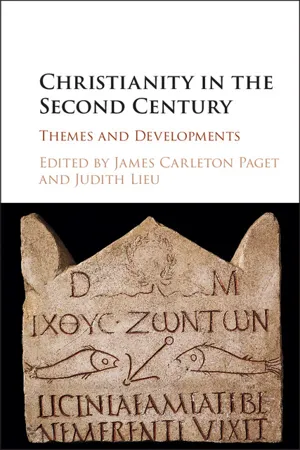 eBook - PDF
Christianity in the Second Century
Themes and Developments
- James Carleton Paget, Judith Lieu(Authors)
- 2017(Publication Date)
- Cambridge University Press(Publisher)
part iii Interpreting Texts and Engaging in Practice chapter 10 Galen and the Christians Texts and Authority in the Second Century AD Rebecca Flemming Galen of Pergamum, the great physician and medical system builder of the Roman Empire, produced some of the most authoritative texts of the second century AD. Whether the assessment is made on the basis of claim or reception, rhetoric or in fl uence, Galen ’ s oeuvre scores impress-ively highly. He is also one of the few external witnesses to the presence of Christian groups, and to Christianity ’ s intellectual presence, in the wider cultural landscape of late second-century Rome. His remarks on the subject are, admittedly, few and slight, but their casualness has its virtues, and scholars have been increasingly drawn to the Galenic perspec-tive on a range of contemporary developments, including the rise of the early Christian movement. 1 His comments openly engage with issues of authority within this movement and, less directly, with texts. Any sense of Christianity as, essentially, a religion of the book is absent, but teaching is involved, and doctrine ( doxa ), both of which must come from somewhere. On one occasion Galen refers to the ‘ school ’ ( diatribê ) of Moses and Christ, which might well suggest the characteristic combination of texts and authority, within a recognisable social form, all points which have been illuminatingly scrutinised in recent scholarship. 2 The approach taken here is a slightly di ff erent one. The focus will be more on the second-century setting and on Galen. eBook - ePub
Medieval Textual Cultures
Agents of Transmission, Translation and Transformation
- Faith Wallis, Robert Wisnovsky(Authors)
- 2016(Publication Date)
- De Gruyter(Publisher)
In this paper, I have attempted to raise some issues relating to the way Galenism gained dominance. I have suggested that Galenism triumphed because a particular group of doctors (out of several) managed to fix the knowledge of Galenic texts as the fundamental criterion for admission to their ranks, and, therefore, a prerequisite for access to the court. This triumph was not an inevitable outcome, since Galenism had rivals; however, these rivals were (one way or another) eliminated.This paper also demonstrates several problems pertaining to the prevailing narrative relating to the reception of the Galenic medical system. I have shown that the reception of Galenism was not an inevitable process; in fact, it was a slow process that took place over a long period of time, and, at any given moment, could have taken a different path. Nor can the transmission of medical knowledge be separated from other aspects of the time: the Nestorians’ struggle for recognition as a valuable part of Islamic society, the sudden turn away from Buddhist knowledge, and the consolidation of cultural categories for what constitutes illness, health, and man’s obligation with regard to his body. Political aspects proved important as well. The foundation of hospitals illustrates a conception that rulers were, in a way, obligated to their subjects’ health – should this obligation be considered religious or political?All of these aspects, and many others, are intertwined with one another, and reflect a cultural context which needs to be unearthed and studied from a new perspective; mainly, that Galenism was something people fought over – it was not given for free. The process that allowed for the dominance of Galenism reflects other social, political, and religious developments, and should be studied in their light.BibliographyN. Abbott, Two Queens of Baghdad: Mother and Wife of H ā r ū n al-Rash ī d , London: Al Saqi, 1986.K. Abbou Hershkovits, Medical Services and Abbasid Ladies, Hawwa 12/1, 2014, pp. 121–136.I. Andorlini, Teaching Medicine in Late Antiquity: Texts and Contexts, in Patrizia Lendinara, Loredana Lazzari, and M.A. D’Aronco, eds., Form and Content of Instruction in Anglo-Saxon England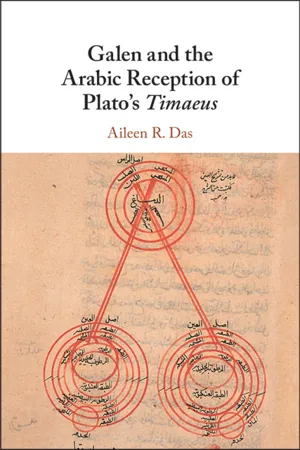
- Aileen R. Das(Author)
- 2020(Publication Date)
- Cambridge University Press(Publisher)
Galen contests the exclusivity of philosophy’s authority on the Timaeus – and the domains of knowledge that the dialogue encompasses in its cosmic account – to enhance med- icine’s epistemic standing. As I proposed in the Introduction, Galen’s polemic with philosophy may be motivated by an anxiety about medicine’s credibility in Roman society. Although Galen’s blanket characterization of Roman doctors as cheats and butchers in On Recognizing the Best Physician serves his rhetoric of exceptionalism, the tract’s complaint about these individuals’ inadequate educations reflects the reality that most practitioners could not afford the lengthy training extolled in Lib.Ord.Prop. and Opt.Med. 51 Galen is by no means the first well-educated and well-to-do doctor in Rome or the wider Graeco-Roman world, but, despite his elite prede- cessors’ efforts to increase medicine’s prestige by distancing their practice from that of their sub-elite peers (for example, slaves, freed- and free- persons, and women), the discipline still occupied an inferior status in 49 Larrain (1992), 9–11. Unaware of the reference in al-Bīrūnī, Schröder (1934: 34) placed the beginning of Plat.Tim. somewhere between Ti. 41d4 and 42e5. 50 See, e.g., Sem. 2.1.45–2.24 and Hipp.Elem. 3.2.1–22. 51 On the social status of doctors in the Graeco-Roman world, see Pleket (1995) and p. 8 above. For Galen’s criticism of the proliferation of medical specialists in Rome and other large cities, see Chapter 2 (pp. 77–80.). Galen and the ‘Medical’ Timaeus 41 relation to philosophy. 52 Whereas medicine continued to have commercial associations in Rome, the preoccupation of the emperor Marcus Aurelius and other figures at the highest social levels with philosophy certainly contributed to its eminence during Galen’s lifetime.
Index pages curate the most relevant extracts from our library of academic textbooks. They’ve been created using an in-house natural language model (NLM), each adding context and meaning to key research topics.

