History

Hippocrates
Hippocrates, often referred to as the "Father of Medicine," was an ancient Greek physician who revolutionized the field of medicine. He is best known for establishing medicine as a science based on observation and empirical evidence, rather than superstition and religious beliefs. His ethical code, the Hippocratic Oath, continues to influence medical practice and ethics to this day.
Written by Perlego with AI-assistance
Related key terms
1 of 5
12 Key excerpts on "Hippocrates"
 eBook - PDF
The Snake in the Clinic
Psychotherapy's Role in Medicine and Healing
- Guy Dargert(Author)
- 2018(Publication Date)
- Routledge(Publisher)
49 CHAPTER FOUR The origins of Western medicine Clinical: adj. 3. scientifically detached; strictly objective. — Makins , 1979, p. 304 L et us now look at the roots of Western medicine. This takes us back to a time when the line between what we now regard as the realm of psychotherapy and that of medicine was less clearly drawn. We discover a very different approach to health which was based on a different way of experiencing the world. We also discover something of great insight and value that has been lost to the practice of modern mainstream medicine Hippocrates Western scientific medicine traces its origins to Hippocrates. Some call him the “father” of modern medicine. He lived some two and a half thousand years ago on the island of Kos in Greece and is referred to in the writings of Plato. Hippocrates is credited with initiating an ethical and rational style of medicine which believed that “health and illness follow a pattern which can be understood through careful observation” 50 THE SNAKE IN THE CLINIC (King, 2001, p. 17). Hippocratic medicine is rational, logical, and considered. The writings of Hippocrates and his followers include theory and observation of specific diseases and detailed case notes of treatments. The writings stress that “nothing is random” and they urge the doctor to “overlook nothing”. They emphasise that nature itself is the ultimate healer; “Nature is the physician in disease.” The continu-ing influence of Hippocrates is recognised today by those medics who choose to take the Hippocratic Oath. The oath invokes and swears by the old Greek gods with particular reference to Asklepios, the Greek god of healing (Hart, 2000, p. 222). Without contradiction the objective, observant, and rational Hippo-crates also considered himself to be, in a spiritual sense, a “son of the god Asklepios” or Asklepiad. If we regard Hippocrates as the “father” of our modern medicine, then it follows in this metaphorical sense that Asklepios is the “grandfather”. No longer available |Learn more
Germ Theory
Medical Pioneers in Infectious Diseases
- Robert P. Gaynes(Author)
- 2020(Publication Date)
- ASM Press(Publisher)
11 2 Hippocrates, the Father of Modern Medicine The history of infectious disease and the practices that attempted to treat them is largely a history of medicine itself. So, we must begin with the foundation of Western medicine. Physicians command a high esteem compared with those engaged in nearly any other occu- pation around the world. This distinguished societal view of physi- cians originated in ancient Greece 2,500 years ago, when the medical profession assumed a new and distinctive character. To understand this transformation, consider how illness was treated before the time of Hippocrates and his colleagues. Medicine before Hippocrates In the centuries before Hippocrates (circa 460 to 370 BCE [Fig. 1]), ancient Greeks believed that divine interventions were required for curing illness. This belief was perhaps understandable when one considers how rapidly certain illnesses can afflict someone. Infec- tions can have the swiftest onset of all disease entities—one moment someone is healthy, and the next moment, he or she is seriously ill. I have had patients describe the precise moment, down to the hour and minute, when symptoms of one of the most common bacterial causes of pneumonia, pneumococcal pneumonia, began. It is un- derstandable that humans would have turned to a higher power to 12 Germ Theory: Medical Pioneers in Infectious Diseases explain this rapid, otherwise inexplicable event. Around 800 BCE, temples/hospitals sprang up throughout the ancient Greek world. These shrines were called asclepiea, after Asclepius, Greek god of medicine. The origins of the principles behind the asclepiea and the practices found inside these temples are murky. If you were ill dur- ing that time, you would go to the temple/hospital to ask a priest/ physician what you might do to effect a cure. eBook - ePub
- Julian Sheather, Matthew Taylor(Authors)
- 2019(Publication Date)
- Thames and Hudson Ltd(Publisher)
1. The Development of Medicine For most of its history, Western medicine has been almost entirely useless – its cures and remedies, cuppings and bleedings, and simples and poultices ineffective or positively hazardous.Hippocrates is the undisputed father of Western medicine, and the Hippocratic oath may be the best-known medical text in the West. Allegedly, it is still sworn on graduation at some medical schools, although presumably adapted: in some translations, it contains an injunction to refrain from seducing slaves in the houses of the sick.Hippocrates (c . 460– c . 375 BCE) Undoubtedly the father of Western medicine, he practised on the island of Cos, off what is now the Turkish coast. Although it is uncertain whether he wrote all the works ascribed to him, the collection known as the Corpus Hippocraticum was enormously influential in the West for nearly two millennia.A This 11th-century English miniature depicts an operation to remove haemorrhoids (right). A patient with gout is treated with cutting and burning of the feet (left).B Although often dramatic, many early medical interventions were almost entirely useless, such as this cupping therapy seen in Ophthalmodouleia by Georg Bartisch (1583).C A medical staple for centuries, bloodletting was eventually shown to be ineffective. From Li Livres dou Santé by Aldobrandino of Siena (late 13th century).Medicine, from its Hippocratic roots until the mid-19th century, was little more than a way to distract the patient while waiting to see if they recovered. According to French philosopher Voltaire (1694–1778), doctors ‘were men who put drugs of which they know little, to cure diseases of which they know less, into bodies of which they know nothing at all’. Some of this changed, and dramatically, from the mid-19th century onwards. But not all of it. As the great medical historian Roy Porter (1946–2002) wrote: ‘The prominence of medicine has lain only in small measure in its ability to make the sick well. This was always true, and remains so today.’ eBook - PDF
Rhetoric and Kairos
Essays in History, Theory, and Praxis
- Phillip Sipiora, James S. Baumlin, Phillip Sipiora, James S. Baumlin(Authors)
- 2012(Publication Date)
- SUNY Press(Publisher)
Hippocrates, Kairos, and Writing in the Sciences catherine r. eskin It could be argued that, of the various meanings of kairos, the interpretation given to it by Hippocrates (460 – 357 b.c.) has exerted the most lasting influ- ence in the field of discourse theory and practice. Two of the three major theoretical treatises by Hippocrates on the nature of medical science and methodology include in the first sentence kairos as a main term. Yet even in those texts which lack a literal use of kairos, timing and time-related issues are prevalent. Kairos represents a significant aspect of Hippocrates’ core the- ories of observational methodology and the term is used in the representa- tion and presentation of significant findings. Although Hippocrates is generally accepted as the father of medicine, few have recognized, or even realized, the extent to which he is responsible for the discourse of science more generally (and some might even claim, of history as well). Perhaps the reason for this oversight is the lack of agreement about the connection between the historical figure of Hippocrates and what is generally called the “Corpus Hippocraticum.” There is no doubt that an historical physi- cian named Hippocrates existed, but the ability of scholars to prove (or dis- prove) his authorship of certain medical texts throws his reliability into doubt (Levine, 19; Prioreschi, 231). For this reason, when I refer to “Hippocrates,” I am not referring to the doctor born on Cos in 460 b.c., but rather to the Hip- pocratic Collection gathered c.300 b.c. by the Alexandrian Medical School. These texts are what has come to represent for us the notion of Hippocrates and Hippocratic medicine. Beyond the issues of textual assignation, however, are the very innovative ideas which Hippocrates left for posterity. eBook - ePub
- David Cantor(Author)
- 2017(Publication Date)
- Routledge(Publisher)
The essays in this collection are divided into four Parts which structure the themes discussed above. In Part I – on Renaissance constructions of Hippocrates – Helen King argues that the portrayal of Hippocrates as the Father of Medicine can be traced, in part, to Galen’s need to project his own views of medicine back to a conveniently distant past. Since Galen had insisted that Hippocrates was God, and he himself merely his prophet, sixteenth-century medical writers were able to represent a return to Hippocrates as consistent with Galenic medicine, while at the same time distancing themselves from Galen. By hailing Hippocrates as ‘Father of Medicine’ such writers could, as she puts it, keep the baby (a long and illustrious past that differentiated medicine from other forms of healing) while throwing out the (Galenic) bathwater. Hippocrates was particularly valuable as a father because so little was known about him, thus opening the paradoxical possibility of the Father of Medicine himself being fathered by his sons. At a time when Renaissance writers came to suggest that the father played a more prominent role than the mother in shaping the foetus (corporal and social), commentators were able to shape their own vision of Hippocrates’s paternity to reflect contemporary notions of science, knowledge, gender, authority and morality.Thomas Rütten’s account of Renaissance notions of progress also suggest a complex view of the relations between past and present among sixteenth-century writers. Such writers, he claims, looked to the past as a source of progress in two different ways, since progress was both past-oriented and future-oriented. Thus while the historical Hippocrates could be construed as the origin of progress, from the mid-sixteenth century, he increasingly became the ultimate goal of progress. Through an analysis of the writings of Vesalius, Paracelsus, Harvey and others, Rütten suggests that such views must be understood in terms of changing Renaissance attitudes towards history, degeneration, revelation, personal authority and seniority, and a reimagining of Hippocrates that allowed practitioners to credit him with some of the ‘progress’ that had been achieved since his death. By ascribing new ideas to him, Hippocrates could, therefore, be constantly re-envisaged according to changing notions of what was ‘progressive’. eBook - PDF
- Mary Louise Gill, Pierre Pellegrin, Mary Louise Gill, Pierre Pellegrin, Pierre Pellegrin, Mary Louise Gill, Pierre Pellegrin(Authors)
- 2009(Publication Date)
- Wiley-Blackwell(Publisher)
This was so even in Hippocrates’ day, even though he dominated the medicine of his time and served as a model for all of ancient medicine, holding in it a place that no philosopher ever held in philosophy. Furthermore, the history of ancient medicine is punctuated by theoretical revolutions (not accompanied by corresponding revolutions in therapy) that preclude us from speaking – or continuing to speak – of “ancient medicine” as an undifferentiated but still significant unity. There are at least three “ancient medicines”: Hippocratic medicine, Alexandrian medicine of the third century bce , and the medicine of the sects and nosographies. Nor did philo-sophy remain self-identical from its appearance in the sixth century bce to the end of antiquity; consequently relations between the two disciplines were radically transformed. Hippocrates With and Against Philosophy Hippocrates was born some ten years after Socrates. He is named as author of about 50 extant writings very different in their topics, doctrines, and dates. Ever since antiquity doubts have been voiced about the authenticity of some of them, but the general tendency was to attribute them, or most of them, to Hippocrates himself. Nowadays scholars are much more wary, and, in any case, the “Hippocratic question” – the problem of knowing which items in the Hippocratic corpus are from Hippocrates’ own hand – is of reduced importance. It remains, nevertheless, that a majority of his-torians of ancient medicine maintain that there is a kind of “Hippocratic spirit” that distinguishes the works of Hippocrates and those in his circle from other treatises. It is often to these “Hippocratic” treatises that scientific features in the modern sense have been anachronistically attributed; for example, a combination of observation, even of experimentation, and reasoning.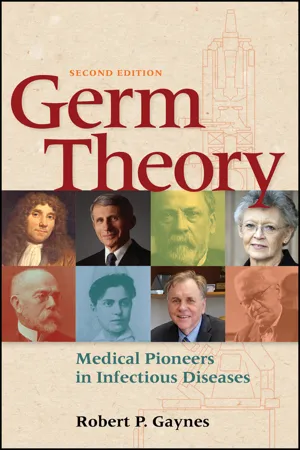 eBook - PDF
Germ Theory
Medical Pioneers in Infectious Diseases
- Robert P. Gaynes(Author)
- 2023(Publication Date)
- ASM Press(Publisher)
A field that believes that the causes and treatment of illness are based solely on invisible and unknowable forces is contrary to a discipline in which the causes of disease can be discovered, and treatment can be aimed at those causes. The move away from divine intervention was a crucial step for medicine. One of the greatest contributions of the ancient Greeks, perhaps its greatest, was the conceptual shift to the belief that disease has a natural, knowable cause. Once Western medicine declared its independence from religious practices, it could advance into a truly scientific discipline. Hippocrates The first individual in Western civilization to be known for his contributions to medicine from the ancient Greek civilization is Hippocrates. While over 70 surviv- ing volumes of writings are attributed to him, historians have determined that 14 • Germ Theory: Medical Pioneers in Infectious Diseases different authors actually wrote these texts. Because of the authorial uncertainty, the collective works have been called the Hippocratic Corpus or body of work, and the physicians who practiced the art, the Hippocratic physicians. For unassailable fact, we know almost nothing of Hippocrates’ life. We do know that Hippocrates was born in 460 BCE on the island of Cos, off the coast of present-day Turkey, but that’s about it. Every other description of Hippocrates’ life is impossible to verify and has been combined with or distorted by legend. The only verification of the tiny biographical fact about his birth comes from two dialogues of Plato, the Protagoras and the Phaedrus. Historians in the 1800s fruitlessly labored to deci- pher which of the surviving ancient Greek texts were written by Hippocrates (2). It is said that Hippocrates lived for a long period, somewhere between 85 and 110 years. We do not know what he looked like, although there are multiple statues said to convey his likeness. eBook - PDF
Hippocratic Medicine
Its Spirit and Method
- William Arthur Heidel(Author)
- 2019(Publication Date)
- Columbia University Press(Publisher)
A well-known historian of medicine declares that the greatest value has always been given to the general therapeutic principles of the Hippocratics and that the imperishable fame of Hippocrates rests chiefly on this foundation. 50 Certainly, if one takes into account the limi-tations of ancient science, it is little short of the mar-velous that medicine today should find so much to ap-prove in the practice of these devoted physicians of ancient times. VI, vii, 3 (V, 338 f., Littré). Cf. De locis in homine, xli (VI, 330 f., Littré); and Aristotle, Tópica, VI, xiii, 12. 5 0 Haeser, Lekrbuch der Geschichte der Medicin, I, 147. eBook - ePub
Matters of life and death
Human Dilemmas in the Light of the Christian Faith (2nd Edition)
- John Wyatt(Author)
- 2012(Publication Date)
- IVP(Publisher)
How can we find a way forward in addressing these issues? To revisit the words of Archbishop William Temple: ‘If you don’t know where you are going, it is sometimes helpful to know where you have been.’ In the confusion of a postmodern age, history has a crucial role in ethics, providing insights as to how we got here in the first place. If we are going to find a way forward together as a society, we need to understand how the ethical debates of today find their roots in the past. A discernible trend in moral philosophy is a renewed interest in the history of ethical traditions. In the same way, Christians who find themselves living in a postmodern age need to develop a renewed appreciation of our Christian history, especially, in my view, the history of the Early Church, and how it met the challenges of the pagan age in which it lived. So I make no apologies for a brief foray into the history of medical ethics, and the ancient craft of Hippocratic medicine.Hippocratic medicine: an ancient tradition
The Graeco-Roman world into which Hippocratic medicine appeared had plenty of healers. There were herbalists of various descriptions, including the practitioners of pharmakeia , referred to earlier – the professional abortionists and poisoners, whose dubious services could be obtained for a fat fee. In addition, various healers were attached to the mystery religions and cults, and there were philosopher-physicians, thinkers who dabbled in the healing arts. It was a common aphorism at the time that, ‘the doctor is physician of the body; the philosopher is physician of the soul’.As we have seen, Graeco-Roman society was often cruel and inhumane. But the Hippocratic physicians seemed to have had a different attitude to their fellow human beings. They were a professional sect: a craft, who traced their origins to the quasi-mystical figure of Hippocrates, an inhabitant of the Greek island of Cos around 400 BC . The Hippocratic band was a clique of skilled practitioners, passing on their mysterious and strange healing customs to carefully selected initiates, who were required to swear a solemn and pagan oath: ‘I swear by Apollo Physician, by Asclepius, by Hygeia, by Panaceia and by all the gods and goddesses, that I will carry out, according to my ability and judgement, this oath.’1 eBook - PDF
- Aho Shemunkasho(Author)
- 2014(Publication Date)
- Gorgias Press(Publisher)
As an example of an Arabic translation, see P. Bachmann, ‘Galens Abhandlung darüber, daß der vorzügliche Arzt Philosoph sein muß’, in Nachrichten der Akademie der Wissenschaften in Göttingen (1/1965), 1-67. 13 Hippocrates, tr. by W. H. S. Jones. Loeb Classical Library (London 1923); - Concerning Airs , 1, 71-117; - Epidemics I, 1, 146-211; - Precepts , 1, 313-33; - On Regimen , 2, 57-126. 14 L. Edelstein, ‘Greek Medicine in its Relation to Religion and Magic’, in Ancient Medicine (Baltimore 1967), 217-46. 15 For the ‘Hippocratic Oath’ see K. Deichgräber, Medicus gratiosus (Wiesbaden 1970); L. Edelstein, The Hippocratic Oath (Baltimore 1943); - ‘The professional ethics of the Greek physician’, in Bull Hist Med 30 (1956), 391-419; G. Harig and J. Kollesch, ‘Der Hippokratische Eid’, in Philologus 122 (1978), 157-76; W. H. S. Jones, The Doctor’s Oath (Cambridge 1924). After the death of Alexander the Great in 323 B.C., Hippocrates’ 6 I NTRODUCTION This system conflicts with that of ancient religious healers, physician-seers ( iatromanteis ) and in particular the cult of Asclepius who, from the fifth century onward, gradually became the god of medicine. Asclepius is mentioned in the Iliad (2.728-33), in Homer’s description of the ships and their leaders assembling for the attack on Troy, and in Pindar’s Pythian Ode. According to Pindar’s Pythian Ode (III. 47-53), Asclepius was honoured as a divine healer, and at Pergamum and Cos there were medical schools as well as shrines where the sick awaited his divine visitations. 16 In the year 292 B. C, Rome and the surrounding countryside were struck by the plague. After they consulted their oracles, they went to Epidauros to bring Asclepius to Rome. Arriving in Rome, sacrifices, incense and perfumes were offered on altars, where Asclepius appeared in the form of a serpent. 17 medicine was developed further in Alexandria, the chief cultural and commercial center. No longer available |Learn more
- Robert M. Veatch(Author)
- 2016(Publication Date)
- Routledge(Publisher)
C H A P T E R2The Hippocratic Oath and Its Challengers: A Brief History
I n Case 1 in Chapter 1 the health care providers and the parents disagreed about how a permanently unconscious young boy should be treated. While the physicians felt it was appropriate to discontinue life support, the parents wanted it to continue. In fact, they could not even agree on whether the boy was dead or alive. Where might a physician, a parent, or a social observer of this scene turn for moral advice about how to handle a case like this? One possibility is to look at a code of ethics. These codes have been prepared by many different cultural, religious, and professional groups. They are lists or codifications of rules of the sort we identified in Chapter 1 as the second level of moral discourse, the next level of generality to which one might move if intuitions about specific cases resist resolution. Codes are meant to present moral rules (or perhaps rights) from the perspective of the group doing the writing. Sometimes they are limited to a specific domain such as medicine; in other codes the scope is more general.THE HIPPOCRATIC TRADITION
The Hippocratic Oath
For many years, some physicians have used the Hippocratic Oath as that summary of moral/medical wisdom. It is not, however, a timeless document used throughout history in all parts of the world. It is part of a collection of writings known as the Hippocratic Corpus . We really don’t know who wrote the oath. The fifth-century b.c.e. physician known as Hippocrates (one of the original leaders of medicine on the island of Cos in ancient Greece) was almost certainly not the author (Edelstein, 1967). The oath is generally believed to have been written about one hundred years later. It is one of several ethical writings along with other, more scientific ones.Most people have not thought extensively about where the oath came from and, more importantly, about the belief system on which it was based. A provocative observation on the island of Cos should arouse curiosity. On the island are the ruins of a Greek healing temple. According to local folklore the school of Hippocrates was associated with this temple.1 eBook - PDF
The Clock and the Mirror
Girolamo Cardano and Renaissance Medicine
- Nancy G. Siraisi(Author)
- 2015(Publication Date)
- Princeton University Press(Publisher)
422-24. In addition to Hippocratic texts, hu- manist scholarship brought to light an epitome of a Life of Hippocrates attrib- uted to Soranus (included in Calvi's Latin edition of the corpus), the list of Hippocrates' works in the Suda, and the Hippocratic pseudepigrapha, a collec- tion of letters and documents giving a novelistic account of various episodes in the life of Hippocrates. For early-fifteenth-century humanist translations into Latin of letters ascribed to Hippocrates and his correspondents, see Kibre, Hip- pocrates latinus, pp. 158-62. The letters were also translated by Fabio Calvi and included in his printed Latin Opera of Hippocrates; see Hippocratis Coi medico- rum longe principis, opera . . . nunc tandem per M. Fabium Rhavennatem, Guilielmum Copum Basiliensem, Nicolaum Leonicenum, et Andream Brentium, viros doctissimos Latinitate donata (Basel, 1526), pp. 479-80. Scholarship on late ancient and Byzantine biographical and bibliographical accounts of Hippocrates and their interrelationship is summarized and evaluated in Pinault, Hippocratic Lives and Legends, pp. 1-34; for the pseudepigrapha, see Hippocrates, Pseudepi- graphic Writings. For the portrait of Hippocrates in this material, see Owsei Temkin, Hippocrates in a World of Pagans and Christians (Baltimore, 1991), pp. 51-75. Thomas Riitten, Demokrit lachender Philosoph und sanguinischer Melancholiker: Eine pseudohippokratische Geschichte (Leiden, 1992), presents some interesting examples of Renaissance uses of the Hippocratic pseud- epigrapha. For a summary of the post-Renaissance history of Hippocratic schol- arship and ideas about Hippocrates, see Smith, Hippocratic Tradition, pp. 13- 44. 44. I. M. Lonie, "Cos versus Cnidus and the Historians: Part 1," History of Science 16 (1978): 49; however, Nutton, "Hippocrates in the Renaissance," p. 423, notes that Mercuriale was still largely following Galen's judgment. See Girolamo Mercuriale, De morbis puerorum. Item de venenis et morbis venenosis.
Index pages curate the most relevant extracts from our library of academic textbooks. They’ve been created using an in-house natural language model (NLM), each adding context and meaning to key research topics.

