History

Good Friday Agreement
The Good Friday Agreement, also known as the Belfast Agreement, was signed in 1998 to bring an end to the conflict in Northern Ireland. It established a power-sharing government and addressed issues such as decommissioning of paramilitary weapons, human rights, and justice. The agreement has been instrumental in maintaining peace and stability in the region.
Written by Perlego with AI-assistance
Related key terms
1 of 5

12 Key excerpts on "Good Friday Agreement"
 eBook - ePub
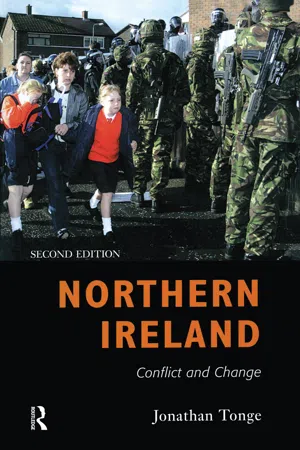
Northern Ireland
Conflict and Change
- Jonathan Tonge(Author)
- 2013(Publication Date)
- Routledge(Publisher)
Chapter 14The Good Friday Agreement
DOI: 10.4324/9781315837871-14The climax of the peace process arrived in April 1998, as political agreement was reached. The Good Friday (or Belfast) Agreement represented the culmination of exhaustive multi-party, intergovernmental and bilateral talks. Although the talks process was not entirely inclusive, the DUP and UKUP declining to participate, the majority of Northern Irish opinion was represented. The Agreement reflected hard bargaining among historical enemies, allied to compromise. At its heart lay the principle of consent for constitutional change in Northern Ireland. Within this overarching principle lay power-sharing, all– Ireland and confederal dimensions, alongside continued intergovernmentalism. A broad sketch of the constitutional agenda of the Good Friday Agreement had been visible at Sunningdale 25 years earlier. For the new Agreement to form the endgame, a new inclusiveness on non-constitutional issues was needed, embracing an equality agenda and ‘end of conflict’ measures, such as paramilitary prisoner releases.14.1 The contents of the Agreement
The Agreement contained several Strands. These were:- Strand 1: a devolved Northern Ireland Assembly of 108 seats, presided over by a cross-community Executive and headed by a First Minister and a Deputy Minister;
- Strand 2: a North-South Ministerial Council, to establish all-Ireland implementation bodies in at least six policy areas;
- Strand 3: a British-Irish Council, comprising representatives from the British and Irish governments, alongside those from devolved institutions in the United Kingdom. A British-Irish intergovernmental conference, designed to explore the totality of relationships between the two islands, replaced the Anglo-Irish Agreement.
The Irish government also dropped its constitutional claim to Northern Ireland. Henceforth, Articles 2 and 3 of the constitution of the Irish Republic would contain a mere aspiration, rather than assertion, of Irish unity. Aside from constitutional issues, the Agreement also covered human rights, equality, decommissioning, prisoners, security and policing. The main equality-oriented measures were: eBook - PDF
- Joanne McEvoy(Author)
- 2008(Publication Date)
- EUP(Publisher)
On 6 April he presented a draft agreement which 118 The Politics of Northern Ireland was rejected by the UUP but formed the basis of the fi nal text agreed by the parties on 10 April. The Good Friday Agreement: an ‘historic’ deal The inter-party talks eventually led to the signing of a deal between the parties at Stormont on Good Friday, 10 April 1998. Much has been written about the signi fi cance of the Agreement which promised a new era for Northern Ireland through new structures of devolved government and an end to the con fl ict. While there had been a number of previous political initiatives in the course of the thirty years of the con fl ict – the Sunningdale Agreement of 1974, the Anglo-Irish Agreement of 1985, the Brooke–Mayhew talks of 1991–2, the Downing Street Declaration of 1993 and the Framework Documents of 1995 – they had all failed to command support from both communities. As mentioned above, the Agreement contained three separate strands, a format which can be traced back to the Brooke–Mayhew talks of 1991–2. Strand One set out the internal structures for the Assembly and the Executive, Strand Two related to north–south Peace Process to Good Friday Agreement 119 Box 6.1 Key events during the 1990s peace process Brooke–Mayhew Talks 1991–2 Downing Street Declaration 1993 IRA ceasefire 1994 Loyalist ceasefire October 1994 Framework Documents 1995 Mitchell Commission Report January 1996 IRA bomb at Canary Wharf, London 9 February 1996 Northern Ireland Forum election 30 May 1996 Start of multi-party talks at Stormont 10 June 1996 Labour won UK General Election May 1997 IRA reinstated ceasefire July 1997 Sinn Féin admitted to inter-party talks September 1997 British and Irish Governments’ ‘Heads of Agreement’ document January 1998 Good Friday Agreement signed 10 April 1998 bodies and the North–South Ministerial Council and Strand Three provided for a British–Irish Council.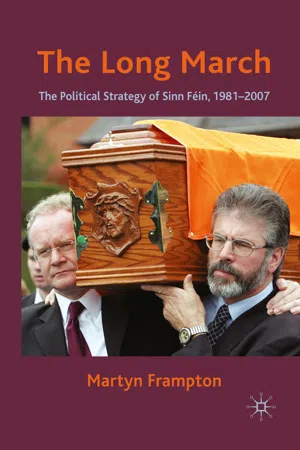 eBook - PDF
The Long March
The Political Strategy of Sinn Fein, 1981-2007
- M. Frampton(Author)
- 2016(Publication Date)
- Palgrave Macmillan(Publisher)
Negotiations and agreement: the challenge As has been stated, although Sinn Féin had been a firm advocate of their being called, the launching of all-party talks in 1997 presented the Adams–McGuinness leadership with a huge challenge. The scale of that challenge only increased as the outline of what would become known as the ‘Belfast’, or ‘Good Friday’, Agreement became clear. With the ‘Heads of Agreement’ document of early 1998 having represented a dilution of the ‘green-ness’ of the ‘Frameworks’ documents, the last weeks of negotiation saw this watered down even further. In those final days, for instance, the number of ‘annexes’ detailing north–south cooperation were reduced from three to one, while the number of designated areas for potential cross-border cooperation fell from forty-nine to twelve (of which only six were eventually enacted). This aspect of the Agreement was subsequently described by David Trimble’s biographer, Dean Godson, as a ‘great triumph’ for the UUP leader and it would seem that Trimble himself may even have wondered whether the scale of his victory might not be too great – to the point where the republican leadership might not be able to endorse the deal. 27 When it was finally agreed, the Good Friday Agreement, by any reckon- ing, stood a significant way short of being a ‘republican’ solution to the Northern Irish conflict. The IRA itself acknowledged this explicitly, stating, ‘Viewed against our republican objectives . . . this document clearly falls short 108 The Long March of presenting a solid basis for a lasting settlement.’ 28 Similarly, Gerry Adams, when reflecting on the negotiations that produced it, declared that the Agree- ment was ‘not the preferred option of any of the participants – certainly not Sinn Féin’s’. 29 In truth, the republican leadership could scarcely have argued otherwise. The Agreement appeared to represent the undisputed triumph of the ‘con- sent principle’. eBook - PDF
The Northern Ireland Question
The Peace Process and the Belfast Agreement
- Brian Barton, Patrick J. Roche(Authors)
- 2009(Publication Date)
- Palgrave Macmillan(Publisher)
The peace process and the Good Friday Agreement form the first initiative since the outbreak of the Troubles to gain cross-part y support in the Republic and this is an important factor in explaining why it remains at the core of Irish government policy nine years later. ‘Post-Agreement Ireland’ has been described as ‘a new dispensation’ 28 and the main consequence of this for the political scene in the Republic has been the level of consensus that has developed on Northern Ireland. All of the parties in the Republic have given their support to the ideologi- cal reformulation involving consent and self-determination as enshrined in t he Good Friday Agreement, and t hey continue to support t he peace process. The main political parties also believe that the cross-party consensus on Northern Ireland will continue, that Northern Ireland policy will not change in the event of a change of government 29 and that the Northern Ireland issue has in fact been settled. 30 This is the case because the politi- cal parties are not only in agreement on the ideological implications of the Good Friday Agreement but also in relation to the short-term and long-term goals for Northern Ireland. The Fianna Fáil manifesto in 2002 asserted the part y’s priorit y to ‘secure lasting peace in Ireland through the The Belfast Agreement and Southern Irish Politics 213 f ull implementation of the Good Friday Agreement’ without ‘prejudice to the ultimate goal of achieving a united Ireland’. 31 Thus while a united Ireland is the stated long-term objective, in the immediate term Fianna Fáil members state that the aim is to fully implement the Good Friday Agreement and since 2002 the goal has been to restore devolved gov- ernment to Northern Ireland. 32 Fine Gael has given its support to this approach and as such it has cross-party support.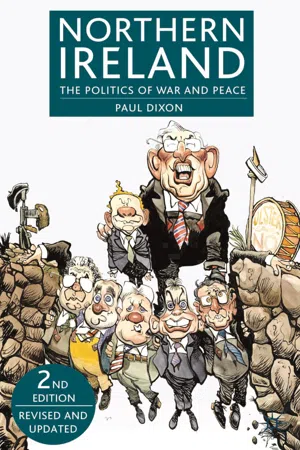 eBook - PDF
Northern Ireland
The Politics of War and Peace
- Paul Dixon(Author)
- 2008(Publication Date)
- Red Globe Press(Publisher)
10 The End of the Peace Process? The Implementation of the Good Friday Agreement, 1998–2007 Introduction The signing of the Good Friday Agreement (GFA) in 1998 was a remarkable achievement. The shape of the deal had been anticipated by: the Brooke–Mayhew talks of 1991–2; the Downing Street Decla-ration in December 1993; the Framework Documents of 1995; and the ‘Heads of Agreement’ document in 1998. What was impressive was the willingness of Sinn Féin and the Ulster Unionist Party to sup-port an agreement that represented such a shift from their previous negotiating positions. The British and Irish governments intended that the GFA would be built on the moderate centre-ground of Northern Irish politics, with the SDLP and UUP marginalizing their hardline Sinn Féin and DUP rivals. There was, as in 1994, no obvi-ous convergence in nationalist and unionist public opinion propelling this accommodation from below. This lack of convergence meant that the GFA was designed so that ‘each protagonist could interpret it as a victory for his tradition’ (Rawnsley 2000, p. 138). Sinn Féin leaders presented the GFA as part of a process towards Irish unity, while pro-Agreement unionist leaders claimed it was a settlement that involved the strengthening of the Union. The rough parameters of the GFA had been outlined, but the implementation of the Agreement was part of ongoing negotiations and some issues, including criminal law, policing, local government, a bill of rights and decommissioning were left open to interpretation and negotiation in order to provide 278 The End of the Peace Process? 279 political elites with the ‘creative ambiguity’ and ‘wriggle room’ to allow the Agreement and peace process to survive and evolve. This chapter will argue that pro-Agreement unionism was under severe pressure as soon as Trimble signed the Agreement. eBook - PDF
Identity and Institutions
Conflict Reduction in Divided Societies
- Neal G. Jesse, Kristen P. Williams(Authors)
- 2012(Publication Date)
- SUNY Press(Publisher)
The links of the two groups with two different states gives it the “bistatal dimension”: Protestants see themselves as British, and thus connected to the United Kingdom; whereas the Catholic minority sees itself as Irish, and hence linked to Ireland. 98 The Agreement’s provisions for majority support in the Assembly and proportionality of both Nationalists and Unionists affords an opportunity for building much-needed trust in order to surmount historic animosities. 99 The pooling of sovereignty between the Irish and British governments allows Britain to change the scope of the regional conflict from one of an internal problem to that of an Irish, or island-wide, problem. Importantly, the involvement of both gov- ernments provides a credible commitment to the Agreement and to the future of the region. Conclusion The Good Friday British-Irish Peace Agreement has led to much euphoria and a counterimpulse of pessimism. Some view the recent settlement as one that places a new set of institutions onto a cen- turies-old conflict without addressing the deep societal divisions that separate the Protestant and Catholic communities. We dis- agree with this view. Unlike previous attempts at solving the con- flict, for the first time all the parties to the conflict are active participants in the Agreement. Importantly, an opportunity for res- 110 Identity and Institutions olution to the long-standing conflict has presented itself through the establishment of institutions that promote overlapping identi- ties, provide for multiple layers of representation, and pool sover- eignty. The key to the success of the new Agreement will be the degree to which trust is established, security dilemmas are amelio- rated, and the security of all parties is ensured. As John Lloyd notes, “[t]he success of the agreement may lie in its very looseness and ambiguity. eBook - ePub
Human Rights and the Northern Ireland Conflict
Law, Politics and Conflict, 1921-2014
- Omar Grech(Author)
- 2017(Publication Date)
- Routledge(Publisher)
6 Peace and human rights, 1985–1998 The long thawIntroduction
This chapter addresses three themes which span the timeframe between the signing of the Anglo-Irish and Good Friday Agreements. The three themes relate to: (1) a number of entrenched human rights challenges in Northern Ireland (and the ways in which they continued to be addressed); (2) the role of human rights concerning conflict resolution negotiations; and (3) the extent to which the conflict resolution efforts in Northern Ireland were more concerned with ending physical violence (negative peace) than with building positive peace (including a deep commitment to and engagement with human rights).The period under examination spans the immediate aftermath of the hunger strikes and Sinn Féin’s increasing electoral activism to the negotiations which led finally to the Peace Agreement of 1998. This period was one characterised by continuing violence, continuing negotiations and increasing hopes for a political settlement. In some ways, this period reflected both continuity and hope for change in Northern Ireland. Continuity was evident in the enduring violence1 perpetrated by republican and loyalist paramilitaries (and occasionally the security forces of the UK) as well as by a continuing concern with human rights issues which had bedevilled Northern Ireland since the 1920s. These human rights concerns centred, inter alia, on: the use of special powers legislation and problems relating to the administration of justice;2 religious discrimination (particularly in employment);3 and the whole area of cultural rights and their expression in terms of the use of flags, emblems and parades.4Hopes for change in the period gradually increased as the 1980s drew to a close and the 1990s dawned. These prospects for change were driven by numerous factors, including the new leadership in both London and Dublin with John Major and Albert Reynolds making sustained efforts at breaking the political deadlock. Other factors included an increasing belief within the republican movement that the political avenue was worth pursuing and a contemporaneous sense of conflict fatigue emerging within the IRA, loyalist paramilitaries and UK security forces.5 With politics gradually becoming a more feasible and attractive option to all parties, the possibility of ending violence became more real than ever. The 1990s, therefore, witnessed long, arduous and hesitating negotiations which finally led to the 1998 Northern Ireland Peace Agreement. Throughout this period, human rights issues formed part of the discourse that coloured the negotiation process, as was evident in the various official communications that emanated from the UK and Irish governments.6 While human rights concerns were referred to continuously, they did not in themselves prove to be the primary issues in the negotiations. As accounts of the negotiations demonstrate, the key contentious issues during the negotiations proved to be decommissioning, the scope and functions of North–South bodies and to a lesser extent the exact functioning of power-sharing.7
- Jean Allain, Siobhán Mullally, Jean Allain, Siobhán Mullally(Authors)
- 2009(Publication Date)
- Hart Publishing(Publisher)
Department of Foreign Affairs Agreed Programme for Government Progress Report April 2007 working for peace Building Peace and Justice Over the next five years, our overriding priority will be to secure lasting peace in Ireland through the full implementation of the Good Friday Agreement, the consoli-dation of its institutions, and the development of a spirit of friendship and coopera-tion between North and South. This we will do without prejudice to the ultimate goal of achieving a united Ireland in peace and agreement. • The Government is committed to securing the earliest possible restoration of he political institutions in Northern Ireland on an inclusive and sustainable basis and the resumed operation of the North–South Ministerial Council. • Significant progress has been made in the last year towards securing these aims. The St Andrews Agreement published by the Governments on 13 October 2006 under-pins the Good Friday Agreement, and sets out a clear way forward for all parties to commit to the full operation of stable power-sharing government in Northern Ireland by 27 March 2007 and to full support for policing and the criminal justice institutions. • The decision in January 2007 by the Sinn Féin Ard Fheis in support of policing and the criminal justice institutions was an important step forward in that regard. The focus then shifted to secure delivery on support for power-sharing by the DUP. The Governments made clear that the Assembly election on 7 March was being held for the explicit purposes of endorsing the St Andrews Agreement and of electing an Assembly that would form a power-sharing Executive on 26 March in accordance with that Agreement and timeframe. eBook - PDF
Political Leadership and the Northern Ireland Peace Process
Role, Capacity and Effect
- C. Gormley-Heenan(Author)
- 2006(Publication Date)
- Palgrave Macmillan(Publisher)
1 Introduction Background On 10 April 1998 Northern Ireland joined a long list of countries which had produced peace agreements in the 1990s. The architects of the Agreement included eight local political parties and the British and Irish governments. Significant architectural influence of the US administra- tion under President Clinton, and to a slightly lesser extent, of the exper- iences of other peace processes which had reached agreement before Northern Ireland, was noted. The Agreement was the culmination of a prolonged peace process, which had followed an equally prolonged and protracted conflict. 1 The origins of this peace process dated back to at least the mid-1980s with the secret dialogue between John Hume, leader of the Social Democratic and Labour Party (SDLP), and Gerry Adams, leader of Sinn Féin. The tentative discussions between Hume and Adams converged with the more formal ‘talks process’ in the early 1990s. 2 This ‘talks process’ gathered further momentum after both the republican and loyalist ceasefires in 1994 and the elections to the multi- party talks process in 1996 and eventually resulted in the signing of the Good Friday Agreement in April 1998. 3 The story of the Northern Ireland peace process is not considered to be particularly unique since the ‘decade of peace processes’ of the 1990s bore witness to a multiplicity of ceasefires and political agreements span- ning all continents. 4 As a consequence, academic studies of such polit- ical conflicts and peace processes have flourished considerably. 5 Many of the works have been comparative in nature. Some have made for more popular comparison than others. For example, most scholars of ethnic conflicts can recount various details of the peace processes in Northern Ireland, Israel/Palestine and South Africa and how a multiplicity of 1 2 Political Leadership and the Northern Ireland Peace Process factors were married together to create ‘settlements’, however long their eventual life span.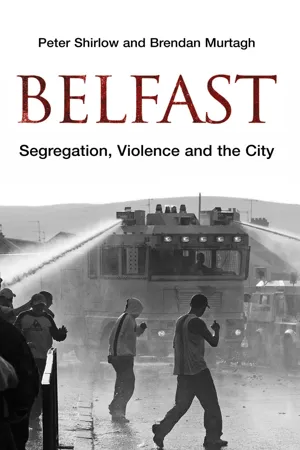 eBook - PDF
Belfast
Segregation, Violence and the City
- Peter Shirlow, Brendan Murtagh(Authors)
- 2006(Publication Date)
- Pluto Press(Publisher)
Devolution has been a central plank within the new political dispensations as it has consolidated a ‘new’ Northern Ireland within which local politicians have gained increasing control over the mechanisms of governance. In addition, potential unionist dominance has been replaced by power-sharing and an institutionalised, quasi-sovereign role in Northern Ireland for the Irish state through the North–South ministerial council. 32 The Belfast Disagreement 33 Disagreement over the naming of the Agreement, adopted on 10 April 1998, which led to devolution, exemplified the uneven ground upon which a lasting settlement was to be built. Unionists prefer the appellation ‘the Belfast Agreement’ while nationalists/republicans use the term ‘the Good Friday Agreement’. The use of different names for the same object is of course commonplace within a divided community, with other notable examples including the use of Derry or Londonderry and the term Six Counties by nationalists/republicans to describe Northern Ireland. Divisive naming is symptomatic of the perpetual reality that Northern Ireland, despite significant and meaningful political change, remains as a ‘disagreed’ place within which politics remain disagreeable. The meaning of the Agreement is interpreted through diverse rationales of constitutional change. For unionists the legitimacy and integrity of Northern Ireland have been underlined by devolution and the endorsement of the principle of consent, which upholds the majority’s objective of remaining within the United Kingdom. Conversely, among nationalists and republicans the creation of a power-sharing executive and the creation of cross-border bodies have been identified as the beginning of the end for Northern Ireland as a constitutional entity. The inability to maintain devolved structures has also been interpreted via the disparate lenses of unionism and nationalism/ republicanism.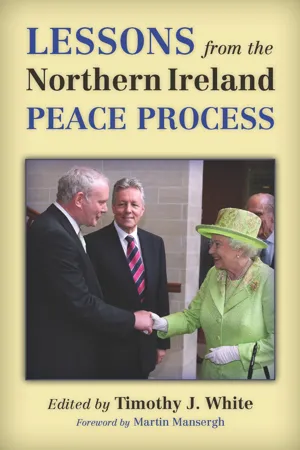
- Timothy J. White(Author)
- 2014(Publication Date)
- University of Wisconsin Press(Publisher)
Its purpose is to consult, discuss, and exchange information on matters of mutual interest including but not limited to transport links, health, education, and approaches to EU issues. The Agreement also estab- lished the British-Irish Council to deal “with the totality of relationships” and bring the British and Irish governments together to promote bilateral cooperation at all levels of mutual interest also operating within a supra- national EU framework. 26 The participants who negotiated the Agreement declared their commit- ment to respect human rights and equality, their dedication to achieve reconciliation and mutual trust, as well as their “absolute commitment to exclusively democratic and peaceful means of resolving differences on political issues.” 27 It is important to note that the constitutional principles of the Agreement were endorsed in referendums both in Northern Ireland and the Republic of Ireland on May 22, 1998. In Northern Ireland 71.1 percent approved the Agreement, and in the Republic of Ireland 94.9 percent supported the Agreement by “voting to erase the territorial claim on the North from their constitution.” 28 The referendums and their out- comes not only added legitimacy to the peace process but also signified the considerable expectations associated with it by the people of Northern Ireland and the Republic of Ireland. Moreover, the Agreement emphasized the significance of reconciliation, specifi cally in terms of the following elements: (1) acknowledging and addressing the suffering of the victims of violence, (2) building a peaceful eBook - PDF
- Dawn Walsh(Author)
- 2017(Publication Date)
- Palgrave Macmillan(Publisher)
Introduction: Contentious Issues and the Implementation of the Good Friday Agreement The role of third parties and external actors in efforts to resolve the conflict in Northern Ireland was one of its most notable aspects. Their involve- ment has been cited by many as being central to the relative success of the peace process and the negotiation of the Good Friday Agreement (GFA). 1 There has been considerable examination of the role of these third parties in the build-up to the 1998 GFA (see e.g. MacGinty 1997; McGarry and O’Leary 2006). There has also been a small amount of work on the role of the USA in post-agreement Northern Ireland (see e.g. Clancy 2010; Marsden 2006). Yet this literature does not directly address the role played by a number of key independent commissions, some with a strong inter- national component, that were charged with managing some of the most contentious issues of the peace process. This volume addresses this missing dimension. Independent commissions were key players in post-agreement Northern Ireland. Though some issues continue to be problematic, in many cases the involvement of independent commissions led to the suc- cessful resolution of problems which were critical stumbling blocks to the implementation and operation of the GFA. The signing of the GFA on the 10th of April 1998 was heralded as an historic day for Northern Ireland. After centuries of violent conflict, the most recent incarnation of which had lasted over thirty years and resulted in the deaths of over three thousand people, there was broad consensus on the way forward for the region. The endorsing of the GFA in popular © The Author(s) 2017 D. Walsh, Independent Commissions and Contentious Issues in Post-Good Friday Agreement Northern Ireland, Rethinking Peace and Conflict Studies, DOI 10.1007/978-3-319-50772-9_1 1 referenda both in Northern Ireland and Ireland further underscored the fundamental progress which the agreement marked.
Index pages curate the most relevant extracts from our library of academic textbooks. They’ve been created using an in-house natural language model (NLM), each adding context and meaning to key research topics.

