Politics & International Relations

Dayton Accords
The Dayton Accords, signed in 1995, ended the Bosnian War by creating a framework for peace in Bosnia and Herzegovina. The agreement established a complex political structure, dividing the country into two entities and providing for a central government. It also outlined human rights provisions and established the International Criminal Tribunal for the former Yugoslavia to address war crimes.
Written by Perlego with AI-assistance
Related key terms
1 of 5

11 Key excerpts on "Dayton Accords"
 eBook - PDF
The War in Our Backyard
The Bosnia and Kosovo Wars through the Lens of the German Print Media
- Margit V. Wunsch Gaarmann(Author)
- 2015(Publication Date)
- Neofelis Verlag(Publisher)
7 The content of the Dayton Accords has been analysed widely in a pleth-ora of secondary literature, most of which was published several years after the negotiations. All concentrate on the political stipulations laid out in the agreement, their implementation, how effective this process was and where its faults lay. Almost unanimously the key literature agrees that the Dayton Accords, which formulated a peace treaty and simultaneously laid out the constitution for post-war Bosnia, did not conclusively address all problems in Bosnia. While the immediate violence subsided, the systemic problems such as tensions and antagonism amongst Serbians, Croatians and Bosniaks, which had been exacerbated by years of war, remained. 8 Moreover, the literature questions the agreement’s efficacy, arguing that Serbia, Croatia and Bosnia only committed half-heartedly after giving in to pressure from the United States. 9 Perhaps the most significant criticism was that two of the belligerents – the Bosnian Serbs and the Bosnian Croats – did not even prop -erly sign the agreement but rather were ‘represented’ by the presidents of their respective patron states, Yugoslavia [Milošević] and Croatia [Tudjman]. 10 In addition to the predominantly negative assessment, another commonal-ity in the secondary literature is the authors’ approach marked by political science. None of the works unlock the historical process of these negotia-tions and the intricate developments leading to the peace conference. Equally, there is no literature detailing the policies or perspectives with which the international delegations approached the discussions, what their objectives 6 Fiona Watson / Tom Dodd: The Dayton Agreement: Progress in Implementation. In: Inter-national Affairs and Defence Section , House of Commons Library . London, Resarch Paper 96/80 (09.07.1996), p. 5; also explored in McMahon / Western: The Death of Dayton. eBook - PDF
Bosnia
Faking Democracy After Dayton
- David Chandler(Author)
- 2000(Publication Date)
- Pluto Press(Publisher)
DAYTON IN CONTEXT The Dayton Agreement was initially celebrated as marking a major step forward in the development of Bosnian sovereignty, creating the opportunity for Bosnians to establish a democrati-cally accountable state after years of war and division. US Secretary of State Warren Christopher noted in September 1996: ‘For four years, their fate was debated by outsiders and overshad-owed by the war. Now the Bosnian people will have their own democratic say. This is a worthy goal in and of itself, because the only peace that can last in Bosnia is the peace that the people of the country freely choose’ (USDoS, 1996b). However, as Susan Woodward notes, Dayton and its imple-mentation has done little to alter Bosnia’s historic lack of autonomy (1998). The promise of democratic accountability is no nearer today than at the beginning of the externally imposed democratisation process in 1991. In fact, Dayton can be seen as one stage in a developing process of international institutional involvement in the Bosnian state. The following sections briefly trace this process to consider Dayton in the broader historical context of the erosion of Bosnian sovereignty. The background to Dayton In this section pre-Dayton developments will be briefly sketched. There is neither the space nor the necessity to give an in-depth 38 BOSNIA historical analysis of the war, successive attempts at international mediation or policy shifts within and between the UN and NATO peace-keepers; many other works provide a thorough historical background to the Dayton Peace Agreement from a military and diplomatic perspective (for example, Cohen, 1995; Dyker and Vejvoda, 1996; Glenny, 1996; Owen, 1996; Silber and Little, 1996; Woodward, 1995). eBook - PDF
A Free City in the Balkans
Reconstructing a Divided Society in Bosnia
- Matthew Parish(Author)
- 2009(Publication Date)
- I.B. Tauris(Publisher)
At that stage, the Americans summoned all the warring parties to the Dayton Air Force Base in Ohio, and in a three week marathon negotiating session forced them to hammer out an agreement. The resulting agreement was a complex document, with 13 annexes, all of which were drafted by American lawyers from the US State Department. A F REE C ITY IN THE B ALKANS 44 The Dayton Peace Accords provided that Bosnia and Herzegovina (‘ Bosna i Herzegovina ’, or ‘BiH’) would become a sovereign state with the same international boundaries as the pre-war borders of the SRBiH. But it partitioned the country into two ‘Entities’, the RS and the FBiH, roughly along the ceasefire line (with some horse-trading). There would be a central government of BiH, but its authorities would be weak, and within strictly delimited spheres; the bulk of legal powers would lie with the Entity governments within their territories, over which they would have exclusive control. A new constitution for Bosnia and Herzegovina, agreed at Dayton, reflected these arrangements. The Dayton Constitution is Annex 4 to the GFAP. It is perhaps unique in being the only constitution in the world whose enacting instrument is an international treaty, and it has never been ratified by any parliament within Bosnia and Herzegovina. It embraced a political philosophy known as ‘consociationalism’. This is a theory of how to structure government in divided societies that focuses on national quotas in government institutions, the forging of consensus between politicians representing the rival groups and mechanisms to prevent outvoting of one group by another. 11 The Dayton Constitution will be studied carefully in subsequent chapters, but for now it suffices to note that the intention of consociational mechanisms is to promote inter-ethnic compromise between political representatives of each group, on the basis that no one group can achieve anything without the cooperation of the others. eBook - PDF
Empire in Denial
The Politics of State-Building
- David Chandler(Author)
- 2006(Publication Date)
- Pluto Press(Publisher)
It was to be a constitution by international decree’ (Bildt, 1998: 139). Although often presented as a peace agreement rather than a framework for the reconstruction of Bosnia, the civilian annexes Denying the Bosnian Protectorate 131 comprised five-sixths of the Dayton Accords and involved a wide range of activities in which international actors, coordinated by the OHR, were mandated temporarily to play key coordinating roles (Gow, 1998: 169). For this reason, the state-level elections, to be held within nine months of the signing ceremony, were initially held to be crucial for restoring ownership over the new state to its citizens. Under the formal Dayton agreement there was to be a year of internationally supervised transition, during which there would be elections and the establishment of the political institutions of the new state, which were to be elected and directly accountable to the people (see Chandler, 1999: 43–51). 1995–99: STRENGTHENING THE HIGH REPRESENTATIVE The planned year of internationally supervised transition to self-governing democracy was due to end with the election of state and entity bodies in September 1996, symbolising ‘the democratic birth of the country’ (PIC, 1996a: §27). Although these bodies were elected under internationally supervised and ratified elections, the transitional international administration was prolonged for a further two-year ‘consolidation period’ and then, in December 1997, extended indefinitely. The extension of the time limits for international withdrawal and the creation of new mandates for international agencies, coordinated by the Peace Implementation Council, was initially justified by the ambiguous wording of the Dayton agreement itself but later by increasingly subjective interpretations of the mandate by the High Representative, including innovative reference to the ‘spirit of Dayton’. eBook - PDF
1995
The Year the Future Began
- W. Joseph Campbell(Author)
- 2015(Publication Date)
- University of California Press(Publisher)
Clinton thought of traveling to Dayton to attend the initialing ceremony, but Holbrooke dissuaded him, saying, “You don’t want to be anywhere near these peo-ple today. They are wild and they don’t deserve a presidential visit.” 137 The accords were signed in mid-December at Elysée Palace, the offi-cial residence in Paris of the French president. In a bit of Gallic pique, the French Foreign Ministry referred to the agreement as the Treaty of the Elysée and, according to Holbrooke, asked speakers at the signing ceremony “to omit any references to Dayton in their remarks.” 138 As Holbrooke noted, the Dayton Accords had shaken “the leadership elite 122 | Peace at Dayton of post–Cold War Europe” and “some European officials were embar-rassed that American involvement had been necessary” to bring the Bosnian conflict to a close. 139 Izetbegovic´, Miloševic´, and Tud ¯ man played to form in Paris. “There were no tears of relief, no emotional scenes of reconciliation” from any of them, the New York Times reported. “They signed without saying a word, put the caps back on their fountain pens and shook hands perfunctorily.” 140 The treaty, Izet-begovic´ said, was akin to swallowing bitter medicine. 141 The Dayton Accords in many ways reflected the complexities, fragility, and contradictions that define the Balkans. The agreement was not with-out serious shortcomings; its flaws were unmistakable. It was, notably, inherently contradictory, containing elements that encouraged integra-tion of Bosnia’s ethnicities as well as elements that served to drive them apart. The fundamental tension lay in the fact that the accords estab-lished a weak central government and two semi-autonomous entities shaped by ethnicity. Both entities—the Muslim-Croat Federation and the Republika Srpska—were granted their own governing structure, par-FIGURE 18. Three Balkan presidents initialed the Dayton peace accords on the afternoon of November 21, 1995, hours after the talks were rescued from collapse.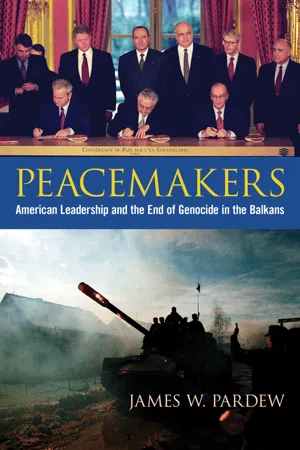 eBook - ePub
Peacemakers
American Leadership and the End of Genocide in the Balkans
- James W. Pardew(Author)
- 2018(Publication Date)
- The University Press of Kentucky(Publisher)
The Dayton Agreement brought peace to Bosnia and in the process influenced important international relationships at a time of great change. Dayton also set the stage for the independence of Kosovo and the ultimate integration of Balkan nations into NATO and the EU.In Bosnia, the Dayton Agreement put in place the constitutional structure to help Bosnia become a viable national state. It 1. ensured that Bosnia was recognized as an independent sovereign nation within its existing boundaries; 2. set the boundary line between the two entities in Bosnia—the Federation and the Republika Srpska; 3. established a democratic constitution for governance of Bosnia; 4. recognized the fundamental rights of citizens; 5. promoted the return of refugees and displaced persons; 6. preserved national monuments; 7. granted authority and status of forces for NATO and associated military forces in Bosnia; 8. authorized international organizations to function in Bosnia with significant authority to assist in implementation;9. authorized an international police presence in Bosnia, which was to serve in advisory capacity only, with no authority to arrest or use force.8Holbrooke stepped aside in 1996 to let others implement the agreement he had negotiated. He remained engaged from the margins, but primary responsibility for implementation fell to international institutions and national capitals.The United States and the Contact Group reinforced the international authority of the Dayton Agreement through a UN Security Council resolution (UNSCR). The day after the agreement was signed in Paris, the Security Council passed UNSCR 1031 in New York. This resolution authorized NATO—without designating NATO by name—to use “all necessary means” under the enforcement provisions of Chapter VII of the UN Charter to implement military aspects of the agreement. The resolution also authorized an international high representative with the authority to oversee civilian aspects of the agreement.9After Dayton, Bosnia was a sovereign nation with a democratic constitution. But its sovereignty was limited for years by the authority given to international institutions put in place by the Dayton Agreement.
- Jim A. Kuypers(Author)
- 1997(Publication Date)
- Praeger(Publisher)
87 PERIOD THREE: 5 DECEMBER 1995 THROUGH 14 DECEMBER 1995 The White House Push for Congressional Support As the date for the signing of the Dayton Accord neared, the White House addressed an increasing number of its comments to congressional leaders. The peace plan, the mission, U.S. Leadership and values were still mentioned, but comments addressed to members of Congress soared. Comments pertaining to the peace plan were still framed the same way as before. The president highlighted the casualties of the Bosnian war, then stated that "because the parties have said they will turn from war to peace, we can now prevent further suffering; we can now shine the light of justice in Bosnia; we can now help its people build a future of hope." 88 Secretary Christopher provided further support for this line of reasoning: "The Dayton agreement has given us our best hope to achieve a lasting peace. We wanted an agreement that ad- dressed all the fundamental issues that divided the parties, with no THE BOSNIAN CRISIS 95 short cuts or ambiguities, and that is what we obtained." 89 During a State Department briefing, Glyn Davies directly addressed criticism of the plan: "Those who initialed the agreement and who will sign the agreement in Paris have been expressing no misgivings to us. Nobody has been nibbling away at it; none of the signatories has been coming to us and asking us to revisit portions of the agreement." 90 Mike McCurry shed light on the importance of the administration's connection of the three Balkan presidents and President Clinton's attendance at the Paris signing of the formal Accord: "[For President Clinton] signing the document that is the final peace accord and also looking at the Presi- dents, seeing them eye to eye as they make their commitments to honor the security guarantees that they have given him related to the pres- ence of our U.S. eBook - ePub
The War in Bosnia-Herzegovina
Ethnic Conflict and International Intervention
- Steven L. Burg, Paul S. Shoup(Authors)
- 2015(Publication Date)
- Routledge(Publisher)
250The Dayton Agreement
The proximity talks among the three parties in Dayton, Ohio were characterized by the same difficulties and disagreements that had characterized earlier international efforts to broker a settlement of the conflict. But they also differed in two critical respects: the willingness of the United States to exert substantial pressure on the parties, especially the Bosnian Muslim leadership, to agree; and the fact that neither the Bosnian Serbs nor the Bosnian Croats—the parties least susceptible to U.S. pressure—were a direct party to the negotiations. The Dayton negotiations in November 1995 represented the continuation of the U.S. strategy of combining military and political pressure with key political concessions, which had emerged in July and August 1995. The United States took direct control over the peace process at Dayton, relegating other Western actors to subordinate roles. According to the leader of the British delegation at Dayton,The US negotiator, supported by a very large team, … organise[d] the agenda and [ran] the negotiation as he wished, with the acquiescence of the rest. They were informed but not consulted, and their primary role was to assist so far as needed, witness and ratify the outcome. But they were not to interfere.251The success of this strategy depended on the willingness of the United States to undertake the kind of commitment that U.S. policymakers—and especially the Pentagon—had been seeking to avoid since the start of the war: the indefinite deployment of U.S. troops on the ground in Bosnia to participate in an international force to monitor the agreement and patrol the cease-fire lines. It also required that the Bosnian Croats and Bosnian Serbs submit to representation by Tudjman and Milošević, respectively, whose designs for the partition of Bosnia were integral to the outcome of the negotiations. eBook - PDF
Peace as War
Bosnia-Herzegovina Post-Dayton
- Dražen Pehar(Author)
- 2019(Publication Date)
- Central European University Press(Publisher)
31 Chapter 1 and governmental structure, as instituted by the Dayton Accords to stop the war, was assumed at the time to be transitional by the original international negotiators. However, it was not offi -cially designated as such due to a compromise with Serbian hard -liners who preferred the Dayton-sanctioned post-war territori -al status quo and segregated political arrangements. Therefore, no plan or timeline was set in place to officially facilitate a tran -sitional process to a viable non-ethnic based constitution and governance structure. The Dayton ethno-political constitution defaulted to expedited fear-based ethno-political elections that only served to entrench hardline obstructionists in power and institutionalize structural violence. (Adams 2014) What does this paragraph actually tell us? First of all, it embod-ies a perspective on the Dayton Accords that is fully in harmony with the Bosniak-Muslim political elite, including Alija Izetbegović. Such a perspective cannot be discerned in the words of the Russian Fed-eration representatives, or of many other representatives of the EU nations, and especially it cannot be discerned in the words of the RS representatives. Second, the paragraph single-handedly projects the key problem in one party to BiH—in other words, it defines RS itself as a problem, not as a constitutional category or as a part of the structure that defined a compromise and thus brought the armed conflict in BiH to a close. Third, the paragraph in fact nearly explicitly claims that the key mediators or international actors (keep in mind that, within this context, we deal primarily with the US representatives and diplomats) did not take seriously the Dayton Constitution for BiH. They took it as something that is about to be dissolved soon. eBook - ePub
Bosnia and Herzegovina
A Polity on the Brink
- Francine Friedman(Author)
- 2013(Publication Date)
- Routledge(Publisher)
The international community intended to bring this type of polity about through external supervision. A one-year transitional international administration would govern until the first elections, at which time Bosnia's new state organs would begin to function while international organizations and internationally appointed individuals would guide Bosnia's economy, judiciary, and human rights institutions for five or six years. Thereafter, it was believed, Bosnia would have become a viable democratic state able to conduct its own affairs with increasingly less international interference. This was the essence of the Dayton Peace Accords.The Dayton Peace Accords
The eleven articles of the NATO-enforced DPA8 provided the structural and institutional framework for the reconstruction and reorganization of the devastated postwar Bosnia in two pages. An additional eleven annexes, wherein the details of postwar Bosnia's governance were laid out, provided for various mechanisms to promote democratization, to protect human rights, and to aid in the economic development of the region. The amount of access given the international community into Bosnia's reconstruction and governance in a document binding in international law makes the DPA and its annexes an extraordinary document. The powers of the Bosnian state were rigidly described, whereas the capabilities of the international community in regard to Bosnia were very ambiguous and, therefore, subject to flexible interpretation.9Articles I and II of the DPA pledged the signatories10 to adhere to recognized principles of international law enshrined in such documents as the UN Charter and the Helsinki Final Act, among others. Furthermore, he signatories were bound to comply with the provisions set forth in Annexes 1-A and 1-B.11 These annexes detailed the military aspects of the peace settlement. Confidence-building measures included reduction of arms to stabilize the region,12 eBook - PDF
- B. Hettne(Author)
- 2016(Publication Date)
- Palgrave Macmillan(Publisher)
11 A Regional Framework for Peace and Development in the Balkans J elica Minic 'We must not permit this to become the most expensive cease- fire in history.' (Javier Solana, NATO Secretary General) 'Our strategic interest must be the adjustment of our economic and social system to the use of international development factors and our opening to the influence of international institutions for finance and development.' 'As a European country we have to search for the ways to establish fast and strong links with the European Union which, being a major economic power, traces the development of a good part of the world economy. We can avoid this influence, but it will be to our detriment.' (Rajko Tomas, University Professor, Banjaluka) INTRODUCTION The Dayton Agreement is the starting point for a complex inter- national project to ensure peace, security and economic prosperity as well as other crucial interests of actors concerned with the sta- bility in the region. This project is similar to that for reconstructing post-war Europe. It includes occupation forces in the most vulner- able zones which have suffered the greatest war damage and are the most dangerous potential hot-beds of new conflicts. There is also the years-long status of a protectorate in terms of essential state functions, which should ensure the establishment of civil society and a market economy compatible with the European environment. It also includes a specific kind of a 'Marshall plan' which should 272 Jelica Minic 273 motivate the economic and political actors and turn towards the attainment of developmental and social objectives, many of which are inevitably regional, due to the small size of the newly created statelets.
Index pages curate the most relevant extracts from our library of academic textbooks. They’ve been created using an in-house natural language model (NLM), each adding context and meaning to key research topics.

