History

Kellogg-Briand Pact
The Kellogg-Briand Pact, signed in 1928, was an international agreement between 62 countries to renounce war as a means of settling disputes. It was an attempt to prevent another world war and promote peace through diplomacy and arbitration. However, it ultimately failed to prevent the outbreak of World War II.
Written by Perlego with AI-assistance
Related key terms
1 of 5
5 Key excerpts on "Kellogg-Briand Pact"
 eBook - PDF
- Kirsten Sellars(Author)
- 2013(Publication Date)
- Cambridge University Press(Publisher)
These initiatives suggested that a general move towards the delegitimisation of aggression was taking place, but had not yet acquired traction within general international law. They either lacked binding force or were concluded as regional, rather than inter- national, agreements. Summarising the trend towards the ‘outlawry of war’ in the years up to 1925, Quincy Wright concluded that despite some piecemeal developments, ‘customary international law does not make war illegal’. 86 The significance of the Kellogg–Briand Pact In late 1927, discussions began over an initiative which, unlike previ- ous efforts, would eventually win near-universal governmental sup- port. The General Treaty for Renunciation of War as an Instrument of National Policy, also known as the ‘Kellogg–Briand Pact’ or the ‘Pact of Paris’, was proposed outside the structure of the League, and, unlike the draft treaty and Protocol, commanded the support of the United States. It was an important landmark in international law, signalling a shift in the status of certain wars from lawful to unlawful, and would later be presented as the precursor to the subsequent criminalisation of aggression. On 6 April 1927, French Foreign Minister Aristide Briand gave a state- ment to Associated Press proposing a pact repudiating war between France and the United States. It barely caused a ripple. He followed it up with a note of 2 June to the American Secretary of State Frank Kellogg, proposing that France and the United States sign a Pact of Perpetual Friendship. 87 Briand had several motives for broaching it: on one hand, he feared a rapprochement between the United States and Germany, and on the other, he wished to stabilise the European status quo through non-aggression pacts with as many states as could be per- suaded to enter into them, including the United States. Briand’s overtures to Washington were not received with open arms. eBook - ePub
Locarno Revisited
European Diplomacy 1920-1929
- Gaynor Johnson(Author)
- 2004(Publication Date)
- Routledge(Publisher)
4McKercher suggests that Chamberlain's involvement in the negotiation of the Kellogg-Briand Pact provides an example of a faltering rather than confident approach to diplomacy. Chamberlain is consigned to a peripheral role but the reason for this is not fully explained.5 Grayson's discussion of the subject is very brief. In defending Chamberlain's handling of European diplomacy, he devotes one paragraph to a discussion of the pact. Such dismissive treatment suggests that he too found little to praise in Chamberlain's actions. At the root of McKercher's argument is scepticism about Chamberlain's ability to understand the dynamics of US foreign policy. The Foreign Secretary had appeared ill-prepared at the Three Power Naval Conference in the summer of 1927, which had extended the provisions made at the Washington Naval Conference of 1921–22.6 Why then should Chamberlain have any greater understanding of the diplomacy behind a pact to outlaw war? David Dutton argues that Chamberlain was not enthusiastic about becoming involved in the negotiations of the Kellogg-Briand Pact and preferred to adopt a cautious approach. 7 This is not an entirely fair assessment. Such observations make little reference to the nature of the relationship between the Locarno powers after 1925 and the bearing that the Locarno powers' relationship with the United States had on the negotiations.8 These issues were very close to Chamberlain's heart.9
- Giulia Pecorella(Author)
- 2021(Publication Date)
- Routledge(Publisher)
Foreign relations of the United States diplomatic papers, 1934. General, the British Commonwealth (US GPO 1934 vol I) 170.This proposal mirrored the substance of the one advanced by the President one year earlier, but its importance lay in being an attempt to define aggression. Notably,If, then, such an agreement were signed by a great majority of the nations on the definite condition that it would go into effect only when signed by all the nations, it would be a comparatively easy matter to determine which nations in this enlightened time are willing to go on record as belonging to the small minority of mankind which still believes in the use of the sword for invasion of and attack upon their neighbors.139139 US President, Franklin D Roosevelt, Address on 28 December 1933.7 The Pact of Paris in the 1930sIn the years between its signature and the beginning of the Second World War, the Pact of Paris was considered an instrument marking a fundamental change in international law: a war between its parties was not a matter of their exclusive concern any more.140 Rather, thanks to both the Covenant and the Briand-Kellogg Pact, that conflict had become ‘of legal concern to everybody connected with the treaty’.141As Henry Stimson put it:140 Henry L Stimson, ‘Neutrality and War Prevention’ (1934/35) 16 International Conciliation 347, 350.141 US Secretary of State, Henry L Stimson (as cited in Quincy Wright, ‘The Meaning of the Pact of Paris’ (1933) 27 AJIL 39, 40).War between nations was renounced by the signatories of the Briand-Kellogg Pact. This means that it has become illegal throughout practically the entire world. It is no longer to be the source and subject of rights. It is no longer to be the principle around which the duties, the conduct, and the rights of nations revolve. It is an illegal thing. Hereafter when two nations engage in armed conflict either one or both of them must be wrongdoers – violators of the general treaty. We no longer draw a circle about them and treat them with the punctilios of the duelist’s code. Instead we denounce them as lawbreakers.142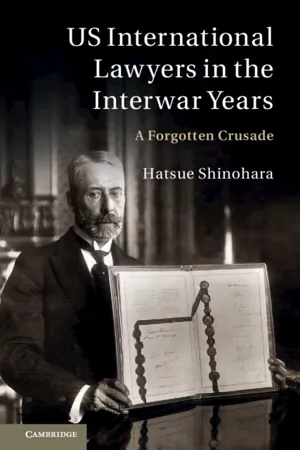 eBook - PDF
US International Lawyers in the Interwar Years
A Forgotten Crusade
- Hatsue Shinohara(Author)
- 2012(Publication Date)
- Cambridge University Press(Publisher)
But as is well known, the Kellogg–Briand Pact had only two articles, which simply proclaimed that each signatory would not resort to war as a means to solve international conflicts and that war would be illegal. It embodied the idea inherent in Levinson’s theory, which was independent in origin of developments in the League of Nations. It was a formula that Lippmann and Wright criticized. Among international lawyers, the most straightforward attack against the Pact came not surprisingly from Borchard, who wrote, “it seems to me more dangerous to sign the Kellogg Pact than to enter the League.” 43 He argued that the reservations and interpretations issued by other powers during the negotiations were legally effective, since they were officially made and communicated to the US government. Likewise, Borchard held that Kellogg’s note of June 23 which acknowledged the American insist- ence on preserving the right of self-defense was legally effective. Based on this interpretation, he wrote that “the Pact of Paris is not a renunciation of war, but formal recognition of the legality of all the wars mentioned in the reservations and exceptions.” He concluded that the Pact did not enhance the cause of peace, but rather created new misunderstandings. Besides, any attempts to abolish war by treaty, by a simple pledge, failed to consider the causes of war, which were “the more fundamental factors of political rivalry and unfair competition.” 44 41 Wright, “The Outlawry of War,” 103. 42 As for diplomatic negotiations, see FRUS, 1928, I, pp. 39–56; Ferrel, Peace in their Time, pp. 170–191. 43 Borchard to Finch, November 17, 1928, ASIL Papers. 44 Edwin M. Borchard, “The Multilateral Treaty for the Renunciation of War,” AJIL 23 ( 1929), 110–120. See also Bederman, “Appraising a Century,” 33. Can international law master war? 78 Other international lawyers were more favorable, although most of them noted weaknesses in the Pact. eBook - PDF
1928–1945
From the consequences of World War I to the end of World War II
- Heinz-Dietrich Fischer(Author)
- 2020(Publication Date)
- De Gruyter(Publisher)
In all public and private utterances here Mr. Kellogg is careful to point out Paul S. Mowrer 45 that the pact results from the generous idea of the French foreign minister, Aristide Briand. To newspaper men as well as to private individuals the secretary never makes the broad statement that the pact will abolish war, but only that it will make war more difficult. Obviously nothing can ever abolish war theoretically, for one nation can always, despite its pledges and antiwar treaties, attack another nation and the nation attacked will defend itself. But, virtually, pledges and treaties do act as a strong deterrent in times of national passion, and, moreover, the idea that a nation wilfully breaking the pact certainly will incur the enmity of all peace-loving peoples and make aggression so dangerous and so likely to fail that the utmost caution will be probable in moments of international crises. To newspapermen of countries not included in Monday's ceremony, Secretary Kellogg gives warm reassurances that immediately after this signature special individ-ual invitations to sign will be formally dispatched to all countries, and the United States sincerely trusts that all will accept the invitation. When French newspapermen in a press conference expressed the hope that the American senate would ratify the pact Mr. Kellogg merely replied that it was the president and the senate who under the American constitution make treaties and he preferred not to be quoted in any way on this subject. Related Readings Balbareu, Cécile: Le pacte de Paris. Pacte Briand-Kellogg sur la mise de la guerre hors la loi, Paris 1929. Barandon, Paul: Das Kriegsverhütungsrecht des Völkerbundes, Berlin 1933. Blum, Rolf: Das System der verbotenen und erlaubten Kriege in Völkerbundssatzung, Locarno-Verträgen und Kellogg-Pakt, Leipzig 1932. Ellis, L(ewis) Ethan: Frank B. Kellogg and American foreign relations, 1925-1929, New Bruns-wick, N.J., 1961.
Index pages curate the most relevant extracts from our library of academic textbooks. They’ve been created using an in-house natural language model (NLM), each adding context and meaning to key research topics.

