History

House of Un American Activities Committee (HUAC)
The House Un-American Activities Committee (HUAC) was a congressional committee established in 1938 to investigate alleged disloyalty and subversive activities by individuals and organizations suspected of having communist ties. HUAC gained notoriety during the Cold War era for its aggressive investigations into Hollywood and the entertainment industry, leading to the blacklisting of many artists and professionals.
Written by Perlego with AI-assistance
Related key terms
1 of 5
12 Key excerpts on "House of Un American Activities Committee (HUAC)"
 eBook - ePub
The Safety of the Kingdom
Government Responses to Subversive Threats
- J. Michael Martinez(Author)
- 2015(Publication Date)
- Carrel Books(Publisher)
Chapter 7 THE HOUSE UN-AMERICAN ACTIVITIES COMMITTEE (HUAC) Until the day I die, I shall wonder how Whittaker Chambers got into my house to use my typewriter. —ALGER HISS, DECEMBER 15, 1948,EXPLAINING HOW A TYPEWRITER BELONGING TO HIS WIFE COULD HAVE BEEN USED TO PRODUCE INCRIMINATING DOCUMENTS 301T he House Un-American Activities Committee (HUAC) was an investigative committee of the US House of Representatives created in the 1930s to determine whether subversive forces threatened the welfare of the American republic. In 1945, the House voted to make HUAC a standing committee. Afterward, it reached the height of its infamy searching for evidence of Communist subversion in the aftermath of World War II.302When HUAC was created, the use of a congressional committee to investigate activities related to the health and welfare of the regime was nothing new. As early as 1792, the US House of Representatives established a committee to explore the circumstances surrounding a calamitous campaign against American Indians. As the decades passed, Congress created select committees to examine all manner of suspicious activities or suspected malfeasance. Armed with subpoena power and a broad grant of authority, investigative committees became important vehicles for ferreting out crucial information that might otherwise remain obscure. In the hands of overzealous investigators or opportunistic members of Congress, however, congressional committees sometimes abridged constitutional protections and exercised a chilling effect on citizens who sought only to speak the truth to power.303In the early years of the republic, congressional committees appeared to have few limitations on their authority until the US Supreme Court considered the matter in Kilbourn v. Thompson . In that 1880 case, a gentleman named Hallet Kilbourn was served with a subpoena duces tecum ordering him to appear, along with a series of documents, before a House committee investigating the bankruptcy of Jay Cooke & Company, an influential investment firm that filed for bankruptcy protection during the Panic of 1873. Kilbourn complied with the subpoena and appeared before the committee, but he refused to answer some questions and failed to produce the required documents. Held in contempt of the House, Kilbourn was placed into custody until he agreed to testify and tender the necessary documents. The much-aggrieved witness eventually filed suit for false imprisonment. The US Supreme Court subsequently reviewed the case and held that Congress possesses the power to punish contempt, but the crucial issue here concerned the authority of a congressional committee to exercise what appeared to be judicial authority. In the court’s view, Kilbourn had been improperly summoned before the committee and imprisoned for contempt. A congressional committee must not be convened for investigative purposes unless the committee acts in accordance with a reasonably well-defined legislative goal.304 eBook - ePub
Elia Kazan
The Cinema of an American Outsider
- Brian Neve(Author)
- 2008(Publication Date)
- I.B. Tauris(Publisher)
3 Elia Kazan and the House Committee on Un-American ActivitiesThe House Committee on Un-American Activities (HUAC) was established in 1938 and became a Standing Committee of the House of Representatives in 1945. As was discussed in Chapter 1 , it was in October 1947 that the Committee held formal hearings in Washington on the film industry, providing a forum for various industry conservatives and some studio heads to testify as to what they saw as Communist influence on the industry. The refusal of the so-called ‘Hollywood Ten’ to answer questions on their Communist affiliations at these hearings led to their being cited for contempt of Congress by the House of Representatives. On the same day representatives of the major studios signed the Waldorf Declaration, pledging that they would not in future employ Communists. This essentially instituted a blacklist, although its full implementation would have to wait nearly three years until 1950 for the Supreme Court to decline to review an appeal on behalf of the Ten.1Senator Joseph McCarthy’s February 1950 speech in Wheeling, West Virginia – in which he began his campaign against Communists in the State Department – came in the immediate wake of the conviction of Alger Hiss, the former State Department official who had been accused by HUAC of passing secrets to a Communist spy ring and was now beginning a five-year sentence for perjury. To the cultural historian Richard Pells the conviction of Hiss ‘lent credence to the theory that all communists should be regarded as potential foreign agents’. Under the Internal Security Act, which became law in September 1950, Communist and Communist front organisations were required to register with the government, while the next year the Supreme Court upheld the convictions of the Communist Party leadership, further legitimating the FBI’s anti-Communist crusade.2 eBook - ePub
Dalton Trumbo
Blacklisted Hollywood Radical
- Larry Ceplair, Christopher Trumbo(Authors)
- 2015(Publication Date)
- The University Press of Kentucky(Publisher)
9The 1947 Hearings of the Committee on Un-American ActivitiesWe called it “the committee.” We never capitalized it. We never called it HUAC or by any other initials. Other such committees, like the California one, we called by name—the Tenney Committee. “The committee” was reserved for the Feds.—Christopher TrumboOne of the great mysteries that confronts anyone who studies the history of the early domestic cold war is how the small- and narrow-minded members of the House Committee on Un-American Activities (1947–1951) succeeded in imposing their rigid and humiliating version of Americanism (nationalism cum patriotism) on the political culture of the United States.1 These men, not Senator Joseph McCarthy (R-Wis.), set the stage for official Cold War anticommunism. They did so by craftily melding together the power of a long-standing bogey (the Communist menace) and the virtually unchallengeable power of a congressional investigation (complete with subpoenas, the chairman’s gavel, and contempt citations). An even greater mystery is why a larger group with arguably loftier intellects and ideals (federal judges) gave their imprimatur to these show trials. Without the contempt convictions, the committee might have been a nuisance but not a name-, status-, and job-destroying juggernaut.On three previous occasions, 1938, 1940, and 1945, the chairman of the Special Committee on Un-American Activities had threatened to investigate Communists in Hollywood. Each time, nothing had transpired. But after the Republican sweep of the 1946 congressional elections, J. Parnell Thomas (R-N.J.), the new chairman of the now-permanent committee, launched an investigation into what he called the “Moscow-directed fifth column” in the United States.2 At the first hearing, held in March 1947, Eric Johnston, president of the producers’ associations, told the committee that Communists had completely failed to capture the movie industry and their propaganda never reached the screen. Several committee members openly scoffed at Johnston’s words,3 and it was soon announced that a three-person subcommittee would be coming to Los Angeles. The subcommittee arrived on May 8 to investigate composer Hanns Eisler (whose brother, Gerhart, was reputed to be the leading Soviet agent in the United States) and, in Thomas’s words, “to initiate an extensive and all-inclusive investigation of communistic activities and influences in the motion-picture industry.”4 The subcommittee held several closed-door hearings at the Biltmore Hotel, listening mainly to members of the Motion Picture Alliance, whom Thomas characterized as “friendly witnesses.”5 eBook - PDF
Dalton Trumbo
Blacklisted Hollywood Radical
- Larry Ceplair, Christopher Trumbo(Authors)
- 2015(Publication Date)
- The University Press of Kentucky(Publisher)
185 9 The 1947 Hearings of the Committee on Un-American Activities We called it “the committee.” We never capitalized it. We never called it HUAC or by any other initials. Other such commit-tees, like the California one, we called by name—the Tenney Committee. “The committee” was reserved for the Feds. —Christopher Trumbo One of the great mysteries that confronts anyone who studies the his-tory of the early domestic cold war is how the small- and narrow-minded members of the House Committee on Un-American Activities (1947–1951) succeeded in imposing their rigid and humiliating version of Americanism (nationalism cum patriotism) on the political culture of the United States. 1 These men, not Senator Joseph McCarthy (R-Wis.), set the stage for official Cold War anticommunism. They did so by craftily melding together the power of a long-standing bogey (the Com-munist menace) and the virtually unchallengeable power of a congres-sional investigation (complete with subpoenas, the chairman’s gavel, and contempt citations). An even greater mystery is why a larger group with arguably loftier intellects and ideals (federal judges) gave their imprimatur to these show trials. Without the contempt convictions, the committee might have been a nuisance but not a name-, status-, and job-destroying juggernaut. On three previous occasions, 1938, 1940, and 1945, the chair-man of the Special Committee on Un-American Activities had threat-ened to investigate Communists in Hollywood. Each time, nothing had transpired. But after the Republican sweep of the 1946 congressional elections, J. Parnell Thomas (R-N.J.), the new chairman of the now-permanent committee, launched an investigation into what he called 186 DALTON TRUMBO the “Moscow-directed fifth column” in the United States.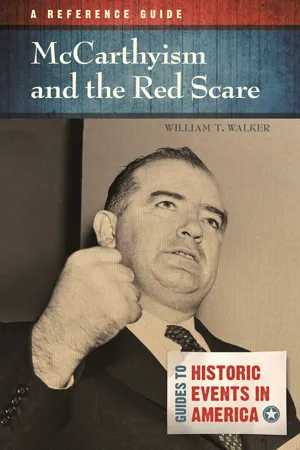 eBook - PDF
McCarthyism and the Red Scare
A Reference Guide
- William T. Walker(Author)
- 2011(Publication Date)
- ABC-CLIO(Publisher)
DOCUMENT 1 Establishment of the Special House Committee for the Investigation of Un-American Activities [The Dies Committee], May 26, 1938 In response to mounting concerns that the United States was being infil- trated by foreign and domestic elements that could threaten the U.S. political system, the U.S. House of Representatives established the Spe- cial House Committee for the Investigation of Un-American Activities on May 26, 1938. Initially chaired by Martin Dies, Jr. (D-Texas), the House Un-American Activities Committee (HUAA) played an active part during the Red Scare after World War II and survived until 1975. Resolved, That the Speaker of the House of Representatives be, and he is hereby, authorized to appoint a special committee to be composed of seven members for the purpose of conducting an inves- tigation of (1) the extent, character, and objects of un-American propaganda activities in the United States, (2) the diffusion with the United States of subversive and un-American propaganda that is instigated from foreign countries or of a domestic origin and attacks the principle of the form of government as guaranteed by the Constitution, and (3) all other questions in relation thereto that would aid Congress in any necessary remedial legislation. (United States, Congressional Record, 75 th Congress, 2nd Session, May 10, 1938, 6562. PRIMARY DOCUMENTS 130 Primary Documents DOCUMENT 2 J. Edgar Hoover Warns of the Threat from American Communists, October 28, 1945 Within months of the defeat of Germany and Japan, J. Edgar Hoover, Director of the Federal Bureau of Investigation (FBI), presented remarks before a meeting of the International Association of Police Chiefs in which he pointed to the security dangers posed by the American Com- munist Party. In this speech, Hoover demonstrated his political acumen by making a clear distinction between the American Communist Party and the Soviet Union. . . . The responsibilities of law enforcement are ever broadening. eBook - ePub
J. Edgar Hoover Goes to the Movies
The FBI and the Origins of Hollywood's Cold War
- John Sbardellati(Author)
- 2012(Publication Date)
- Cornell University Press(Publisher)
5
THE 1947 HUAC TRIALS
I never as a citizen want to see our country become urged, by either fear or resentment of this group, that we ever compromise with any of our democratic principles through that fear or resentment. —Ronald Reagan, speaking before HUAC, October 1947The show began on Monday, October 20, 1947. Microphones and loudspeakers amplified the air, floodlights swung from the majestic chandeliers, and lawmen steered the crowd of hundreds eager to get a glimpse of Gary Cooper or Robert Montgomery. Such was the atmosphere as the House Committee on Un-American Activities ushered in its most publicized investigation to date with its hearings on Communist infiltration in Hollywood. “It has been launched with that ineffable touch of showmanship which the naïve Easterner associates with a Hollywood premiere,” the New York Times reported, “lacking only in orchids, evening dress and searchlights crisscrossing the evening sky.” HUAC reserved the largest available auditorium in D.C. for the event—the caucus room in the Old House Office Building—and welcomed coverage from the national press and major broadcasting networks. The committee hoped for a spectacle.1Chairman J. Parnell Thomas opened the hearings by recognizing the enormity of his committee’s undertaking. Hollywood represented one of the nation’s largest industries, its output consumed by eighty-five million Americans each week. This fact, so Thomas charged, necessitated HUAC’s investigation, for the movies held the power to shape American thought and culture. “With such vast influence over the lives of American citizens as the motion-picture industry exerts,” Thomas pleaded, “it is not unnatural—in fact it is very logical—that subversive and undemocratic forces should attempt to use this medium for un-American purposes.” Thomas claimed that the soured relations with the Soviet Union created an international system fraught with peril. Communists in the United States had long practiced their “boring from within” strategy, but the new Cold War made their endeavors all the more hazardous to national security. Thomas asserted that Soviet plans for world domination were made clear by the reopening of the Communist International. Communists in Hollywood, therefore, represented both an internal and external threat to the United States, the “chief target in what we might call the Soviet Union’s ideological war” against the West. No longer merely a domestic concern, the threat of Communism in Hollywood now struck a more dire chord, and HUAC’s investigation marked an opening salvo in the cultural cold war.2 eBook - ePub
The Subversive Screen
Communist Influence in Hollywood's Golden Age
- Brian E. Birdnow(Author)
- 2019(Publication Date)
- Praeger(Publisher)
CHAPTER SIX The HUAC HearingsAfter the preliminary skirmishes of May 1947, Congressman J. Parnell Thomas announced that he would hold public hearings on communist infiltration of the motion picture industry in Washington, D.C. during the second week of October. The House Committee on Un-American Activities, known, as we have stated, as HUAC, issued forty-three subpoenas, twenty-four of them to a group known as the “friendly witnesses.” These were Hollywood figures who had expressed guarded support for the inquiry, and, in fact, some of them had testified at the earlier closed executive sessions in Los Angeles in May. The remaining nineteen individuals on the subpoena list, eleven of whom were called to testify, had publicly denounced the hearings and had let it be known that they planned not to cooperate. Consequently, they were known as the “unfriendly witnesses.”The nineteen witnesses deemed the “unfriendlies” had been classified as likely communists by the Motion Picture Alliance for the Preservation of American Ideals, a relatively new organization of politically conservative members of the film community. The rather unwieldy name of the organization led to people referring to this group by the acronym MPA, short for Motion Picture Alliance. The list of “unfriendly witnesses” consisted of Alvah Bessie, Herbert Biberman, Bertolt Brecht, Lester Cole, Richard Collins, Edward Dmytryk, Gordon Kahn, Howard Koch, Ring Lardner, Jr., John Howard Lawson, Albert Maltz, Lewis Milestone, Samuel Ornitz, Larry Parks, Irving Pichel, Robert Rossen, Waldo Salt, Adrian Scott, and Dalton Trumbo. The “Nineteen Unfriendlies,” along with their attorneys, now had to formulate a defense strategy.1While most observers waited for the next move in this complex minuet, official Hollywood began to choose sides. In the late summer of 1947, party organizer Harold Salemson claimed that the battle lines were forming among the Hollywood elite. He pointed out that a party splinter group, the Progressive Citizens of America, included John Garfield, Lena Horne, Edward G. Robinson, Anne Revere, Gene Kelly, Paul Henreid, Betty Garrett, Katharine Hepburn, Paul Draper, Howard Da Silva, Lee J. Cobb, Gregory Peck, and others. He also mentioned a so-called “Republican” group, which included Ginger Rogers, Robert Montgomery, Adolphe Menjou, George Murphy, Walt Disney, screenwriter Morrie Ryskind, and director-producer Leo McCarey, as closely following the developments, although coming at things via different routes.2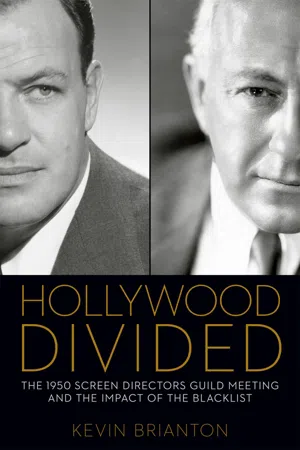 eBook - PDF
Hollywood Divided
The 1950 Screen Directors Guild Meeting and the Impact of the Blacklist
- Kevin Brianton(Author)
- 2016(Publication Date)
- The University Press of Kentucky(Publisher)
6 The full HUAC investigations began in October 1947. Nineteen sub- poenas were issued, and SDG members Herbert Biberman, Edward Dmytryk, Lewis Milestone, Irving Pichel, and Robert Rossen were among those called to testify—an odd selection as Milestone and Pichel were not Communists. The mixture of Hollywood glamour and the sinister threat of Communism proved irresistible for the media: the hearings drew so much attention that spectators needed to wear sunglasses to avoid the The House Un-American Activities Committee Arrives in Hollywood 15 glare from the lights of film crews. The hearings worked through a roster of what the FBI called “friendly witnesses” during the first few days of the carefully planned testimony. The investigations have been labeled a show trial by critics, and with good reason. The FBI had been working for months to ensure that HUAC had a good supply of potential anti- Communist witnesses. It had also identified possible Communists through eight years of FBI investigation. When the hearings began on October 20, the SDG immediately came into sharp focus with the testimony of the conservative director Sam Wood, who was president of the MPAPAI. Wood argued: “There is a constant effort to get control of the Guild. In fact, there is an effort to get control of all unions and guilds in Hollywood. I think our most serious time was when George Stevens was president; he went in the service and another gentleman took his place, who died, and it was turned over to John Cromwell. Cromwell, with the assistance of three or four others, tried hard to steer us into the Red river, but we had a little too much weight for that.” Sam Wood had a gentle-looking face that belied an almost obsessive anti-Communism: he made his children swear anti- Communist affidavits or face being disinherited. He had started his career as an assistant to DeMille in 1915, and these long-time colleagues were now strong anti-Communist allies.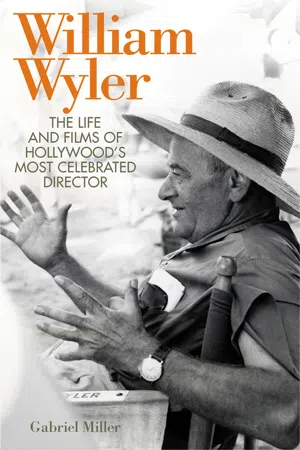 eBook - ePub
William Wyler
The Life and Films of Hollywood’s Most Celebrated Director
- Gabriel Miller(Author)
- 2013(Publication Date)
- The University Press of Kentucky(Publisher)
14
The House Un-American Activities Committee
Detective Story (1951), Roman Holiday (1953), The Desperate Hours (1955), The Children's Hour (1961)In September 1947, J. Parnell Thomas, a Republican congressman from New Jersey, reconvened the House Un-American Activities Committee (HUAC) to investigate “alleged subversive influence on motion pictures.” More than forty people from the film industry received subpoenas to appear before the committee. There were two groups of witnesses. One—termed “friendly” by the committee—was made up of individuals willing to name fellow workers whom they thought to be members of the Communist Party and to identify moments in films that contained communist propaganda. The second group—labeled “unfriendly”—consisted of nineteen actors, writers, producers, and directors who became, in effect, the defendants. Of these nineteen, only eleven were called to testify. One of the eleven, German playwright Bertolt Brecht, denied membership in the Communist Party and promptly left the country. The others, who became known as the “Hollywood Ten,” were eventually tried, fined, and imprisoned for contempt of Congress.Shortly after the announcement that the HUAC would hold its first hearings in October 1947, Wyler and his friends John Huston, Philip Dunne, and Canadian actor Alexander Knox met to form a group in opposition to the hearings. At first, they called their campaign Hollywood Fights Back, but they later changed the name to the Committee for the First Amendment (CFA). The CFA gathered at Ira Gershwin's home—along with a group of Hollywood stars that included Edward G. Robinson, Danny Kaye, Humphrey Bogart, Lauren Bacall, Burt Lancaster, Gregory Peck, Myrna Loy, Ava Gardner, Henry Fonda, and Gene Kelly—and prepared a statement that ran a few days later in newspapers across the country and was also presented to Congress in the form of a petition. An early version of the petition, which was signed by David Selznick, John Ford, Bette Davis, George Stevens, and Frank Capra, among others, read in part: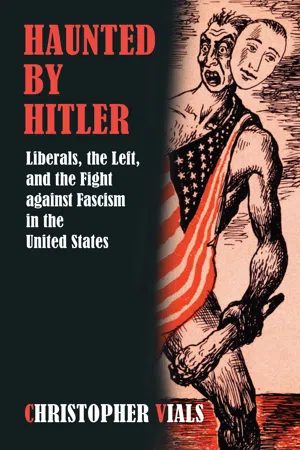 eBook - ePub
Haunted by Hitler
Liberals, the Left, and the Fight against Fascism in the United States
- Christopher Vials(Author)
- 2017(Publication Date)
- University of Massachusetts Press(Publisher)
The senator did not originate the phenomenon which came to bear his name, McCarthyism, but when he started to fall, the whole edifice of domestic anticommunist repression began to crack. Its postwar incarnation began in earnest with the resumption of the House Committee on Un-American Activities (HUAC) in 1946 and its hearings on the Hollywood Ten in 1947; with Truman’s purge of suspected communists from federal agencies and the establishment of a List of Subversive Organizations by his attorney general in 1947; and with the American Business Consultants’ publication Red Channels in 1950, a reference guide used by radio, television, and film executives to blacklist individuals suspected of communist affiliation. McCarthy, whose plebeian, tough-guy persona made him a seminal figure in the emergence of right-wing populism in the United States, came to personify this wave of political reaction. 3 And as a number of scholars have noted, the wave he rode was not so much one of repression of communism as of any challenge to the Cold War consensus and entrenched power. 4 Over the course of his wild, devastating four years of power, begun in 1950, he used his position as chair of the Senate Internal Security Subcommittee (SISS) to hunt down domestic Communists and in so doing turned a range of social institutions upside down, including the State Department, labor unions, the culture industries, the university system, and the military. McCarthy had always been a controversial, polarizing figure, one who had more critics than fans. 5 Liberals chafed under his accusations of treason, establishment figures like the U.S. diplomat George Kennan, the publisher Henry Luce, and Dwight Eisenhower eventually saw him as compromising the legitimate fight against communism, and the left justifiably felt that his unchecked power threatened its very existence. His probe of the U.S eBook - PDF
Unions, Radicals, and Democratic Presidents
Seeking Social Change in the Twentieth Century
- Martin Halpern(Author)
- 2003(Publication Date)
- Praeger(Publisher)
Second, they sought to halt any push toward an expanded New Deal by destroying the left-progressive coalition that helped propel the New Deal forward. Left-wing organi- zations often played initiating roles on both domestic and foreign policy fronts and they were therefore a special target, but anyone who challenged the cold war consensus was subject to attack. 19 HUAC's visit to Detroit was preceded by "all the ballyhoo of a three- ring circus." FBI and committee investigators began questioning Detroit activists in preparation for the hearings as early as October 1951. Two weeks before the committee arrived, Detroit's newspapers joined in creat- ing an anticommunist climate when they gave front-page banner head- lines to Bereneice Baldwin's testimony identifying 28 Detroiters as Communists before the Subversive Activities Control Board hearing in Washington on the question of registering Communists under the Internal Security Act. 20 Progressives attempted to combat the incipient hysteria. The Civil Rights Congress devoted its full energies to organizing the defense. Local 600 established a defense committee to support its subpoenaed members and protect the local itself. Ford Facts, the local's paper, focused an entire issue on an attack on HUAC. The newspaper criticized the reactionary voting records of committee members and several building presidents wrote columns against the committee. The Wolverine Bar Association unanimously deplored the HUAC investigation and expressed support of 68 Unions, Radicals, and Democratic Presidents its "highly respected" member, C. Lebron Simmons. The Baptist Minister- ial Alliance, for its part, gave full backing to Rev. Hill. On the Sunday before the hearings opened, the ministers group gained broad community support at a rally it sponsored at Rev. Hill's church. Local 600 held a protest rally of 500 at the same time.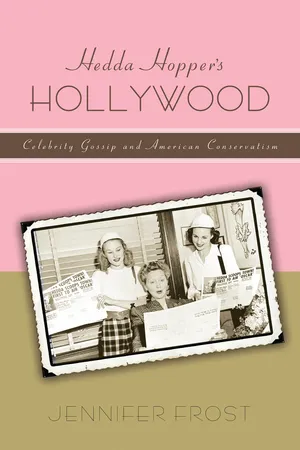 eBook - ePub
Hedda Hopper’s Hollywood
Celebrity Gossip and American Conservatism
- Jennifer Frost(Author)
- 2011(Publication Date)
- NYU Press(Publisher)
In 1947, as she had in 1940 with its forerunner, Hopper gladly welcomed HUAC, now a permanent committee in a Republican-controlled Congress, to Hollywood. So did her MPA colleagues Adolph Menjou, Robert Taylor, and Walt Disney. In March, the same month an emboldened HUAC commenced its first post–World War II investigation of the motion picture industry, Hopper wrote, “We have dawdled long enough. It seems to me the time has come for facts, not vagaries; action, not lethargy. If, as they have so often been accused, ‘Communist front’ organizations have a direct link with a foreign government unfriendly toward our way of life, let it be proved once and for all by our government.” 23 HUAC’s premises and purposes in launching its Hollywood investigation were consistent with Hopper’s anti-Communist campaign. HUAC sought to expose Communist propaganda in the movies and, as part of the effort to conflate liberalism with Communism, the connection between the Roosevelt administration and wartime films about the Soviet Union—a connection Hopper later made with Mission to Moscow. “I was told at the time F.D.R. told Jack Warner to make it. It would give Americans a more kindly feeling toward Commies,” she later wrote, forgetting her own kindly feelings during the war. 24 HUAC also aimed to destroy the Communist Party, undermine the film industry’s interest in making films that criticized any aspect of the United States, and set the stage and gain publicity for its Cold War pursuit of “un-American activities.” 25 Hopper backed all these aims, as did her allies in Hollywood. In May 1947, HUAC held hearings in Los Angeles and heard testimony from fourteen witnesses deemed “friendly” because they, like Hopper, endorsed the HUAC investigation; most of these “friendlies” were her allies in the Motion Picture Alliance
Index pages curate the most relevant extracts from our library of academic textbooks. They’ve been created using an in-house natural language model (NLM), each adding context and meaning to key research topics.

