History

Life in Nazi Germany
Written by Perlego with AI-assistance
Related key terms
1 of 5
3 Key excerpts on "Life in Nazi Germany"
 eBook - ePub
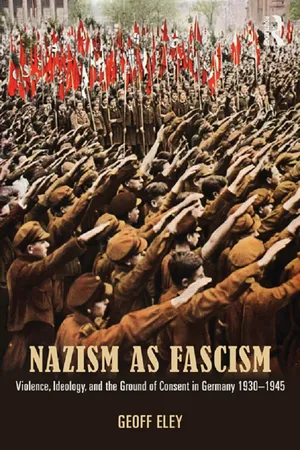
Nazism as Fascism
Violence, Ideology, and the Ground of Consent in Germany 1930-1945
- Geoff Eley(Author)
- 2013(Publication Date)
- Routledge(Publisher)
Making some kind of workable life under Nazism had to entail such “grayness” so long as the options of emigration or illegality – or identifying positively with the regime – were not to be embraced. Moreover, historians now gravitate more toward the war years than the 1930s; they are ever more likely to see the coming Holocaust and German– Jewish relations as the main determinative context; they treat race qua the “racial state” as the principal organizing term; and they stress the practical conformities exacted by the regime’s everyday functioning as much as its spectacular manifestations, overt ideological interventions, and manifest political presence. Highly particularized micro-histories, biographies and memoirs, and “memory work” of all kinds form one familiar setting. With the exception of the major biographies, current research likewise de-emphasizes the more traditional political and institutional sites of analysis, turning instead to areas such as leisure and tourism, sexuality, cinema-going, music, the arts, fashion, consumption, and popular culture in all of its ways. In the process, a far more nuanced appreciation for the complexities of living under Nazism has certainly developed, whether for discrete social categories of the populace or for the various dimensions of people’s lives. Those old moral truths offered by the binaries of “victims versus perpetrators” and “resistance versus collaboration” are no longer quite as easily invoked. 1 One consequence of these developments is, in principle, to reinstate the value of ideological analysis, which for many years social history’s dominance tended effectively to banish from the field. For all their admirable subtlety, for example, convinced materialists such as Broszat and Mason treated “social context” and “ideology” dichotomously, giving unambiguous explanatory precedence to the former over the latter eBook - ePub
- Stephen J. Lee(Author)
- 2013(Publication Date)
- Routledge(Publisher)
Outside the Volksgemeinschaft DOI: 10.4324/9780203717851-8 Background The Nazi regime was totally committed to the pursuit of a racial policy of Aryanism, or the projection of the German people as the master race. This involved the concept of Social Darwinism, or the survival of the fittest – within the People’s Community or Volksgemeinschaft. Analysis 1 shows the origins of racial theories and the impact of the regime’s actions on those who were, for some reason, considered unworthy of inclusion in, or a threat to, the Volksgemeinschaft. Those who were ‘alien to the community’ (gemeinschaftsfremd) included people with hereditary or transmissible ‘impairments’; those – such as vagrants, alcoholics or homosexuals – with unacceptable lifestyles; and members of ‘inferior’ races, including gypsies (more accurately called Sinti and Roma), Negroes, Slavs and – above all – Jews. Measures included disabling legislation, deprivation of civil rights, sterilisation, confinement to concentration camps and, under the radicalising impact of war, ‘euthanasia’ and extermination. The most extreme manifestation of Nazi racial policies was the Holocaust, in which over six million Jews and several hundred thousand gypsies were killed from 1941 onwards by SS squads (Einsatzgruppen) and units of the Wehrmacht or, following the Wannsee Conference of January 1942, in gas chambers at Auschwitz, Treblinka, Maidenek, Sobibor and Chelmo. Analysis 2 considers different interpretations about the origins of the Holocaust, about the extent to which the German people were involved, and the type of mentality needed to take part in acts of genocide eBook - ePub
- Frank McDonough(Author)
- 2014(Publication Date)
- Routledge(Publisher)
Deutschland über Alles” to mean that nothing in the wide world surpasses in his eyes this Germany, people and land – that man is a socialist’. On this definition, National Socialism was a form of uncritical loyalty to the state. The ‘radical’ wing of the Nazi Party – led by Gregor Strasser – argued that a National Socialist state should control the economic life and resources of the nation, and then use them for the benefit of the whole community. Hitler realised such ideas would alienate business and army support. As a result, ‘socialist’ ideas were marginalised in the Nazi programme before Hitler came to power – and most of the supporters of these ideas were brutally killed in the blood purge (known as ‘the Night of the Long Knives’) which took place in 1933.As we have seen, much of Nazi ideology was borrowed from ideas long current in nationalist and anti-Semitic groups, which were themselves borrowed from the ideas of right-wing philosophers and social Darwinist writers. Nazism, like a very large sponge, soaked up these ideas, and then wrung them out to form the misty sludge known as National Socialism. Yet the importance of ideology for Hitler, was not in the ideas themselves: most of them were mythologised and utopian dreams, unsuited to the practical realities of a modern industrial society, or were eugenic and racist mumbo-jumbo which, if applied, would inevitably lead, even though the road may be twisted, towards genocide and war. Hitler could scarcely define an ‘Aryan’, or a ‘Jew’, and he often admitted privately that most of his master race ideas had little chance of being achieved in his lifetime, if at all. What Nazi ideology could do successfully was to define – in exaggerated terms – internal enemies: ‘the Jews and the Marxists’ and external ones: France and the Soviet Union, which had to be ‘destroyed’ or ‘eliminated’ or ‘exterminated’ before the Germans could begin to create their Volkisch utopia. Yet in the period when Hitler rose to power, it was the optimistic and utopian dream of creating a harmonious Volksgemeinschaft
Index pages curate the most relevant extracts from our library of academic textbooks. They’ve been created using an in-house natural language model (NLM), each adding context and meaning to key research topics.

