History

Nazism and Hitler
Written by Perlego with AI-assistance
Related key terms
1 of 5
4 Key excerpts on "Nazism and Hitler"
 eBook - ePub
Democracy and Dictatorship
Their Psychology and Patterns
- Zevedei Barbu(Author)
- 2013(Publication Date)
- Routledge(Publisher)
Chapter One Dictatorship of the Right
DOI: 10.4324/9781315888712-12‘ . . . nothing appears more surprising to those who consider human affairs with a philosophical eye than the easiness with which the many are governed by the few.’ David HumeThe German political régime of the period between 1933-45 is generally known under the name of Nazism or Hitlerism. Though lasting a relatively short time it embodied in its doctrine and practice the most characteristic totalitarian trends of our century. Like Italian Fascism and many other Fascist movements, Nazism was a dictatorship of the right, a political organization based on exclusivist and aggressive nationalism under the personal dictatorship of a leader.From the political point of view Nazism was characterized by the concentration of absolute power in the hands of a leader who exercised it by means of his own party organized in a military manner. It was a typical one-party system in which democratic electoral methods were replaced by occasional plebiscites on issues selected by the leader.From the economic point of view Nazism was a case of a controlled economy. In principle the system of private ownership remained untouched. Free enterprise, however, was considerably limited by the interference of the State in the processes of production and distribution.The Nazi régime required the individual's total integration with the aims of his group as represented by the leader and his party. Nazis were against that kind of life which allows the individual a ‘quiet’ fulfilment of his social duties. They asked for enthusiasm and sacrifice for the common cause. Nazism was firstly a stato d'animo (Mussolini) and only in the second place a political formula.At the cultural level Nazism was a case of directed culture, with an official ideology, coined by the leaders of the Party and enforced upon the whole cultural activity of the community. The cultural outlook had a strong mystic character, without being religious; it was idealistic, and yet not oriented towards spiritual values; it called itself revolutionary, and in spite of this it was not progressive, but on the contrary, traditionalist. The ideal of man was embodied in the strong man or in the possessor of political power.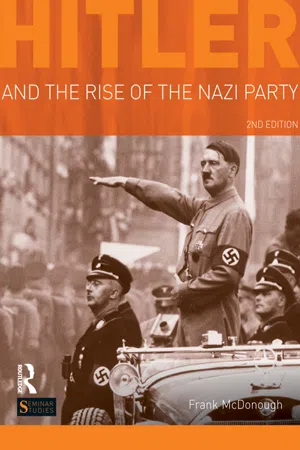 eBook - ePub
- Frank McDonough(Author)
- 2014(Publication Date)
- Routledge(Publisher)
The acceptance of a general theory of fascism has also encountered similar problems of gaining credibility among historians and political scientists. No single theory of fascism can possibly explain the different characteristics of the many different regimes and political parties which called themselves ‘fascist’ and operated throughout Europe during the inter-war period. Even Nazism and Italian Fascism exhibited major ideological differences. Race was of fundamental significance in Nazi ideology, but of comparative insignificance to Italian Fascists. Mussolini gave open support to many aspects of modernity, while Hitler tended to stress the need to incorporate many lost medieval customs into German society. At the same time, there were many similarities between Italian Fascism and National Socialism, including, extreme nationalism, emphasis on strong dictatorial leadership, a strong anti-Marxism, which implied the destruction of working-class and Marxist organisations, ruthless repression of all opposition groups, contempt for democratic forms of government, the glorification of war, strong support for rearmament, a stress on the need for economic self-sufficiency, the use of propaganda and, especially, in the rise to power of Mussolini and Hitler, the forging of alliances with existing anti-democratic elites within the state, and the creation of paramilitary organisations of ex-soldiers to add to the sense of general chaos on the streets. In most respects, fascist ideology opposed existing ‘established’ religion, but at the same time projected a messianic mission, which resembled a devotion to a religious faith. Fascism was a sort of political religion, which expressed a rather utopian vision of the future, in which a new state and a ‘new man’ would prosper. Fascism also stressed action and daring, which appealed to young people. Another key characteristic of fascist ideology was its stress on male chauvinism and male domination over society. Fascist ideology had little interest in women’s equality or women’s rights.In spite of the similarities between the Italian and German versions of fascism, many historians do not accept Nazism was simply a mere derivative version of Italian Fascism, primarily because the specific differences between Italian Fascism and National Socialism when examined in detail outweigh the similarities, especially, the over-arching race theory within National Socialism, to which all other aspects of Nazi ideology and policy were inextricably linked. Put this way, Nazism can be viewed as a unique phenomenon because its emphasis on race, and the anti-modern idea of the Volkisch state differed greatly from the modernist ideas of Italian Fascism. More importantly, Hitler’s unique personality and ideological obsession with race gave Nazism specific German–Austrian characteristics which must be analysed in the context of the historical development of Germany.The Historical Roots of Nazism
No major historical force emerges without some prior development and the historical roots of Nazism stretched back into history. Nazi propaganda certainly acknowledged its debt to many past historical influences. Hitler claimed ‘A man who has no sense of history, is like a man who has no eyes and ears’ (Bullock, 1962 eBook - ePub
Digital Demagogue
Authoritarian Capitalism in the Age of Trump and Twitter
- Christian Fuchs(Author)
- 2018(Publication Date)
- Pluto Press(Publisher)
In section three, Neumann shows how Nazism’s ideology and class system interacted. Ideologically, Nazi-fascism ‘claims to have […] created a society differentiated not by classes but according to occupation and training’ (367). But in reality, under the ideological guise of racism and nationalism, it ‘deepened and solidified’ class antagonisms (367). Nazism organised society in ‘a monistic, total, authoritarian’ (400) manner that was ideologically presented as an ‘abstract “people’s community,” which hides the complete depersonalization of human relations and the isolation of man from man’ (402).The essence of National Socialist social policy consists in the acceptance and strengthening of the prevailing class character of German society, in the attempted consolidation of its ruling class, in the atomization of the subordinate strata through the destruction of every autonomous group mediating between them and the state, in the creation of a system of autocratic bureaucracies interfering in all human relations. (367)Nazism’s totalitarian monopoly capitalism deepened capitalist class structures via a terroristic state driven by anti-Semitic and racist ideology, abolished the rule of law and exercised the utmost violence.Nazi Germany’s Economy: Totalitarian State Capitalism or Totalitarian Monopoly Capitalism?
Franz L. Neumann (1944/2009, 116–20, 275) argues that the ‘Aryanisation’ of Jewish property served the expansion of German monopoly capitalist interests such as those of Otto Wolff AG (steel), Friedrich Flick’s conglomerate (steel, iron, coal), or Mannesmann (steel, iron) (Neumann 1944/2009, 275, 288–92). Also, the Germanisation of conquered economies would have been part of German Nazi imperialism (275–7). Corporations in Nazi Germany were large cartels and combines that were based on the leadership principle (233). Cartels were brought about by compulsory cartelisation (Neumann, Marcuse and Kirchheimer 2013, 270, 273–4).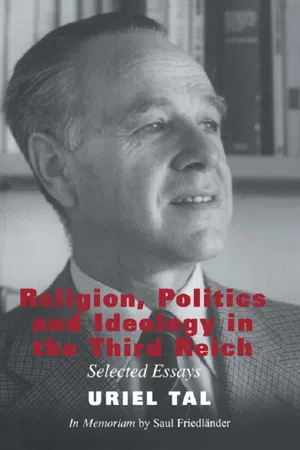 eBook - ePub
Religion, Politics and Ideology in the Third Reich
Selected Essays
- Uriel Tal(Author)
- 2004(Publication Date)
- Routledge(Publisher)
5Therefore, violence did not necessarily or exclusively mean simply the use of brute force. Of course, it goes without saying that this kind of explicit, overt force, mainly in terms of ‘political might’, was one of the main manifestations of Nazi violence from its very beginnings. Carl J. Friedrich made this clear by enumerating some of the main characteristic features of totalitarian regimes: the predominance of an official ideology covering all vital aspects of man’s existence; the rule of a single political party passionately and unquestioningly dedicated to the ruling ideology; a technologically conditioned almost total monopoly of the control of all means of power, including mass communication or education; and a system of terroristic police control often methodically exploiting scientific psychology or sociology.6However, violence as an integral part of the Nazi ideology and regime as a whole was meant to be applied rather indirectly. From its very beginnings, among the Free Corps and the Schutz und Trutz Bund during the first years of the Weimar Republic,7 as well as among its first student organizations,8 and more so later with the establishment of the Third Reich,9 Nazism intended to develop, groom, educate, and mold a new type of man, a man who did not need the power of the police or any other kind of Anwendung von Zwang (‘application of coercion’) to make him conform to the norms of the state or of society. The type of person Nazism tried to create was one who would demand of himself to act, think, feel, and believe according to what the regime expected of him, or according to what he expected the regime might expect from him. The entire complex of ideological and normative expectations applying to a member of the Aryan race was to be internalized and acted upon by the individual as a matter of course, lest he lose his peace of mind. In the long run, instead of exercising violent power by means of police coercion, Nazism intended to indoctrinate its youth so that no external violence would be needed in order to ensure the faithfulness of the German, or, more precisely, his total identification with the state, the race, the Reich, and their culmination and essence: the Führer.10
Index pages curate the most relevant extracts from our library of academic textbooks. They’ve been created using an in-house natural language model (NLM), each adding context and meaning to key research topics.

