History

Red Terror
Written by Perlego with AI-assistance
Related key terms
1 of 5
3 Key excerpts on "Red Terror"
 eBook - ePub
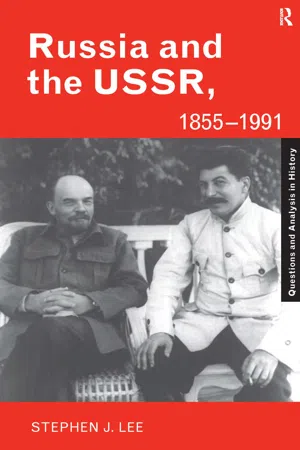
Russia and the USSR, 1855–1991
Autocracy and Dictatorship
- Stephen J. Lee(Author)
- 2020(Publication Date)
- Routledge(Publisher)
Oprichniki and the NKVD. Yet, despite the continuity, the Soviet period does seem to have practised terror on a much larger scale than Tsarist Russia. Within the period covered by this book, the most intense periods of Tsarist terror seem to have occurred in the last two decades of the nineteenth century – under Alexander III and Nicholas II. Yet these paled into insignificance beside the terror of the Lenin and Stalin periods. Under Lenin, terror became a ‘cleansing’ process, supported by Trotsky as a means of accelerating the dictatorship of the proletariat. ‘We shall not’, said Trotsky, ‘enter the kingdom of socialism in white gloves on a polished floor.’ By contrast, Tsarist terror operated to remove perceived threats to the existing system, not as part of the baptism of fire for a new one. The Leninist terror was reactivated by Stalin and given a new twist to ensure personal dictatorship. Under Stalin, therefore, terror entered a phase of reaction while retaining a revolutionary impetus. His purges added a Tsarist capriciousness to ideological bloodletting – and unleashed massive destruction and misery. For this reason Stalin has aptly been called a ‘Red Tsar’.The pulse of terror was a feature of both Tsarist and Soviet Russia. Nicholas I used it selectively, and Alexander II dispensed with it in the 1860s but allowed its use by his officials in the late 1860s and early 1870s – only to have removed it again by 1881. Alexander III sanctioned it in the 1880s, as did Nicholas II between 1894 and 1905; both, however, found it more difficult to justify thereafter. The Soviet regime used to terror on a larger scale during the Civil War (1918–21) but ended the Cheka in 1921. Stalin reactivated and massively increased the terror in two waves: 1931–9 and 1946–53. Unlike anyone else in Russian history he made it the norm rather than the exception. This helps explain the revulsion against Stalin from his successor, Khrushchev, and the abandonment of terror as an integral part of the methods of repression by future Soviet leaders like Brezhnev and Andropov, even though the latter had previously been head of the KGB.We have already seen that repression can be interpreted as the hallmark of either a strong or a weak regime. The same duality can be attached to terror. Normally the strongest exponents of terror are seen as those maintaining their power most effectively – especially Alexander III in the tradition of Nicholas I and Stalin, a combination of Lenin and a latter-day Ivan the Terrible. Yet, it has been argued, this presupposes that the initiative for terror always came from the top and affected those below. An alternative is to see terror as an endemic condition within Russia, fed by social as much as political influences. Although sometimes started by political initiatives, the actual process was determined from below. The worst of the terror in the later Tsarist period manifested itself in the pogroms against the Jews during the 1880s and 1890s: these were not directly instigated by the authorities, although the latter were implicated by their apparent indifference to the plight of those who were being persecuted. Revisionist historians have also called into question the extent of Stalin’s control over the purges of the 1930s, arguing instead that much of the momentum came from an excess of local zeal (see Analysis 2). Terror, in other words, spiralled out of control. eBook - ePub
Thou Shalt Kill
Revolutionary Terrorism in Russia, 1894-1917
- Anna Geifman(Author)
- 2020(Publication Date)
- Princeton University Press(Publisher)
A list of the more sensational terrorist acts perpetrated by the radicals against leading political figures in the early years of the century, while impressive, does not convey the magnitude of the phenomenon. Although several prominent members of the government were assassinated, including Sipiagin in April of 1902, his successor as minister of the interior, Viacheslav von Plehve, in July of 1904, and even the tsar’s uncle, the governor-general of Moscow, Grand Duke Sergei Aleksandrovich, in February of 1905, these were only isolated instances of terror, the majority of which were executed by a single terrorist group, the PSR Combat Organization. When all varieties of violence assumed mass proportions following the outbreak of the revolution, political assassinations and expropriations also began to be perpetrated en masse.The government found itself fighting to preserve the existing order against numerous adversaries: peasants who were killing landowners and burning their estates; striking workers fighting on the barricades; soldiers and sailors firing on their officers and throwing them overboard; the non-Russian nationalities taking up arms against the imperial authorities in the borderlands; cohorts of the radicals, ready for violence, assuming control of entire towns; and the intelligentsia cheering the revolt all the while. Under these conditions widespread terrorism became both the catalyst for and the result of Russia’s internal crisis. On the one hand, individual assassination attacks and expropriations played a primary role in undermining the political and economic stability of the tsarist regime, inhibiting its efforts to wage an effective antirevolutionary war on multiple fronts. On the other, terrorism was allowed to assume enormous proportions only as a consequence of a whole complex of revolutionary events in Russia—events that many contemporaries characterized as “bloody anarchy,” or simply, “one vast madhouse.”56THE EXTENT OF TERROR
The magnitude of the revolutionary terrorism is evident even from the incomplete statistics available, which clearly indicate that in Russia in the first decade of the century political assassinations and revolutionary robberies were indeed a mass phenomenon. During a one-year period beginning in October 1905, a total of 3,611 government officials of all ranks were killed and wounded throughout the empire.57 Nor did the convocation of the First State Duma in April 1906 put an end to the terrorist practices, which, along with various mass forms of revolutionary upheaval, continued to plague Russia throughout 1906 and 1907. By the end of 1907 the total number of state officials who had been killed or injured came to nearly 4,500.58 The picture becomes a particularly terrifying one in consideration of the fact that an additional 2,180 private individuals were killed and 2,530 wounded in terrorist attacks between 1905 and 1907, for a grand total of more than 9,000 casualties in the period.59 No longer available |Learn more
Terrorism
A History
- Randall D. Law(Author)
- 2016(Publication Date)
- Polity(Publisher)
10 The Era of State TerrorJudged by the standards of the day, individual and small-group terrorism around the turn of the century in Russia, Europe, the United States, Ireland, India, and elsewhere seemed to have reached enormous proportions. But after 1914, two world wars, Nazi genocide, and the creation of totalitarian regimes reminded Europeans that states were still the primary sources of organized terror, violence, and death. In the Soviet Union alone, perhaps fifty million people died “unnatural deaths” in political purges, man-made famines, and war.1 The terror unleashed during these years left permanent marks on the maps and psyches of Europeans, marks that continue to exert great influence today.As for the history of terrorism, there are two principal lessons: that acts carried out by subversive groups provide a treasure trove of tactics and strategies that are as murderously useful to repressive regimes; and that a regime’s accusation of terrorism against its opponents can also be useful in manufacturing support and consensus.Russia’s revolutions
Despite the assassinations carried out by the Combat Organization and the random bombings of the anarchists, it was not terrorism that directly brought down the Russian Empire. That was accomplished in February 1917 by hungry protesters in St. Petersburg demonstrating against an incompetent government’s prosecution of a hopeless war, and by the soldiers and police who refused to fire on them. Theirs was a people’s revolution. Not so the Bolsheviks’ armed coup d’état eight months later against the Provisional Government, which led to a quick Russian exit from the war, the rapid construction of a one-party dictatorship, and the enactment of a radical socialist program.Lenin’s party had in theory rejected sub-state terrorism, following the pre-revolutionary line espoused by Leon Trotsky, who had denounced assassination and “individual terror” as futile and ahistorical. And yet the Bolsheviks bore the imprint of their predecessors: they practiced banditry and economic terrorism under the designation of “revolutionary expropriations”; preserved their underground movement thanks to the conspiratorial methods pioneered by the People’s Will and other groups; and walked in the footsteps of Nechaev, who plotted a revolution on behalf of but not by
Index pages curate the most relevant extracts from our library of academic textbooks. They’ve been created using an in-house natural language model (NLM), each adding context and meaning to key research topics.

